Fasting Rules
 Meat
Allowed
Meat
Allowed
 Fish
Allowed
Fish
Allowed
 Dairy
Allowed
Dairy
Allowed
 Oil
Allowed
Oil
Allowed
 Wine
Allowed
Wine
Allowed
Saints & Commemorations
Ven. George the Chozebite
Gregory of the Kiev Caves
Our Venerable Mother Domnica (Domnina) (ca. 474)
She was born in Rome and reared in the love of Christ. She secretly left her parents’ house and traveled by ship to Alexandria, where she found lodging with four virtuous pagan maidens. By her example and counsel these four were in time led to abandon idolatry and embrace Domnica’s faith. The five then sailed to Constantinople, where it is said that the Patriarch Nectarius (October 11) was notified of their coming by an angel and met them at the dock. The
She was born in Rome and reared in the love of Christ. She secretly left her parents’ house and traveled by ship to Alexandria, where she found lodging with four virtuous pagan maidens. By her example and counsel these four were in time led to abandon idolatry and embrace Domnica’s faith. The five then sailed to Constantinople, where it is said that the Patriarch Nectarius (October 11) was notified of their coming by an angel and met them at the dock. The Patriarch baptized the four maidens himself, giving them the names Dorothea, Evanthia, Nonna and Timothea, then settled them and Domnica in a monastery.
Soon the fame of Domnica’s pure life, wise teaching, and wondrous healings spread throughout the city, and even the Emperor Theodosius, with the Empress and his court, came to see her. Soon the crowds made it impossible for her and her sisters to live the heavenly life for which they had entered the monastery; so they relocated the monastery to a remote, demon-haunted location where executions had once commonly been performed, since everyone avoided the area. Here a new monastery was built by order of the Emperor, and the sisters found peace.
Saint Domnica’s fame continued, and she became not only a healer but an oracle for the city of Constantinople, prophesying the death of the Emperor Theodosius and the unrest which followed it. She reposed in peace, having first entrusted the care of the monastery to Dorothea. At the moment of her death, the whole monastery was shaken, and those present saw Saint Domnica dressed as a bride, being borne heavenward escorted by a company of white-clad monks and nuns.
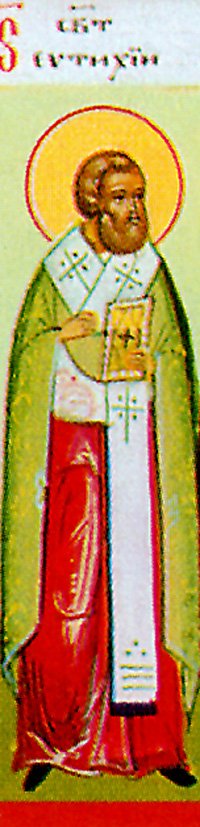
Saint Atticus, Patriarch of Constantinople (425)
Saint Eutychius, Archbishop of Constantinople, was born in a village called “Divine” in the province of Phrygia. His father Alexander was a soldier, and his mother Synesia was the daughter of the priest Hesychius of Augustopolis. Saint Eutychius received the first rudiments of his education and a Christian upbringing from his grandfather the priest.
On
Saint Eutychius, Archbishop of Constantinople, was born in a village called “Divine” in the province of Phrygia. His father Alexander was a soldier, and his mother Synesia was the daughter of the priest Hesychius of Augustopolis. Saint Eutychius received the first rudiments of his education and a Christian upbringing from his grandfather the priest.
Once, while playing a childhood game, the boy wrote his own name with the title of Patriarch. By this he seemed to predict his future service. He was sent to Constantinople at age twelve for further education. The youth persevered in his study of science and realized that human wisdom is nothing in comparison to the study of divine Revelation. Therefore, he decided to dedicate himself to monastic life. Saint Eutychius withdrew into one of the Amasean monasteries and received the angelic schema. For his strict life he was made archimandrite of all the Amasean monasteries, and in 552 was appointed to the Patriarchal throne.
When the Fifth Ecumenical Council prepared to assemble during the reign of the holy emperor Justinian (527-565), the Metropolitan of Amasea was ill and he sent Saint Eutychius in his place. At Constantinople the aged Patriarch Saint Menas (August 25) saw Saint Eutychius and predicted that he would be the next Patriarch. After the death of the holy Patriarch Menas, the Apostle Peter appeared in a vision to the emperor Justinian and, pointing his hand at Eutychius, said, “Let him be made your bishop.”
At the very beginning of his patriarchal service, Saint Eutychius convened the Fifth Ecumenical Council (553), at which the Fathers condemned the heresies cropping up and anathematized them. However, after several years a new heresy arose in the Church: Aphthartodocetism [asartodoketai] or “imperishability” which taught that the flesh of Christ, before His death on the Cross and Resurrection, was imperishable and not capable of suffering.
Saint Eutychius vigorously denounced this heresy, but the emperor Justinian himself inclined toward it, and turned his wrath upon the saint. By order of the emperor, soldiers seized the saint in the church, removed his patriarchal vestments, and sent him into exile to an Amasean monastery (565).
The saint bore his banishment with meekness, and lived at the monastery in fasting and prayer, and he worked many miracles and healings.
Thus, through his prayer the wife of a devout man, Androgenes, who had given birth only to dead infants, now gave birth to two sons who lived to maturity. Two deaf-mutes received the gift of speech; and two grievously ill children were restored to health. The saint healed a cancerous ulcer on the hand of an artist. The saint also healed another artist, anointing his diseased hand with oil and making over it the Sign of the Cross.
The saint healed not only bodily, but also spiritual afflictions: he banished the devil out of a girl that had kept her from Holy Communion; he expelled a demon from a youth who had fled from a monastery (after which the youth returned to his monastery); he healed a drunken leper, who stopped drinking after being cleansed of his leprosy.
During the Persian invasion of Amasea and its widespread devastation, they distributed grain to the hungry from the monastery granaries on the saint’s orders, and by his prayers, the stores of grain at the monastery were not depleted.
Saint Eutychius received from God the gift of prophecy. He revealed the names of two of Emperor Justinian’s successors: Justin (565-578) and Tiberias (578-582).
After the death of the holy Patriarch John Scholastikos, Saint Eutychius returned to the cathedra in 577 after his twelve year exile, and he again wisely ruled his flock.
Four and a half years after his return to the Patriarchal throne, in 582, Saint Eutychius gathered together all his clergy on Thomas Sunday, blessed them, and peacefully fell asleep in the Lord.
Troparion - Tone 4
In truth you were revealed to your flock as a rule of faith, / an image of humility and a teacher of abstinence; / your humility exalted you; / your poverty enriched you. / Hierarch Father Eutychius, / entreat Christ our God / that our souls may be saved.
Kontakion - Tone 8
Let us all chant with faith and love, O people, / blessing the godly Eutychius as a great pastor and minister, / an all-wise teacher and expeller of heresies, / for he entreats the Lord on behalf of us all!
Saint Severinus (482)
St. Severinus came to the borderland of present-day Gemany and Austria from the east — possibly the Egyptian desert — to care for the Roman Christians who were endangered by invading barbarians during the collapse of the Roman Empire. He remained there until the end of his life. While he was there he advised both common people and kings to put eternal life first, and taught them to be generous to one another and to lead a true Christian life. He
St. Severinus came to the borderland of present-day Gemany and Austria from the east — possibly the Egyptian desert — to care for the Roman Christians who were endangered by invading barbarians during the collapse of the Roman Empire. He remained there until the end of his life. While he was there he advised both common people and kings to put eternal life first, and taught them to be generous to one another and to lead a true Christian life. He built a monastery and protected from harm those who gathered around him. As he foretold, the monks and other Christians who had followed him escaped to safety in Italy, taking St. Severinus’ incorrupt relics with them. His relics are still honored in Frattamaggiore, Italy (near Naples).
—from the 2006 Saint Herman Calendar
Scripture Readings
☩Epistle
James 1:19-27
19
Wherefore, my beloved brethren, let every man be swift to hear, slow to speak, slow to wrath:
20
For the wrath of man worketh not the righteousness of God.
21
Wherefore lay apart all filthiness and superfluity of naughtiness, and receive with meekness the engrafted word, which is able to save your souls.
22
But be ye doers of the word, and not hearers only, deceiving your own selves.
23
For if any be a hearer of the word, and not a doer, he is like unto a man beholding his natural face in a glass:
24
For he beholdeth himself, and goeth his way, and straightway forgetteth what manner of man he was.
25
But whoso looketh into the perfect law of liberty, and continueth therein, he being not a forgetful hearer, but a doer of the work, this man shall be blessed in his deed.
26
If any man among you seem to be religious, and bridleth not his tongue, but deceiveth his own heart, this man’s religion is vain.
27
Pure religion and undefiled before God and the Father is this, To visit the fatherless and widows in their affliction, and to keep himself unspotted from the world.
☩Gospel
Mark 9:10-16
10
And they kept that saying with themselves, questioning one with another what the rising from the dead should mean.
11
And they asked him, saying, Why say the scribes that Elias must first come?
12
And he answered and told them, Elias verily cometh first, and restoreth all things; and how it is written of the Son of man, that he must suffer many things, and be set at nought.
13
But I say unto you, That Elias is indeed come, and they have done unto him whatsoever they listed, as it is written of him.
14
And when he came to his disciples, he saw a great multitude about them, and the scribes questioning with them.
15
And straightway all the people, when they beheld him, were greatly amazed, and running to him saluted him.
16
And he asked the scribes, What question ye with them?
Liturgical data sourced from OCA.org and orthocal.info