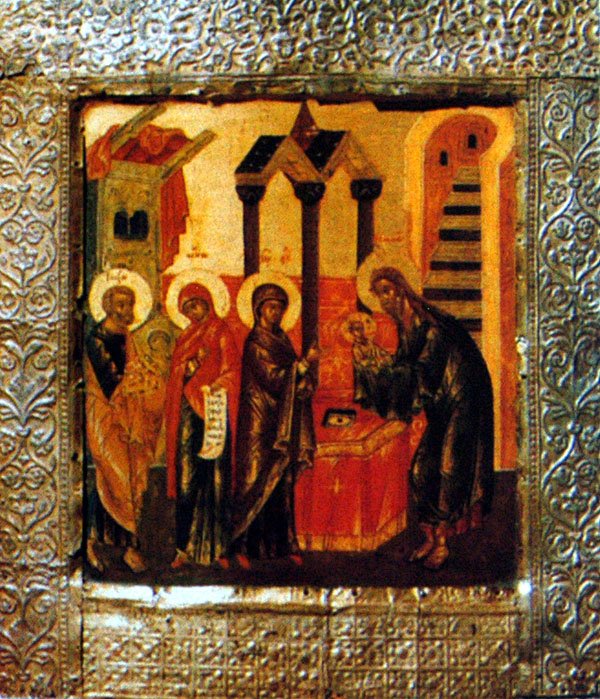
Afterfeast of the Meeting of our Lord in the Temple
The fourth day of the Afterfeast of the Meeting of the Lord falls on February 6.
Troparion - Tone 1
Hail, Virgin Theotokos, full of grace; / for from you has shone forth the Sun of Righteousness, Christ our God, / giving light to those in darkness. / Be glad, O righteous Elder; / for you received in your arms the Redeemer of our souls, / Who bestows upon us the resurrection.
Kontakion - Tone 1
By Your birth, You sanctified a virginal womb, / and fittingly You blessed Simeon’s hands, O Christ God; / even now You have saved us by anticipation. / Grant peace to Your faithful people whom You have loved, O only Lover of mankind.
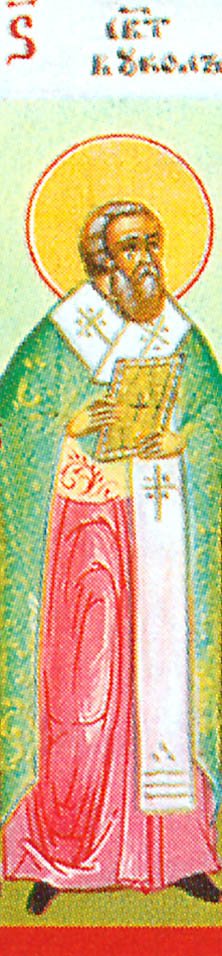
Saint Bucolus, Bishop of Smyrna
Saint Bucolus, Bishop of Smyrna, was a disciple of the holy Apostle and Evangelist John the Theologian, and became the first Bishop of Smyrna (Asia Minor).
By the grace of God, Saint Bucolus converted many of the pagans to Christ and baptized them. As a wise and experienced guide, he defended his flock from the darkness of heresy.
Saint Bucolus, Bishop of Smyrna, was a disciple of the holy Apostle and Evangelist John the Theologian, and became the first Bishop of Smyrna (Asia Minor).
By the grace of God, Saint Bucolus converted many of the pagans to Christ and baptized them. As a wise and experienced guide, he defended his flock from the darkness of heresy.
He died in peace between the years 100-105. He entrusted his flock to Saint Polycarp (February 23), one of the Apostolic Fathers, who was also a disciple of the holy Apostle John the Theologian. At the grave of Saint Bucolus grew a myrtle tree, which healed the sick.
Troparion - Tone 4
You shone with the rays of virtue / received from him who leaned on the Master’s breast. / Resplendent, God-inspired hierarch, / you led your flock to the pastures of truth. / Entreat Christ our God for those who honor you, father Bucolus.
Kontakion - Tone 2
He who was beloved of Christ / saw the purity of your life; / he made you a shepherd of the Church / and a radiant lamp of godliness. / Holy father Bucolus, / you truly emulated his virtues.
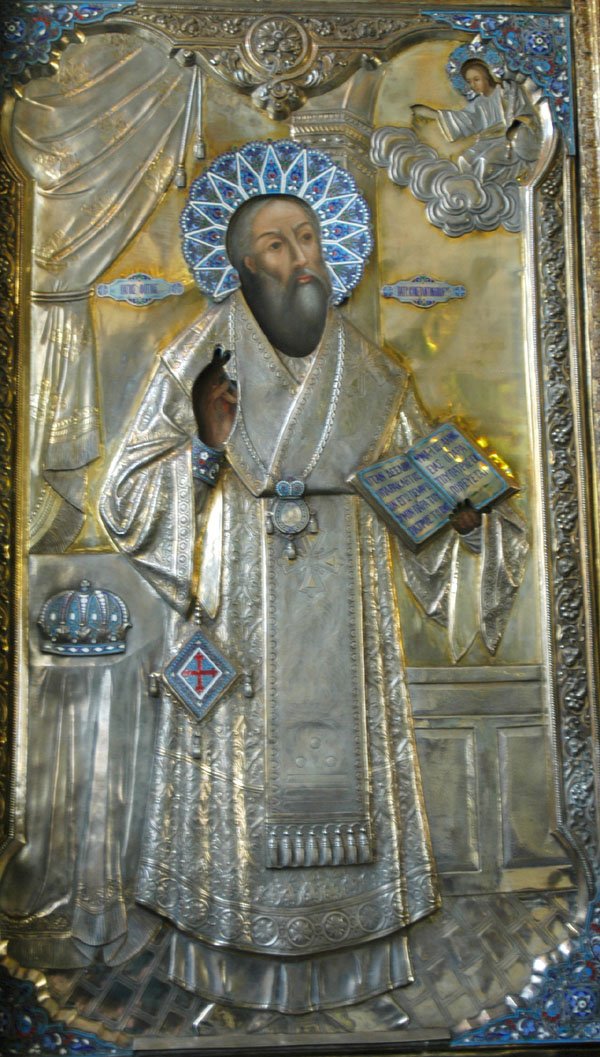
Saint Photius, Patriarch of Constantinople
Saint Photius, Patriarch of Constantinople, “the Church’s far-gleaming beacon,” lived during the ninth century, and came from a family of zealous Christians. His father Sergius died as a martyr in defense of holy icons. Saint Photius received an excellent education and, since his family was related to the imperial house, he occupied the position of first state secretary in the Senate. His c
Saint Photius, Patriarch of Constantinople, “the Church’s far-gleaming beacon,” lived during the ninth century, and came from a family of zealous Christians. His father Sergius died as a martyr in defense of holy icons. Saint Photius received an excellent education and, since his family was related to the imperial house, he occupied the position of first state secretary in the Senate. His contemporaries said of him: “He so distinguished himself with knowledge in almost all the secular sciences, that it rightfully might be possible to take into account the glory of his age and compare it with the ancients.”
Michael, the young successor to the throne, and Saint Cyril, the future Enlightener of the Slavs, were taught by him. His deep Christian piety protected Saint Photius from being seduced by the charms of court life. With all his soul, he yearned for monasticism.
In 857 Bardas, who ruled with Emperor Michael, deposed Patriarch Ignatius (October 23) from the See of Constantinople. The bishops, knowing the piety and extensive knowledge of Photius, informed the emperor that he was a man worthy to occupy the archpastoral throne. Saint Photius accepted the proposal with humility. He passed through all the clerical ranks in six days. On the day of the Nativity of Christ, he was consecrated bishop and elevated to the patriarchal throne.
Soon, however, discord arose within the Church, stirred up by the removal of Patriarch Ignatius from office. The Synod of 861 was called to end the unrest, at which the deposition of Ignatius and the installation of Photius as patriarch were confirmed.
Pope Nicholas I, whose envoys were present at this council, hoped that by recognizing Photius as patriarch he could subordinate him to his power. When the new patriarch proved unsubmissive, Nicholas anathematized Photius at a Roman council.
Until the end of his life Saint Photius was a firm opponent of papal intrigues and designs upon the Orthodox Church of the East. In 864, Bulgaria voluntarily converted to Christianity. The Bulgarian prince Boris was baptized by Patriarch Photius himself. Later, Saint Photius sent an archbishop and priests to baptize the Bulgarian people. In 865, Saints Cyril and Methodius were sent to preach Christ in the Slavonic language. However, the partisans of the Pope incited the Bulgarians against the Orthodox missionaries.
The calamitous situation in Bulgaria developed because an invasion by the Germans forced them to seek help in the West, and the Bulgarian prince requested the Pope to send his bishops. When they arrived in Bulgaria, the papal legates began to substitute Latin teachings and customs in place of Orthodox belief and practice. Saint Photius, as a firm defender of truth and denouncer of falsehood, wrote an encyclical informing the Eastern bishops of the Pope’s actions, indicating that the departure of the Roman Church from Orthodoxy was not only in ritual, but also in its confession of faith. A council was convened, censuring the arrogance of the West.
In 867, Basil the Macedonian seized the imperial throne, after murdering the emperor Michael. Saint Photius denounced the murderer and would not permit him to partake of the Holy Mysteries of Christ. Therefore, he was removed from the patriarchal throne and locked in a monastery under guard, and Patriarch Ignatius was restored to his position.
The Synod of 869 met to investigate the conduct of Saint Photius. This council took place with the participation of papal legates, who demanded that the participants sign a document (Libellus) condemning Photius and recognizing the primacy of the Pope. The Eastern bishops would not agree to this, and argued with the legates. Summoned to the council, Saint Photius met all the accusations of the legates with a dignified silence. Only when the judges asked him whether he wished to repent did he reply, “Why do you consider yourselves judges?” After long disputes, the opponents of Photius were victorious. Although their judgment was baseless, they anathematized Patriarch Photius and the bishops defending him. The saint was sent to prison for seven years, and by his own testimony, he thanked the Lord for patiently enduring His judges.
During this time the Latin clergy were expelled from Bulgaria, and Patriarch Ignatius sent his bishops there. In 879, two years after the death of Patriarch Ignatius, another council was summoned (many consider it the Eighth Ecumenical Council), and again Saint Photius was acknowledged as the lawful archpastor of the Church of Constantinople. Pope John VIII, who knew Photius personally, declared through his envoys that the former papal decisions about Photius were annulled. The council acknowledged the unalterable character of the Nicean-Constantinople Creed, rejecting the Latin distortion (“filioque”), and acknowledging the independence and equality of both thrones and both churches (Western and Eastern). The council decided to abolish Latin usages and rituals in the Bulgarian church introduced by the Roman clergy, who ended their activities there.
Under Emperor Basil’s successor, Leo, Saint Photius again endured false denunciations, and was accused of speaking against the emperor. Again deposed from his See in 886, the saint completed the course of his life in 891. He was buried at the monastery of Eremia.
The Orthodox Church venerates Saint Photius as a “pillar and foundation of the Church,” an “inspired guide of the Orthodox,” and a wise theologian. He left behind several works, exposing the errors of the Latins, refuting soul-destroying heresies, explicating Holy Scripture, and exploring many aspects of the Faith.
Troparion - Tone 5
Being of one mind with the Apostles and a teacher of the entire world, O Photios, / intercede with the Master of all / that He may grant peace to the world, and to our souls great mercy.
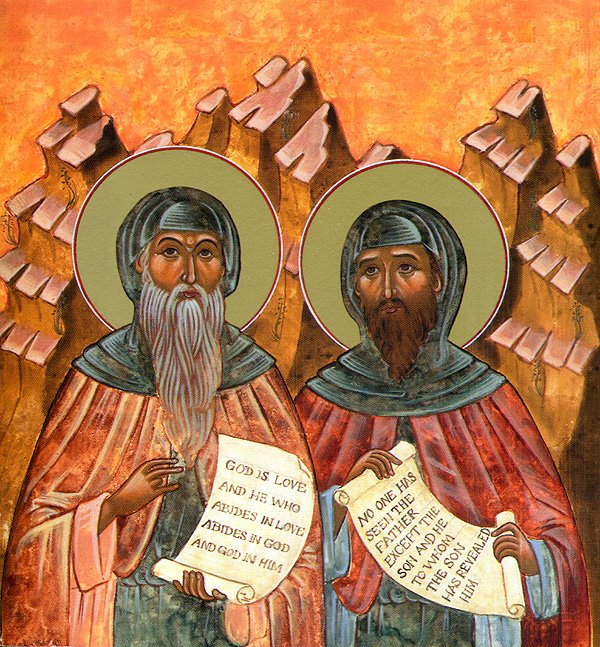
Venerable Barsanuphius the Great and John the Prophet
‘Saint Barsanuphius the Great, who was from Egypt, and his disciple, Saint John the Prophet, struggled in very strict reclusion during the sixth century at the monastery of Abba Seridus at Gaza of Palestine, and were endowed with amazing gifts of prophecy and spiritual discernment. They are mentioned by Saint Dorotheus of Gaza, their disciple, in his writings. M
‘Saint Barsanuphius the Great, who was from Egypt, and his disciple, Saint John the Prophet, struggled in very strict reclusion during the sixth century at the monastery of Abba Seridus at Gaza of Palestine, and were endowed with amazing gifts of prophecy and spiritual discernment. They are mentioned by Saint Dorotheus of Gaza, their disciple, in his writings. Many of the counsels they sent to Christians who wrote to them are preserved in the book which bears their names. Once certain of the Fathers besought Saint Barsanuphius to pray that God stay His wrath and spare the world. Saint Barsanuphius wrote back that there were “three men perfect before God,” whose prayers met at the throne of God and protected the whole world; to them it had been revealed that the wrath of God would not last long. These three, he said, were “John of Rome, Elias of Corinth, and another in the diocese of Jerusalem,” concealing the name of the last, since it was himself.’ (Great Horologion)
Saint Barsanuphius lived in such reclusion that only Abbot Seridus ever saw him: once a week the Abbot would bring him three loaves and some water, and would write down the Saint’s counsels. Some of the brethren came to suspect that Barsanuphius was an invention of the Abbot, and to relieve their minds he came out of his cell for the only time, greeted them, washed their feet, and withdrew again.
It is unknown when St Barsanuphius reposed. When it was suspected that he had died in his cell, the Patriarch of Jerusalem ordered that it be opened, but fire blasted forth from the door, preventing any from entering.
Troparion - Tone 1
Mystical tongues of the Holy Spirit / rational harps of grace / sounding forth sweet hymns of discernment / which soothe and rejoice men’s souls, / you moved them to cast off the yoke of passion / and to trample on Satan’s head. / Therefore, God-like Barsanuphius and wise John, / deliver those who sing to you: / Glory to Him who has given you grace! / Glory to Him who has blessed you! / Glory to Him who has saved many through your holy words of counsel!
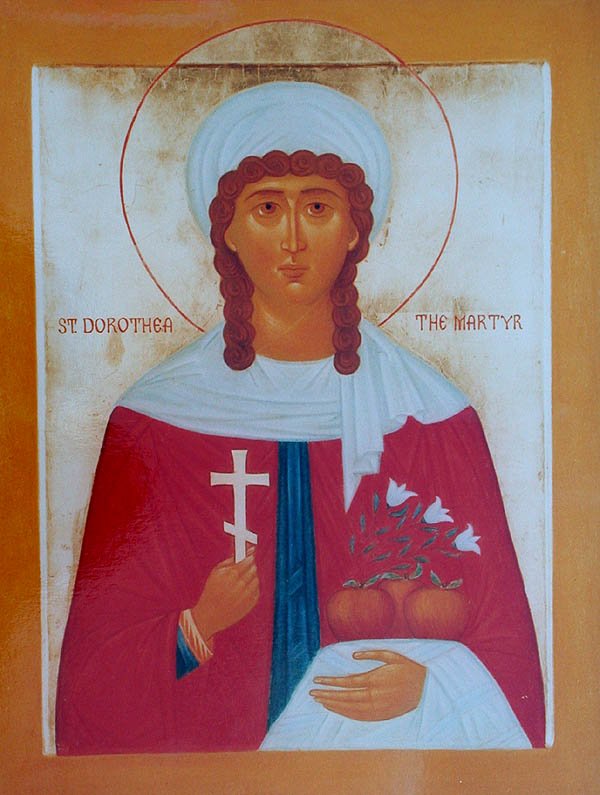
Virgin Martyr Dorothy at Caesarea, in Cappadocia, and those with her
The Holy Martyr Dorothy, the Martyrs Christina, Callista and the Martyr Theophilus lived in Caesarea of Cappadocia and suffered under the emperor Diocletian in either the year 288 or 300.
Saint Dorothy was a pious Christian maiden, distinguished by her great beauty, humility, prudence, and God-given wisdom, which astonished many.
The Holy Martyr Dorothy, the Martyrs Christina, Callista and the Martyr Theophilus lived in Caesarea of Cappadocia and suffered under the emperor Diocletian in either the year 288 or 300.
Saint Dorothy was a pious Christian maiden, distinguished by her great beauty, humility, prudence, and God-given wisdom, which astonished many. Arrested upon orders of the governor Sapricius, she steadfastly confessed her faith in Christ and was subjected to tortures.
Failing to break the will of the saint, the governor sent to her two women, the sisters Christina and Callista, who once were Christians, but fearing torture, they renounced Christ and began to lead impious lives. He ordered them to get Saint Dorothy to offer sacrifice to the pagan gods, but just the reverse happened. Saint Dorothy convinced them that the mercy of God is granted to all who repent, so they corrected themselves and returned to Christ. The tormentors tied them back to back and burned them in a vat of tar. Through martyrdom, Christina and Callista atoned for their sin of apostasy, receiving from God not only forgiveness, but crowns of victory.
Saint Dorothy was again subjected to tortures, but she gladly endured them and accepted the death sentence. She cried out with joy, thanking Christ for calling her to Paradise and to the heavenly bridal chamber. As they led the saint to execution Theophilus, one of the governor’s counselors, laughed and said to her, “Bride of Christ, send me an apple and some roses from the Paradise of your Bridegroom.” The martyr nodded and said, “I shall do that.”
At the place of execution, the saint requested a little time to pray. When she finished the prayer, an angel appeared before her in the form of a handsome child presenting her three apples and three roses on a pure linen cloth. The saint requested that these be given to Theophilus, after which she was beheaded by the sword.
Having received the gracious gift, the recent mocker of Christians was shaken, and he confessed Christ as the true God. His friends were astonished, and wondered whether he were joking, or perhaps mad. He assured them he was not joking. Then they asked the reason for this sudden change. He asked what month it was. “February,” they replied. “In the winter, Cappadocia is covered with ice and frost, and the trees are bare of leaves. What do you think? From where do these apples and flowers come?” After being subjected to cruel tortures, Saint Theophilus was beheaded with a sword.
The relics of Saint Dorothy are in Rome in the church dedicated to her, and her head is also at Rome, in a church of the Mother of God at Trastevero.
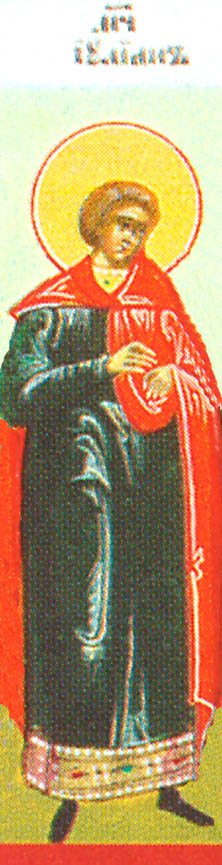
Martyr Julian of Emesa
The Holy Martyr Julian was a native of the Phoenician city of Emesa, and he suffered in the year 312 under the emperor Maximian. He was a skilled physician, and healed illnesses not only of the body but also of the soul, and he converted many people to faith in Christ the Savior.
When they led away the holy Martyrs Bishop Silvanus, Deacon Luke and the Reader Mocius (February 29) to be eaten by wild beasts, Julian encouraged them and urged them not to fear death for the Lord.
The Holy Martyr Julian was a native of the Phoenician city of Emesa, and he suffered in the year 312 under the emperor Maximian. He was a skilled physician, and healed illnesses not only of the body but also of the soul, and he converted many people to faith in Christ the Savior.
When they led away the holy Martyrs Bishop Silvanus, Deacon Luke and the Reader Mocius (February 29) to be eaten by wild beasts, Julian encouraged them and urged them not to fear death for the Lord. He was also arrested and put to death. His head, hands and feet were pierced with long nails.
Troparion - Tone 4
Your holy martyr Julian, O Lord, / through his suffering has received an incorruptible crown from You, our God. / For having Your strength, he laid low his adversaries, / and shattered the powerless boldness of demons. / Through his intercessions, save our souls!
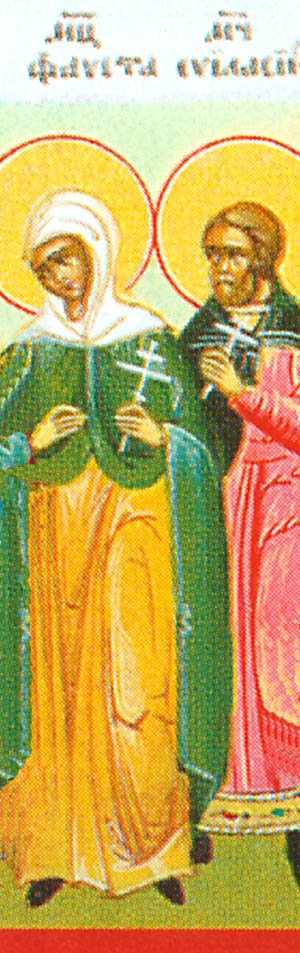
Virgin Martyr Fausta, and Martyrs Evilasius and Maximus, at Cyzicus
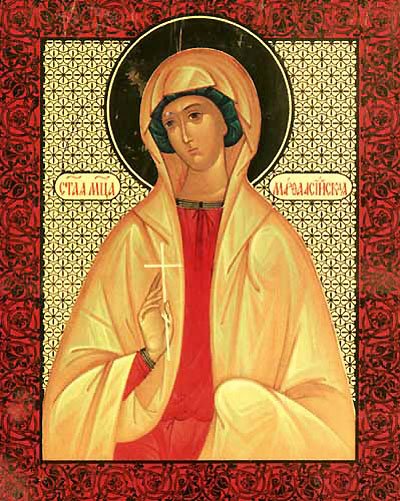
Virgin Martyrs Martha and Mary, and their brother Lycarion, in Egypt
The holy virgin martyrs Martha and Mary were sisters who lived in Asia Minor, and fervently desired to suffer for the Lord Jesus Christ. Once, a pagan military commander marched past their house. The sisters went out to him and loudly declared that they were Christians. At first the commander paid no attention to them, but they persistently shouted after him, repeating their confession.
The holy virgin martyrs Martha and Mary were sisters who lived in Asia Minor, and fervently desired to suffer for the Lord Jesus Christ. Once, a pagan military commander marched past their house. The sisters went out to him and loudly declared that they were Christians. At first the commander paid no attention to them, but they persistently shouted after him, repeating their confession.
They were arrested together with their brother Lykarion. All three were crucified, and during the execution their mother came to them, encouraging them in their sufferings for Christ. The sisters were pierced with spears, and Lykarion was beheaded by the sword.
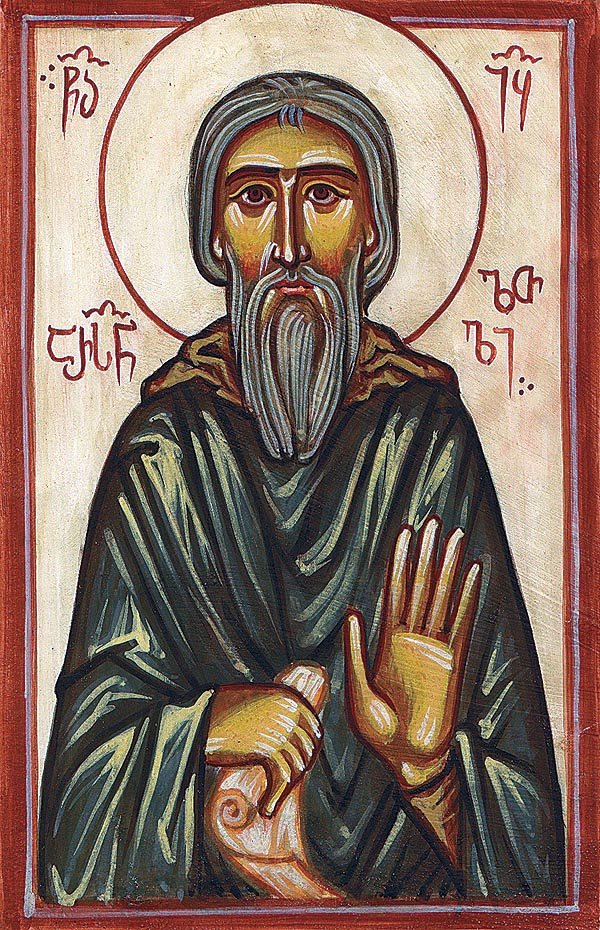
Saint Arsenius of Iqalto, Georgia
Saint Arsen of Iqalto was a translator, researcher, compiler of manuscripts, hymnographer, philosopher, and a great defender of the Georgian Christian Faith. His father was Ibadi Vachnadze, a wise, learned man and a fluent speaker of the Greek language. He directed the academy at Iqalto Monastery and was an instructor of Holy King Davit the Restorer.
Saint Arsen of Iqalto was a translator, researcher, compiler of manuscripts, hymnographer, philosopher, and a great defender of the Georgian Christian Faith. His father was Ibadi Vachnadze, a wise, learned man and a fluent speaker of the Greek language. He directed the academy at Iqalto Monastery and was an instructor of Holy King Davit the Restorer.
Few details about the life of Saint Arsen have been preserved, but we know that he lived in the 11th and 12th centuries and was a younger contemporary of Saint Eprem the Lesser. He received both his primary and higher education in Byzantium, at Mangana Monastery, which had been founded by the Byzantine emperor Constantine IX Monomachus (1042-1055). At the academy he completed one of his most important projects: a translation of the Byzantine historian George Hamartolus’ Chronicle. Hamartolus’ work is a nine-volume account of history from Adam to the year A.D. 842. Also at Mangana, Arsen translated a volume of dogmatic-polemical writings into Georgian and called his work Dogmatikon . In the years that followed, works translated by other authors were added to the book.
After completing his studies at Mangana Monastery, Arsen moved to the Black Mountains near Antioch to continue his labors under the guidance of Saint Eprem the Lesser. Following Saint Eprem’s repose, he returned to Mangana Monastery to continue his translations. In 1114 King Davit the Restorer summoned Arsen back to Georgia, to the Gelati Academy in the west. It was there that he translated The Nomocanon (a Byzantine collection of ecclesiastical law) from the original Greek into Georgian. Arsen later returned to Kakheti in eastern Georgia, where he founded an academy at Iqalto Monastery. He also participated in the Council of Ruisi-Urbnisi, which had been convened by King Davit the Restorer. One of King Davit’s biographers writes that he invited “Arsen of Iqalto, translator and interpreter of the Greek and Georgian languages and enlightener of many churches.”
Arsen was present at the repose of King Davit the Restorer, and it is believed that he composed the king’s epitaph:
I fed seven kings with my wealth,
Drove the Turks, Persians, and Arabs from our borders,
Moved the fish from one river to another,
And, having accomplished all these things,
Lay my hands upon my heart to die.
The “theologian, philosopher, physicist, anatomist, writer of allegories and verses, epic poet, and compiler of Church typika” Arsen was buried in Iqalto next to Saint Zenon, the founder of Iqalto Monastery.
Troparion - Tone 8
By a flood of tears you made the desert fertile, / and your longing for God brought forth fruits in abundance. / By the radiance of miracles you illumined the whole universe! / O our holy father Arsenius, pray to Christ our God to save our souls!
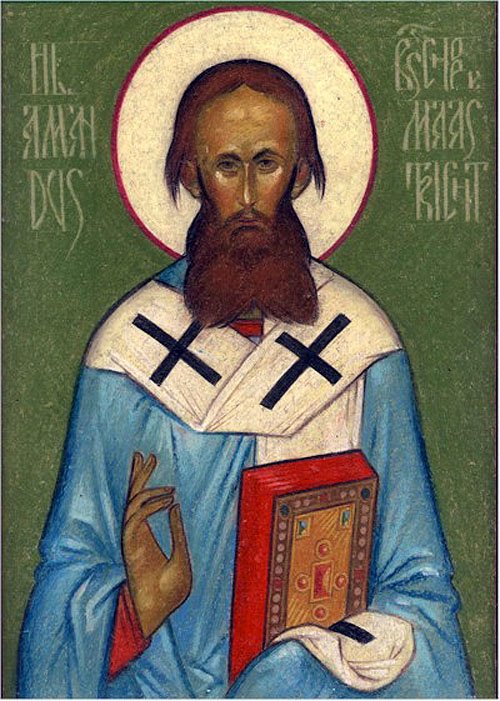
Saint Amand, Abbot of Maastricht
No information available at this time.
Troparion - Tone 4
In truth you were revealed to your flock as a rule of faith, / an image of humility and a teacher of abstinence; / your humility exalted you; / your poverty enriched you. / Hierarch Father Amand, / entreat Christ our God / that our souls may be saved.
Scripture Readings
☩Epistle
1 John 2:7-17
7
Brethren, I write no new commandment unto you, but an old commandment which ye had from the beginning. The old commandment is the word which ye have heard from the beginning.
8
Again, a new commandment I write unto you, which thing is true in him and in you: because the darkness is past, and the true light now shineth.
9
He that saith he is in the light, and hateth his brother, is in darkness even until now.
10
He that loveth his brother abideth in the light, and there is none occasion of stumbling in him.
11
But he that hateth his brother is in darkness, and walketh in darkness, and knoweth not whither he goeth, because that darkness hath blinded his eyes.
12
I write unto you, little children, because your sins are forgiven you for his name’s sake.
13
I write unto you, fathers, because ye have known him that is from the beginning. I write unto you, young men, because ye have overcome the wicked one. I write unto you, little children, because ye have known the Father.
14
I have written unto you, fathers, because ye have known him that is from the beginning. I have written unto you, young men, because ye are strong, and the word of God abideth in you, and ye have overcome the wicked one.
15
Love not the world, neither the things that are in the world. If any man love the world, the love of the Father is not in him.
16
For all that is in the world, the lust of the flesh, and the lust of the eyes, and the pride of life, is not of the Father, but is of the world.
17
And the world passeth away, and the lust thereof: but he that doeth the will of God abideth for ever.
☩Gospel
Mark 14:3-9
3
And being in Bethany in the house of Simon the leper, as he sat at meat, there came a woman having an alabaster box of ointment of spikenard very precious; and she brake the box, and poured it on his head.
4
And there were some that had indignation within themselves, and said, Why was this waste of the ointment made?
5
For it might have been sold for more than three hundred pence, and have been given to the poor. And they murmured against her.
6
And Jesus said, Let her alone; why trouble ye her? she hath wrought a good work on me.
7
For ye have the poor with you always, and whensoever ye will ye may do them good: but me ye have not always.
8
She hath done what she could: she is come aforehand to anoint my body to the burying.
9
Verily I say unto you, Wheresoever this gospel shall be preached throughout the whole world, this also that she hath done shall be spoken of for a memorial of her.
 Meat
Allowed
Meat
Allowed
 Fish
Allowed
Fish
Allowed
 Dairy
Allowed
Dairy
Allowed
 Oil
Allowed
Oil
Allowed
 Wine
Allowed
Wine
Allowed