He lived at the time of the first persecutions of the holy icons. He was born in Ravenna to a noble family, and became bishop of his native city. Soon his reputation as a true shepherd of Christ’s flock spread, and he was elected Bishop of Catania in Sicily. As is so often true even today, the city, though nominally Christian, was plagued by superstition and paganism. T
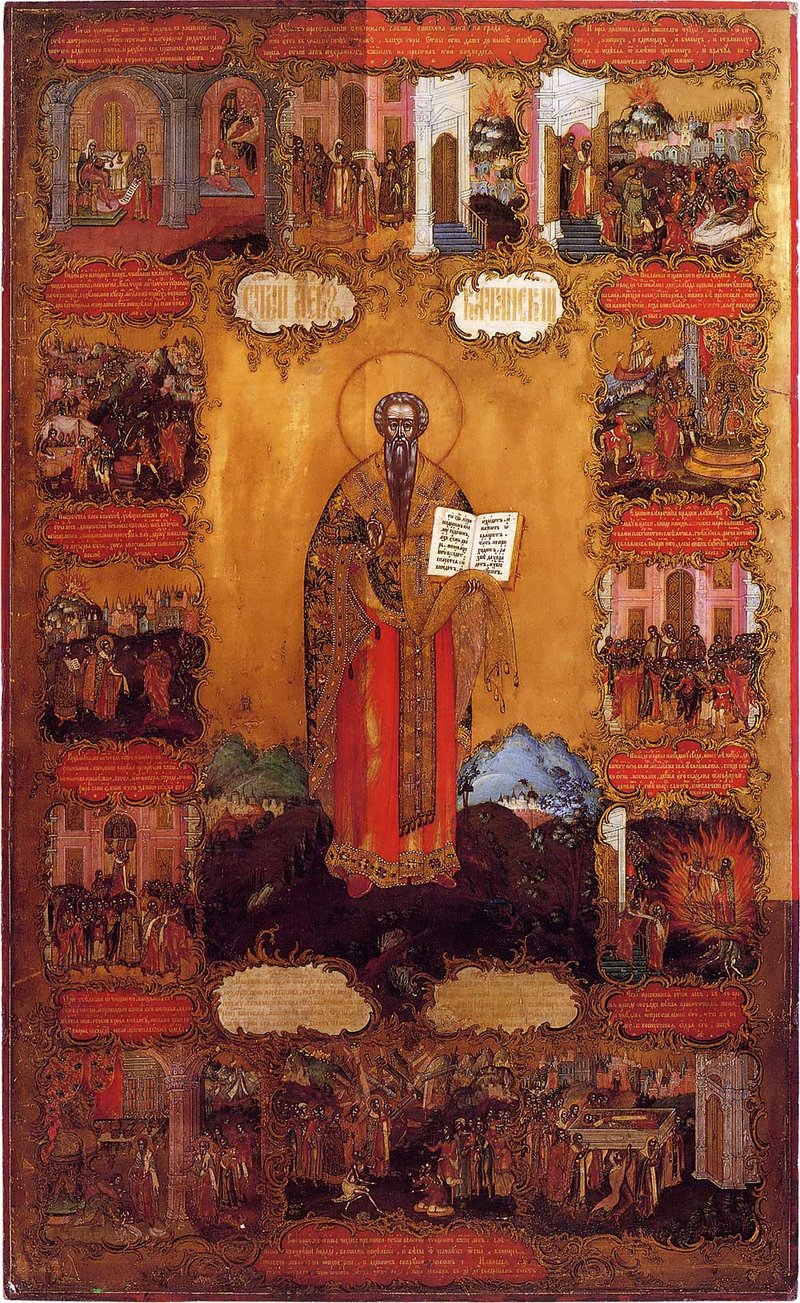
He lived at the time of the first persecutions of the holy icons. He was born in Ravenna to a noble family, and became bishop of his native city. Soon his reputation as a true shepherd of Christ’s flock spread, and he was elected Bishop of Catania in Sicily. As is so often true even today, the city, though nominally Christian, was plagued by superstition and paganism. The holy bishop set about to turn the people away from error: by his prayers he caused a pagan temple to collapse and built a church on its site, dedicated to the Forty Maryrs of Sebaste. At that time the entire island was under the oppressive rule of a magus named Heliodorus, who used all his magical skills to oppress the people and advance himself. Though he had been taken captive by Imperial order, and condemned to death, he was always able to escape his captors by his occult skills. Saint Leo, who sought the conversion of everyone, did his best to turn the magus to Christ, but to no effect. One day Heliodorus entered the church during the Divine Liturgy, mocking the Mysteries of Christ. The Saint came out of the sanctuary and, casting his omophorion over the mocker, instantly deprived him of his demonic powers. The Prefect of Sicily ordered the magus to be burnt alive. Bishop Leo went to the stake with him, but emerged unmarked without even the smell of fire upon him, while Heliodorus was burnt to ashes.
Saint Leo’s fierceness in defense of the Faith was matched by his love and compassion for the poor and defenseless, for whom he poured himself out unceasingly with prayers, alms and visitation. By his prayers he restored sight to the blind and healed the paralyzed. After his repose, his holy relics, which exuded a fragrant myrrh, were venerated in a church that he had founded in honor of Saint Lucia.
Troparion - Tone 1
You were shown forth as a resplendent priest, / a teacher of godliness and a wonderworker, blessed hierarch Leo; / by the light of heavenly virtue you were enriched with the power of the Spirit, / and heal the souls and bodies of those who hasten to you. / Glory to Christ who has glorified you! / Glory to Him who has crowned you! / Glory to Him who through you works healing for all!
Kontakion - Tone 2
With hymns of praise let us crown Leo, / who was consecrated to the Lord from early childhood; / he received grace while still a babe in swaddling clothes. / He is a brightly shining star in the Church: / its valiant defender and firm support!
Venerable Agathon, Wonderworker of the Kiev Caves
Saint Agathon of the Kiev Caves was a great ascetic, and he healed the sick by a laying his hands upon them. He also possessed the gift of prophecy and foretold the time of his own death. His memory is celebrated also at the Synaxis of the Monks of the Far Caves on August 28.
Troparion - Tone 8
By a flood of tears you made the desert fertile, / and your longing for God brought forth fruits in abundance. / By the radiance of miracles you illumined the whole universe! / O our holy father Agathon, pray to Christ our God to save our souls!
St Bessarion the Great, wonder-worker of Egypt (466)
“An Egyptian by birth, Abba Bessarion was initiated into the angelic life by Saint Anthony the Great. He later became a disciple of Saint Macarius, the founder of Scetis (19 Jan.), and then set out to lead the life of a wanderer, borne hither and thither by Providence like a bird by the wind. All his wealth lay in the Gospel, which he always had in his hand. L
“An Egyptian by birth, Abba Bessarion was initiated into the angelic life by Saint Anthony the Great. He later became a disciple of Saint Macarius, the founder of Scetis (19 Jan.), and then set out to lead the life of a wanderer, borne hither and thither by Providence like a bird by the wind. All his wealth lay in the Gospel, which he always had in his hand. Living in the open air, he patiently endured all weathers, untroubled by care for a dwelling or for clothing. Fortified by the strength of the faith, he thus remained untouched by all the passions of the flesh.
“On coming to a monastery where the brethren led the common life, he would sit weeping at the gate. A brother once offered him hospitality and asked why he was distressed. ‘I cannot live under a roof, until I have regained the wealth of my house,’ he replied, meaning the heavenly inheritance lost since Adam. ‘I am afflicted, in danger of death every day, and without rest because of my huge misfortunes, which oblige me ever to travel on in order to finish my course.’
“He wandered for forty years without ever lying down to sleep, and he spent all of forty days and forty nights standing wide awake in a thorn bush. One winter’s day, he was walking through a village when he came upon a dead man. Without hesitation, he took off his own coat and covered the body. A little further on, he gave his tunic to a poor man who was shivering in the cold. An army officer, who happened to be passing, saw the naked ascetic and wanted to know who had stripped him of his clothing. ‘He did!’ replied Bessarion, holding up the Gospel Book. On another occasion, he met with a poor man and, having nothing to give him in alms, he hurried to the market in order to sell his Gospel Book. On his disciple’s asking him where the Book was, he replied cheerfully, ‘I have sold it in obedience to the words which I never cease to hear: Go, sell what you possess and give to the poor‘ (Matt. 19:21).
“Through this evangelic way of life he became a chosen vessel of Grace, and God wrought many miracles through him. One day, for example, he made sea water sweet through the sign of the Cross, to quench his disciple’s thirst. When the latter wanted to keep some for the remainder of the journey, he prevented him, saying, ‘God is here, God is everywhere!’ At another time, having stood for two weeks in prayer with hands raised to heaven, he brought about rain enough to fill a thirsty brother’s coat. Then there was the time when he stopped the sun from setting until he reached the cell of an elder whom he wished to meet; and the time when he walked across the waters of a river. Through these and many other wonders wrought by the Saint, God showed, as He did with Moses, Joshua and Elias, that He grants His servants mastery even over natural phenomena. Through the power of Christ, he raised a paralytic, drove out demons and showed himself truly to be a ‘god’ upon the earth.
“When, having reached his goal, he was at the point of regaining that dwelling in heaven which he had sought throughout his wanderings, he said to those about him, ‘The monk ought, like the cherubim, to be all eye.’
“In answer to a brother who asked what a monk living in community ought to do, he replied: ‘Keep silence and do not measure yourself.’ Indeed, this is how even in the midst of people one can obtain the grace of the great anchorites.” (Synaxarion)
Beheading of Venerable Cornelius, Abbot of the Pskov Caves
The Hieromartyr Cornelius of the Pskov Caves was born in the year 1501 at Pskov into the noble family of Stephen and Maria. In order to give their son an education, his parents sent him to the Pskov Mirozh monastery, where he worked under the guidance of an Elder. He made candles, chopped wood, studied his letters, transcribed and adorned books, and also painted icons.
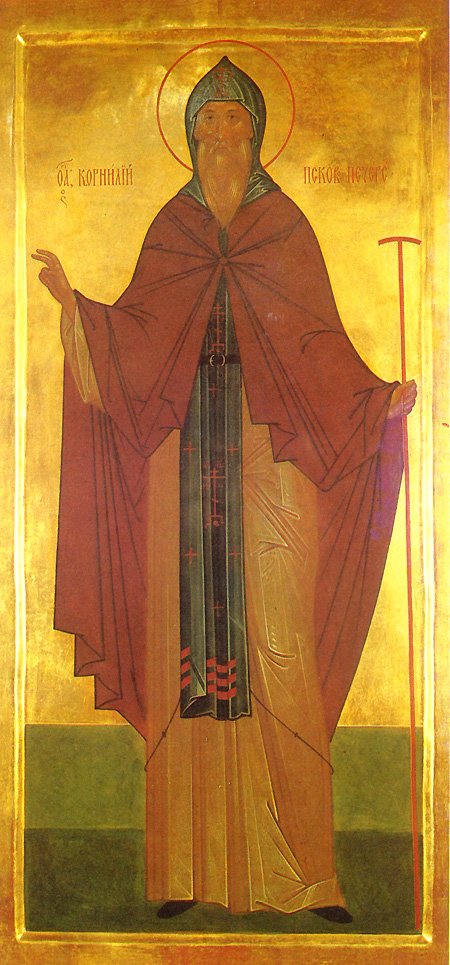
The Hieromartyr Cornelius of the Pskov Caves was born in the year 1501 at Pskov into the noble family of Stephen and Maria. In order to give their son an education, his parents sent him to the Pskov Mirozh monastery, where he worked under the guidance of an Elder. He made candles, chopped wood, studied his letters, transcribed and adorned books, and also painted icons. Having finished his studies, Cornelius returned to his parental home with the resolve to become a monk.
Once, the government clerk Misiur Munekhin took Cornelius with him to the Pskov Caves monastery in the woods. The solemnity of services in the cave church produced such a strong impression on Cornelius that he left his parental home forever and received monastic tonsure at the Pskov Caves monastery.
In 1529, at the age of twenty-eight, Saint Cornelius was made igumen and became head of the monastery. While he was igumen, the Pskov Caves monastery reached its prime. The number of brethren increased from 15 to 200 men. This number of monks was not surpassed under any subsequent head of the monastery.
The activity of Saint Cornelius extended far beyond the bounds of the monastery. He spread Orthodoxy among the Esti [Aesti] and Saeti people living around the monastery, he built churches, hospices, homes for orphans and those in need. During a terrible plague in the Pskov region Saint Cornelius walked through the plague-infested villages to give Communion to the living and to sing burial services for the dead.
During the Livonian war Saint Cornelius preached Christianity in the occupied cities, built churches, and distributed generous aid from the monastery storerooms to the Esti and Livonians suffering from the war. At the monastery he selflessly doctored and fed the injured and the maimed, preserved the dead in the caves, and inscribed their names in the monastery Synodikon for eternal remembrance.
In the year 1560, on the Feast of the Dormition of the Mother of God, Saint Cornelius sent a prosphora and holy water as blessing for the Russian armies besieging the city of Thellin. On that very day the Germans surrendered the city.
In 1570 when a See was established in Livonian Yuriev, a certain igumen Cornelius was appointed as Bishop of Yuriev and Velyansk (i.e., Thellin). Some have identified him with Saint Cornelius, but this does not correspond with actual events.
Saint Cornelius was a great lover of books, and at the monastery there was quite a collection of books. In 1531 his work entitled, “An Account of the Origin of the Pechersk Monastery” appeared. In the mid-sixteenth century the Pskov Caves monastery took over the tradition of writing chronicles from the Spaso-Eleaszar monastery.
At the start of the chronicles were accounts of the first two Pskov chronicles from 1547 to 1567. Besides this, Igumen Cornelius left behind a great monastery Synodikon for remembering the deceased brothers and benefactors of the monastery, and from the year 1588 he began to maintain the “Stern Book” [“Kormovaya kniga”: since the rear of a ship is called the stern, the sense of the title is “looking back in remembrance”]. He also compiled a “Description of the Monastery” and a “Description of the Miracles of the Pechersk Icon of the Mother of God.”
Saint Cornelius expanded and beautified the monastery, he further enlarged the monastery caves, he moved the wooden church of the Forty Martyrs of Sebaste beyond the monastery enclosure to the monastery gate, and on its site he built a church in the name of the Annunciation of the Most Holy Theotokos in the year 1541. In 1559, he constructed a church dedicated to the Protection of the Most Holy Theotokos.
The Caves monastery, on the frontier of the Russian state, was not only a beacon of Orthodoxy, but also a bulwark against the external enemies of Russia.
In 1558-1565, Saint Cornelius built a massive stone wall around the monastery, and over the holy gates, he built a stone church dedicated to Saint Nicholas, entrusting the protection of the monastery to him. In the church was a sculpted wooden icon of “Nicholas the Warrior.”
In the chronicle compiled by the hierodeacon Pitirim, the martyric death of Saint Cornelius was recorded: “This blessed Igumen Cornelius ... was igumen forty-one years and two months. Not only as a monk, but also by his fasting and holy life, he was an image of salvation ... in these times there was much unrest in the Russian land. Finally, the earthly Tsar (Ivan the Terrible) sent him from this corruptible life to the Heavenly King in the eternal habitations, on February 20, 1570, in his 69th year.” (This information is on a ceramic plate, from the ceramics covering the mouth of the tomb of Saint Cornelius).
In the ancient manuscripts of the Trinity-Sergiev Lavra it was written that Igumen Cornelius came out from the monastery gates with a cross to meet the Tsar. Ivan the Terrible, angered by a false slander, beheaded him with his own hands, but then immediately repented of his deed, and carried the body to the monastery. The pathway made scarlet by the blood of Saint Cornelius, along which the Tsar carried his body to the Dormition church, became known as the “Bloody Path.” Evidence of the Tsar’s repentance was the generous recompense he made to the Pskov Caves monastery after the death of Saint Cornelius. The name of the igumen Cornelius was inscribed in the Tsar’s Synodikon.
The body of Saint Cornelius was set into the wall of “the cave formed by God,” where it remained for 120 years without corruption. In the year 1690, Metropolitan Marcellus of Pskov and Izborsk, had the relics transferred from the cave to the Dormition cathedral church and placed in a new crypt in the wall.
On December 17, 1872 the relics of Saint Cornelius were transferred from the former tomb into a copper-silver reliquary. They were placed into a new reliquary in 1892. It is presumed that the service to the martyr was composed for the Uncovering of the Relics in the year 1690.
Troparion - Tone 1
The image of God was truly preserved in you, O Father, / for you took up the Cross and followed Christ. / By so doing you taught us to disregard the flesh for it passes away / but to care instead for the soul, since it is immortal. / Therefore your spirit, venerable Cornelius, rejoices with the angels.
Hieromartyr Sadoc (Sadoth), Bishop of Persia, and 128 Martyrs with him
The Hieromartyr Sadoc, Bishop of Persia, and 128 Martyrs with him suffered in Persia under Sapor II. Saint Sadoc was successor of the hieromartyr Simeon (April 17). He once had a dream, in which Saint Simeon told him of his own impending martyric death. Standing in great glory atop a ladder reaching up to Heaven, Saint Simeon said, “Ascend to me, Sadoc, and be not afraid. Y
The Hieromartyr Sadoc, Bishop of Persia, and 128 Martyrs with him suffered in Persia under Sapor II. Saint Sadoc was successor of the hieromartyr Simeon (April 17). He once had a dream, in which Saint Simeon told him of his own impending martyric death. Standing in great glory atop a ladder reaching up to Heaven, Saint Simeon said, “Ascend to me, Sadoc, and be not afraid. Yesterday I ascended, and today you will ascend.”
Soon the emperor Sapor, renewing the persecution against Christians, ordered that Saint Sadoc be arrested with his clergy and flock. In all, 128 people were arrested, including nine virgins. They were thrown into prison, where they were cruelly tortured for five months. They were told to renounce the Christian Faith and instead to worship the sun and fire. The holy martyrs bravely answered, “We are Christians and worship the One God.” They were sentenced to beheading by the sword.
Troparion - Tone 4
Your holy martyrs O Lord, / through their sufferings have received incorruptible crowns from You, our God. / For having Your strength, they laid low their adversaries, / and shattered the powerless boldness of demons. / Through their intercessions, save our souls!
Saint Agathon, Pope of Rome
Saint Agathon, Pope of Rome, was the son of pious Christian parents, who provided him an excellent education. After their death, Saint Agathon distributed his inheritance to the poor and became a monk. His virtuous life could not remain concealed from people. In 679, he was elected as the Bishop of Rome, and he remained in this position until his death in 682.
Troparion - Tone 4
In truth you were revealed to your flock as a rule of faith, / an image of humility and a teacher of abstinence; / your humility exalted you; / your poverty enriched you. / Hierarch Father Agathon, / entreat Christ our God / that our souls may be saved.
Monastic Martyrs of Valaam Monastery
These thirty-four venerable fathers of the Monastery of the Transfiguration at Valaam on Lake Ladoga were massacred by a party of converts to Lutheranism who besieged the monastery and attempted to make the brethren renounce the Orthodox Faith.
Troparion - Tone 4
O God of our Fathers, / ever dealing with us according to Your compassion, take not Your mercy from us, / but direct our lives in peace / through the prayers of Your Monastic Martyrs.
 Meat
Allowed
Meat
Allowed
 Fish
Abstain
Fish
Abstain
 Dairy
Abstain
Dairy
Abstain
 Oil
Abstain
Oil
Abstain
 Wine
Abstain
Wine
Abstain