Fasting Rules
 Meat
Abstain
Meat
Abstain
 Fish
Abstain
Fish
Abstain
 Dairy
Abstain
Dairy
Abstain
 Oil
Abstain
Oil
Abstain
 Wine
Abstain
Wine
Abstain
Saints & Commemorations
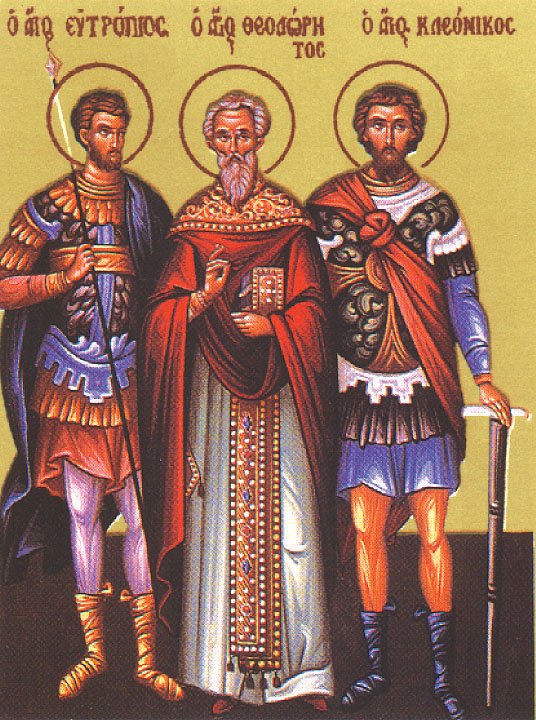
Martyrs Eutropius, Cleonicus, and Basiliscus of Amasea
They were fellow-soldiers and kinsmen of St Theodore the Tyro (Feb. 17). When St Theodore received his martyrdom, they were kept in prison because the governor of Amasia was unwilling to execute them. But a new and crueler governor, Asclepiodotus, took his place and ordered the three soldiers of Christ to be brought to him.
They were fellow-soldiers and kinsmen of St Theodore the Tyro (Feb. 17). When St Theodore received his martyrdom, they were kept in prison because the governor of Amasia was unwilling to execute them. But a new and crueler governor, Asclepiodotus, took his place and ordered the three soldiers of Christ to be brought to him. At first, the governor used flattery and bribery to attempt to turn the three from Christ. He invited Eutropius to dine with him, but Eutropius refused, quoting the Psalm ‘Blessed is the man that walketh not in the counsels of the ungodly.’ He then offered them a huge amount of silver, which they likewise refused, telling the governor that Judas lost his soul for silver. The governor then turned to torture, subjecting the three to extreme torments. At last, he condemned Eutropius and Cleonicus to crucifixion, for which they joyfully gave thanks that they had been found worthy to die the same death as Christ. Basiliscus was held in prison awhile longer in hopes that the deaths of his companions would weaken his resolve; but when he remained steadfast in the Faith, he was beheaded, on May 22 (on which he is also commemorated) in 308.
Troparion - Tone 4
Let us praise Eutropius, Basiliscus and divine Cleonicus, / the three holy athletes of Christ. / They surpassed human endurance in their contests / and professed the supremacy of the Trinity. / Now they ceaselessly intercede that we all may be saved!
Kontakion - Tone 4
Eutropius, Basiliscus and Cleonicus, / bound together in unity of faith, / by their noble contest speedily destroyed the enemies’ ranks!
Saint Piamoun
The holy virgin Piamoun (Πιαμούν) was from Egypt, and she lived during the IV century. Her Life is recorded by Palladius in his Lausiac History .
When the Saint was very young her father died, but her Christian mother raised her with discipline and admonition of the Lord (Ephesians 6:4). When she grew up, she and her mother engaged in works of mercy and compassion. They w
The holy virgin Piamoun (Πιαμούν) was from Egypt, and she lived during the IV century. Her Life is recorded by Palladius in his Lausiac History .
When the Saint was very young her father died, but her Christian mother raised her with discipline and admonition of the Lord (Ephesians 6:4). When she grew up, she and her mother engaged in works of mercy and compassion. They were not wealthy, but out of their meagre income, they were able to help their poor and weak brethren.
Saint Piamoun would eat a little food in the evening, and at night she kept constant vigil. She also labored at weaving linen, and she was found worthy of the gift of foresight.
One day a certain village in Upper Egypt attacked another village because of a quarrel about sharing the waters of the Nile. They fought so violently that many men were killed. This village then moved stealthily against the Saint's village. Men marched with staves and spears, intending to kill the inhabitants.
An Angel of the Lord appeared to Saint Piamoun and warned her that her village would be attacked by the stronger villagers. Summoning the priests of her church, she said, "Go forth to meet the enemy, for they are coming against you, otherwise you and the village will perish. If you beg them not to attack, then perhaps they will spare the village."
The priests were afraid and told her, "We do not dare to face them, for we know their ferocity and their arrogance. However, if you wish to save the village and your own house, then you go out to meet them."
The holy virgin did not go forth, but instead she went up to her roof and stood all night long in prayer. She made many bows and prayed that God would immobilize the enemy where they stood, three miles from her village. Immediately they became paralyzed and were unable to move from that place. It was revealed to them that it was the prayers of Saint Piamoun which hindered them from moving. Therefore, they sent a message to the villagers that they wished to make peace. They also told them to give thanks to God, for it was the prayers of Saint Piamoun which had prevented them from attacking.
When her mother reposed, the venerable one continued the work of ministering to her suffering brothers and sisters by herself. She visited their homes, comforted them, and strengthened their faith.
When Saint Piamoun reposed in 337, there was widespread mourning in her village.
Troparion - Tone 8
In you, O Mother, was preserved with exactness what is according to the image; / for you took up the Cross and followed Christ. / By so doing, you taught us to disregard the flesh, for it passes away; / but to care for the soul, since it is immortal. / Therefore, O Venerable Piamoun, your spirit rejoices with the Angels.
An Unknown Girl in Alexandria (?)
“She was from a wealthy house, having a good father who suffered much and had a difficult death, and an evil mother who had an easy life, died in peace and was buried with honour. In uncertainty whether to live by the example of her father or her mother, this maiden had a vision, in which the state of her father and of her mother were shown to her. S
“She was from a wealthy house, having a good father who suffered much and had a difficult death, and an evil mother who had an easy life, died in peace and was buried with honour. In uncertainty whether to live by the example of her father or her mother, this maiden had a vision, in which the state of her father and of her mother were shown to her. She saw her father in the Kingdom of God, and her mother in darkness and torment. This determined her to devote her whole life to God, and, like her father, follow the commandments of God without regard to any opposition or misfortune that she might have to endure. And she followed the commandments of God to the end, with His help, and was made worthy of the Kingdom of heaven, in which she was reunited with her beloved father.” (Prologue)
Saints Zenon and Zoilus
It is not known just when or where Saint Zenon and Saint Zoilos lived, but according to the Byzantine verse Synaxarion , they died while living in the world (Paris. Coislin. 223, from the year 1301). 1
The names of Saint Zenon and Saint Zoilos and a couplet composed for them were included in the Greek Menaion (printed in Venice in 1596) and in the Synaxaristis .
It is not known just when or where Saint Zenon and Saint Zoilos lived, but according to the Byzantine verse Synaxarion , they died while living in the world (Paris. Coislin. 223, from the year 1301). 1
The names of Saint Zenon and Saint Zoilos and a couplet composed for them were included in the Greek Menaion (printed in Venice in 1596) and in the Synaxaristis . When the Greek Synaxaria were translated into Slavonic, their names and the couplet in their honor were included in the various Prologs . From there, they were incorporated into the Great Reading Menaion (Великие Минеи Четии) for March, and into the modern calendar of the Russian Orthodox Church.
The couplet reads: "Released from this life, Zenon and Zoilos went forth to a better life" (literally "existence").
1 Le fonds Coislin is a collection of Greek manuscripts acquired by Pierre Séguier, but named for Henri-Charles de Coislin, its second owner. It is now held in the National Library of France.
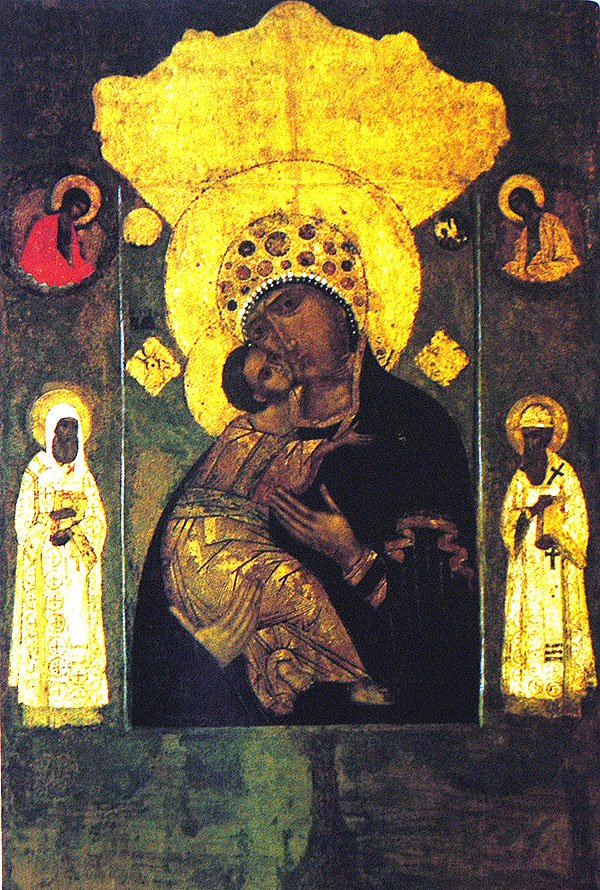
Icon of the Mother of God of Volokolamsk
The Volokolamsk Icon of the Mother of God is a copy of the Vladimir Icon of the Moscow Dormition cathedral. The icon was brought from Zvenigorod to the Dormition monastery of Saint Joseph of Volokolamsk on March 2, 1572, during the second week of Great Lent and was solemnly met by Igumen Leonid (1563-1566; 1568-1573) and all the monastic brethren.
The Volokolamsk Icon of the Mother of God is a copy of the Vladimir Icon of the Moscow Dormition cathedral. The icon was brought from Zvenigorod to the Dormition monastery of Saint Joseph of Volokolamsk on March 2, 1572, during the second week of Great Lent and was solemnly met by Igumen Leonid (1563-1566; 1568-1573) and all the monastic brethren.
It is distinguished by its particular depiction on the margins of Saint Cyprian (right) and Saint Gerontius (left), Metropolitans of Moscow.
The name of Metropolitan Cyprian is associated with the first arrival of the ancient Vladimir Icon of the Mother of God from Constantinople to Moscow in the year 1395, and under Metropolitan Gerontius in 1480 the Vladimir Icon came finally to Moscow.
In the year 1588 the Volokolamsk Icon was dedicated atop the gate in the church at the south gates of the Saint Joseph of Volokolamsk monastery in honor of the Meeting of the Vladimir Icon of the Most Holy Theotokos (August 26).
At the end of the seventeenth century, when a church of the same name was built in Moscow at Staraya Basmanna, the church atop the gate of Saint Joseph of Volokolamsk was rededicated in honor of the holy Apostles Peter and Paul. The Volokolamsk Icon was transferred to its proper place on the iconostasis of the new cathedral Dormition church of the monastery of Saint Joseph of Volokolamsk.
In 1578, the icon was recognized as wonderworking.
Troparion - Tone 4
Today the most glorious city of Volok and the Holy Monastery of Saint Joseph shine radiantly, / as the dawn of the sun, O Sovereign Lady, / your wonderworking Icon, to which we now flock and pray to you: / “O most wondrous Sovereign Lady Theotokos. / Entreat Christ our God, Who was born of you, / to deliver your city and all Christian cities and countries unharmed by all the slanders of the Enemy, / and to save our souls, for He is merciful.”
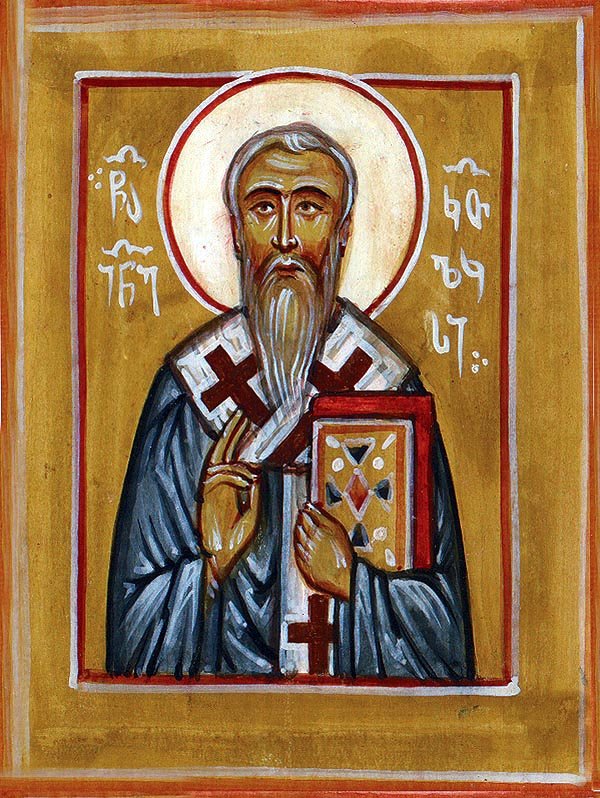
Saint John (Chrysostom) IV, Catholicos of Georgia
The Holy Catholicos John IV (Chrysostom) led the Apostolic Church of Georgia from approximately 980 to 1001.
Catholicos Basil III’s “Story of Saint Shio’s Miracles” describes how the hitherto childless parents of Saint John prayed at length to Saint Shio of Mgvime. After the birth of John, his God-fearing parents sent him to be raised at Shio-Mgvime Monastery.
There
The Holy Catholicos John IV (Chrysostom) led the Apostolic Church of Georgia from approximately 980 to 1001.
Catholicos Basil III’s “Story of Saint Shio’s Miracles” describes how the hitherto childless parents of Saint John prayed at length to Saint Shio of Mgvime. After the birth of John, his God-fearing parents sent him to be raised at Shio-Mgvime Monastery.
There he acquired the sanctity and wisdom for which he would later be called “Chrysostom,” meaning “golden mouth” in Greek. By this name he has been known throughout the history of the Georgian Church.
There is yet another John called “Chrysostom” who was also a Catholicos, from 1033 to 1049. This John was a disciple of Holy Catholicos-Patriarch Melchizedek I and his successor as chief shepherd of the Georgian Church.
His life and labors were full of the same holiness as those of the holy catholicos John who is commemorated on this day. For this reason John IV and John V are often erroneously believed to be one and the same person.
Troparion - Tone 4
In truth you were revealed to your flock as a rule of faith, / an image of humility and a teacher of abstinence; / your humility exalted you; / your poverty enriched you. / Hierarch Father John, / entreat Christ our God / that our souls may be saved.
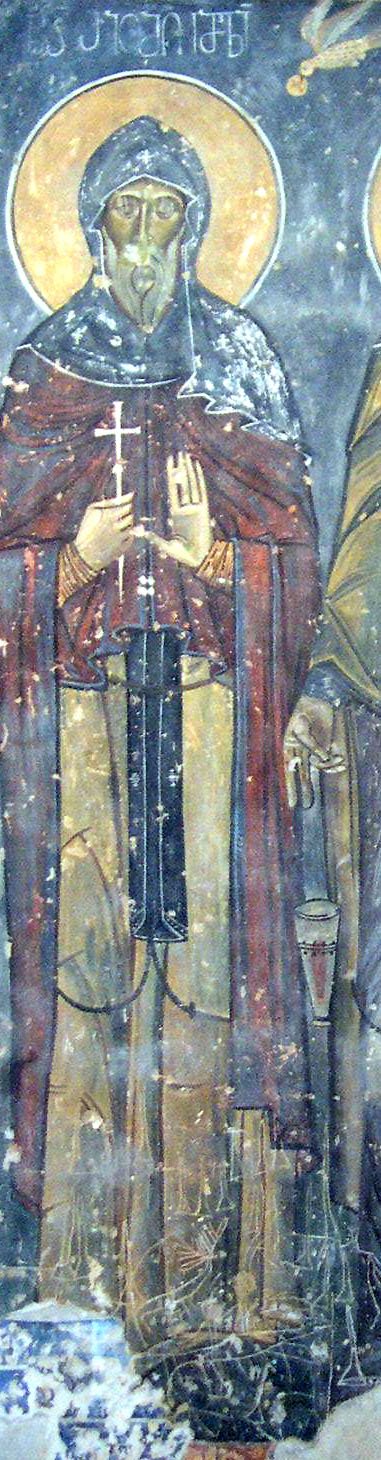
Venerable Shio Mgvime
The Georgian Orthodox Church commemorates Saint Shio of Mgvime several times throughout the year. Saint John of Zedazeni and his twelve disciples, among whom was Saint Shio of Mgvime, are commemorated on May 7; the repose of Saint Shio is celebrated on May 9; and on Cheese-fare Thursday the Church celebrates the miracle that, for centuries, occurred every year at Saint Shio’s grave.
The Georgian Orthodox Church commemorates Saint Shio of Mgvime several times throughout the year. Saint John of Zedazeni and his twelve disciples, among whom was Saint Shio of Mgvime, are commemorated on May 7; the repose of Saint Shio is celebrated on May 9; and on Cheese-fare Thursday the Church celebrates the miracle that, for centuries, occurred every year at Saint Shio’s grave.
The 19th-century historian Marie Brosset wrote that every year prior to the 18th century, on Cheese-fare Thursday, the relics of Saint Shio rose up out of the ground from the place of their burial. Those who approached them in faith and reverence received healing of their afflictions.
In the 18th century the Persian shah Nadir (1736-1747) invaded Georgia. Hearing about this miracle and becoming convinced of its truth, the enraged shah assailed the monastery and destroyed the shrine containing the saint’s holy relics. A group of Christians later gathered Saint Shio’s holy relics and reburied them in their former place, but to this day they have never risen again.
Troparion - Tone 8
By a flood of tears you made the desert fertile, / and your longing for God brought forth fruits in abundance. / By the radiance of miracles you illumined the whole universe! / O our holy father Shio, pray to Christ our God to save our souls!
Scripture Readings
View scripture readings for this date on OCA.org.
View readings on OCA.orgLiturgical data sourced from OCA.org and orthocal.info