Fasting Rules

Meat not allowed Meat Abstain
Fish not allowed Fish Abstain
Dairy not allowed Dairy Abstain
Oil not allowed Oil Abstain
Wine not allowed Wine Abstain

Saints & Commemorations

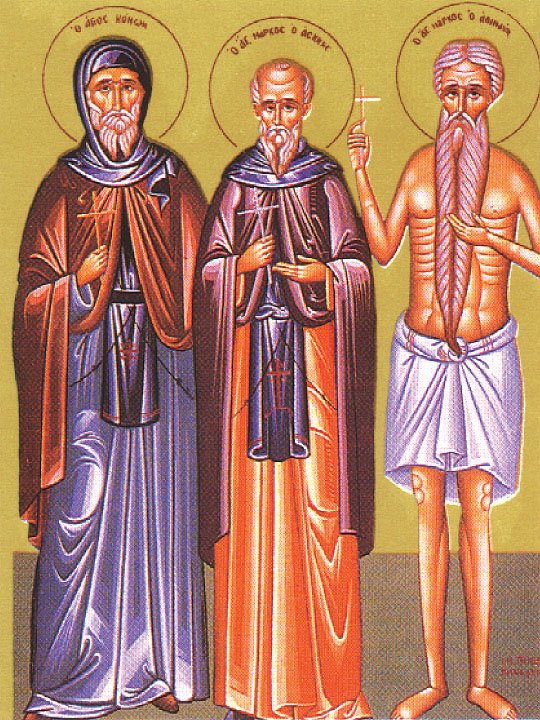
Martyr Conon of Isauria
Martyr Conon of Isauria

The holy Martyr Conon lived in the days of the holy Apostles; he was born in the village of Bydane of Isauria in Asia Minor, to parents named Nestor and Nada. He was instructed in the Faith and baptised into Christ by the Archangel Michael himself, who, it is said, accompanied him for the rest of his life. The holy Martyr Conon lived in the days of the holy Apostles; he was born in the village of Bydane of Isauria in Asia Minor, to parents named Nestor and Nada. He was instructed in the Faith and baptised into Christ by the Archangel Michael himself, who, it is said, accompanied him for the rest of his life. His parents joined him in marriage to a pagan maiden named Anna; but on their wedding night he took a candle, put it under a vessel, and asked her ‘Which is better, light or darkness?’ She answered ‘Light,’ and he told her of the Christian faith and the joys of the spiritual life. She accepted Christ, and the two agreed to live in virginity. Conon went on to bring many pagans to Christ, including his own parents. His wife and both parents died after a few years (Nestor as a Martyr) and he gave himself up entirely to prayer, fasting, and contemplation on God. He was known as a wonder-worker, and even evil spirits were compelled to serve him. During one of the persecutions, Magnus the governor of Isauria imprisoned Conon and had him tortured, beaten and stabbed with knives. Believers obtained some of his blood, and the sick who were anointed with it became well. A large crowd of Christians whom Conon had brought to Faith surrounded the governor’s palace demanding Conon’s release, and the frightened governor let him go. He lived for two more years in his own home, then reposed in peace.
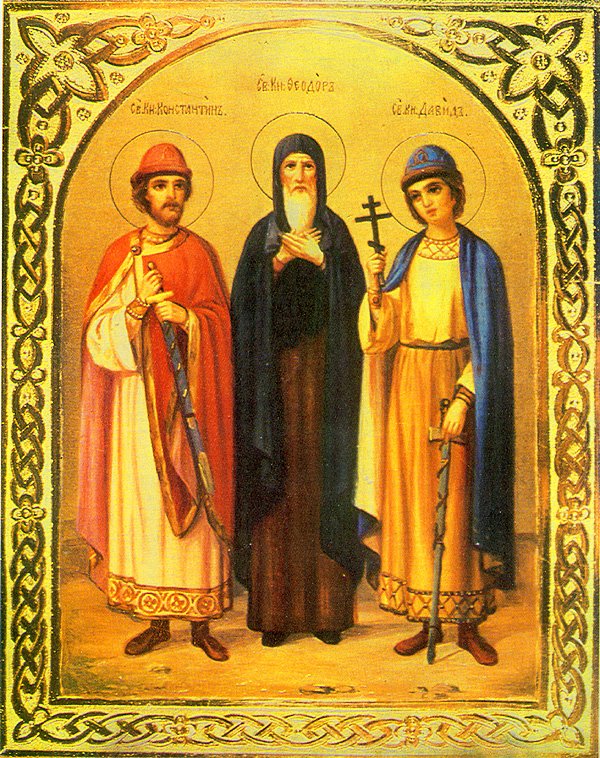
Finding of the relics of Saint Theodore, Prince of Smolensk and Yaroslavl, and his children

Finding of the relics of Saint Theodore, Prince of Smolensk and Yaroslavl, and his children

On March 5, 1463, the relics of holy Prince Theodore and his sons, David and Constantine were uncovered at Yaroslavl. The chronicler, an eyewitness to the event, wrote: “At the city of Yaroslavl in the monastery of the Holy Savior they unearthed three Great Princes: Prince Theodore Rostislavich and his sons David and Constantine, and brought them above the ground. T On March 5, 1463, the relics of holy Prince Theodore and his sons, David and Constantine were uncovered at Yaroslavl. The chronicler, an eyewitness to the event, wrote: “At the city of Yaroslavl in the monastery of the Holy Savior they unearthed three Great Princes: Prince Theodore Rostislavich and his sons David and Constantine, and brought them above the ground. The Great Prince Theodore was a man of great stature, and they placed his sons David and Constantine beside him. They were shorter than he was. All three had lain in a single grave.” The physical appearance of the holy prince so impressed the eyewitnesses and those present at the uncovering of the relics, that an account of this event was entered into the Prologue (lives of saints) in Saint Theodore’s Life, and also into the text of the Manual for Iconographers. Saints Theodore, David and Constantine are also commemorated on September 19.

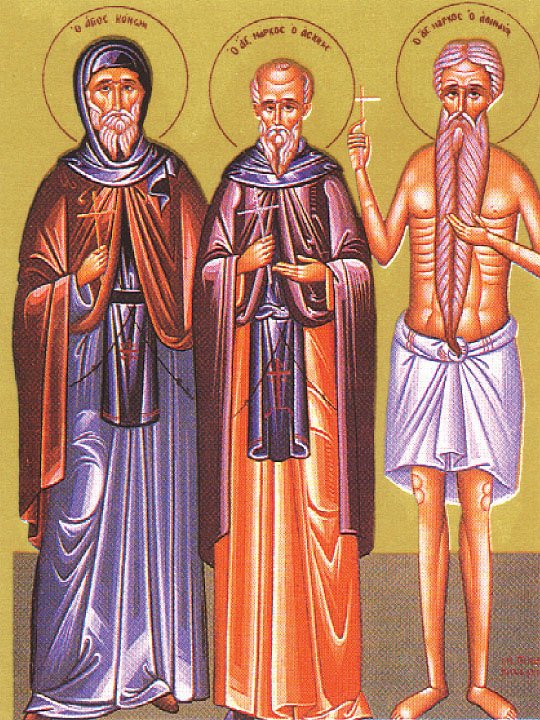
St Mark of Athens (4th c.)

He was born in Athens of pagan parents, but believed and was baptized, and, forsaking everything, lived as a hermit in the desert beyond Egypt. He did not see another human being for ninety-five years, and we would know nothing of his life had not the monk Serapion come upon him. Mark was about to depart this life, and lived only long enough to tell Serapion his story. He was born in Athens of pagan parents, but believed and was baptized, and, forsaking everything, lived as a hermit in the desert beyond Egypt. He did not see another human being for ninety-five years, and we would know nothing of his life had not the monk Serapion come upon him. Mark was about to depart this life, and lived only long enough to tell Serapion his story. Serapion then gave him burial.

Monastic Martyr Adrian of Poshekhonye, Yaroslavl

Saint Adrian of Poshekhonye was born at Rostov the Great at the end of the sixteenth century, of pious parents named Gregory and Irene. Saint Adrian received monastic tonsure at the monastery of Saint Cornelius of Komel (May 19). Among the brethren gathered around Saint Cornelius were some capable builders and iconographers, so the monastery churches were constructed and adorned by the saints themselves. Saint Adrian of Poshekhonye was born at Rostov the Great at the end of the sixteenth century, of pious parents named Gregory and Irene. Saint Adrian received monastic tonsure at the monastery of Saint Cornelius of Komel (May 19). Among the brethren gathered around Saint Cornelius were some capable builders and iconographers, so the monastery churches were constructed and adorned by the saints themselves. In the final years of Saint Cornelius’s life, Kazan Tatars invaded the territory around the monastery, and he led all the brethren to the River Ukhtoma. But the Tatars did not touch the monastery, being frightened off by the sight of the many soldiers defending it, and they soon withdrew from the Vologda district. Saint Cornelius returned to the monastery with the brethren and reposed there on May 19, 1537. Three years after the death of Saint Cornelius, Saint Adrian, then a hierodeacon, greatly desired to go into a wilderness place and found a monastery in honor of the Most Holy Theotokos. The Lord helped him fulfill his intention. A certain unknown Elder of striking appearance came to the Corniliev monastery. Saint Adrian asked him his name, and the Elder referred to himself as “the lowly one.” When Saint Adrian invited him to his own cell and asked him to say something beneficial for the soul, the Elder said that he would show Saint Adrian the spot where he should build the church and monastery of the Most Holy Theotokos. Saint Adrian immediately went to the Superior, Igumen Laurence, and sought his blessing to live in the wilderness. Recalling Saint Cornelius’s order that any monks who wished to withdraw into the wilderness should be released from the monastery, Igumen Laurence did not hinder Saint Adrian but gave him his blessing. He also sent with him his assistant, Elder Leonid. After they prayed at the grave of Saint Cornelius, Saint Adrian and Elder Leonid went on their way, led by the mysterious black-robed monk. Saint Adrian carried with him an icon of the Dormition of the Mother of God, which he also painted. On September 13, 1540, the eve of the Feast of the Exaltation of the Cross of the Lord, Saint Adrian and Elder Leonid arrived in the wild Poshekhonye forest, near the settlements of Belta, Patrabolsha, Shelshedolsk and Ukhorsk. They halted at the banks of the River Votkha. There the Elder leading them suddenly became invisible. The astonished travelers began to chant the Canon and service of the Feast, with tears of thanks to God. Indeed this was a portent of the future fame of the monastery, a place where God would be glorified. For three years Saint Adrian and the Elder Leonid survived in the wilderness solitude, suffering want, overcoming temptations from the devil and the whisperings of wicked folk, and then they began to fulfill their intention. Choosing a suitable moment, the ascetics went to Moscow to ask the blessing of Metropolitan Macarius to establish a monastery and church in honor of the Dormition of the Mother of God on the Poshekhonye side of the River Votkha. Saint Macarius gave his blessing to the ascetics to build the monastery, and he gave them a written document to that effect. He ordained Adrian to the priesthood and elevated him to the rank of igumen. In the document he had given to Saint Adrian, the hierarch bade “priests, deacons, monks and laymen to listen to him and obey him in everything, as befits a pastor and teacher.” At Moscow the Poshekhonye ascetics found generous benefactors who gave the monks abundant offerings to build their church. Returning to their wilderness spot on May 31, 1543, Saint Adrian laid the foundations for the church with a trapeza, in honor of the Dormition of the Most Holy Theotokos. Having embellished and consecrated the new church, Saint Adrian began the construction of the monastery. The strict monastic Rule of Saint Cornelius was introduced at the monastery. Having nothing of their own, a little being sufficient for everyone, the saints devoted a large portion of their time to prayer, both in church and in their cells, and no small time was allotted to the reading of Holy Scripture. This reading was done “not in an elegant voice, nor for effect, but in a humble and mild voice. One reads, and another speaks of what is read.” They also read in private. In addition to his duties as igumen, Saint Adrian also occupied himself with painting icons. When his holy soul longed for complete silence, he withdrew into the depths of the forest into the cell and chapel he had built one verst away from the monastery. Six years after the founding of the monastery, Elder Leonid reposed. Saint Adrian and the brethren buried him with reverence. The number of the brethren had increased during this time. They built three cells as dwellings, and a fourth for preparing food and baking bread. Saint Adrian began to make plans for the construction of a large stone church, and he gathered a sum of money for this purpose. One year after the repose of Elder Leonid, during Great Lent of 1550, on the eve of the commemoration of the 42 Ammoreian Martyrs (March 6), armed robbers burst into the monastery and murdered Saint Adrian after beating him. The holy relics of Saint Martyr Adrian were uncovered on December 17, 1626, solemnly transferred into the monastery church and placed in an open crypt by the right kliros (choir). Many miracles occurred at the grave of Saint Adrian.

Troparion - Tone 1

The image of God was truly preserved in you, O Father, / for you took up the Cross and followed Christ. / By so doing you taught us to disregard the flesh for it passes away / but to care instead for the soul, since it is immortal. / Therefore your spirit, venerable Adrian, rejoices with the angels.

Kontakion - Tone 2

As a venerable and proven ascetic, as an honorable and renowned martyr, / and as a model of the desert life, O most exalted Adrian, / we sing hymns of praise to you, / for you have trampled upon serpents.

Martyr Onesimus of Isauria

The Holy Martyr Onesimus (Onisius) lived in Palestine. He was beheaded with the sword for confessing faith in Christ.

Troparion - Tone 4

Your holy martyr Onesimus, O Lord, / through his sufferings has received an incorruptible crown from You, our God. / For having Your strength, he laid low his adversaries, / and shattered the powerless boldness of demons. / Through his intercessions, save our souls!
Martyr Conon the Gardener of Pamphylia

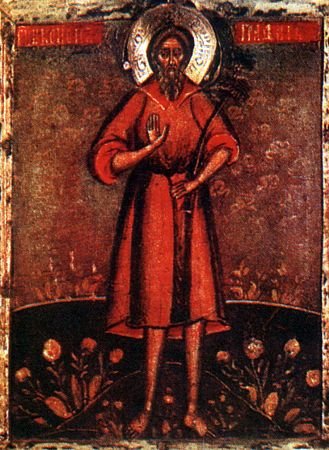
Martyr Conon the Gardener of Pamphylia

The Holy Martyr Conon the Gardener was born in Nazareth of Galilee, but he lived in the city of Mandona, where he occupied himself with gardening. He was a God-fearing man, sincere in heart, and without malice. The saint suffered for his faith in Christ under the emperor Decius (249-251). When they brought him to trial, he unwaveringly and firmly confessed his faith. The Holy Martyr Conon the Gardener was born in Nazareth of Galilee, but he lived in the city of Mandona, where he occupied himself with gardening. He was a God-fearing man, sincere in heart, and without malice. The saint suffered for his faith in Christ under the emperor Decius (249-251). When they brought him to trial, he unwaveringly and firmly confessed his faith. The torturers drove nails into his feet and dragged him behind a chariot until the sufferer collapsed from exhaustion. With a prayer, he surrendered his spirit to the Lord.

Troparion - Tone 4

Your holy martyr Conon, O Lord, / through his suffering has received an incorruptible crown from You, our God. / For having Your strength, he laid low his adversaries, / and shattered the powerless boldness of demons. / Through his intercessions, save our souls!
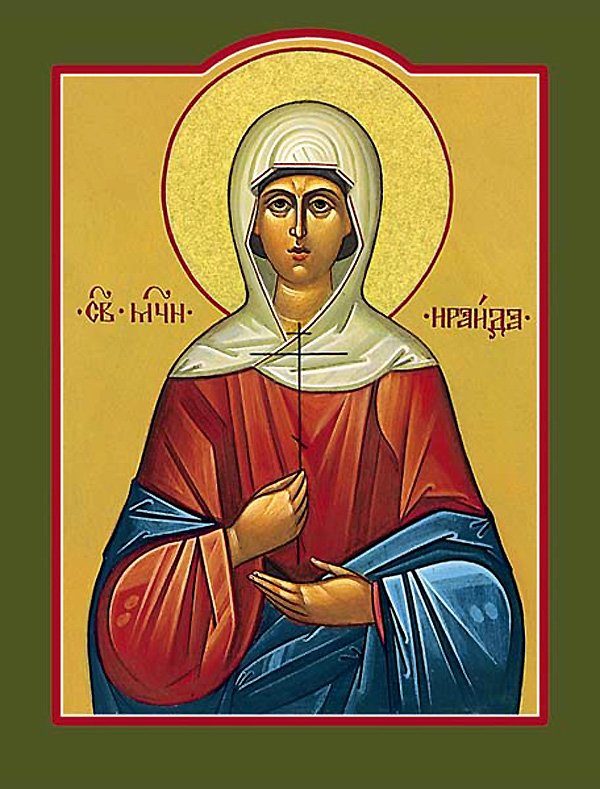
Virgin Martyr Irais (Rhais) of Antinoe in Egypt

Virgin Martyr Irais (Rhais) of Antinoe in Egypt

No information on the life of this saint is available at this time.

Martyr Eulogius of Palestine

The Holy Martyr Eulogius was a native of Palestine. After the death of his pagan parents he gave away all his inheritance to the poor, and he himself became a wanderer and went through Palestine, converting pagans to Christianity. During the time of a persecution he was arrested, subjected to terrible tortures and beheaded.

Troparion - Tone 3

Your holy martyr Eulogius, O Lord, / through his suffering has received an incorruptible crown from You, our God. / For having Your strength, he laid low his adversaries, / and shattered the powerless boldness of demons. / Through his intercessions, save our souls!

Martyr Eulampius of Palestine

The Holy Martyr Eulampius lived in Palestine. He was beheaded for his faith in Christ.

Troparion - Tone 3

Your holy martyr Eulampius, O Lord, / through his suffering has received an incorruptible crown from You, our God. / For having Your strength, he laid low his adversaries, / and shattered the powerless boldness of demons. / Through his intercessions, save our souls!

Saint Mark the Ascetic of Egypt

Saint Mark the Ascetic of Egypt

St Mark was a disciple of St John Chrysostom, tonsured a monk at the age of forty by St John himself. He then withdrew to the Nitrian desert and lived for sixty years as a hermit, devoting himself to fasting, prayer, and writing spiritual discourses. Saint Mark knew all the Holy Scriptures by heart. His compassion was so great that he wept at the distress of any of God’s creatures: once he wept for the blind pup of a hyena, and the pup received its sight. T St Mark was a disciple of St John Chrysostom, tonsured a monk at the age of forty by St John himself. He then withdrew to the Nitrian desert and lived for sixty years as a hermit, devoting himself to fasting, prayer, and writing spiritual discourses. Saint Mark knew all the Holy Scriptures by heart. His compassion was so great that he wept at the distress of any of God’s creatures: once he wept for the blind pup of a hyena, and the pup received its sight. Though he lived alone in the desert, it is said that he received Communion from an angel. The holy and scholarly Patriarch Photios held his writings in the highest esteem, and at one time there was a saying, ‘sell all that you have, and buy Mark.’ Some of these beautiful and profound writings may be read in English in the first volume of the Philokalia.

Troparion - Tone 8

By a flood of tears you made the desert fertile, / and your longing for God brought forth fruits in abundance. / By the radiance of miracles you illumined the whole universe! / O our holy father Mark, pray to Christ our God to save our souls!

Saint Hesychius the Faster of Bithynia

Saint Hesychius the Faster was born in the eighth century in the coastal city of Adrineia in Bithynia. Raised since his youth in piety, he left his parental home and practiced asceticism in a wilderness spot on Mount Maionis. Despite the threat of demons and wild animals and robbers living there, the holy ascetic in seeking greater solitude settled there and built himself a cell, digging himself a garden and eating from the fruit of his labors. Saint Hesychius the Faster was born in the eighth century in the coastal city of Adrineia in Bithynia. Raised since his youth in piety, he left his parental home and practiced asceticism in a wilderness spot on Mount Maionis. Despite the threat of demons and wild animals and robbers living there, the holy ascetic in seeking greater solitude settled there and built himself a cell, digging himself a garden and eating from the fruit of his labors. After a certain while disciples began to throng to him. At a spring of water in a valley not far off Saint Hesychius built a church in the name of the holy Apostle Andrew the First-Called. Even during his lifetime he was granted the gift of wonderworking. One time they brought a demon-possessed girl to him. Her parents, falling down at the feet of the holy ascetic, implored his holy prayers for her healing. The holy ascetic made prayer for the unfortunate one, and the devils left her. Turning to the parents of the healed girl, Saint Hesychius predicted that a women’s holy monastery would arise at the place their daughter was healed. And actually the prophecy was fulfilled in the future. An angel appeared to Saint Hesychius three days before his end and predicted to him his approaching demise. He accepted the news with joy. And before his blessed end, the saint summoned his disciples and for a long while he instructed them. At midnight the cell of the saint and the surrounding area suddenly gleamed with a heavenly light, and Saint Hesychius fell asleep in the Lord with the words: “Into Thy hands, O Lord, I commend my spirit.” At the place of his efforts, in accord with the prediction of Saint Hesychius, was later on built a women’s monastery. The holy relics of Saint Hesychius, buried at the church of the holy Apostle Andrew the First-Called, were later transferred by Theophylactus, Bishop of Amasea, to the city of Amasea (Asia Minor). Today’s saint should not be confused with Saint Hesychius the Theologian, the priest of Jerusalem (March 28), whose writings are in the Philokalia .

Troparion - Tone 8

By a flood of tears you made the desert fertile, / and your longing for God brought forth fruits in abundance. / By the radiance of miracles you illumined the whole universe! / O our holy father Hesychius, pray to Christ our God to save our souls!
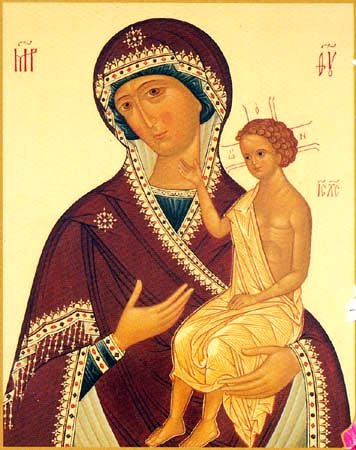
Icon of the Mother of God “The Nurturer”

Icon of the Mother of God “The Nurturer”

In the Icon called “Nurturing,” the Mother of God is depicted with her eternal Child sitting on her left arm. Christ’s right hand is extended upward to the face of the All-Pure Virgin. Before 1917, the holy image was located in the Kazan Cathedral on Red Square, but it was lost after the destruction of that church in 1936. The c In the Icon called “Nurturing,” the Mother of God is depicted with her eternal Child sitting on her left arm. Christ’s right hand is extended upward to the face of the All-Pure Virgin. Before 1917, the holy image was located in the Kazan Cathedral on Red Square, but it was lost after the destruction of that church in 1936. The church was rebuilt in 1993, and it houses a copy of the Nurturing Icon. At that place there is a list of wonderworking icons glorified throughout Russia for their miracles. The title of the Icon speaks for itself. Parents pray for their children in her presence, asking the Most Holy Theotokos to take them under her protection, to send them understanding, and to fill their hearts with wisdom. Until our own time, a brief prayer has been associated with this image: O All-Holy Lady, Virgin Theotokos, save and keep under your protection my children (names), all boys and girls and infants, both those who are baptized and those who are nameless and those being carried in their mother's womb. Cover them with your own maternal mantle. Preserve them in the fear of God and in obedience to their parents. Implore your Son and our Lord to grant them what is needful for their salvation. I entrust them to your maternal providence, for you are the divine protection of your servants. Amen.

Troparion - Tone 4

You were nurtured in the Temple and in the Holy of Holies, / robed with faith and in wisdom and perpetual virginity. / The Archangel Gabriel brought you greetings from Heaven and cried: / “Hail, O full of grace, hail, Most Glorious Lady, / the Lord is with you.”

Kontakion - Tone 6

We have no other help, we have no other hope, but you, O Lady. / Help us, for in you we hope, / and of you we boast, for we are your servants. / Let us not be put to shame.

Saint John, New Martyr of Bulgaria

The holy New Martyr John was born in Bulgaria in 1775. Since fanatical Moslems believed that they would be assured of an eternal “paradise” where they would enjoy beautiful virgins and an abundance of food if they could force Christians to deny Christ and follow Mohammed, they spared no effort to convert Christians through flattery or by threats of death. Wh The holy New Martyr John was born in Bulgaria in 1775. Since fanatical Moslems believed that they would be assured of an eternal “paradise” where they would enjoy beautiful virgins and an abundance of food if they could force Christians to deny Christ and follow Mohammed, they spared no effort to convert Christians through flattery or by threats of death. When John was still a boy, he fell in with Moslem companions. Through various ways, he was led to renounce Christ and to follow Islam. He came to his senses when he was about sixteen, and was stricken with grief at his denial of Christ. He fled to Mt. Athos to the Great Lavra. Here he spent his time in repentence under the guidance of an Elder. He lived a monastic life of great strictness for three years, yet his conscience continued to trouble him. With the blessing of his Elder, he decided to travel to Constantinople to wipe out his apostasy by confessing Christ in a public way and by shedding his blood. The young monk dressed himself as a Turk, which a Christian was not permitted to do. Arriving in Constantinople, he went directly to the church of Hagia Sophia, which had been turned into a mosque. Right in front of the Moslems, he made the Sign of the Cross and began to recite Christian prayers. Then he said in a loud voice that he had been born a Christian, but had fallen into error and renounced Christ. Now, he declared, he wished to renounce the false religion of Mohammed in order to follow Christ once more. The Turks fell into a frenzied rage when they heard his words. They seized him and began to torture him in various ways. “Renounce Christ,” they said, “and return to the Moslem faith, or you will be killed.” Saint John replied, “Without Christ, there is no salvation.” The furious Hagarenes dragged the saint out to the courtyard to behead him. In this manner, Saint John received the crown of martyrdom in 1784 at the age of nineteen.

Troparion - Tone 3

Your holy martyr John, O Lord, / through his suffering has received an incorruptible crown from You, our God. / For having Your strength, he laid low his adversaries, / and shattered the powerless boldness of demons. / Through his intercessions, save our souls!

Scripture Readings

View scripture readings for this date on OCA.org.

View readings on OCA.org

Liturgical data sourced from OCA.org and orthocal.info