Fasting Rules
 Meat
Abstain
Meat
Abstain
 Fish
Abstain
Fish
Abstain
 Dairy
Abstain
Dairy
Abstain
 Oil
Abstain
Oil
Abstain
 Wine
Abstain
Wine
Abstain
Saints & Commemorations
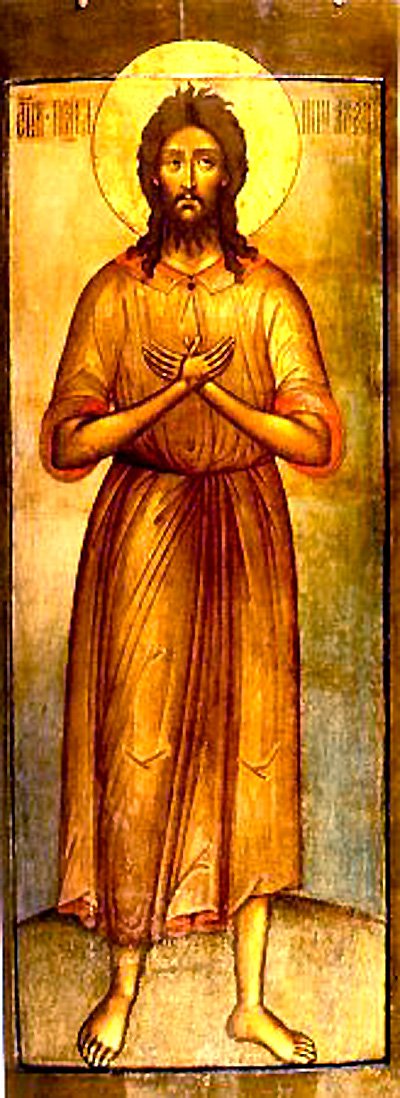
Venerable Alexis the Man of God
He was born of pious and noble parents in Rome in the time of the Emperor Honorius. His parents, Euphemianus and Agalais, set a high standard of godly living: his father, though wealthy, sat down to dine only once a day, at sunset. By his parents’ arrangement Alexis was married at a young age. However, without ever living with his new wife, he fled to Edessa in Mesopotamia, where he lived in asceticism for eighteen years, presenting himself as a beggar in order to avoid the praise of men. W
He was born of pious and noble parents in Rome in the time of the Emperor Honorius. His parents, Euphemianus and Agalais, set a high standard of godly living: his father, though wealthy, sat down to dine only once a day, at sunset. By his parents’ arrangement Alexis was married at a young age. However, without ever living with his new wife, he fled to Edessa in Mesopotamia, where he lived in asceticism for eighteen years, presenting himself as a beggar in order to avoid the praise of men. When, despite his efforts, he began to be known as a holy man, he fled the city and took ship for Laodicea. By divine providence, the ship was blown off course and forced to land in Rome. Taking this as a sign, Alexis, still disguised as a beggar, returned to his parents’ house, where he sat at the gates, unrecognized by any of his family. His father, not knowing who he was, allowed him to live in a hut in his courtyard. There Alexis spent another seventeen years, living only on bread and water. He died clutching a piece of paper on which he had revealed his true identity. At the time of his death, the pope of Rome heard a voice saying “Look for the Man of God,” and revealing where he should look. It is said that the Emperor Honorius, the Pope and a large retinue came to the house, where they found Alexis dead in his tiny hut, his face shining like the sun. His parents and wife were at first overcome with grief to learn that their son and husband had been secretly living near them, but they were comforted when they saw that his body healed the sick and exuded a fragrant myrrh. Thus they knew that God had glorified him. His head is preserved at the Church of St Laurus on the Peloponnese.
Troparion - Tone 4
You budded from a famous and glorious root; / you blossomed from a royal and illustrious city, O supremely wise Alexis; / you disdained everything on earth as corruptible and fleeting, / and you hastened to Christ the Master. / Always entreat Him to save our souls.
Kontakion - Tone 4
Today with hymns and praise / we celebrate the feast of Alexis the blessed and we cry aloud: / Rejoice, gladsome adornment of the righteous!
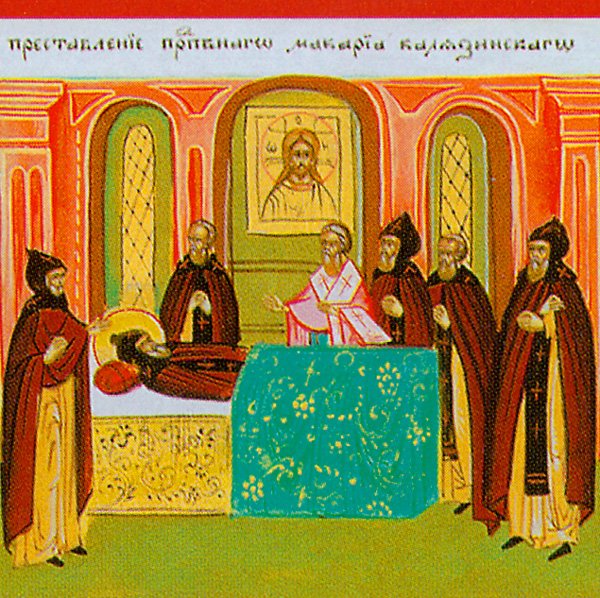
Venerable Macarius the Wonderworker, Abbot of Kalyazin
Saint Macarius of Kalyazin (in the world Matthew) was born in 1400 in the village of Gribkovo (Kozhino), near the city of Kashin, into the family of the boyar Basil Kozha. From youth he yearned for monasticism, but he married at the insistence of his parents.
After a year his parents died, and after three more years his wife Elena also reposed.
Saint Macarius of Kalyazin (in the world Matthew) was born in 1400 in the village of Gribkovo (Kozhino), near the city of Kashin, into the family of the boyar Basil Kozha. From youth he yearned for monasticism, but he married at the insistence of his parents.
After a year his parents died, and after three more years his wife Elena also reposed. Having nothing to bind him to his former life, Matthew became a monk at the Nikolaev Klobukov monastery. Desiring solitude, he left the city monastery with the abbot’s blessing, and he found a suitable place between two lakes, eighteen versts from Kashin. Here the monk raised a cross and founded a solitary wilderness monastery.
The boyar Ivan Kolyaga, to whom the nearby lands belonged, began to fear that a monastery would grow up there, and that monks would begin to cultivate the wastelands. The Enemy of our salvation planted such spite and enmity in the boyar, that he decided to kill the saint. Suddenly, he was stricken with a grievous illness. Fear of death awakened repentance in the boyar. Ivan Kolyaga was carried to the saint and told him of his evil intent, asking forgiveness.
“God forgive you”, the humble ascetic replied. Wishing to expiate his sin and to help the saint, the boyar gave his lands to the growing monastery. The monks built a temple dedicated to the Most Holy Trinity. Word of the boyar Kolyaga’s conversion brought many people to the monk, seeking salvation. Saint Macarius tonsured Kolyaga and named the monastery Kalyazin for him.
It became necessary to choose an igumen. Saint Macarius was then fifty-three years of age, but he considered himself unworthy of this dignity and he asked each of the older men coming to him to become the monastery’s priest and igumen. Yielding to the common will, the saint was made igumen by Bishop Moses of Tver.* The new igumen prepared for his first service at the altar of God with long solitary prayer, and then communed all the brethren with the Holy Mysteries.
In the rank of igumen, Saint Macarius labored to guide the brethren. The monastery had two chalices, a diskos and two plates fashioned by Saint Macarius on a lathe. He guided not only the monks, but also laypeople coming to the monastery, dealing with both the educated and the simple.
Despite his noble origin and his position of igumen, the saint wore ragged, frayed and patched clothing. In his conduct and his way of life Saint Macarius was so simple that the haughty heretic Vassian, sneeringly called him the “peasant of Kalyazin.” The saint preferred to hear himself mocked rather than praised. He went to solitary places, delighted to be alone with nature. Wild animals, sensing his holiness, walked with him like sheep, they submitted to him, and sometimes took food from him.
The spiritual stature of Saint Macarius was close to the spiritual stature of Saint Paphnutius of Borov (May 1, 1477). Not by chance did Saint Paphnutius’ disciple, Saint Joseph of Volokolamsk (September 9, 1515), visit Saint Macarius in 1478 and write down his impressions of him: “When I arrived at this place,” said Saint Macarius, “seven Elders came with me from the monastery of Klobukov. They were so excellent in virtues, fasting and monastic life, that all the brethren came to them to receive instruction and benefit. They enlightened all and taught them for their benefit. They affirmed the virtuous life, and censured those inclined to misconduct, and neither did they seek to do their own will.”
Though the humble igumen was silent about his own efforts, they were not hidden from Saint Joseph. Perceiving the holiness of the igumen, he accounted him blessed and spoke about the life of the monastery: “Such piety and decorum were in that monastery, where everything was done in harmony with the patristic and communal traditions, that even the great Elder Metrophanes Byvaltsev was amazed. He had just come from Mount Athos, where he spent nine years, and said to the brethren: ‘My efforts and my journey to the Holy Mountain were in vain, because one can find salvation in the Kalyazin monastery. Life here is similar to life in the cenobitic monasteries of the Holy Mountain.’”
From the moment Saint Macarius settled in the wilderness, he did not abandon his strict Rule because of old age. Even during his lifetime the saint repeatedly healed the paralyzed and the demon-possessed.
The saint reposed on March 17, 1483. At the time of his death they found heavy chains on him, about which no one knew. The incorrupt relics of Saint Macarius were uncovered on May 26, 1521 when ditches were dug for a new church. A Council of 1547 established his local festal celebration.
* The successor of Bishop Moses was Saint Macarius’ brother, Bishop Gennadius (Kozhin) (1460-1477). The nephew of Saint Macarius, Saint Paisius of Uglich (January 8 and June 6) was also famed for his sanctity. The Kalyazin monastery had a collection of the sermons of Saint Gregory the Theologian, which Saint Macarius had copied in his own hand.
Troparion - Tone 8
You deadened your carnal mind by abstinence and vigil. / The place watered by the sweat of your labors proclaims your admonitions like God’s trumpet. / After your repose your relics pour forth healings. / Therefore we cry to you: pray to Christ our God that our souls may be saved!
Kontakion - Tone 2
You desired the life of heaven / and delighted in abstinence, labors and sweat. / You bridled the flesh and received the grace to work wonders. / You appear as a radiant light, O righteous Father Macarius. / Therefore the Church of Christ glorifies you!
Ven. Makary of Kalyazinsk
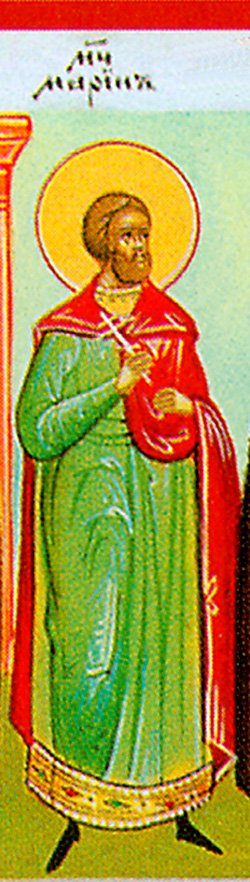
Martyr Marinus
The Life of Saint Marinus has been preserved in the Byzantine Synaxaristḗs, which states that the Holy Martyr lived during a time when the Church was being persecuted, and that he was a zealous Christian. Therefore, when he saw the pagans offering sacrifices to their false "gods," he destroyed the altar and trampled upon the idols, confessing that he was a Christian. F
The Life of Saint Marinus has been preserved in the Byzantine Synaxaristḗs, which states that the Holy Martyr lived during a time when the Church was being persecuted, and that he was a zealous Christian. Therefore, when he saw the pagans offering sacrifices to their false "gods," he destroyed the altar and trampled upon the idols, confessing that he was a Christian. For that reason, he was arrested and beaten with whips, then he was suspended and his sides were raked, and the pagans also knocked out his teeth with stones and dragged him along the ground by his hair. After that, Saint Marinus was bound and brought before the archon, who, after subjecting the Martyr to further tortures, ordered him to be beheaded with a sword.
None of the surviving accounts specify the time and place of Saint Marinus's martyrdom.
Troparion - Tone 3
Your holy martyr Marinus, O Lord, / through his suffering has received an incorruptible crown from You, our God. / For having Your strength, he laid low his adversaries, / and shattered the powerless boldness of demons. / Through his intercessions, save our souls!
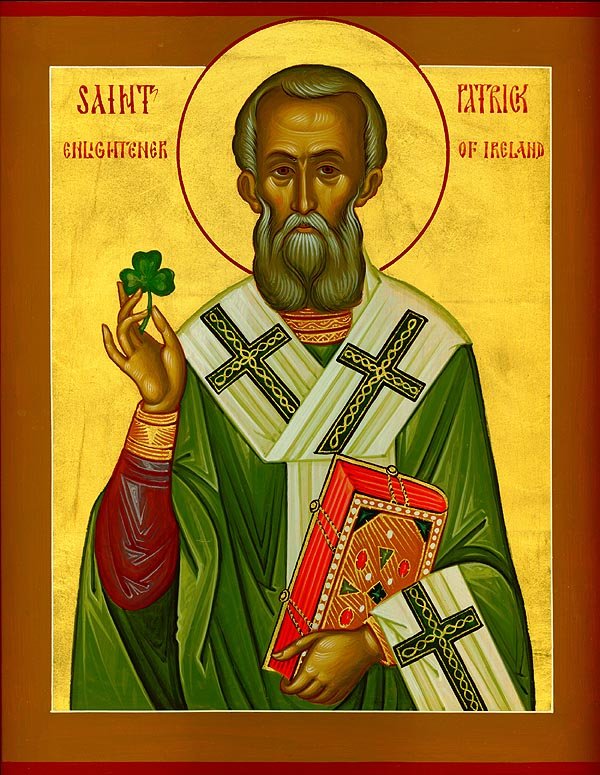
Saint Patrick, Bishop of Armagh, Enlightener of Ireland
“Saint Patrick, the Apostle of the Irish, was seized from his native Britain by Irish marauders when he was sixteen years old. Though the son of a deacon and grandson of a priest, it was not until his captivity that he sought out the Lord with his whole heart. In his Confession, the testament he wrote towards the end of his life, he says, ‘After I came to Ireland — every day I had to tend sheep, and many times a day I prayed — the love of God and His fear came to me more and more, and my faith was strengthened. And my
“Saint Patrick, the Apostle of the Irish, was seized from his native Britain by Irish marauders when he was sixteen years old. Though the son of a deacon and grandson of a priest, it was not until his captivity that he sought out the Lord with his whole heart. In his Confession, the testament he wrote towards the end of his life, he says, ‘After I came to Ireland — every day I had to tend sheep, and many times a day I prayed — the love of God and His fear came to me more and more, and my faith was strengthened. And my spirit was so moved that in a single day I would say as many as a hundred prayers, and almost as many at night, and this even when I was staying in the woods and on the mountain; and I would rise for prayer before daylight, through snow, through frost, through rain, and I felt no harm.”
After six years of slavery in Ireland, he was guided by God to make his escape, and afterwards struggled in the monastic life in Aesir in Gaul [now France], under the guidance of the holy Bishop Germanus. Many years later he was ordained bishop and sent to Ireland once again, about the year 432, to convert the Irish to Christ. His arduous labours bore so much fruit that within seven years, three bishops were sent from Gaul to help him shepherd his flock, ‘my brethren and sons whom I have baptized in the Lord — so many thousands of people,’ he says in his Confession.
His apostolic work was not accomplished without much ‘weariness and painfulness,’ long journeys through difficult country, and many perils; he says his very life was in danger twelve times. When he came to Ireland, as its enlightener, it was a pagan country; when he ended his earthly life some thirty years later, about 461, the Faith of Christ was established in every corner.” (Great Horologion)
The work of St Patrick and his brethren has been called the most successful single missionary venture in the history of the Church.
It is said of St Patrick that he chanted the entire Psalter every day.
Troparion - Tone 3
Holy Bishop Patrick, / faithful shepherd of Christ’s royal flock, / you filled Ireland with the radiance of the Gospel: / The mighty strength of the Trinity! / Now that you stand before the Savior, / pray that He may preserve us in faith and love!
Kontakion - Tone 4
From slavery you escaped to freedom in Christ’s service: / He sent you to deliver Ireland from the devil’s bondage. / You planted the Word of the Gospel in pagan hearts. / In your journeys and hardships you rivaled the Apostle Paul! / Having received the reward for your labors in heaven, / never cease to pray for the flock you have gathered on earth, / Holy bishop Patrick!
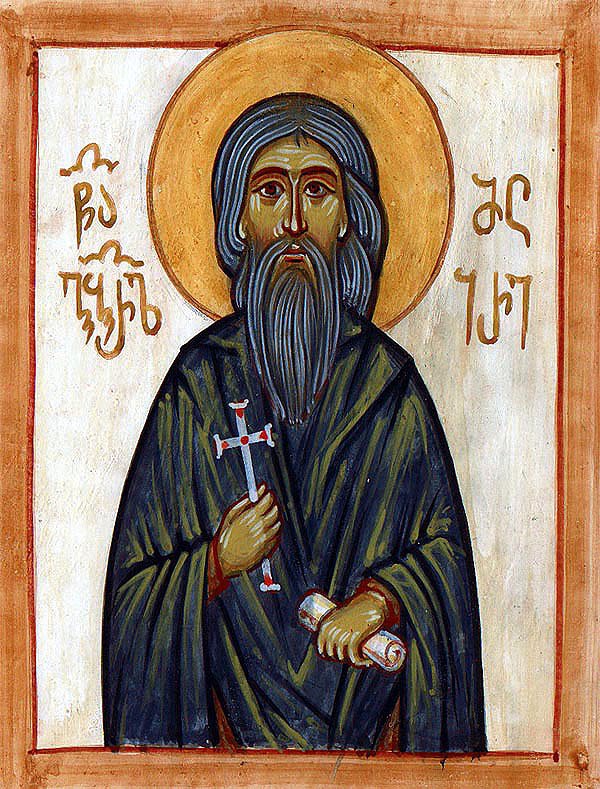
Hieromartyr Gabriel the Lesser
Saint Gabriel the Lesser was a major figure in the eighteenth-century Georgian Church. Few details of his life are known, but it is evident that the education he received was quite good for the period. Striving toward the monastic life but still living in the world, Gabriel tried in every way to close himself off from the vanity of the world.
Saint Gabriel the Lesser was a major figure in the eighteenth-century Georgian Church. Few details of his life are known, but it is evident that the education he received was quite good for the period. Striving toward the monastic life but still living in the world, Gabriel tried in every way to close himself off from the vanity of the world. He kept a small sewing shop in Tbilisi and distributed most of his profits to the poor.
One day Saint Gabriel abandoned his business and set off for the Davit-Gareji Wilderness, where he was tonsured a monk.
Saint Gabriel occupied much of his time with writing, and his works left a significant mark on the spiritual literature of Georgia. He compiled several collections of patristic writings, and he also wrote original works of a theological nature. His original writings include An Explanation of the Hierarchical Liturgy , which describes in detail the meaning of every part of the service, Spiritual Stories of the Pious, The Life and Labors of Venerable Schemamonk Onisphore, A Short Story of Porphyry , and writings on the Nomocanon of the Sixth Ecumenical Council.
Among the brothers at his monastery, Saint Gabriel was distinguished by a remarkable capacity for love and a fervent desire to help others: he helped all, cared for all, and encouraged all. During the Great Fast in 1802, a certain archdeacon came from Tbilisi to Davit-Gareji Monastery, desiring to draw closer to the ascetic way of life. After some time, however, he became anxious to see his family and decided to return home. Saint Gabriel accompanied him on his way, but the two men were suddenly assailed by Dagestanis, and the holy father was killed. The brothers carried his relics back to the monastery and buried them there with great honor.
Troparion - Tone 4
By sharing in the ways of the Apostles, / you became a successor to their throne. / Through the practice of virtue, you found the way to divine contemplation, O inspired one of God; / by teaching the word of truth without error, you defended the Faith, / even to the shedding of your blood. / Hieromartyr Gabriel, entreat Christ God to save our souls.
Scripture Readings
View scripture readings for this date on OCA.org.
View readings on OCA.orgLiturgical data sourced from OCA.org and orthocal.info