Fasting Rules

Meat not allowed Meat Abstain
Fish not allowed Fish Abstain
Dairy not allowed Dairy Abstain
Oil not allowed Oil Abstain
Wine not allowed Wine Abstain

Saints & Commemorations

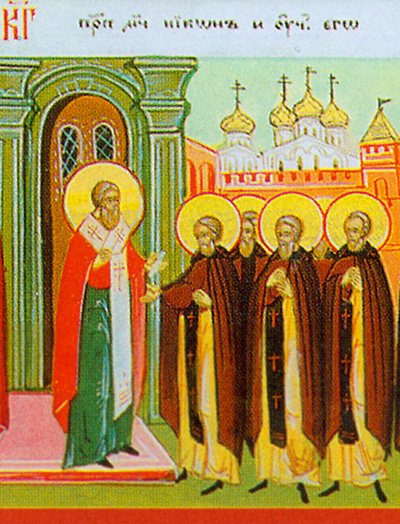
Martyr Nikon and 199 disciples with him in Sicily

Martyr Nikon and 199 disciples with him in Sicily

He was born in Neapolis (Naples) to a pagan father and a Christian mother, and became an officer in the Roman army. Though he was not baptised, his mother had secretly instructed him in the Christian faith. Once, in a battle, his company was completely surrounded by the enemy, and Nikon recalled his mother’s counseling that, whenever he was in trouble, he should make the sign of the Cross and call upon Christ. T He was born in Neapolis (Naples) to a pagan father and a Christian mother, and became an officer in the Roman army. Though he was not baptised, his mother had secretly instructed him in the Christian faith. Once, in a battle, his company was completely surrounded by the enemy, and Nikon recalled his mother’s counseling that, whenever he was in trouble, he should make the sign of the Cross and call upon Christ. This he did, and was immediately filled with strength and resolution, so that the enemy’s army was routed. Nikon went home, openly crying out ‘Great is the God of the Christians!’ to the great joy of his mother. He traveled secretly to Cyzicus in Asia, where the bishop Theodosius baptised him. He then entered a monastery to spend his days in prayer and study. But some years later Theodosius, who was near death, had a vision in which he was told to consecrate Nikon as his successor. He summoned Nikon from the monastery and, to the monk’s amazement, immediately ordained him a deacon, then a priest, then a bishop. Later, bishop Nikon returned to Italy to preach the Gospel of Christ. In Naples, he found his mother still alive, and remained with her until her death. He then set out with nine disciples, former fellow-soldiers, to proclaim the Faith. Through the Saint’s grace-filled preaching and example, many more disciples were soon added to this number. At that time a great persecution of Christians was underway, and Quintinianus, ruler of that region, seized Nikon and his companions and handed them over to the torturers. One hundred ninety of Nikon’s companions perished under torture. Nikon himself was beaten, flayed, and even thrown from a high cliff, but was miraculously preserved. Finally he was slain by the sword and his body thrown in a field to be eaten by the beasts. A shepherd boy, possessed by a spirit of madness, found the body, fell on it, and was instantly healed. He told his story to some Christians, who found the body and gave it honorable burial. Saint Nikon contested during the reign of the Emperor Decius.

Troparion - Tone 4

By your ascetic way of life / you conquered the crafty one, Holy Father Nikon. / By virtue of your holy life you became a rule and model to your disciples, / and with them you struggled for the Faith in the West. / You have all attained glory in heaven.

Kontakion - Tone 8

Of like discipline with the Ascetics, and rivaling the holy Athletes in zeal, / you were offered to the Lord through martyrdom, steadfast and righteous Martyrs. / As your sure guide you had the glorious Nikon; / fighting together with him you sang: Alleluia.
Venerable Nikon, Abbot of the Kiev Far Caves

Venerable Nikon, Abbot of the Kiev Far Caves

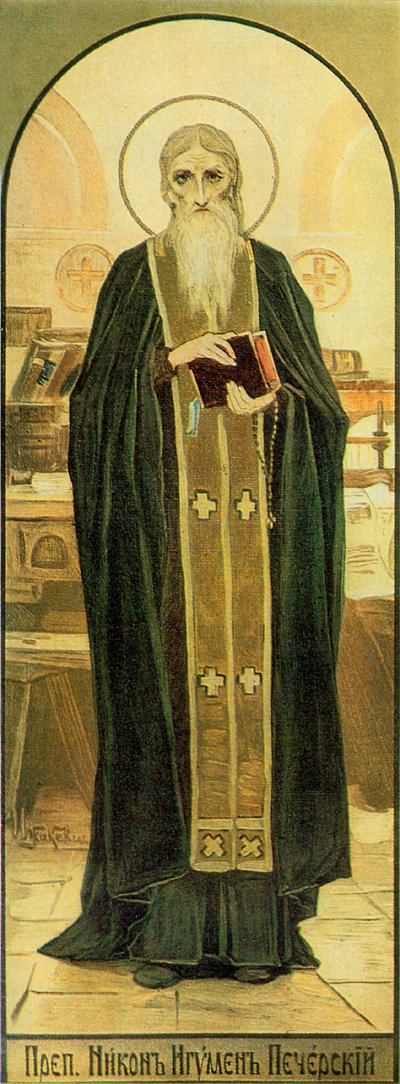
Saint Nikon of the Kiev Caves was the first disciple and fellow-ascetic of Saint Anthony (July 10), the founder of the Kiev Caves monastery, to which he came as a priest. At the monastery he tonsured all the new monks, and among their number was Saint Theodosius of the Caves (May 3 and August 14). For tonsuring the favorites of the Great Prince Izyaslav, Saints Barlaam (November 19) and Ephraim (January 28 ), Saint Nikon brought the wrath of the prince down upon himself, but he refused to force the new monks to leave the monastery. Saint Nikon of the Kiev Caves was the first disciple and fellow-ascetic of Saint Anthony (July 10), the founder of the Kiev Caves monastery, to which he came as a priest. At the monastery he tonsured all the new monks, and among their number was Saint Theodosius of the Caves (May 3 and August 14). For tonsuring the favorites of the Great Prince Izyaslav, Saints Barlaam (November 19) and Ephraim (January 28 ), Saint Nikon brought the wrath of the prince down upon himself, but he refused to force the new monks to leave the monastery. The princess calmed Izyaslav, and he left Saint Nikon in peace. When the number of brethren in the monastery had increased, Saint Nikon desired to go into seclusion and live as a hesychast. He went to the Tmutarakan peninsula (on the eastern banks of the Kerchensk straits) and settled in an unpopulated spot. When news of his holy life and spiritual gifts spread throughout the region, many gathered about him, wishing to follow his example. Thus a monastery and a church were founded in the name of the Most Holy Theotokos. When he returned to the Kiev Caves monastery, Saint Nikon was obedient to Saint Theodosius as his spiritual Father. According to Saint Nestor the Chronicler (October 27), when Saint Theodosius had to go somewhere, he entrusted all the brethren to the care of Saint Nikon. Sometimes he asked Saint Nikon to offer instruction to the brethren in place of himself. Often, when Saint Nikon was binding books, Saint Theodosius sat near him and spun the thread for the binding. When Prince Svyatoslav drove out his brother Izyaslav from Kiev, Saint Nikon returned to the monastery he founded. He returned under the igumen Stephen. When Saint Stephen (April 27) left the Kiev Caves monastery, Saint Nikon was chosen as igumen of the monastery. He toiled much to adorn his monastery with spiritual books and icons. He died at a great old age (+ 1088) and was buried in the Near Caves of Saint Anthony.

Troparion - Tone 8

By a flood of tears you made the desert fertile, / and your longing for God brought forth fruits in abundance. / By the radiance of miracles you illumined the whole universe! / O our holy father Nikon, pray to Christ our God to save our souls!
Martyr Philetus the Senator, his wife and sons, and those with them in Illyria

Martyr Philetus the Senator, his wife and sons, and those with them in Illyria

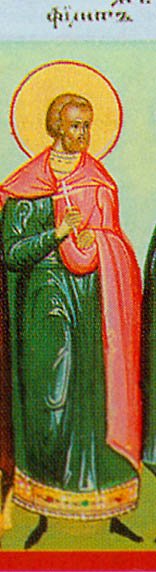
Saint Philetus was a dignitary at the court of the emperor Hadrian (117-138), a persecutor of Christians. For openly confessing his faith in Christ the Savior, Saint Philetus was brought to trial with his wife Saint Lydia and their sons Macedonius and Theoprepius. By Hadrian’s order, Saint Philetus was sent with his family to Illyria to the military governor Amphilochius to be tortured. Saint Philetus was a dignitary at the court of the emperor Hadrian (117-138), a persecutor of Christians. For openly confessing his faith in Christ the Savior, Saint Philetus was brought to trial with his wife Saint Lydia and their sons Macedonius and Theoprepius. By Hadrian’s order, Saint Philetus was sent with his family to Illyria to the military governor Amphilochius to be tortured. Amphilochius gave orders to suspend them from a tree and to torture them with knives. After this, they were locked up in prison with the jailer Cronides, who believed in Christ and was also thrown in jail. An angel came to them by night and eased their sufferings. On the following day the martyrs were plunged into a cauldron of boiling oil, but the oil cooled instantly, and the saints remained unharmed. The military governor Amphilochius was so astonished at this miracle that he himself believed in Christ and went into the boiling oil saying, “Lord, Jesus Christ, help me!” and he remained unharmed. The tortures were repeated when the emperor Hadrian came to Illyria. They threw the holy martyrs into the boiling oil again and again, but by the power of God they remained alive. The humiliated emperor returned to Rome, and the holy martyrs gave thanks to God, then they surrendered their holy souls to Him.

Troparion - Tone 4

Your holy martyrs, O Lord, / through their sufferings have received an incorruptible crown from You, our God. / For having Your strength, they laid low their adversaries, / and shattered the powerless boldness of demons. / Through their intercessions, save our souls!

Righteous Basil of Mangazea in Siberia

Righteous Basil of Mangazea: Saint Basil was born in the town of Yaroslavl around 1587. His father was a merchant, but the family was very poor. As a child, Basil spent much of his time in church, praying fervently and participating in the divine services. When he was twelve, the boy set out to earn his living. Righteous Basil of Mangazea: Saint Basil was born in the town of Yaroslavl around 1587. His father was a merchant, but the family was very poor. As a child, Basil spent much of his time in church, praying fervently and participating in the divine services. When he was twelve, the boy set out to earn his living. After a difficult journey through wild forests, he came to the Russian village of Mangazea in Siberia on the River Taz. This was an area inhabited by Mongols and indigenous peoples of Siberia. After stopping to pray in the village church, Saint Basil found a job with a local merchant. The merchant was a person of low moral character and did not believe in God, so while he appreciated Basil’s work, he did not care for the boy’s religious inclinations. Soon the cruel merchant came to hate his clerk and began to mistreat him. During the Matins of Pascha, thieves robbed the merchant’s shop. The merchant discovered the theft and went to the governor, accusing Basil of being one of the thieves. So great was the merchant’s hatred of Basil that he falsely accused the young man. The governor did not even bother to investigate the charges, but had Basil arrested and tortured to make him admit his guilt. In spite of unbearable tortures, the saint kept saying, “I am innocent.” Enraged by Basil’s endurance and meekness, the merchant struck him in the head with a ring of keys. Saint Basil fell to the floor and surrendered his soul to God. The governor ordered that the saint’s body be placed in a coffin and buried in a swamp. After several years, the servants who disposed of the body began to speak about the child’s murder. Soon all the residents of Mangazea knew that the saint’s relics were in the swamp. Because of many signs that took place, people began to address prayers to Saint Basil. Forty-two years after the unjust murder of the saint, his coffin was removed from the swamp and his holy relics were found to be incorrupt. A chapel was built over his grave, and in 1670 the relics were placed in the church of Holy Trinity Monastery near Turakhanov. In 1719 the holy Metropolitan Philotheus of Siberia (May 31) sent a carved reliquary to the monastery. Many miracles took place there, and Saint Basil helped Metropolitan Philotheus on many occasions A new stone church was built at Holy Trinity Monastery in 1787, and the relics were transferred there. In iconography, Saint Basil is portrayed as a young man with light brown hair, bare-footed and wearing only a shirt. He is also depicted on the Abaletsk Icon “Of the Sign” (July 20, November 27).

Troparion - Tone 8

By God's providence you came from the city of Yaroslavl to the Siberian region, / and we honor your suffering for chastity at the hands of your master in Mangazeya, O blessed Basil, / for Christ God has crowned you with a martyr's crown in Heaven, / and He has glorified you on earth with incorruption and miracles. / O revered Martyr, preserve our land in peace, and pray for the salvation of our souls.

Kontakion - Tone 4

Enlightened by divine grace, O God-lover, / you completed the course of your life in chastity, patience, and martyrdom; / therefore, even after death the radiance of your life has been revealed, / for you pour forth miracles to those who come with faith to venerate your tomb, crying out: / “Rejoice, Saint Basil, wonderworker of Mangazeya and of all Siberia.”

Monastic Martyr Luke of Saint Anne’s Skete on Mount Athos and Odrin

No information available at this time.

Troparion - Tone 1

The image of God was truly preserved in you, O Father, / for you took up the Cross and followed Christ. / By so doing you taught us to disregard the flesh for it passes away / but to care instead for the soul, since it is immortal. / Therefore your spirit, venerable Luke, rejoices with the angels.

Kontakion - Tone 2

As a venerable and proven ascetic, as an honorable and renowned martyr, / and as a model of the desert life, O most exalted Luke, / we sing hymns of praise to you, / for you have trampled upon serpents.
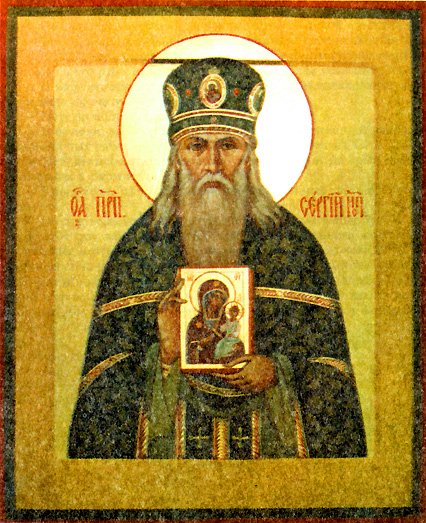
Venerable Sergius (Srebryansky), the New Confessor of Tver

Venerable Sergius (Srebryansky), the New Confessor of Tver

No information available at this time.

Troparion - Tone 8

Champion of Orthodoxy, teacher of purity and of true worship, / the enlightener of the universe and the adornment of hierarchs: / all-wise father Sergius, your teachings have gleamed with light upon all things. / Intercede before Christ God to save our souls.

Scripture Readings

View scripture readings for this date on OCA.org.

View readings on OCA.org

Liturgical data sourced from OCA.org and orthocal.info