Fasting Rules
 Meat
Abstain
Meat
Abstain
 Fish
Abstain
Fish
Abstain
 Dairy
Abstain
Dairy
Abstain
 Oil
Allowed
Oil
Allowed
 Wine
Allowed
Wine
Allowed
Saints & Commemorations
5th Saturday of Great Lent: of the Akathist to the Theotokos
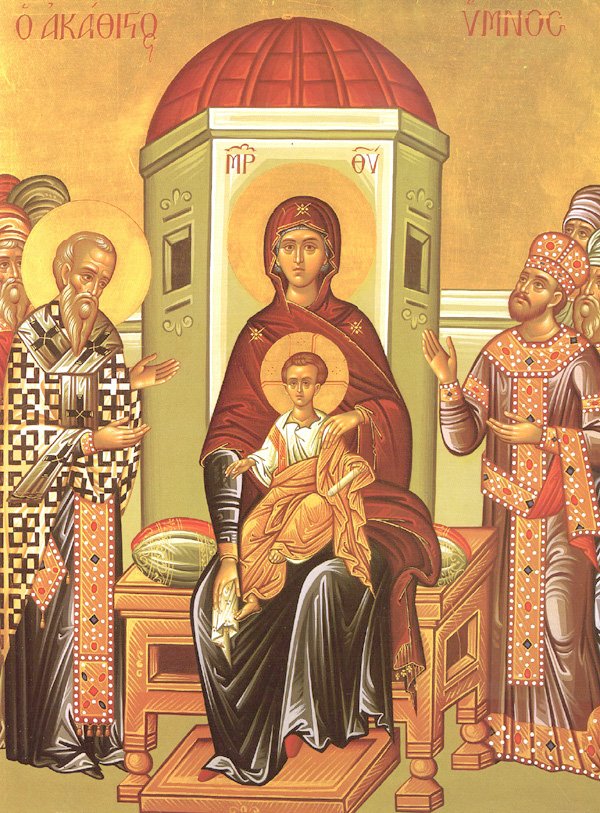
On the Fifth Saturday of Great Lent, the Saturday of the Akathist, we commemorate the “Laudation of the Virgin” Icon of the Most Holy Theotokos.
In 625, when the emperor Heraclius was fighting the Persians, the Khan sent forces to attack Constantinople by land and by sea. Patriarch Sergius urged the people not to lose heart, but to trust in God.
A
On the Fifth Saturday of Great Lent, the Saturday of the Akathist, we commemorate the “Laudation of the Virgin” Icon of the Most Holy Theotokos.
In 625, when the emperor Heraclius was fighting the Persians, the Khan sent forces to attack Constantinople by land and by sea. Patriarch Sergius urged the people not to lose heart, but to trust in God.
A procession was made around the city with the Cross of the Lord, the robe of the Virgin, the Icon of the Savior not made by hands, and the Hodēgḗtria Icon of the Mother of God. The Patriarch dipped the Virgin’s robe in the sea, and the city’s defenders beat back the Khan’s sea forces. The sea became very rough, and many boats sank. The invaders retreated, and the people of Constantinople gave thanks to God and to His Most Pure Mother.
On two other occasions, in 655 and 705, the Theotokos protected the city from Saracen invaders. A feastday dedicated to the Laudation of the Virgin was established to commemorate these victories. The Akathist to the Mother of God is believed to originate from this period, and its use has spread from Constantinople to other Orthodox lands.
The icon before which the Akathist was sung was given to the Dionysiou Monastery on Mt. Athos by Emperor Alexius Comnenos. There, it began to flow with myrrh. There were at least three wonderworking copies of this icon in Russia before the Revolution.
This icon shows the Mother of God seated on a throne, and surrounded by Prophets with scrolls.
Troparion - Tone 8
When the archangel understood the mysterious command, / he came to the house of Joseph with haste and proclaimed to the unwedded Lady: / The One Who bowed the heavens by His condescension / is contained wholly and without change in you! / As I behold Him in your womb, taking the form of a servant, I am frightened, but cry: / Rejoice, unwedded Bride!
Kontakion - Tone 8
Victorious leader of triumphant hosts, / we your servants, delivered from evil, sing our grateful thanks to you, Theotokos! / As you possess invincible might set us free from every calamity, / so that we may sing: Rejoice, unwedded Bride!
Ven. Hilarion the New
He took up the monastic life when very young, and lived as a recluse for many years, and gained the grace to heal sicknesses and drive out demons by his prayers. Later he became abbot of the Monastery of Pelekete in Bithynia. During the reign of the Emperor Leo the Isaurian, he and his monastery steadfastly upheld the holy icons, and were fiercely persecuted.
He took up the monastic life when very young, and lived as a recluse for many years, and gained the grace to heal sicknesses and drive out demons by his prayers. Later he became abbot of the Monastery of Pelekete in Bithynia. During the reign of the Emperor Leo the Isaurian, he and his monastery steadfastly upheld the holy icons, and were fiercely persecuted. Hilarion and his forty monks were exiled to a prison near Ephesus, where the Saint reposed.
Venerable Hilarion the New, Abbot of Pelekete
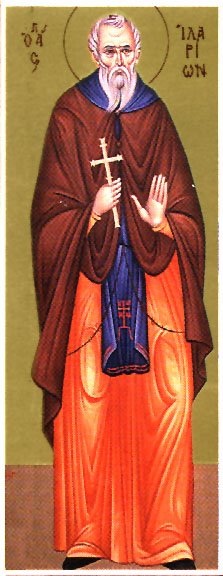
Saint Hilarion the New, Igumen of Pelekete Monastery, from his youth devoted himself to the service of God and spent many years as a hermit. Because of his holy and blameless life he was ordained to the holy priesthood, and later he was made igumen of the Pelekete monastery (near the Dardanelles). Saint Hilarion was granted gifts of clairvoyance and wonderworking by the Lord.
Saint Hilarion the New, Igumen of Pelekete Monastery, from his youth devoted himself to the service of God and spent many years as a hermit. Because of his holy and blameless life he was ordained to the holy priesthood, and later he was made igumen of the Pelekete monastery (near the Dardanelles). Saint Hilarion was granted gifts of clairvoyance and wonderworking by the Lord.
Through prayer he brought down rain during a drought, and like the Prophet Elisha he separated the waters of a river, he drove harmful beasts from the fields, he filled the nets of fishermen when they had no success in fishing, and he did many other miracles. In addition to these things, he was able to heal the sick and cast out demons.
Saint Hilarion suffered on Great and Holy Thursday in the year 754, when the military commander Lakhanodrakon suddenly descended upon the Pelekete monastery in pursuit of icon-venerators, boldly forcing his way into the church, disrupting the service and throwing the Holy Gifts upon the ground. Forty-two monks were arrested, slapped into chains, sent to the Edessa district and murdered. The remaining monks were horribly mutilated: they beat them, they burned their beards with fire, they smeared their faces with tar and cut off the noses of some of the confessors. Saint Hilarion died for the veneration of icons during this persecution.
Saint Hilarion left behind spiritual works containing moral directives for spiritual effort. Saint Joseph of Volokolamsk (September 9 and October 18) was well acquainted with the work of Saint Hilarion, and he also wrote about the significance of monastic struggles in his own theological works.
Troparion - Tone 5
Adorned with gladness of soul / as a pure vessel of the wisdom of Christ, / you were a reflection of the life in God. / Therefore you are resplendent with the light of virtues, / O Father Hilarion, / and you guide us unerringly to the salvation of our souls!
Kontakion - Tone 4
Righteous Hilarion, like a fruitful olive tree that has blossomed, / with your oil you mystically make radiant those who sing to you: / “Rejoice, unwavering rule of the righteous!”
Stephen the Wonderworker
Venerable Stephen, Wonderworker, Abbot of Triglia
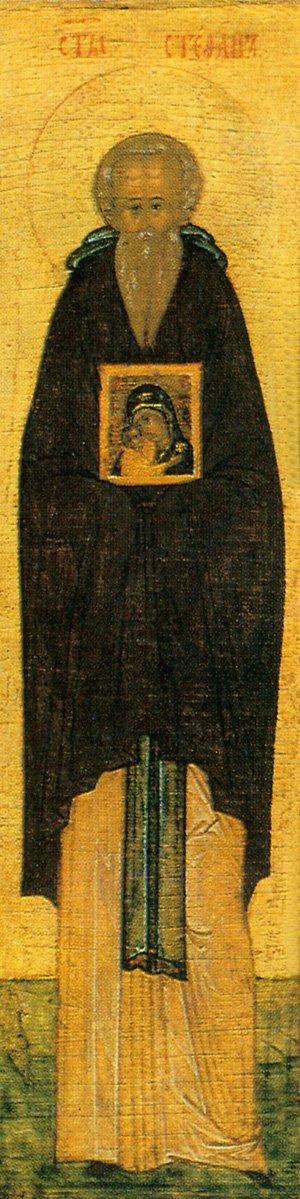
Saint Stephen the Confessor, Igumen of Triglia Monastery, suffered under the iconoclast emperor Leo the Armenian (813-820). From a young age, the holy ascetic dedicated his life to God and received monastic tonsure. He later became head of the Triglia monastery near Constantinople.
When persecution again began against holy icons, the saintly igumen was summoned for questioning, and they tried to force him to sign a document rejecting the veneration of icons.
Saint Stephen the Confessor, Igumen of Triglia Monastery, suffered under the iconoclast emperor Leo the Armenian (813-820). From a young age, the holy ascetic dedicated his life to God and received monastic tonsure. He later became head of the Triglia monastery near Constantinople.
When persecution again began against holy icons, the saintly igumen was summoned for questioning, and they tried to force him to sign a document rejecting the veneration of icons. Saint Stephen steadfastly refused to betray Orthodoxy and he boldly denounced the emperor for his impiety. They subjected the saint to cruel torments, after which they sent him to prison in the year 815. Weakened and sick, the holy Confessor Stephen soon died in prison from his sufferings.
Troparion - Tone 8
Champion of Orthodoxy, teacher of purity and of true worship, / the enlightener of the universe and the adornment of hierarchs: / all-wise father Stephen, your teachings have gleamed with light upon all things. / Intercede before Christ God to save our souls.
Repose of Gerontissa Gavrilia (1992) (March 15 OC)
Mother Gavrilia, who was known to many who are still alive, has not been officially glorified by the Church, but is considered by many to be a Saint of our time. Her fine biography, Ascetic of Love, has been translated into English and several other languages. The account below is excerpted from that on the web site of St Gregory Palamas Monastery.
Mother Gavrilia, who was known to many who are still alive, has not been officially glorified by the Church, but is considered by many to be a Saint of our time. Her fine biography, Ascetic of Love, has been translated into English and several other languages. The account below is excerpted from that on the web site of St Gregory Palamas Monastery.
“The Gerontissa Gabrielia was born in Constantinople a hundred years ago on October 2/15, 1897. She grew up in the City until her family moved to Thessalonika in 1923. She went to England in 1938 and stayed there throughout the Second World War. She trained as a chiropodist and physiotherapist. In 1945 she returned to Greece where she worked with the Friends Refugee Mission and the American Farm School in Thessalonika in early post-war years. Later she opened her own therapy office in Athens until 1954. In March of that year her mother died and the office was closed. Sister Lila left Greece and traveled overland to India where she worked with the poorest of the poor, even the lepers, for five years.
“It was not until 1959 that she went to the Monastery of Mary and Martha in Bethany, Palestine, to become a nun. When she arrived she asked Fr. Theodosius the chaplain for a rule of prayer. Fr. Theodosius was somewhat surprised to find that she could read even ancient Byzantine Greek. Fr. Theodosius said, “The great elders that we hear about no longer exist. I certainly am not one. You came here to save your soul. If I start giving you rules, you will lose you soul and I will as well. But here is Fr. John. He will be your elder.” So for her first year in the monastery he set her to reading only the Gospels and St. John Climacus. (It should be noted that at that time the Ladder had not been published in modern Greek.)
“She was three years in Bethany. In April, 1962, word came that Patriarch Athenagoras of Constantinople sought to send an Orthodox monastic to Taize in France. Sister Gabrielia went by way of Taize (she spoke fluent French from childhood) to America.
“In 1963 she was back in Greece. The Gerontissa was tonsured to the Small Schema by Abbot Amphilochios (Makris) on Patmos in the Cave of St. Anthony under the Monastery of Evangelismos just before she and the nun Tomasina left again for India. Elder Amphilochios was enthusiastic at the idea a nun who would be open to the an active outreach in the world. In India she was for three year in Nani Tal in Uttar Pradesh where Fr. Lazarus Moore was the priest and where he consulted the Gerontissa in his translations of the Psalter and the Fathers. Between 1967 and 1977 the Gerontissa traveled in the Mission field of East Africa, in Europe including visiting old friends and spiritual fathers Lev Gillet and Sophrony of Essex, again to America, and briefly in Sinai where Archbishop Damianos was attempting to reintroduce women’s monasticism. She traveled extensively, with much concern and broad love for the people of God. Some of her spiritual children found her in Jerusalem beside the Tomb of Christ; others found her on the mission field of East Africa. For years beginning in about 1977, she lived hidden in a little apartment, the “House of the Angels” in Patissia in the midst of the noise and smog and confusion of central Athens. A little place, a hidden place, a precious place to those who knew her there.
“In 1989 she moved to Holy Protection hermitage on the island of Aegina, close by the shrine of St. Nectarios. There she called the last two of her spiritual children to become monastics near her, and there she continued to receive many visitors. At the start of Great Lent in 1990 she was hospitalized for lymphatic cancer. She was forty days in the hospital, leaving during Holy Week and receiving communion of Pascha. And to the puzzlement of the doctors, the cancer disappeared. It was not yet her time.
“The Gerontissa finally withdrew to quiet. With only one last nun she moved for the last time in this life, to the island of Leros. There they established the hesychastirion of the Holy Archangels. Only in this last year of her life did she accept the Great Schema at the hands of Fr. Dionysious from Little St. Anne’s Skete on Athos. He came to give her the Schema in the Chapel of the Panaghia in the Kastro on the top of Leros.
“Gerontissa Gabrielia passed from this world on March 28, 1992, having never built a monastery. Over the years, six of her spiritual children did become monastics, but never more that one or two were with her at a time. Only the angels could count the number of lives that God touched and changed through her. Her biography and collected writings were published in Greek in 1996, through the work of her last monastic daughter and the contribution of many, many others who held the Gerontissa dear. An English translation is in process [Note: it has now been published].
“Anyone who knew the Gerontissa realized that God has not left us without His saints, even down to the present day. The few words recorded here scarcely suggest the clarity and love of her soul. Words are only the tools of this world; the wonder of the Gerontissa was wrapped in the mystery of the silence of the world to come.
“She never sought a reputation. She never allowed anything about her to be published during her long life and only allowed her children to take photographs in her very last years. Those whom God touched through her called her Gerontissa; she never made herself anything but the nun Gabrielia.
“She was humility and love incarnate.”
The Gerontissa embodied an ‘ecumenism’ that might serve as a model for many in our time: she was completely loving and open to all people of all faiths, yet while working freely with protestants and Hindus in service to man, she never compromised any aspect of her Orthodox faith. Once, some protestant fellow-workers suggested that they pray together; Mother Gavrilia thanked them lovingly, but said ‘I only pray in church or alone.’
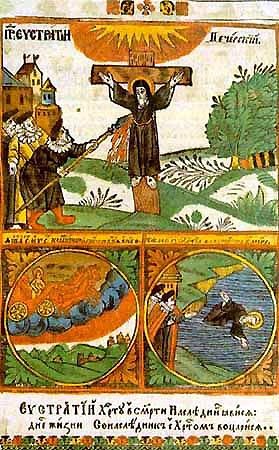
Monastic Martyr Eustratius of the Kiev Near Caves
Martyr Eustratius of the Caves was born in the eleventh century at Kiev into a wealthy family. As an adult, he received monastic tonsure at the Kiev Caves monastery, after giving away all his possesions to the poor. Saint Eustratius humbly underwent obediences at the monastery, strictly fulfilling the rule of prayer and passing his days in fasting and vigilance.
Martyr Eustratius of the Caves was born in the eleventh century at Kiev into a wealthy family. As an adult, he received monastic tonsure at the Kiev Caves monastery, after giving away all his possesions to the poor. Saint Eustratius humbly underwent obediences at the monastery, strictly fulfilling the rule of prayer and passing his days in fasting and vigilance.
In 1096 the Polovetsians captured Kiev and ravaged the monastery of the Caves, doing away with many of the monks. Saint Eustratius was taken into captivity, and was sold into slavery with thirty monastic laborers and twenty inhabitants of Kiev to a certain Jew living in Korsun.
The impious Jew tried to make the captives deny Christ, threatening to kill those who refused by starving them. Saint Eustratius encouraged and exhorted his brother Christians, “Brothers! Let none of us who are baptized and believe in Christ betray the vows made at Baptism. Christ has regenerated us through water and the Spirit. He has freed us from the curse of the Law by His Blood, and He has made us heirs of His Kingdom. If we live, we shall live for the Lord. If we die, we shall die in the Lord and inherit eternal life.”
Inspired by the saint’s words, the captives resolved to die of starvation, rather than renounce Christ, Who is the food and drink of Eternal Life. Exhausted by hunger and thirst, some captives perished after three days, some after four days, and some after seven days. Saint Eustratius remained alive for fourteen days, since he was accustomed to fasting from his youth. Suffering from hunger, he still did not touch food nor water. The impious Jew, seeing that he had lost the money he had paid for the captives, decided to take revenge on the holy monk.
The radiant Feast of the Resurrection of Christ drew near, and the Jewish slave owner was celebrating the Jewish Passover with his companions. He decided to crucify Saint Eustratius. The cruel tormentors mocked the saint, offering to let him share their Passover meal. The Martyr replied, “The Lord has now bestown a great grace upon me. He has permitted me to suffer on a cross for His Name just as He suffered.” The saint also predicted a horrible death for the Jew.
Hearing this, the enraged Jew grabbed a spear and stabbed Saint Eustratius on the cross. The martyr’s body was taken down from the cross and thrown into the sea. Christian believers long searched for the holy relics of the martyr, but were not able to find them. But through the Providence of God the incorrupt relics were found in a cave and worked many miracles. Later, they were transferred to the Near Caves of the Kiev Caves monastery.
The prediction of the holy Martyr Eustratius that his blood would be avenged was fulfilled soon after his death. The Byzantine Emperor issued a decree expelling all Jews from Korsun, depriving them of their property, and putting their elders to death for torturing Christians. The Jew who crucified Saint Eustratius was hanged on a tree, receiving just punishment for his wickedness.
Troparion - Tone 1
The image of God was truly preserved in you, O Father, / for you took up the Cross and followed Christ. / By so doing you taught us to disregard the flesh for it passes away / but to care instead for the soul, since it is immortal. / Therefore your spirit, venerable Eustratius, rejoices with the angels.
Kontakion - Tone 2
As a venerable and proven ascetic, as an honorable and renowned martyr, / and as a model of the desert life, O most exalted Eustratius, / we sing hymns of praise to you, / for you have trampled upon serpents.
Venerable Hilarion of Pskov, Lake Gdov
Saint Hilarion of Gdov and Pskov Lake, was a disciple of Saint Euphrosynus of Pskov (May 15). In 1460 on the banks of the River Zhelcha, not far from Gdov, he founded the Ozersk [Lake] Monastery of the Protection of the Mother of God. The monastery bordered the territory of the Livonian Knights, and the monks constantly suffered the incursions of that military order.
Saint Hilarion of Gdov and Pskov Lake, was a disciple of Saint Euphrosynus of Pskov (May 15). In 1460 on the banks of the River Zhelcha, not far from Gdov, he founded the Ozersk [Lake] Monastery of the Protection of the Mother of God. The monastery bordered the territory of the Livonian Knights, and the monks constantly suffered the incursions of that military order. Despite harsh conditions and insufficient means, Saint Hilarion maintained a high level of pious and ascetic life at the monastery, and made great efforts to adorn and build up the monastery.
Saint Hilarion reposed on March 28, 1476 and was buried in the church of the Protection of the Most Holy Theotokos in the monastery he founded. Afterwards, a church was built at the monastery in honor of the Nativity of Christ. The left chapel was dedicated to the founder of the Gdov monastery. Saint Hilarion of Gdov is also commemorated on October 21, on the Feast of his heavenly patron and namesake.
Troparion - Tone 8
By a flood of tears you made the desert fertile, / and your longing for God brought forth fruits in abundance. / By the radiance of miracles you illumined the whole universe! / O our holy father Hilarion, pray to Christ our God to save our souls!
Martyred brothers Barachisius and Jonah, and those with them, in Persia
Saint Barachisius was the brother of Saint Jonah. They were Christians who lived in the village of Yasa in Persia during the time of the emperor Sapor (310-331), a fierce persecutor of Christians.
Learning that Christians were being tortured in the city of Baravokh, they went there to the prison where Saints Zanithas, Lazarus, Maruthas, Narses, Elias, Marinus, Habib, Sembeeth (Sivsithina), and Savva were being held.
Saint Barachisius was the brother of Saint Jonah. They were Christians who lived in the village of Yasa in Persia during the time of the emperor Sapor (310-331), a fierce persecutor of Christians.
Learning that Christians were being tortured in the city of Baravokh, they went there to the prison where Saints Zanithas, Lazarus, Maruthas, Narses, Elias, Marinus, Habib, Sembeeth (Sivsithina), and Savva were being held.
They encouraged them to adhere to the Christian Faith until the very end. The holy brothers were arrested and brought to trial before the Persian princes Masdrath, Siroth and Marmis, who urged them to worship the sun, fire, and water. The holy martyrs firmly confessed their faith in Christ and would not agree to the demands of the pagans. Therefore, they were subjected to fierce torments and death.
Saint Jonah suffered first. They tied the holy martyr to a tree and beat him for a long time, then they dragged him across the ice of a frozen lake. They also cut off his fingers and toes, and cut out his tongue. Then they peeled the skin from his head, and finally sawed his body in half and threw it in a ditch.
They placed red-hot shackles on the wrists of Saint Barachisius, poured molten tin in his nose, ears and mouth, and they raked him with sharp instruments, after they tied him to a turning wheel. The holy martyr surrendered his soul to God after they poured boiling tar in his mouth.
The bodies of the holy martyrs Jonah, Barachisius and the other martyrs were buried by a pious Christian named Habdisotes.
Troparion - Tone 4
Your holy martyrs, O Lord, / through their sufferings have received an incorruptible crown from You, our God. / For having Your strength, they laid low their adversaries, / and shattered the powerless boldness of demons. / Through their intercessions, save our souls!
Martyr Boyan, Prince of Bulgaria
The Holy Martyr Boyan, Prince of Bulgaria, suffered for Christ around the year 830. When his pagan brother Malomir [Vladimir] ascended the Bulgarian throne, Prince Boyan asked him to free the learned Christian Kinamon, who had been in prison for a long time for refusing to participate in pagan sacrifices under Prince Obrit (Krutogon), Prince Malomir’s predecessor.
The Holy Martyr Boyan, Prince of Bulgaria, suffered for Christ around the year 830. When his pagan brother Malomir [Vladimir] ascended the Bulgarian throne, Prince Boyan asked him to free the learned Christian Kinamon, who had been in prison for a long time for refusing to participate in pagan sacrifices under Prince Obrit (Krutogon), Prince Malomir’s predecessor.
Malomir consented and gave Kinamon to Prince Boyan as a slave. Kinamon spoke to Boyan about Christianity, telling him of the errors of paganism and that belief in Christ is necessary for salvation. At the end of their conversation he told the prince, “Without Jesus Christ there is no light for the mind, no life for the soul. He alone is the Teacher of mankind and our Savior. By His death, He has reconciled fallen mankind with God. If you do not wish to perish, believe in the Lord Jesus.” Prince Boyan recognized the truth of his words, and was inspired to ask for Baptism.
The newly-converted prince was filled with a love of prayer, fasting and contemplation of God. Malomir, learning about the conversion of his brother to Christianity, demanded that he renounce the Christian Faith and return to paganism. Instead, the holy Prince Boyan answered, “I despise the pagan idols and I revere Christ, the true God. No one shall separate me from the love of Christ.” Malomir, hearing his brother’s reply, sentenced him to death.
Before his martyric death, the holy martyr-prince declared: “The faith for which I now die will spread throughout the Bulgarian land. You vainly imagine that you will stop it by killing me. Temples to the true God will be built, and priests will offer Him true worship. The idols and their foul sacrifices, however, will vanish.” Then he said to his brother Malomir, “You will gain nothing from your cruelty, and death will soon overtake you.”
The holy martyr was killed by the sword, and his predictions to his brother were the first to be fulfilled. Malomir soon died, and since he had no heir, his elder brother Presian (836-852) succeeded to the throne. Prince Presian’s son, the holy Prince Boris, in holy Baptism Michael (May 2) later Christianized the Bulgarian nation. Thus the prophecy of the holy Martyr Prince Boyan was fulfilled.
Troparion - Tone 3
Your holy martyr Boyan, O Lord, / through his suffering has received an incorruptible crown from You, our God. / For having Your strength, he laid low his adversaries, / and shattered the powerless boldness of demons. / Through his intercessions, save our souls!
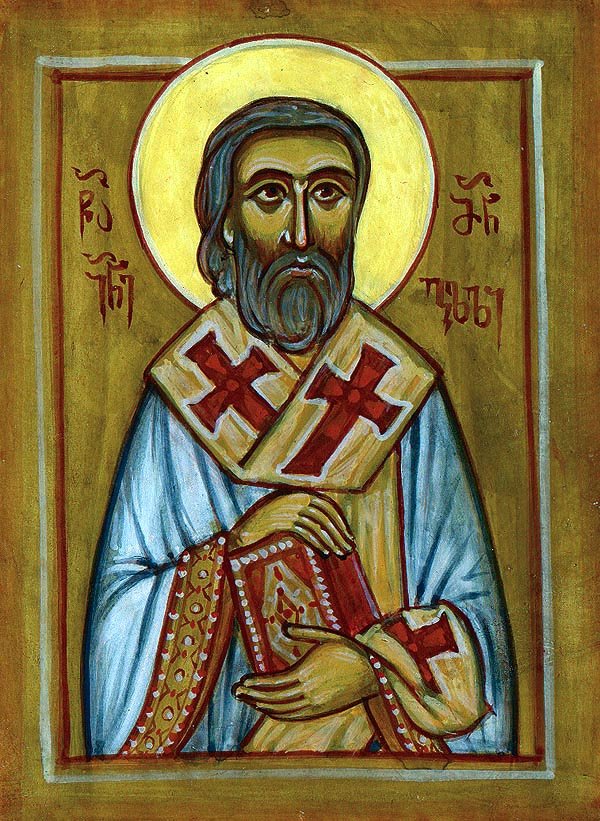
Venerable John, Bishop of Manglisi
Saint John (Saakadze) of Manglisi was born in 1668 and spiritually nurtured in the Davit-Gareji Wilderness. Outstanding in virtue, John was quickly ordained a hieromonk, and soon after consecrated bishop of Manglisi.
In 1724 Saint John left Davit-Gareji for Derbend, Dagestan, where he constructed a wooden church and began to preach Christianity among the local people.
Saint John (Saakadze) of Manglisi was born in 1668 and spiritually nurtured in the Davit-Gareji Wilderness. Outstanding in virtue, John was quickly ordained a hieromonk, and soon after consecrated bishop of Manglisi.
In 1724 Saint John left Davit-Gareji for Derbend, Dagestan, where he constructed a wooden church and began to preach Christianity among the local people. He labored there with eleven other pious believers. Saint John’s humble life and the miracles he performed attracted the attention of the Muslim Dagestanis, and even the government took notice of his tireless evangelical activity.
At that time the Georgian King Vakhtang VI (1703-1724) and Tsar Peter the Great of Russia were corresponding regularly about the evangelization of the Caspian seacoast. Both kings recognized the importance of Saint John’s activity in regard to this matter, and they generously contributed to his efforts. With their help, Saint John built one church in honor of the Nativity of the Theotokos and another in honor of Great-martyr Catherine.
In 1737 John left his disciples in Dagestan and journeyed to Astrakhan, near the place where the Volga flows into the Caspian Sea. There he constructed a church in honor of Saint John the Evangelist, which was converted into a monastery in 1746. Archimandrite Herman, one of Saint John’s disciples, was elevated as abbot of this monastery.
While in Astrakhan, Saint John discovered that many ethnic Georgians were passing through the city of Kizliar in Ossetia, but they did not have a church in which to celebrate the divine services. So he traveled to Kizliar and, with help from his kinsmen, built a church and opened a preparatory school for clergy nearby.
On March 28, 1751, Saint John reposed in Kizliar at the age of eighty-three. He was buried in the church that he himself had constructed.
Later, by order of King Teimuraz II (1744-1761), the myrrh-streaming relics of Saint John were translated to Tbilisi and buried in Sioni Cathedral, in front of the Manglisi Icon of the Mother of God.
Troparion - Tone 4
In truth you were revealed to your flock as a rule of faith, / an image of humility and a teacher of abstinence; / your humility exalted you; / your poverty enriched you. / Hierarch Father John, / entreat Christ our God / that our souls may be saved.
Saint Hesychios the Presbyter of Jerusalem
Saint Hesychios lived a life of asceticism in Palestine in the IV century, and distinguished himself by writing spiritual treatises. He was born and raised in Jerusalem. After studying the depths of the Holy Scriptures, he enriched himself with the knowledge of God. Then, after he left, he became a monk, and lived in the desert, thinking of the Holy Fathers who were there, gathering flowers of virtue from each one, like a busy bee.
Saint Hesychios lived a life of asceticism in Palestine in the IV century, and distinguished himself by writing spiritual treatises. He was born and raised in Jerusalem. After studying the depths of the Holy Scriptures, he enriched himself with the knowledge of God. Then, after he left, he became a monk, and lived in the desert, thinking of the Holy Fathers who were there, gathering flowers of virtue from each one, like a busy bee. It was impossible for him to escape being noticed, such was his virtue, and so he was compelled to be ordained as a priest by the then Archbishop of Jerusalem. He remained near the Lord's Tomb, and other places where our Lord Jesus Christ suffered His Holy Passion for our sake, and from those sources he drew knowledge and wisdom. Therefore, he interpreted and clarified every Scripture, for the benefit of many.
In addition to what is in the Synaxarion, Theophanēs in his Chronography informs us that the ordination of Saint Hesychios to the priesthood was performed immediately as soon as Saint Cyril (+ 412) ascended the Archiepiscopal throne of Alexandria. Saint Cyril of Scythopolis, who knew things from the local tradition, in addition to the characterizations of Saint Hesychios, calls him "presbyter and teacher of the Church," "enlightened," "theologian," and "far-famed luminary." He also states that at the dedication of the monastery church of Saint Euthymios by Patriarch Juvenal (422 – 458), in 428 or 429, Saint Hesychios was also present in his entourage, to the great joy of Saint Euthymios.
The Saint became active in the doctrinal debates of that time near the side of Saint Cyril of Alexandria, whose anti-Nestorian policy he followed, as may be inferred from the section of his Ecclesiastical History, quoted in the Acts of the Fifth Ecumenical Synod which met at Constantinople in 553.
Saint Hesychios was well known by all, and was found worthy of the gift of working miracles. He served God in every way. He reposed in peace, and joyously went to the Lord. His grave at the eastern gate of Jerusalem was still being shown around the year 570, and there was a chapel dedicated to him. At his Synaxis, gifts were also distributed to the poor.
Works considered to be written by this Holy Father include: "Commentary on Leviticus," "Commentary on Job," "Interpretation of the Psalms," "Interpretation of Isaiah," "Ecclesiastical History," "Homilies," etc.
Saint Hesychios is mentioned on the Saturday before Cheesefare Sunday (Ode 8 at Matins): "Let us give glory to John Chrysostom, and to the two Cyrils, the pillars of divine wisdom, and also to Hesychios another Theologian, along with the divine Meletios who discoursed concerning God."
Scripture Readings
☩Epistle
Hebrews 9:24-28
24
For Christ is not entered into the holy places made with hands, which are the figures of the true; but into heaven itself, now to appear in the presence of God for us:
25
Nor yet that he should offer himself often, as the high priest entereth into the holy place every year with blood of others;
26
For then must he often have suffered since the foundation of the world: but now once in the end of the world hath he appeared to put away sin by the sacrifice of himself.
27
And as it is appointed unto men once to die, but after this the judgment:
28
So Christ was once offered to bear the sins of many; and unto them that look for him shall he appear the second time without sin unto salvation.
☩Gospel
Luke 10:38-42; 11:27-28
38
Now it came to pass, as they went, that he entered into a certain village: and a certain woman named Martha received him into her house.
39
And she had a sister called Mary, which also sat at Jesus’ feet, and heard his word.
40
But Martha was cumbered about much serving, and came to him, and said, Lord, dost thou not care that my sister hath left me to serve alone? bid her therefore that she help me.
41
And Jesus answered and said unto her, Martha, Martha, thou art careful and troubled about many things:
42
But one thing is needful: and Mary hath chosen that good part, which shall not be taken away from her.
Liturgical data sourced from OCA.org and orthocal.info