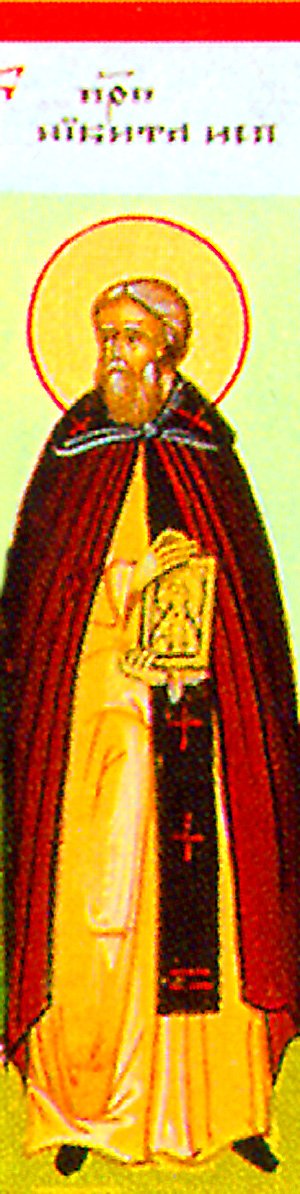
He was born in Caesarea of Bithynia. His widowed father became a monk, leaving Nicetas to the care of his grandmother. Nicetas himself, when he was grown, entered a monastery in Midikion, on the Sea of Marmara. After seven years of monastic life he was ordained hieromonk by Patriarch Tarasios. When Nikephoros, the abbot of the monastery, died, the brethren chose Nicetas as their new abbot.
When Leo the Armenian became Emperor, he revived the iconoclast heresy, even though it had been put down under the Empress Irene and condemned by an Ecumenical Council. The Emperor deposed and exiled the holy Patriarch Nicephoros, putting a heretic in his place. Nicetas, because he was known for his holiness and steadfast reverence for the holy icons, was imprisoned and tortured, but did not waver in his defense of Orthodoxy. Nicetas was taken from prison to prison, torture to torture, and exiled twice, until at last Leo the Armenian died and the Orthodox Emperor Michael came to the throne and freed all those imprisoned for Orthodoxy.
Once freed, Nicetas retired to a secluded hermitage near Constantinople, where he passed the remainder of his life in prayer and thanksgiving. When he died, his body was taken back to his monastery; during the journey, many of the sick who touched his holy body were healed.
Venerable Niketas the Confessor, Abbot of Medikion
Saint Niketas (Nikḗtas) the Confessor was born in Bithynian Caesarea (northwest Asia Minor) of a pious family. His mother died eight days after his birth, and his father Philaretos became a monk. The child remained in the care of his grandmother, who raised him in a true Christian spirit. From his youth Saint Niketas attended church and was a disciple of the hermit Stephanos. W
Saint Niketas (Nikḗtas) the Confessor was born in Bithynian Caesarea (northwest Asia Minor) of a pious family. His mother died eight days after his birth, and his father Philaretos became a monk. The child remained in the care of his grandmother, who raised him in a true Christian spirit. From his youth Saint Niketas attended church and was a disciple of the hermit Stephanos. With his blessing, Saint Niketas set off to the Mydicia monastery, where Saint Nikephoros (Nikēphóros) (March 13) was the igumen.
After seven years of virtuous life at the monastery, famed for its strict monastic rule, Saint Niketas was ordained presbyter. Saint Nikephoros, knowing the holy life of the young monk, entrusted to him the guidance of the monastery when he himself became ill.
Not wanting power, Saint Niketas devoted himself to the enlightenment and welfare of the monastery. He guided the brethren by his own example. Soon the fame of the lofty life of its inhabitants of the monastery attracted many seeking salvation. After several years, the number of monks had increased to one hundred.
When Saint Nikephoros departed to the Lord in his old age, the brethren unanimously chose Saint Niketas as igumen.
The Lord granted Saint Niketas the gift of wonderworking. Through his prayer a deaf-mute child received the gift of speech; two demon-possessed women were healed; he restored reason to one who had lost his mind, and many of the sick were healed of their infirmities.
During these years under the emperor Leo the Armenian (813-820), the Iconoclast heresy resurfaced and oppression increased. Orthodox bishops were deposed and banished. At Constantinople a council of heretics was convened in 815, at which they deposed the holy Patriarch Nikephoros (806-815), and in his place they chose the heretical layman Theodotus. They also installed heretics in place of exiled and imprisoned Orthodox bishops.
The emperor summoned all the heads of the monasteries and tried to bring them over to the Iconoclast heresy. Among those summoned was Saint Niketas, who stood firmly for the Orthodox confession. Following his example, all the igumens remained faithful to the veneration of holy icons. Therefore, they threw him into prison. Saint Niketas bravely underwent all the tribulations and encouraged firmness of spirit in the other prisoners.
Then the emperor and the false patriarch Theodotus attempted to trick those who remained faithful to Orthodox teaching. They promised that the emperor would give them their freedom and permit the veneration of the icons on one condition: that they take Communion from the pseudo-patriarch Theodotus.
For a long time the saint had doubts about entering into communion with a heretic, but other prisoners begged him to go along with them. Acceding to their entreaties, Saint Niketas went into the church, where icons were put out to deceive the confessors, and he accepted Communion.
But when he returned to his monastery and saw that the persecution against icons was continuing, he then repented of his deed, returned to Constantinople and fearlessly denounced the Iconoclast heresy. He ignored all the emperor’s threats.
Saint Niketas was again locked up in prison for six years until the death of the emperor Leo the Armenian. Enduring hunger and travail, Saint Niketas worked miracles by the power of his prayers: through his prayer the Phrygian ruler released two captives without ransom; three shipwrecked men for whom Saint Niketas prayed, were thrown up on shore by the waves.
Saint Niketas reposed in the Lord in 824. The saint’s body was buried at the monastery with reverence. Later, his relics became a source of healing for those coming to venerate the holy confessor.
Troparion - Tone 4
You were a firm pillar and an undaunted guardian of sacred tradition, O Nicetas; / you were adorned with holy dispassion and became an illustrious confessor of the Faith. / Accept the prayers of those who cry to you, / interceding for them with Christ our God.
Kontakion - Tone 2
You acquired a heavenly mind and life, / shining as brightly as the sun in the splendor of your deeds! / Father Nicetas, you enlighten those in the darkness of life guiding them all to God. / Pray without ceasing for us all!
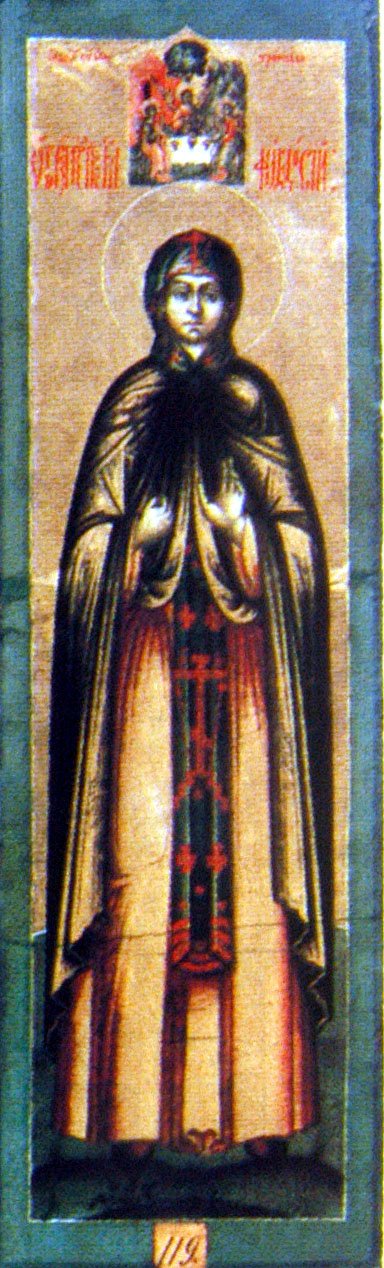
Holy Virgin Martyr Theodosίa of Tyre
Saint Theodosίa of Tyre lived during the III and IV centuries. Once, during a persecution against Christians, which had already lasted for five years, the seventeen-year-old Theodosίa visited some condemned Christian prisoners in the Praetorium at Caesarea in Palestine. It was the day of Holy Pascha, and the Martyrs were speaking about the Kingdom of God. S
Saint Theodosίa of Tyre lived during the III and IV centuries. Once, during a persecution against Christians, which had already lasted for five years, the seventeen-year-old Theodosίa visited some condemned Christian prisoners in the Praetorium at Caesarea in Palestine. It was the day of Holy Pascha, and the Martyrs were speaking about the Kingdom of God. Saint Theodosίa asked them to remember her when they appeared before the Lord.
When the soldiers saw that the girl had bowed to the prisoners, they seized her and led her before the governor, Urban. The governor urged the Saint to offer sacrifice to the idols, but she refused, professing her faith in Christ. Then she was subjected to cruel tortures; her sides and breasts were raked with iron claws until her bones were exposed. She endured this in silence with astonishing courage. Again Urban told her to sacrifice, but she mocked him saying: “Foolish man, why do you persist? Can you not see that I have received everything I prayed for, and that I am honored to share the fate of these Martyrs for Christ?"
After saying this, she was tormented even more severely than before. The holy virgin was cast into the sea with a stone tied around her neck, but Angels rescued her from the depths. Then they tossed her into the arena to be eaten by wild animals. Seeing that the beasts would not touch her, the soldiers beheaded her.
That night Saint Theodosίa appeared to her parents, who had tried to persuade their daughter not to let herself be tortured. She wore radiant garments, a crown upon her head, and held a luminous gold cross in her hand. She said to them, “Behold the great glory of which you wished to deprive me!”
The Holy Virgin Martyr Theodosίa of Tyre suffered for Christ on April 3 in the year 307 or 308. She is also commemorated on May 29 (the transfer of her relics to Constantinople, and later to Venice).
Saint Joseph the Hymnographer (886)
“Saint Joseph was from Sicily, the son of Plotinus and Agatha. Because Sicily had been subjugated by the Moslems, he departed thence and, passing from place to place, came with Saint Gregory of Decapolis (see Nov. 20) to Constantinople, where he endured bitter afflictions because of his pious zeal. T
“Saint Joseph was from Sicily, the son of Plotinus and Agatha. Because Sicily had been subjugated by the Moslems, he departed thence and, passing from place to place, came with Saint Gregory of Decapolis (see Nov. 20) to Constantinople, where he endured bitter afflictions because of his pious zeal. Travelling to Rome, he was captured by Arab pirates and taken to Crete, whence he later returned to Constantinople. He became an excellent hymnographer and reposed in holiness shortly after 886 (according to some, it was in 883). The melismatic canons of the Menaion are primarily the work of this Joseph; they bear his name in the acrostic of the Ninth Ode. He also composed most of the sacred book known as the Paracletike, which complements the Octoechos. For this reason, Joseph is called par excellence the Hymnographer.” (Great Horologion)
The “bitter afflictions” which St Joseph suffered were probably due (judging from his dates) to his veneration of the holy icons.
Note: In the Slavic calendar he is commemorated on April 4.
Saint Seraphim of Vyritsa (1949) (March 21 OC)
Born in 1866, he married and had three children. In 1920, at the age of 54, he and his wife quietly separated and each entered monastic life. Eventually he became the spiritual father of the St. Alexander Nevsky Lavra in St. Petersburg, where, as a clairvoyant staretz, he also confessed thousands of laity.
Born in 1866, he married and had three children. In 1920, at the age of 54, he and his wife quietly separated and each entered monastic life. Eventually he became the spiritual father of the St. Alexander Nevsky Lavra in St. Petersburg, where, as a clairvoyant staretz, he also confessed thousands of laity. He said, “I am the storage room where people’s afflictions gather.” In imitation of his patron saint, he prayed for a thousand nights on a rock before an icon of St. Seraphim of Sarov. He reposed in the Lord in 1949 and the Church of Russia glorified him in August of 2000. Thus his whole life as a monk was spent under Communist persecution.
Martyr Irene
No information available at this time.
Troparion - Tone 4
Your lamb Irene calls out to You, O Jesus, in a loud voice: / “I love You, my Bridegroom, and in seeking You I endure suffering. / In Baptism I was crucified so that I might reign in You, / and I died so that I might live with You. / Accept me as a pure sacrifice, / for I have offered myself in love.” / Through her prayers, save our souls, since You are merciful.
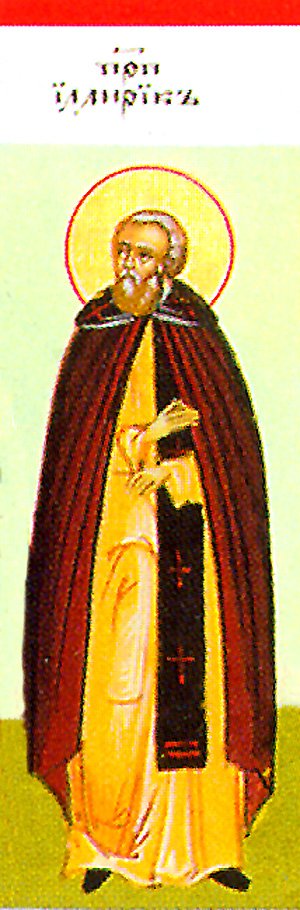
Saint Illyricus of Mount Myrsinon in the Peloponnesus
Saint Illyricus the Wonderworker devoted himself to ascetic struggles on Mount Myrsinon in the Peloponnesus. The dates of his birth and death are unknown.
Troparion - Tone 8
By a flood of tears you made the desert fertile, / and your longing for God brought forth fruits in abundance. / By the radiance of miracles you illumined the whole universe! / O our holy father Illyricus, pray to Christ our God to save our souls!
Martyrs Elpidephorus, Dius, Bithonius, and Galycus
The Holy Martyrs Elpidephorus, Dius, Bithonius, and Galycus suffered for their faith in Jesus Christ. They cut off the head of Saint Elpidephorus with a sword, Saint Dius was executed by stoning, Saint Bithonius was drowned in the sea, and Saint Galycus was condemned to be eaten by wild beasts.
Troparion - Tone 4
Your holy martyrs O Lord, / through their sufferings have received incorruptible crowns from You, our God. / For having Your strength, they laid low their adversaries, / and shattered the powerless boldness of demons. / Through their intercessions, save our souls!
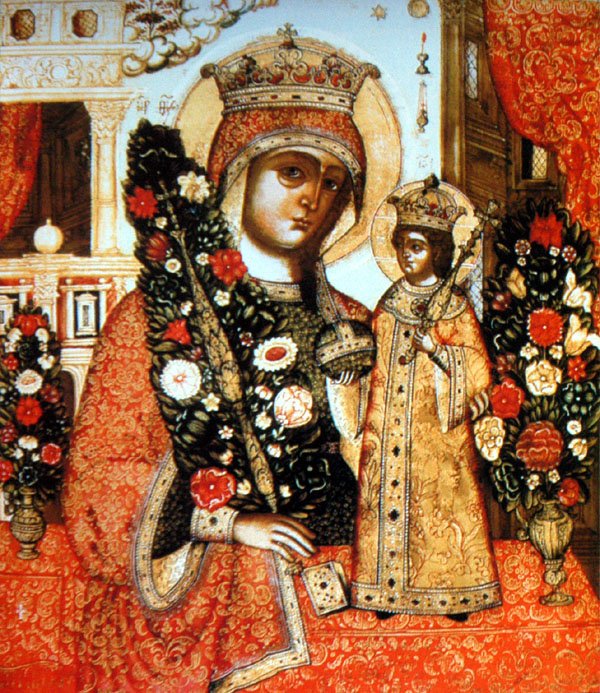
“Unfading Flower” Icon of the Mother of God
The "Unfading Flower" Icon depicts the Theotokos holding her Divine Son on her right arm, and in her left hand is a bouquet of white lilies. The lilies symbolize the unfading flower of virginity and purity of the Mother of God, to whom the Church sings: “You are the root of virginity and the Unfading Flower of purity.”
In Moscow there are two churches with Icons with this name: the church of the Dormition at Mogil'tsy (December 31), and the Alexeyev Monastery. Oth
The "Unfading Flower" Icon depicts the Theotokos holding her Divine Son on her right arm, and in her left hand is a bouquet of white lilies. The lilies symbolize the unfading flower of virginity and purity of the Mother of God, to whom the Church sings: “You are the root of virginity and the Unfading Flower of purity.”
In Moscow there are two churches with Icons with this name: the church of the Dormition at Mogil'tsy (December 31), and the Alexeyev Monastery. Other icons of this name are in Kungur (Perm Gubernia); in the former town of Kadome of Tambov Province, namely, in the Merciful Theotokos womens' monastery; and in the Nativity of the Theotokos church of Voronezh.
There is a similar Icon in the church of Saint Nicholas in the village of Budishch (Poltava Gubernia). It resembles a number of very old icons which are also revered in that place. Every year on April 3, many people gather in the village of Budishch to venerate this Icon, along with a copy of the Vladimir Icon of the Mother of God. Several miraculous healings of the sick have occurred before this Icon.
Troparion - Tone 5
Rejoice, O Bride of God, / rejoice, mystical rod which blossomed the Unfading Flower;1 / rejoice, O Sovereign Lady, / through whom we are filled with joy and inherit life.1 This is a quotation from the Saturday of the Akathist Hymn, Canon to the Theotokos, Ode 7.
Kontakion
Rejoice, O Bride of God, / rejoice, mystical rod which blossomed the Unfading Flower;1 / rejoice, O Sovereign Lady, / through whom we are filled with joy and inherit life.