Fasting Rules
 Meat
Abstain
Meat
Abstain
 Fish
Abstain
Fish
Abstain
 Dairy
Abstain
Dairy
Abstain
 Oil
Abstain
Oil
Abstain
 Wine
Abstain
Wine
Abstain
Saints & Commemorations
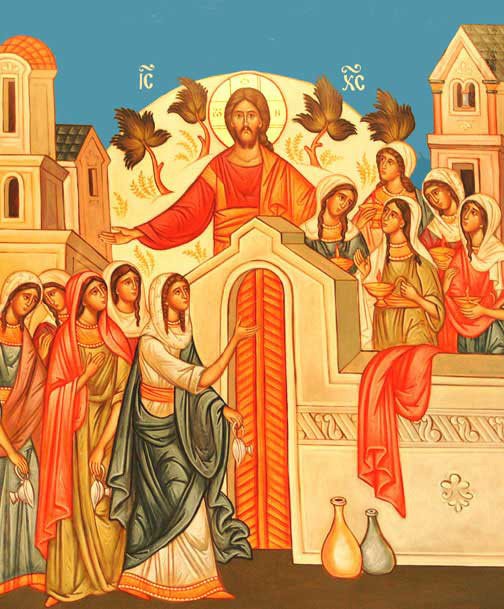
Great and Holy Tuesday
Holy Week: A Liturgical Explanation for the Days of Holy Week
3. MONDAY, TUESDAY, WEDNESDAY: THE END
These three days, which the Church calls Great and Holy have within the liturgical development of the Holy Week a very definite purpose. They place all its celebrations in the perspective of End Times; they remind us of the eschatological meaning of Pascha.
Holy Week: A Liturgical Explanation for the Days of Holy Week
3. MONDAY, TUESDAY, WEDNESDAY: THE END
These three days, which the Church calls Great and Holy have within the liturgical development of the Holy Week a very definite purpose. They place all its celebrations in the perspective of End Times; they remind us of the eschatological meaning of Pascha. So often Holy Week is considered one of the “beautiful traditions” or “customs,” a self-evident “part” of our calendar. We take it for granted and enjoy it as a cherished annual event which we have “observed” since childhood, we admire the beauty of its services, the pageantry of its rites and, last but not least, we like the fuss about the Paschal table. And then, when all this is done we resume our normal life. But do we understand that when the world rejected its Savior, when “Jesus began to be sorrowful and very heavy... and his soul was exceedingly sorrowful even unto death,” when He died on the Cross, “normal life” came to its end and is no longer possible. For there were “normal” men who shouted “Crucify Him” who spat at Him and nailed Him to the Cross. And they hated and killed Him precisely because He was troubling their normal life. It was indeed a perfectly “normal” world which preferred darkness and death to light and life.... By the death of Jesus the “normal” world, and “normal” life were irrevocably condemned. Or rather they revealed their true and abnormal inability to receive the Light, the terrible power of evil in them. “Now is the Judgment of this world” (John 12:31). The Pascha of Jesus signified its end to “this world” and it has been at its end since then. This end can last for hundreds of centuries, but this does not alter the nature of time in which we live as the “last time.” “The fashion of this world passeth away...” (I Cor. 7:31).
Pascha means passover, passage. The feast of Passover was for the Jews the annual commemoration of their whole history as salvation, and of salvation as passage from the slavery of Egypt into freedom, from exile into the promised land. It was also the anticipation of the ultimate passage—into the Kingdom of God. And Christ was the fulfillment of Pascha. He performed the ultimate passage: from death into life, from this “old world” into the new world into the new time of the Kingdom. And he opened the possibility of this passage to us. Living in “this world” we can already be “not of this world,” i.e. be free from slavery to death and sin, partakers of the “world to come.” But for this we must also perform our own passage, we must condemn the old Adam in us, we must put on Christ in the baptismal death and have our true life hidden in God with Christ, in the “world to come....”
And thus Easter is not an annual commemoration, solemn and beautiful, of a past event. It is this Event itself shown, given to us, as always efficient, always revealing our world, our time, our life as being at their end, and announcing the Beginning of the new life.... And the function of the three first days of Holy Week is precisely to challenge us with this ultimate meaning of Pascha and to prepare us to the understanding and acceptance of it.
1. This eschatological (which means ultimate, decisive, final) challenge is revealed, first, in the common troparion of these days:
Behold the Bridegroom comes at midnight,
And blessed is the servant whom He shall find watching,
And again unworthy is the servant whom He shall find heedless.
Beware, therefore, O my soul, do not be weighed down with sleep,
Lest you be given up to death and lest you be shut out of the Kingdom.
But rouse yourself crying: Holy, Holy, Holy, are You, O our God!
Through the Theotokos have mercy on us!
Midnight is the moment when the old day comes to its end and a new day begins. It is thus the symbol of the time in which we live as Christians. For, on the one hand, the Church is still in this world, sharing in its weaknesses and tragedies. Yet, on the other hand, her true being is not of this world, for she is the Bride of Christ and her mission is to announce and to reveal the coming of the Kingdom and of the new day. Her life is a perpetual watching and expectation, a vigil pointed at the dawn of this new day. But we know how strong is still our attachment to the “old day,” to the world with its passions and sins. We know how deeply we still belong to “this world.” We have seen the light, we know Christ, we have heard about the peace and joy of the new life in Him, and yet the world holds us in its slavery. This weakness, this constant betrayal of Christ, this incapacity to give the totality of our love to the only true object of love are wonderfully expressed in the exapostilarion of these three days:
“Thy Bridal Chamber I see adorned, O my Savior
And I have no wedding garment that I may enter,
O Giver of life, enlighten the vesture of my soul
And save me.”
2. The same theme develops further in the Gospel readings of these days. First of all, the entire text of the four Gospels (up to John 13: 31) is read at the Hours. This recapitulation shows that the Cross is the climax of the whole life and ministry of Jesus, the Key to their proper understanding. Everything in the Gospel leads to this ultimate hour of Jesus and everything is to be understood in its light. Then, each service has its special Gospel lesson.
At Matins: Matthew 22: 15-23, 39. Condemnation of Pharisees, i.e. of the blind and hypocritical religion, of those who think they are the leaders of man and the light of the world, but who in fact “shut up the Kingdom of heaven to men.”
At the Presanctified Liturgy: Matthew 24: 36-26, 2. The End again and the parables of the End: the ten wise virgins who had enough oil in their lamps and the ten foolish ones who were not admitted to the bridal banquet; the parable of ten talents “. . . Therefore be ye also ready, for in such an hour as ye think not the Son of Man cometh.” And, finally the Last Judgment.
3. These Gospel lessons are explained and elaborated in the hymnology of these days: the stichiras and the triodia (short canons of three odes each sung at Matins). One warning, one exhortation runs through all of them: the end and the judgment are approaching, let us prepare for them:
“Behold, O my soul, the Master has conferred on thee a talent
Receive the gift with fear;
Lend to him who gave; distribute to the poor
And acquire for thyself thy Lord as thy Friend;
That when He shall come in glory,
Thou mayest stand on His right hand
And hear His blessed voice:
Enter, my servant, into the joy of thy Lord.”
(Tuesday Matins)
4. Throughout the whole Lent the two books of the Old Testament read at Vespers were Genesis and Proverbs. With the beginning of Holy Week they are replaced by Exodus and Job. Exodus is the story of Israel’s liberation from Egyptian slavery, of their Passover. It prepares us for the understanding of Christ’s exodus to His Father, of His fulfillment of the whole history of salvation. Job, the Sufferer, is the Old Testament icon of Christ. This reading announces the great mystery of Christ’s sufferings, obedience and sacrifice.
5. The liturgical structure of these three days is still of the Lenten type. It includes, therefore, the prayer of Saint Ephrem the Syrian with prostrations, the augmented reading of the Psalter, the Liturgy of the Presanctified Gifts and the Lenten liturgical chant. We are still in the time of repentance, for repentance alone makes us partakers of the Pascha of Our Lord, opens to us the doors of the Paschal banquet. And then, on Great and Holy Wednesday, as the last Liturgy of the Presanctified Gifts is about to be completed, after the Holy Gifts have been removed from the altar, the priest reads for the last time the Prayer of Saint Ephrem. At this moment, the preparation comes to an end. The Lord summons us now to His Last Supper.
by THE VERY REV. ALEXANDER SCHMEMANN
Troparion - Tone 8
Behold the Bridegroom comes at midnight, / and blessed is the servant whom He shall find watching, / and again unworthy is the servant whom He shall find heedless. / Beware, therefore, O my soul, do not be weighed down with sleep, / lest you be given up to death and lest you be shut out of the Kingdom. / But rouse yourself crying: Holy, Holy, Holy, are You, O our God! / Through the Theotokos have mercy on us!
Kontakion - Tone 2
You know that this is the last hour, O wretched soul, / and fear the cutting of the fig tree. / Work diligently therefore at the talent given to you / keep watch and pray: / Let us not remain outside the bridal chamber of Christ.
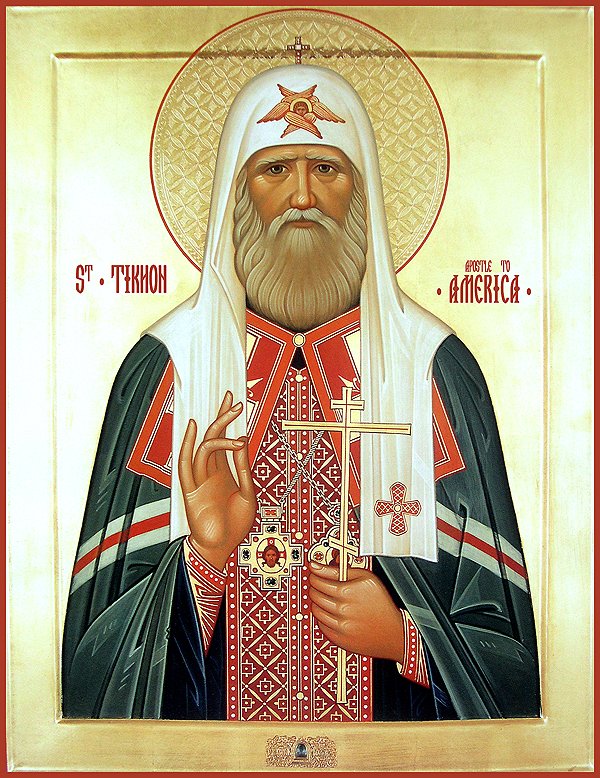
Repose of Saint Tikhon, Patriarch of Moscow, Enlightener of North America
Saint Tikhon, Patriarch of Moscow and Enlightener to America was born as Vasily Ivanovich Belavin on January 19, 1865 into the family of Ioann Belavin, a rural priest of the Toropetz district of the Pskov diocese. His childhood and adolescence were spent in the village in direct contact with peasants and their labor.
Saint Tikhon, Patriarch of Moscow and Enlightener to America was born as Vasily Ivanovich Belavin on January 19, 1865 into the family of Ioann Belavin, a rural priest of the Toropetz district of the Pskov diocese. His childhood and adolescence were spent in the village in direct contact with peasants and their labor. From his early years he displayed a particular religious disposition, love for the Church as well as rare meekness and humility.
When Vasily was still a boy, his father had a revelation about each of his children. One night, when he and his three sons slept in the hayloft, he suddenly woke up and roused them. He had seen his dead mother in a dream, who foretold to him his imminent death, and the fate of his three sons. She said that one would be unfortunate throughout his entire life, another would die young, while the third, Vasily, would be a great man. The prophecy of the dead woman proved to be entirely accurate in regard to all three brothers.
From 1878 to 1883, Vasily studied at the Pskov Theological Seminary. The modest seminarian was tender and affectionate by nature. He was fair-haired and tall of stature. His fellow students liked and respected him for his piety, brilliant progress in studies, and constant readiness to help comrades, who often turned to him for explanations of lessons, especially for help in drawing up and correcting numerous compositions. Vasily was called “bishop” and “patriarch” by his classmates.
In 1888, at the age of 23, Vasily Belavin graduated from the Saint Petersburg Theological Academy as a layman, and returned to the Pskov Seminary as an instructor of Moral and Dogmatic Theology. The whole seminary and the town of Pskov became very fond of him. He led an austere and chaste life, and in 1891, when he turned 26, he took monastic vows. Nearly the whole town gathered for the ceremony. He embarked on this new way of life consciously and deliberately, desiring to dedicate himself entirely to the service of the Church. The meek and humble young man was given the name Tikhon in honor of Saint Tikhon of Zadonsk.
He was transferred from the Pskov Seminary to the Kholm Theological Seminary in 1892, and was raised to the rank of archimandrite. Archimandrite Tikhon was consecrated Bishop of Lublin on October 19, 1897, and returned to Kholm for a year as Vicar Bishop of the Kholm Diocese. Bishop Tikhon zealously devoted his energy to the establishment of the new vicariate. His attractive moral make-up won the general affection, of not only the Russian population, but also of the Lithuanians and Poles. On September 14, 1898, Bishop Tikhon was made Bishop of the Aleutians and Alaska. As head of the Orthodox Church in America, Bishop Tikhon was a zealous laborer in the Lord’s vineyard.
He did much to promote the spread of Orthodoxy, and to improve his vast diocese. He reorganized the diocesan structure, and changed its name from “Diocese of the Aleutians and Alaska” to “Diocese of the Aleutians and North America” in 1900. Both clergy and laity loved their archpastor, and held him in such esteem that the Americans made Archbishop Tikhon an honorary citizen of the United States.
On May 22, 1901, he blessed the cornerstone for Saint Nicholas Cathedral in New York, and was also involved in establishing other churches. On November 9, 1902, he consecrated the church of Saint Nicholas in Brooklyn for the Syrian Orthodox immigrants. Two weeks later, he consecrated Saint Nicholas Cathedral in NY.
In 1905, the American Mission was made an Archdiocese, and Saint Tikhon was elevated to the rank of Archbishop. He had two vicar bishops: Bishop Innocent (Pustynsky) in Alaska, and Saint Raphael (Hawaweeny) in Brooklyn to assist him in administering his large, ethnically diverse diocese. In June of 1905, Saint Tikhon gave his blessing for the establishment of Saint Tikhon’s Monastery.
In 1907, he returned to Russia, and was appointed to Yaroslavl, where he quickly won the affection of his flock. They came to love him as a friendly, communicative, and wise archpastor. He spoke simply to his subordinates, never resorting to a peremptory or overbearing tone. When he had to reprimand someone, he did so in a good-natured, sometimes joking manner, which encouraged the person to correct his mistakes.
When Saint Tikhon was transferred to Lithuania on December 22, 1913, the people of Yaroslavl voted him an honorary citizen of their town. After his transfer to Vilnius, he did much in terms of material support for various charitable institutions. There too, his generous soul and love of people clearly manifested themselves. World War I broke out when His Eminence was in Vilnius. He spared no effort to help the poor residents of the Vilnius region who were left without a roof over their heads or means of subsistence as a result of the war with the Germans, and who flocked to their archpastor in droves.
After the February Revolution and formation of a new Synod, Saint Tikhon became one of its members. On June 21, 1917, the Moscow Diocesan Congress of clergy and laity elected him as their ruling bishop. He was a zealous and educated archpastor, widely known even outside his country.
On August 15, 1917, a local council was opened in Moscow, and Archbishop Tikhon was raised to the dignity of Metropolitan, and then elected as chairman of the council. The council had as its aim to restore the life of Russian Orthodox Church on strictly canonical principles, and its primary concern was the restoration of the Patriarchate. All council members would select three candidates, and then a lot would reveal the will of God. The council members chose three candidates: Archbishop Anthony of Kharkov, the wisest, Archbishop Arseny of Novgorod, the strictest, and Metropolitan Tikhon of Moscow, the kindest of the Russian hierarchs.
On November 5, following the Divine Liturgy and a Molieben in the Cathedral of Christ the Savior, a monk removed one of the three ballots from the ballot box, which stood before the Vladimir Icon of the Mother of God. Metropolitan Vladimir of Kiev announced Metropolitan Tikhon as the newly elected Patriarch. Saint Tikhon did not change after becoming the primate of the Russian Orthodox Church. In accepting the will of the council, Patriarch Tikhon referred to the scroll that the Prophet Ezekiel had to eat, on which was written, “Lamentations, mourning, and woe.” He foresaw that his ministry would be filled with affliction and tears, but through all his suffering, he remained the same accessible, unassuming, and kindly person.
All who met Saint Tikhon were surprised by his accessibility, simplicity and modesty. His gentle disposition did not prevent him from showing firmness in Church matters, however, particularly when he had to defend the Church from her enemies. He bore a very heavy cross. He had to administer and direct the Church amidst wholesale church disorganization, without auxiliary administrative bodies, in conditions of internal schisms and upheavals by various adherents of the Living Church, renovationists, and autocephalists.
The situation was complicated by external circumstances: the change of the political system, by the accession to power of the godless regime, by hunger, and civil war. This was a time when Church property was being confiscated, when clergy were subjected to court trials and persecutions, and Christ’s Church endured repression. News of this came to the Patriarch from all ends of Russia. His exceptionally high moral and religious authority helped him to unite the scattered and enfeebled flock. At a crucial time for the church, his unblemished name was a bright beacon pointing the way to the truth of Orthodoxy. In his messages, he called on people to fulfill the commandments of Christ, and to attain spiritual rebirth through repentance. His irreproachable life was an example to all.
In order to save thousands of lives and to improve the general position of the church, the Patriarch took measures to prevent clergy from making purely political statements. On September 25, 1919, when the civil war was at its height, he issued a message to the clergy urging them to stay away from political struggle.
The summer of 1921 brought a severe famine to the Volga region. In August, Patriarch Tikhon issued a message to the Russian people and to the people of the world, calling them to help famine victims. He gave his blessing for voluntary donations of church valuables, which were not directly used in liturgical services. However, on February 23, 1922, the All-Russian Central Executive Committee published a decree making all valuables subject to confiscation.
According to the 73rd Apostolic Canon, such actions were regarded as sacrilege, and the Patriarch could not approve such total confiscation, especially since many doubted that the valuables would be used to combat famine. This forcible confiscation aroused popular indignation everywhere. Nearly two thousand trials were staged all over Russia, and more than ten thousand believers were shot. The Patriarch’s message was viewed as sabotage, for which he was imprisoned from April 1922 until June 1923.
His Holiness, Patriarch Tikhon did much on behalf of the Russian Orthodox Church during the crucial time of the so-called Renovationist schism. He showed himself to be a faithful servant and custodian of the undistorted precepts of the true Orthodox Church. He was the living embodiment of Orthodoxy, which was unconsciously recognized even by enemies of the church, who called its members “Tikhonites.”
When Renovationist priests and hierarchs repented and returned to the church, they were met with tenderness and love by Saint Tikhon. This, however, did not represent any deviation from his strictly Orthodox policy. “I ask you to believe me that I will not come to agreement or make concessions which could lead to the loss of the purity and strength of Orthodoxy,” the Patriarch said in 1924.
Being a good pastor, who devoted himself entirely to the church’s cause, he called upon the clergy to do the same: “Devote all your energy to preaching the word of God and the truth of Christ, especially today, when unbelief and atheism are audaciously attacking the Church of Christ. May the God of peace and love be with all of you!”
It was extremely painful and hard for the Patriarch’s loving, responsive heart to endure all the Church’s misfortunes. Upheavals in and outside the church, the Renovationist schism, his primatial labors, his concern for the organization and tranquility of Church life, sleepless nights and heavy thoughts, his confinement that lasted more than a year, the spiteful and wicked baiting of his enemies, and the unrelenting criticism sometimes even from the Orthodox, combined to undermine his strength and health.
In 1924, Patriarch Tikhon began to feel unwell. He checked into a hospital, but would leave it on Sundays and Feast Days in order to conduct services. On Sunday, April 5, 1925, he served his last Liturgy, and died two days later. On March 25/April 7, 1925 the Patriarch received Metropolitan Peter and had a long talk with him. In the evening, the Patriarch slept a little, then he woke up and asked what time it was. When he was told it was 11:45 P.M., he made the Sign of the Cross twice and said, “Glory to Thee, O Lord, glory to Thee.” He did not have time to cross himself a third time.
Almost a million people came to say farewell to the Patriarch. The large cathedral of the Donskoy Monastery in Moscow could not contain the crowd, which overflowed the monastery property into the square and adjacent streets. Saint Tikhon, the eleventh Patriarch of Moscow, was primate of the Russian Church for seven and a half years.
It would be difficult to imagine the Russian Orthodox Church without Patriarch Tikhon during those years. He did so much for the Church and for the strengthening of the Faith itself during those difficult years of trial. Perhaps his own words best sum up his life: “May God teach every one of us to strive for His truth, and for the good of the Holy Church, rather than something for our own sake.”
Saint Tikhon is also commemorated on September 26 / October 9 (the day of his glorification); October 5/18 (Synaxis of Moscow Saints); November 5/18 (his election to the Patriarchal throne); January 25 / February 7 (Synaxis of the New Martyrs and Confessors of Russia, if it is a Sunday, if not, then on the nearest Sunday to January 27; February 9/22 (the Discovery of his relics).
Troparion - Tone 1
Let us praise Tikhon, the patriarch of all Russia, / and enlightener of North America / an ardent follower of the Apostolic traditions, / and good pastor of the Church of Christ. / Who was elected by divine providence, / and laid down his life for his sheep. / Let us sing to him with faith and hope, / and ask for his hierarchical intercessions: / Keep the church in Russia in tranquility, / and the church in North America in peace. / Gather her scattered children into one flock, / bring to repentance those who have renounced the True Faith, / preserve our lands from civil strife, / and entreat God’s peace for all people!
Kontakion - Tone 3
Today the assembly of New Martyrs / stands together with us in the Church / and together we raise a festive song / celebrating the uncovering of the relics of our Hierarch Father Tikhon / who defeated the enemy and preserved the Faith / While protecting the flock entrusted to him. / For he ever prays for us all / that we may never be deprived of the Love of God.
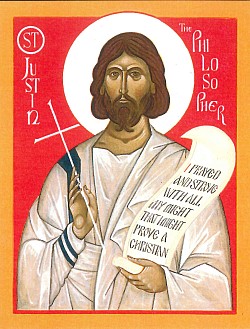
St Justin (Popovic) of Chelije in Serbia (1979) (March 25 OC)
He was born on the Feast of the Annunciation 1894, in Vranje, South Serbia, to a family whose seven previous generations had been headed by priests (Popovich means ‘family or son of a priest’ in Serbian). He began reading the scriptures at a young age, and as an adult carried a New Testament with him, reading three chapters every day. He
He was born on the Feast of the Annunciation 1894, in Vranje, South Serbia, to a family whose seven previous generations had been headed by priests (Popovich means ‘family or son of a priest’ in Serbian). He began reading the scriptures at a young age, and as an adult carried a New Testament with him, reading three chapters every day. He studied at the Seminary of St Sava in Belgrade while St Nikolai Velimirovic (March 18) was on the faculty. In 1914, Blagoje (as he was called before his tonsure) completed the nine-year seminary program. He desired to become a monk, but postponed entry into the monastic ranks due to the outbreak of war and the poor health of his parents. He spent the war caring for his parents and serving as a student nurse.
In 1915 he was tonsured a monk under the name Justin, after St Justin the Philosopher. Shortly thereafter he traveled to Petrograd to study at the seminary; there he acquired a deep, first-hand knowledge of the Russian ascetical tradition and a lifelong love of Russian spirituality, especially that of the common people. He then attended Oxford University from 1916 to 1919, writing a doctoral dissertation which was rejected. After a brief return to Belgrade, he entered the Greek Orthodox School of Theology in Athens. As in Russia, he used his time there not merely to study but to drink in the Orthodox spirituality of the Greek people. He was ordained to the diaconate while in Greece, then to the priesthood after returning to Belgrade in 1922. He wept ‘as a newborn babe’ throughout his ordination service. One of his first labors as a priest was to translate the Divine Liturgy into modern Serbian. During this period he came to know Metropolitan Anthony Khrapovitsky (later first hierarch of the Russian Orthodox Church abroad) and St John Maximovich, both of whom were living in Serbia as exiles from the Russian Revolution.
Father Justin’s preaching, writing and spiritual counsel became known throughout his country. In 1931 he was sent to Czechoslovakia to help in reorganizing the Church there (then under the jurisdiction of the Serbian Church), which was greatly tried and weakened by Uniatism. Realizing the people’s crying need a clear exposition of the Faith in their own language, he began in 1932 his three-volume Dogmas of the Orthodox Church. The first volume was so well-received that Fr Justin was made Professor of Dogmatics at the Seminary of St Sava, where he remained, completing the Dogmas and several other books, until the end of World War II. The new atheistic Communist regime then banned him from the university system, and Fr Justin lived from that time on in various Serbian monasteries.
In 1948 he entered Chelije Monastery, where he remained until his repose in 1979. He became Archimandrite and spiritual head of the Monastery. It was during this period that he emerged as a great light of Orthodoxy: pious believers from all parts of Yugoslavia, from Greece, and from all over the world traveled to Chelije to hear the holy Justin’s preaching and seek his counsel.
Saint Justin reposed in peace in 1979 at the age of 85, on the Feast of the Annunciation — the date of his birth. Since his repose, many miracles have been witnessed at his grave: healings, flashes of unearthly light from his tomb, and conversions of unbelievers by his prayers. His many writings are increasingly recognized as a fount of pure Orthodox teaching in the midst of our dark time.
Note: St Justin is commemorated on the anniversary of his repose, so his commemoration only coincides with the Feast of the Annunciation on the Old Calendar.
Holy Martyr Calliopius, with his mother Theoclea (304)
Calliopius was the only son of a senator from Pamphylia and his wife Theoclea, who had long prayed to God for a child. The devout Theoclea reared her son in purity of life and love for God from infancy. When persecution of Christians broke out under Maximian, Theoclea put Calliopius aboard a ship bound for Pompeiopolis to save him from the persecutors.
Calliopius was the only son of a senator from Pamphylia and his wife Theoclea, who had long prayed to God for a child. The devout Theoclea reared her son in purity of life and love for God from infancy. When persecution of Christians broke out under Maximian, Theoclea put Calliopius aboard a ship bound for Pompeiopolis to save him from the persecutors. But Calliopius, as soon as he disembarked, encountered a pagan festival, where he was arrested when he refused to make sacrifice to the idols. Brought before the governor Maximus, he freely confessed that he was a Christian. For this he was cruelly tortured and thrown into prison. His mother, hearing of his torments, sold her goods and hurried to comfort him and encourage him in his martyrdom.
Calliopius was sentenced to death by crucifixion, as it happened on Holy Thursday; but the holy Theoclea bribed the officials to postpone the execution by one day, so that her son might imitate the Lord’s Crucifixion on the day that He endured it; she also prevailed upon the torturers to crucify Calliopius upside-down (like St Peter) in humility toward the Lord. When her son’s lifeless body was taken down from the cross, Theoclea cast herself upon it and died.
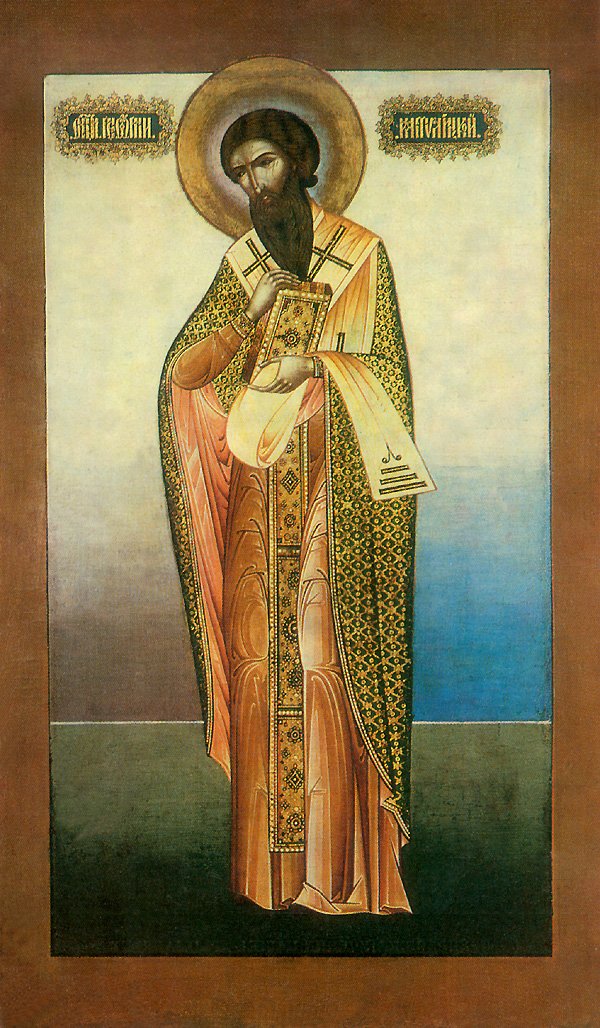
Saint George the Confessor, Bishop of Mytilene
Saint George, Metropolitan of Mytilene, from his youth led a monastic life, and was especially accomplished in the virtue of humility. In the reign of Leo the Isaurian (716-741) the saint underwent persecution from the iconoclasts and became a Confessor.
During the reign of the emperor Constantine Porphyrogenitos (780-797) Saint George was elevated to the archbishopal cathedra of the city of Mytilene on the island of Lesbos.
Saint George, Metropolitan of Mytilene, from his youth led a monastic life, and was especially accomplished in the virtue of humility. In the reign of Leo the Isaurian (716-741) the saint underwent persecution from the iconoclasts and became a Confessor.
During the reign of the emperor Constantine Porphyrogenitos (780-797) Saint George was elevated to the archbishopal cathedra of the city of Mytilene on the island of Lesbos. His life was radiant with prudence and purity and resembled the life of angels. He possessed a gift of wonderworking, cast out unclean spirits and healed incurable diseases. The saint distinguished himself by his compassion, and he helped all the needy. In 815, during the reign of the iconoclast Leo the Armenian (813-820), the holy archpastor was banished and sent to Cherson, where he died after the year 820.
At the hour of his death a bright star shone in the heavens over the city of Mytilene.
Troparion - Tone 3
Like a meadow planted by God / you were fruitful with the grace of the Spirit, / O holy Archpastor of the Mysteries. / You cultivated the souls of the faithful / refreshing them with living water. / O righteous Father George, / pray Christ our God to grant us great mercy!
Kontakion - Tone 4
You shone on the world like the sun, O holy and righteous George, / inspired initiate of the holy Faith, / enlightening your disciples!
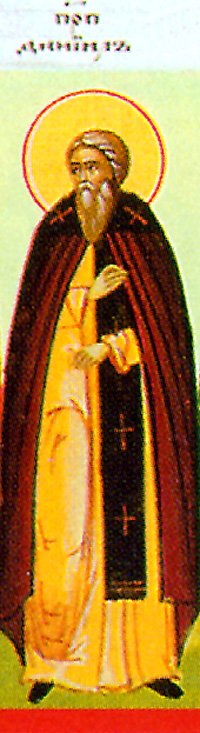
Venerable Daniel, Abbot of Pereslavl-Zalessky
Saint Daniel of Pereslavl (in the world Demetrius) was born around 1460 in the city of Pereslavl-Zalessky. He was the son of pious and God-loving parents, Constantine and Theodosia, who later was tonsured as a nun with the name Thekla. Therefore, it is not surprising that from his childhood, Daniel had a great love for the monastic life.
Saint Daniel of Pereslavl (in the world Demetrius) was born around 1460 in the city of Pereslavl-Zalessky. He was the son of pious and God-loving parents, Constantine and Theodosia, who later was tonsured as a nun with the name Thekla. Therefore, it is not surprising that from his childhood, Daniel had a great love for the monastic life. He learned a great deal about the angelic life from Igumen Jonah of the Monastery of Saint Nikḗtas the Stylite (May 24) at Pereyaslavl.
When Saint Daniel arrived at the Borov monastery in 1466, Saint Paphnutius (May 1) entrusted him to Elder Leucius of Volokolamsk (August 17), who was an experienced ascetic in the spiritual life. Saint Leucius was a disciple of Saint Paphnutius of Borov and an associate of Saint Joseph of Volokolamsk (September 9).Under his guidance, Saint Daniel reached his spiritual maturity.
Years later, Saint Daniel returned to Pereyaslavl, and there he demonstrated much love for his neighbor. He buried the neglected, the poor, and those without any family. The saint also founded a monastery on the site of the cemetery.
Anticipating the approach of death, Archimandrite Daniel was tonsured into the Great Schema. The blessed Elder reposed on April 7, 1540, in the 81st year of his life. His incorrupt relics were recovered in 1625.
The Lord glorified His saint with numerous miracles. Saint Daniel is also commemorated on December 30 and July 28.
Troparion - Tone 3
From your youth, O blessed one, you devoted yourself entirely to the Lord, / always obeying God and resisting the devil, you overcame sinful passions, / thereby becoming a temple1 of God and you built a beautiful monastery for the glory of the Most Holy Trinity, / and for Christ's flock gathered in them, O God-pleaser, you departed to the eternal abodes, O Father Daniel. / Entreat the tri-hypostatic God, one in essence, for the salvation of our souls.1 Corinthians 3:16; 6:19.
Kontakion - Tone 8
From your youth, O blessed one, you devoted yourself entirely to the Lord, / always obeying God and resisting the devil, you overcame sinful passions, / thereby becoming a temple1 of God and you built a beautiful monastery for the glory of the Most Holy Trinity, / and for Christ's flock gathered in them, O God-pleaser, you departed to the eternal abodes, O Father Daniel. / Entreat the tri-hypostatic God, one in essence, for the salvation of our souls.
Martyr Calliopius at Pompeiopolis in Cilicia
The Holy Martyr Calliopius was born in Perge, Pamphylia of the pious woman Theoklia, wife of a renowned senator. Theoklia was childless for a long time. She fervently prayed for a son, vowing to dedicate him to God.
Soon after the birth of her son Theoklia was widowed. When Saint Calliopius reached adolescence, a fierce persecution against Christians began.
The Holy Martyr Calliopius was born in Perge, Pamphylia of the pious woman Theoklia, wife of a renowned senator. Theoklia was childless for a long time. She fervently prayed for a son, vowing to dedicate him to God.
Soon after the birth of her son Theoklia was widowed. When Saint Calliopius reached adolescence, a fierce persecution against Christians began. Theoklia, learning that her son would be denounced as a Christian, sent him to Cilicia in Asia Minor.
When the saint arrived at Pompeiopolis, Paphlagonia there was a celebration in honor of the pagan gods. They invited the youth to take part in the proceedings, but he said he was a Christian and refused. They reported this to the prefect of the city Maximus. Saint Calliopius was brought before him to be tried. At first, he attempted to persuade Calliopius to worship the gods, promising to give him his own daughter in marriage. After the youth rejected this offer, Maximus subjected him to terrible tortures. He ordered the martyr to be beaten on the back with iron rods, and on the stomach with ox-hide thongs. Finally, the prefect had him tied to an iron wheel, and he was roasted over a slow fire. After these tortures, they threw the martyr Calliopius into prison.
When Theoklia heard about the sufferings of her son, she wrote her last will, freed her slaves, distributed her riches to the poor, and hastened to Saint Calliopius. The brave mother gave money to the guard and got into the prison to see her son. There she encouraged him to endure suffering to the end for Christ.
When on the following day the saint refused to renounce Christ, Maximus gave orders to crucify the martyr. The day of execution happened to be Great Thursday, when the Savior’s last meal with His disciples is commemorated.
Theoklia begged the guard to crucify her son head downward, since she considered it unworthy for him to be crucified like the Lord. Her wish was granted. The holy martyr hung on the cross overnight and died on Great Friday in the year 304.
When the holy martyr was removed from the cross, Theoklia gave glory to the Savior. She embraced the lifeless body of her son and gave up her own spirit to God. Christians buried their bodies in a single grave.
Troparion - Tone 3
Your holy martyr Calliopius, O Lord, / through his suffering has received an incorruptible crown from You, our God. / For having Your strength, he laid low his adversaries, / and shattered the powerless boldness of demons. / Through his intercessions, save our souls!
St Nilus (Nil Sorsky), abbot of Sora (1508)
St Nilus established the monastic skete (a community of monks living separately like hermits, but sharing some common life) in Russia. He took one side of a religious controversy that troubled the Russian Church’s life for many years. St Nilus and his disciples claimed that prayer and ascetic struggle are the whole purpose of monastic life, and opposed monastic ownership of property, or involvement in works such as almshouses, hospitals, and orphanages. J
St Nilus established the monastic skete (a community of monks living separately like hermits, but sharing some common life) in Russia. He took one side of a religious controversy that troubled the Russian Church’s life for many years. St Nilus and his disciples claimed that prayer and ascetic struggle are the whole purpose of monastic life, and opposed monastic ownership of property, or involvement in works such as almshouses, hospitals, and orphanages. Joseph, abbot of Volokalamsk, took up the argument on the other side, insisting that the Church and its monks should be involved in good works (and have the means to do those works) as well as in prayer. The two groups became known as the “Possessors” (Joseph’s side) and the “Non-Possessors” (Nilus’ side). Each group had reason to be troubled by the other’s extremes: Monasteries owned huge amounts of land, kept serfs, and were subject to corruption by involvement in finance; at the same time, the Church formed most of the ‘welfare’ system of Russia, and the Non-possessors did not suggest how the poor were to be tended, or orphans cared for, without the monasteries’ charity. Many of the Non-possessors tended toward a non-Russian and almost un-Orthodox puritanism, condemning beautiful churches and icons as diversions from true spirituality.
The Possessors (not surprisingly) were favored by the Tsarist government, and eventually won out. The artificial division of the Church into mystical and practical ‘parties,’ and the victory of one of the parties, led to a period of stagnation in the Russian church that was only corrected two hundred years later, when a great renewal of religious life, characterized by such holy Fathers as St Paisios Velichkovsky and St Seraphim of Sarov, restored the fullness and balance of Orthodox life to the Russian church.
An indication of the fullness of Orthodoxy: the Church has glorified not only St Nilus but his opponent St Joseph of Volokalamsk, who is commemorated on Sept. 9.
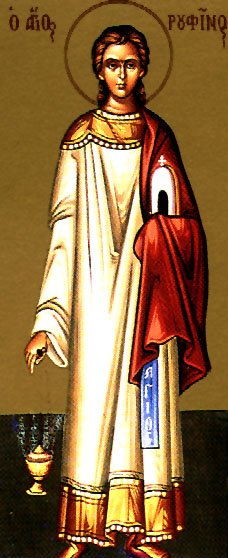
Martyrs Rufinus the Deacon, Aquilina, and 200 soldiers with them at Sinope
After the Emperors Diocletian and Maximian abdicated in 305, Maximinus Daia was elevated to the rank of Caesar and was given the eastern provinces and Egypt to govern. He continued Diocletian's severe persecution of Christians, and in 306 he issued an edict requiring every man, woman, and child to offer sacrifice to the pagan "gods." Even babies were forced to eat the flesh of sacrificial victims, whose blood was sprinkled on every item sold in the markets.
After the Emperors Diocletian and Maximian abdicated in 305, Maximinus Daia was elevated to the rank of Caesar and was given the eastern provinces and Egypt to govern. He continued Diocletian's severe persecution of Christians, and in 306 he issued an edict requiring every man, woman, and child to offer sacrifice to the pagan "gods." Even babies were forced to eat the flesh of sacrificial victims, whose blood was sprinkled on every item sold in the markets.
When Maximinus became Emperor in 310, Rufinus, a deacon of the Church at Sinope (Σινώπη) on the Black Sea, was converting many people to Christianity. For this reason, he was arrested and imprisoned.
A noble Christian woman named Aquilina was also arrested and put in jail because she visited Rufinus and took care of him. Both Saints were brought before a judge, who ordered that they be subjected to horrible torments after they had confessed their faith in Christ. Finally, Saint Rufinus was beheaded, and Saint Aquilina received the crown of martyrdom by fire. Her hands were tied behind her back while her stomach was burned, thereby causing her death.
After witnessing the suffering and the miracles of Saints Rufinus and Aquilina, 200 soldiers were converted to Christ, by the grace of God. The infuriated ruler ordered that every one of them be put to death. They were bound and led to the place of execution, where all the martyrs were beheaded and received their incorruptible crowns of glory from the Lord.
Troparion - Tone 4
Your holy martyrs O Lord, / through their sufferings have received incorruptible crowns from You, our God. / For having Your strength, they laid low their adversaries, / and shattered the powerless boldness of demons. / Through their intercessions, save our souls!
Saint Savvas the New of Kalymnos (1948) (March 25 OC)
He was born in Thrace to a poor family. Early in life he desired to become a monk and, failing to get his parents’ consent, left secretly for Mt Athos. After several years there, he traveled to Palestine, where he entered the Monastery of St George the Chozebite. In 1903 he was ordained to the priesthood. F
He was born in Thrace to a poor family. Early in life he desired to become a monk and, failing to get his parents’ consent, left secretly for Mt Athos. After several years there, he traveled to Palestine, where he entered the Monastery of St George the Chozebite. In 1903 he was ordained to the priesthood. From 1907–1916 he lived in severe asceticism as a hermit on the banks of the Jordan. After living in several monasteries in Greece, he served with St Nektarios of Aegina for the last year of the Saint’s life (he reposed in 1920). After six more years on Aegina, Fr Savvas moved to the island of Kalymnos, where he spent the remainder of his life. He lived in quietness and asceticism, acquiring a reputation throughout the island as a confessor and spiritual father. He slept only a few hours each night, and gave away any money that came to him the same day, since he believed that it was wrong for a monk to have money in his cell after nightfall.
Saint Savvas reposed on the Old Calendar feast of the Annunciation in 1948. Innumerable miracles and healings have been wrought through his intercession. A striking example occurred in 1957: A group of young islanders were talking about the Saint, and one of them, who doubted his sanctity, said ‘If this lamp breaks I’ll believe.’ At that moment the lamp shattered spontaneously.
The following account is from Mother Nectaria McLees’ Evlogeite! A pilgrim’s guide to Greece: ‘His last words of counsel to his nuns were, “…love… is the bond of perfection,” and to the abbess he said, “Love, love, love (Agapa, agapa, agapa).” Then he clapped his hands six times, saying “The Lord, the Lord, the Lord…”
‘In 1957 his relics were uncovered in the presence of Metropolitan Isidoros of Kalymnos, who described them as “the bones being perfectly joined, and the vestments intact.” When the sepulchre was opened a divine and otherworldly fragrance covered the area, even to the outskirts of town far below. In 1961, an iconographer of the Skete of Kapsokalyvia on Mount Athos painted an icon of St. Savvas at Abbess Philothei’s request. The icon arrived by ferry, and as it was being transferred from the post office to the customs house where the nuns would pick it up, the convent bell began ringing by itself and continued until the icon was brought to the monastery.’
Venerable Serapion of Egypt
Saint Serapion lived during the fifth century in Egypt. He was called the linen cloth-wearer (Sindonite) since he wore only a coarse linen garb called a “sindon.” From his youth the monk lived like the birds of the air, without a shelter.
For several days at a time he did not eat, not having the means to buy bread. He
Saint Serapion lived during the fifth century in Egypt. He was called the linen cloth-wearer (Sindonite) since he wore only a coarse linen garb called a “sindon.” From his youth the monk lived like the birds of the air, without a shelter.
For several days at a time he did not eat, not having the means to buy bread. He gave away his sindon to a beggar who was shivering from the cold, and he himself was naked.
A certain Greek philosopher, wishing to test the non-covetousness of the monk, gave him a gold coin and watched him. The saint went to the bakery, bought one loaf of bread, gave the merchant the gold coin and left, having no regard for the value of the money.
Saint Serapion led many on the way of salvation. Once, he was the servant of a Greek actor, whom he converted to Christ. The actor, imitating the example of the holy life of the saint, believed and was baptized together with all his family. He asked Saint Serapion to remain with him not as a servant, but as a guide and friend, but the monk went away, not taking any of the money offered him.
Traveling to Rome, Saint Serapion got on a ship, but paid nothing to the ship owners. At first they began to reproach him for this, but noticing that the Elder had gone five days already without eating, they began to feed him for the sake of God, and in this they fulfilled the command of the Lord.
At Rome, the saint continued to wander about, going from house to house, having nothing, accumulating only spiritual wealth for himself and for his neighbor.
Troparion - Tone 8
By a flood of tears you made the desert fertile, / and your longing for God brought forth fruits in abundance. / By the radiance of miracles you illumined the whole universe! / O our holy father Serapion, pray to Christ our God to save our souls!
Scripture Readings
☩Epistle
Hebrews 7:26-8:2
26
For such an high priest became us, who is holy, harmless, undefiled, separate from sinners, and made higher than the heavens;
27
Who needeth not daily, as those high priests, to offer up sacrifice, first for his own sins, and then for the people’s: for this he did once, when he offered up himself.
28
For the law maketh men high priests which have infirmity; but the word of the oath, which was since the law, maketh the Son, who is consecrated for evermore.
1
Now of the things which we have spoken this is the sum: We have such an high priest, who is set on the right hand of the throne of the Majesty in the heavens;
2
A minister of the sanctuary, and of the true tabernacle, which the Lord pitched, and not man.
☩Gospel
Matthew 22:15-23:39
15
Then went the Pharisees, and took counsel how they might entangle him in his talk.
16
And they sent out unto him their disciples with the Herodians, saying, Master, we know that thou art true, and teachest the way of God in truth, neither carest thou for any man: for thou regardest not the person of men.
17
Tell us therefore, What thinkest thou? Is it lawful to give tribute unto Cesar, or not?
18
But Jesus perceived their wickedness, and said, Why tempt ye me, ye hypocrites?
19
Shew me the tribute money. And they brought unto him a penny.
20
And he saith unto them, Whose is this image and superscription?
21
They say unto him, Cesar’s. Then saith he unto them, Render therefore unto Cesar the things which are Cesar’s; and unto God the things that are God’s.
22
When they had heard these words, they marvelled, and left him, and went their way.
23
The same day came to him the Sadducees, which say that there is no resurrection, and asked him,
24
Saying, Master, Moses said, If a man die, having no children, his brother shall marry his wife, and raise up seed unto his brother.
25
Now there were with us seven brethren: and the first, when he had married a wife, deceased, and, having no issue, left his wife unto his brother:
26
Likewise the second also, and the third, unto the seventh.
27
And last of all the woman died also.
28
Therefore in the resurrection whose wife shall she be of the seven? for they all had her.
29
Jesus answered and said unto them, Ye do err, not knowing the scriptures, nor the power of God.
30
For in the resurrection they neither marry, nor are given in marriage, but are as the angels of God in heaven.
31
But as touching the resurrection of the dead, have ye not read that which was spoken unto you by God, saying,
32
I am the God of Abraham, and the God of Isaac, and the God of Jacob? God is not the God of the dead, but of the living.
33
And when the multitude heard this, they were astonished at his doctrine.
34
But when the Pharisees had heard that he had put the Sadducees to silence, they were gathered together.
35
Then one of them, which was a lawyer, asked him a question, tempting him, and saying,
36
Master, which is the great commandment in the law?
37
Jesus said unto him, Thou shalt love the Lord thy God with all thy heart, and with all thy soul, and with all thy mind.
38
This is the first and great commandment.
39
And the second is like unto it, Thou shalt love thy neighbour as thyself.
40
On these two commandments hang all the law and the prophets.
41
While the Pharisees were gathered together, Jesus asked them,
42
Saying, What think ye of Christ? whose son is he? They say unto him, The Son of David.
43
He saith unto them, How then doth David in spirit call him Lord, saying,
44
The Lord said unto my Lord, Sit thou on my right hand, till I make thine enemies thy footstool?
45
If David then call him Lord, how is he his son?
46
And no man was able to answer him a word, neither durst any man from that day forth ask him any more questions.
1
Then spake Jesus to the multitude, and to his disciples,
2
Saying, The scribes and the Pharisees sit in Moses’ seat:
3
All therefore whatsoever they bid you observe, that observe and do; but do not ye after their works: for they say, and do not.
4
For they bind heavy burdens and grievous to be borne, and lay them on men’s shoulders; but they themselves will not move them with one of their fingers.
5
But all their works they do for to be seen of men: they make broad their phylacteries, and enlarge the borders of their garments,
6
And love the uppermost rooms at feasts, and the chief seats in the synagogues,
7
And greetings in the markets, and to be called of men, Rabbi, Rabbi.
8
But be not ye called Rabbi: for one is your Master, even Christ; and all ye are brethren.
9
And call no man your father upon the earth: for one is your Father, which is in heaven.
10
Neither be ye called masters: for one is your Master, even Christ.
11
But he that is greatest among you shall be your servant.
12
And whosoever shall exalt himself shall be abased; and he that shall humble himself shall be exalted.
13
But woe unto you, scribes and Pharisees, hypocrites! for ye shut up the kingdom of heaven against men: for ye neither go in yourselves, neither suffer ye them that are entering to go in.
14
Woe unto you, scribes and Pharisees, hypocrites! for ye devour widows’ houses, and for a pretence make long prayer: therefore ye shall receive the greater damnation.
15
Woe unto you, scribes and Pharisees, hypocrites! for ye compass sea and land to make one proselyte, and when he is made, ye make him twofold more the child of hell than yourselves.
16
Woe unto you, ye blind guides, which say, Whosoever shall swear by the temple, it is nothing; but whosoever shall swear by the gold of the temple, he is a debtor!
17
Ye fools and blind: for whether is greater, the gold, or the temple that sanctifieth the gold?
18
And, Whosoever shall swear by the altar, it is nothing; but whosoever sweareth by the gift that is upon it, he is guilty.
19
Ye fools and blind: for whether is greater, the gift, or the altar that sanctifieth the gift?
20
Whoso therefore shall swear by the altar, sweareth by it, and by all things thereon.
21
And whoso shall swear by the temple, sweareth by it, and by him that dwelleth therein.
22
And he that shall swear by heaven, sweareth by the throne of God, and by him that sitteth thereon.
23
Woe unto you, scribes and Pharisees, hypocrites! for ye pay tithe of mint and anise and cummin, and have omitted the weightier matters of the law, judgment, mercy, and faith: these ought ye to have done, and not to leave the other undone.
24
Ye blind guides, which strain at a gnat, and swallow a camel.
25
Woe unto you, scribes and Pharisees, hypocrites! for ye make clean the outside of the cup and of the platter, but within they are full of extortion and excess.
26
Thou blind Pharisee, cleanse first that which is within the cup and platter, that the outside of them may be clean also.
27
Woe unto you, scribes and Pharisees, hypocrites! for ye are like unto whited sepulchres, which indeed appear beautiful outward, but are within full of dead men’s bones, and of all uncleanness.
28
Even so ye also outwardly appear righteous unto men, but within ye are full of hypocrisy and iniquity.
29
Woe unto you, scribes and Pharisees, hypocrites! because ye build the tombs of the prophets, and garnish the sepulchres of the righteous,
30
And say, If we had been in the days of our fathers, we would not have been partakers with them in the blood of the prophets.
31
Wherefore ye be witnesses unto yourselves, that ye are the children of them which killed the prophets.
32
Fill ye up then the measure of your fathers.
33
Ye serpents, ye generation of vipers, how can ye escape the damnation of hell?
34
Wherefore, behold, I send unto you prophets, and wise men, and scribes: and some of them ye shall kill and crucify; and some of them shall ye scourge in your synagogues, and persecute them from city to city:
35
That upon you may come all the righteous blood shed upon the earth, from the blood of righteous Abel unto the blood of Zacharias son of Barachias, whom ye slew between the temple and the altar.
36
Verily I say unto you, All these things shall come upon this generation.
37
O Jerusalem, Jerusalem, thou that killest the prophets, and stonest them which are sent unto thee, how often would I have gathered thy children together, even as a hen gathereth her chickens under her wings, and ye would not!
38
Behold, your house is left unto you desolate.
39
For I say unto you, Ye shall not see me henceforth, till ye shall say, Blessed is he that cometh in the name of the Lord.
Notes
["Presanctified Liturgy"]
Liturgical data sourced from OCA.org and orthocal.info