Fasting Rules
 Meat
Allowed
Meat
Allowed
 Fish
Allowed
Fish
Allowed
 Dairy
Allowed
Dairy
Allowed
 Oil
Allowed
Oil
Allowed
 Wine
Allowed
Wine
Allowed
Saints & Commemorations
Bright Monday
On Bright Monday the Church commemorates the Sweet-Kissing (Glykophilousa) Icon of the Most Holy Theotokos.
Like the Ivḗron Icon (March 31), the Sweet-Kissing Icon was also saved from the iconoclasts by a pious woman in the ninth century. It also traveled miraculously upon the sea, arriving at Mt. A
On Bright Monday the Church commemorates the Sweet-Kissing (Glykophilousa) Icon of the Most Holy Theotokos.
Like the Ivḗron Icon (March 31), the Sweet-Kissing Icon was also saved from the iconoclasts by a pious woman in the ninth century. It also traveled miraculously upon the sea, arriving at Mt. Athos, the “Garden of the Theotokos,” where it was honored by the monks.
A nobleman named Simeon was an iconoclast who shared the emperor Theophilus’s hatred for the holy icons. Simeon’s wife Victoria, on the other hand, venerated icons, especially a certain icon of the Mother of God before which she prayed each day. Simeon could not tolerate his wife’s piety, so he demanded that she give him the icon so he could burn it. Victoria threw the icon into the sea, hoping that it would be preserved through God’s providence.
Years later, the icon appeared on the shores of Mt. Athos near the monastery of Philotheou. The igumen and the brethren of the monastery retrieved the icon and placed it in the church, where it worked many miracles.
In 1830 a pilgrim came to the monastery from Adrianopolis. He listened to the history of the icon and the miracles associated with it, but regarded such things as childish fables. The monk who had related all this was surprised and grieved by the pilgrim’s disbelief, fearing that such doubts indicated an unhealthy spiritual state. He did all that he could to remove the pilgrim’s skepticism, but the man stubbornly adhered to his opinion.
The Mother of God, in her compassion, finally healed the pilgrim’s soul in a rather dramatic way. On the very day that he had his discussion with the monk, the pilgrim was walking on an upper balcony. Suddenly, he lost his footing and began to fall. In his distress he called out, “Most Holy Theotokos, help me!” The Mother of God heard him, and he landed on the ground completely unharmed.
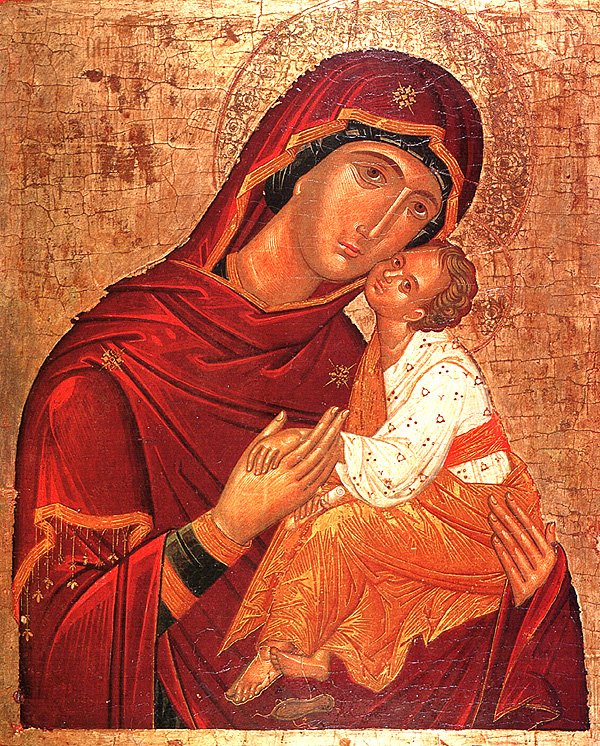
The icon is one of the Eleusa (Tenderness) type. It is unusual in that it shows the Virgin kissing her Child. Christ raises His hand as if to repulse His mother’s caress.
Other Sweet-Kissing (Tenderness) icons are:
Pskov (May 21, June 23, August 26, October 7)
Icon of the Mother of God of Mt. Athos, “Sweet Kissing”
Like the Panagia Portaitissa, the Glykophilousa Icon is one of those which were saved during the iconoclastic period and brought miraculously to Mount Athos. It originally belonged to Victoria, the devout wife of the senator Symeon. Victoria was one who venerated the holy icons, especially that of the Most Holy Theotokos, before which she prayed each day.
Like the Panagia Portaitissa, the Glykophilousa Icon is one of those which were saved during the iconoclastic period and brought miraculously to Mount Athos. It originally belonged to Victoria, the devout wife of the senator Symeon. Victoria was one who venerated the holy icons, especially that of the Most Holy Theotokos, before which she prayed each day. Her husband was an iconoclast who found her piety offensive, for he, like Emperor Theophilos (r. 829-842), found the veneration of icons distasteful. Symeon told his wife to give him her icon so that he could burn it. In order to save the icon from being destroyed, she threw it into the sea, and it floated away standing upright on the waves. After a few years, the icon appeared on the shores of Mount Athos near the Monastery of Philotheou, where it was received with great honor and rejoicing by the Abbot and Fathers of the Monastery, who had been informed of its impending arrival through a revelation of the Theotokos.
A spring of holy water sprouted forth on the very spot where they placed the icon on the shore. Every year on Monday of Bright Week there is a procession and blessing of water. Numerous miracles have occurred.
Although there are many miracles of the Glykophilousa Icon, we will mention only a few. In 1713, the Mother of God answered the prayers of the devout Ecclesiarch Ioannikios, who complained about the poverty of the monastery. She assured him that she would provide for the material needs of the monastery.
Another miracle took place in 1801. A pilgrim, after seeing the precious offerings having from the icon, planned to steal them. He stayed in the Temple after the Ecclesiarch closed it. Then he stole the offerings and left for the port of Ivḗron Monastery. There he found a boat that was leaving for Ierissos. After a while the ship sailed, but despite the excellent weather, it remained stationary in the sea. When the Ecclesiarch saw what had happened, the abbot sent monks out in various directions. Two went to the port of Ivḗron and when they saw the immobile ship, they realized what happened. The guilty man who committed this fearful sacrilege asked for forgiveness. The monks were magnanimous and did not want the thief to be punished.
A pilgrim from Adrianopolis visited Philotheou Monastery in 1830. He listened attentively to a monk tell the story of the holy Icon and the miracles associated with it, but he regarded the account as a fictitious tale which only a child might believe. The monk was grieved at the man’s unbelief, and tried to persuade him that everything he had said was absolutely true. The unfortunate pilgrim remained unconvinced.
That very day, as the pilgrim was walking on an upper balcony, he slipped and began to fall. He cried out, “Most Holy Theotokos, help me!” The Mother of God heard him and came to his assistance. The pilgrim landed on the ground completely unharmed.
The Glykophilousa Icon belongs to the Eleousa (the Virgin of Tenderness) category of icons, where the Mother accepts the affection shown by the Child Christ. The icon is commemorated by the Church on March 27 and also on Bright Monday. The icon depicts the Theotokos inclining toward Christ, Who embraces her. She seems to be embracing Him more tightly than in other icons, and her expression is more affectionate.
The Icon is located on a pillar on the left side of the katholikon (main church).
St Martin the Confessor, pope of Rome (655)
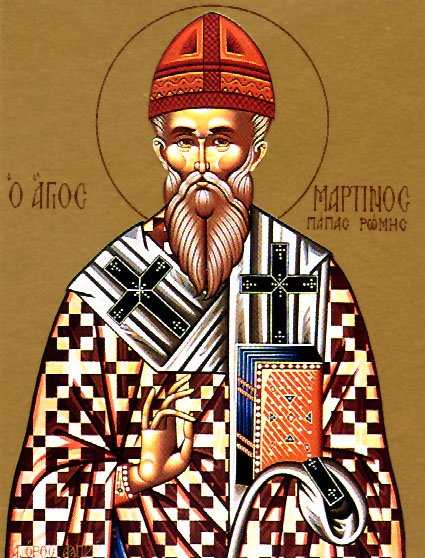
Saint Martin the Confessor, Pope of Rome, was a native of the Tuscany region of Italy. He received a fine education and entered into the clergy of the Roman Church. After the death of Pope Theodore I (642-649), Martin was chosen to succeed him.
At this time the peace of the Church was disturbed by the Monothelite heresy (the false doctrine that in Christ there is only one will, whereas in fact He has a divine, and a human will).
Saint Martin the Confessor, Pope of Rome, was a native of the Tuscany region of Italy. He received a fine education and entered into the clergy of the Roman Church. After the death of Pope Theodore I (642-649), Martin was chosen to succeed him.
At this time the peace of the Church was disturbed by the Monothelite heresy (the false doctrine that in Christ there is only one will, whereas in fact He has a divine, and a human will). The endless disputes of the Monothelites with the Orthodox took place in all levels of the population. Even the emperor Constans (641-668) and Patriarch Paul of Constantinople (641-654) were adherents of the Monothelite heresy. The emperor Constans II published the heretical “Pattern of Faith” (Typos), obligatory for all the population. In it all further disputes were forbidden.
The heretical “Pattern of Faith” was received at Rome in the year 649. Saint Martin, a firm supporter of Orthodoxy, convened the Lateran Council at Rome to condemn the Monothelite heresy. At the same time Saint Martin sent a letter to Patriarch Paul, persuading him to return to the Orthodox confession of faith. The enraged emperor ordered the military commander Olympius to bring Saint Martin to trial. But Olympius feared the clergy and the people of Rome who had descended upon the Council, and he sent a soldier to murder the holy hierarch. When the assassin approached Saint Martin, he was blinded. The terrified Olympius fled to Sicily and was soon killed in battle.
In 654 the emperor sent another military commander, Theodore, to Rome. He accused Saint Martin of being in secret correspondence with the enemies of the Empire, the Saracens, and of blaspheming the Most Holy Theotokos, and of uncanonically assuming the papal throne.
Despite the proofs offered by the Roman clergy and laity of Saint Martin’s innocence, the military commander Theodore with a detachment of soldiers seized Saint Martin by night and took him to Naxos, one of the Cyclades islands in the Aegean Sea. Saint Martin spent an entire year on this almost unpopulated island, suffering deprivation and abuse from the guards. Then they sent the exhausted confessor to Constantinople for trial.
They carried the sick man on a stretcher, but the judges callously ordered him to stand up and answer their questions. The soldiers propped up the saint, who was weakened by illness. False witnesses came forward slandering the saint and accusing him of treasonous relations with the Saracens. The biased judges did not even bother to hear the saint’s defense. In sorrow he said, “The Lord knows what a great kindness you would show me if you would deliver me quickly over to death.”
After such a trial they brought the saint out in tattered clothes to a jeering crowd. They shouted, “Anathema to Pope Martin!” But those who knew the holy Pope was suffering unjustly, withdrew in tears. Finally the sentence was announced: Saint Martin was to be deposed from his rank and executed. They bound the half-naked saint with chains and dragged him to prison, where they locked him up with thieves. These were more merciful to the saint than the heretics.
In the midst of all this the emperor went to the dying Patriarch Paul and told him of the trial of Saint Martin. He turned away from the emperor and said, “Woe is me! This is another reason for my judgment.” He asked that Saint Martin’s torments be stopped. The emperor again sent a notary and other persons to the saint in prison to interrogate him. The saint answered, “Even if they cripple me, I will not have relations with the Church of Constantinople while it remains in its evil doctrines.” The torturers were astonished at the confessor’s boldness, and they commuted his death sentence to exile at Cherson in the Crimea.
Saint Martin departed to the Lord, exhausted by sickness, hunger and deprivations on September 16, 655. Two other bishops, who were banished to Cherson, also died after many hardships. The Saint was buried just outside the city of Cherson, in the Blachernae church of the Most Holy Theotokos. Great crowds of people visited his tomb because of the many miracles which took place there. Later, his relics were transferred to Rome, and placed in a church dedicated to Martin of Tours (November 11). The transfer of his relics is commemorated on November 12.
The Monothelite heresy was condemned at the Sixth Ecumenical Council in 680.
In Greek usage, the holy Confessor Martin is commemorated on April 13 and on September 20, while the Slavic churches commemorate him on April 14.
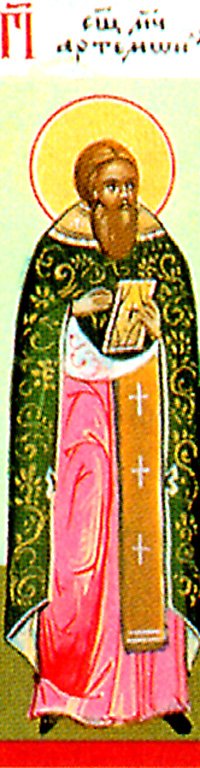
Hieromartyr Artemon of Laodikeia
At the time of Diocletian’s persecutions, he was a very old man, having served as a reader for sixteen years, then a deacon for twenty-eight years, and finally as a priest for thirty years, for a total of seventy-four years. The pagan judge put him in the Temple of Aesculapius, where large snakes were kept and worshiped as gods. T
At the time of Diocletian’s persecutions, he was a very old man, having served as a reader for sixteen years, then a deacon for twenty-eight years, and finally as a priest for thirty years, for a total of seventy-four years. The pagan judge put him in the Temple of Aesculapius, where large snakes were kept and worshiped as gods. Though the judge meant for Artemon to be attacked by the snakes, the holy priest immobilized them with the sign of the Cross, brought them out of the temple and, in front of the pagan priests, breathed on the snakes, which died instantly. The chief priest, Vitalis, fell to his knees and cried ‘Great is the Christian God!’ Artemon baptised him along with several of his friends.
The unrepentant judge then condemned Artemon to be thrown into burning pitch, but the judge himself was thrown off his horse into the pitch and died. After this, Artemon went free for a time and spent his time teaching the Faith to his people (“accompanied always by two tame deer,” says St Nikolia Velimirovic!). But he was arrested again and beheaded in the year 303.
Troparion - Tone 4
By sharing in the ways of the Apostles, / you became a successor to their throne. / Through the practice of virtue, you found the way to divine contemplation, O inspired one of God; / by teaching the word of truth without error, you defended the Faith, / even to the shedding of your blood. / Hieromartyr Artemon, entreat Christ God to save our souls.
Kontakion - Tone 4
Made worthy of a sacred confession, / and completing your life as a martyr, / you were translated to heaven, / receiving from God an unfading crown. / Therefore we celebrate your holy memory, calling out: / Remember us, as you stand before Christ, / O wise Hieromartyr Artemon.
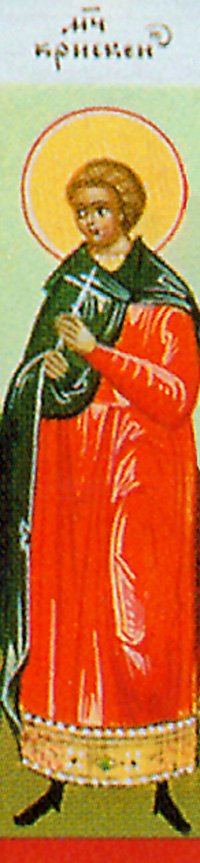
Martyr Crescens of Myra in Lycia
The Holy Martyr Crescens (Kreskes) was descended from an illustrious family and lived in Myra of Lycia. When a throng of city inhabitants were on the way to the pagan temple, he urged them to forsake paganism and come to Christ. This incident became known to the city prefect.
When the prefect asked the saint about his parentage, the saint, not wishing to bring unpleasantness to his parents, said nothing except that he was a Christian.
The Holy Martyr Crescens (Kreskes) was descended from an illustrious family and lived in Myra of Lycia. When a throng of city inhabitants were on the way to the pagan temple, he urged them to forsake paganism and come to Christ. This incident became known to the city prefect.
When the prefect asked the saint about his parentage, the saint, not wishing to bring unpleasantness to his parents, said nothing except that he was a Christian. The prefect knew Saint Crescens’ father and wanted to do him a favor. He suggested that Saint Crescens only appear to offer sacrifice to idols, while remaining a Christian.
The holy martyr replied, “It is impossible for the body not to do as the soul thinks, since the soul governs and moves the body.” They beat the holy martyr Crescens and raked him with iron claws, and then burned him in a fire.
Saint Andrew of Crete (July 4) mentions the Martyr Crescens in his Sermon on the Feast of Saint Nicholas the Wonderworker (December 6), who also came from Myra of Lycia.
Troparion - Tone 3
Your holy martyr Crescens, O Lord, / through his suffering has received an incorruptible crown from You, our God. / For having Your strength, he laid low his adversaries, / and shattered the powerless boldness of demons. / Through his intercessions, save our souls!
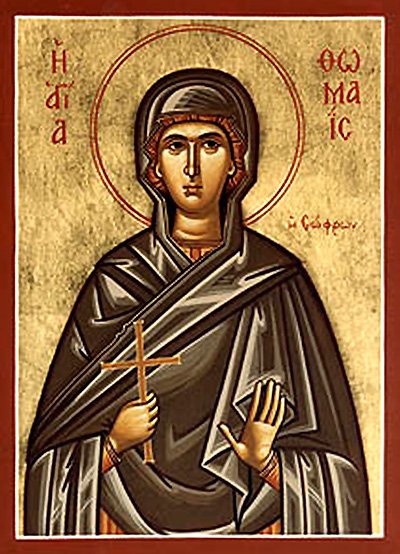
Martyr Thomais of Alexandria
The Holy Martyr Thomais (Thomaίs) was born into a Christian family in the city of Alexandria. She was raised in piety, and loved to read spiritual books.
When she was fifteen, Thomais married a fisherman, who was also a Christian. The young couple lived in the home of her husband’s family, where Saint Thomaίs was loved for her mild and gentle disposition, and for her other good traits.
He
The Holy Martyr Thomais (Thomaίs) was born into a Christian family in the city of Alexandria. She was raised in piety, and loved to read spiritual books.
When she was fifteen, Thomais married a fisherman, who was also a Christian. The young couple lived in the home of her husband’s family, where Saint Thomaίs was loved for her mild and gentle disposition, and for her other good traits.
Her father-in-law, at the prompting of the devil, was captivated by her beauty. One night, when his son went out fishing, he attempted to lead his daughter-in-law into sin. Horrified, Saint Thomais admonished the senseless old man, reminding him of the Last Judgment and the penalty for sin. Infuriated by her steadfastness, he grabbed a sword and threatened to cut off her head. Saint Thomaίs replied: “Even if you cut me to pieces, I shall not stray from the Lord's commandments.” Overcome with passion, the old man cut Saint Thomais in two with the sword. Thus, the Saint received the crown of martyrdom in the year 476.
Divine punishment overtook the murderer. He was struck blind and could not find the door in order to escape. The next morning, the friends of the Saint’s husband came to the door. They saw her body, and the blind old man covered with blood. The murderer confessed his evil deed and asked to be taken to the judge for punishment. He was then beheaded for his crime.
At this time, Saint Daniel of Skete (Skḗtē) (June 7) happened to be in Alexandria. He told the monks of the Oktokaidekaton Monastery (at the eighteenth milestone on the road leading west from Alexandria) to bring the Martyr's body to the Monastery and bury her in the cemetery with the departed Fathers. Some of the monks were scandalized because he wanted to bury a woman’s body with the monks. Saint Daniel replied, “She is a mother to me and to you, because she died for her chastity.”
After the funeral Saint Daniel returned to Skete. Soon one of the young monks confessed to him that he was being tormented by carnal passions. Saint Daniel ordered him to go and pray at the grave of the Holy Martyr Thomais. The monk obeyed the Elder. As he prayed at the grave, he fell into a light sleep. Saint Thomaίs appeared to him and said, “Father, receive my blessing and go in peace.”
When he awakened, the monk felt joy and peace in his soul. After this, he told Saint Daniel that he was no longer bothered by the temptations of the flesh. Abba Daniel exclaimed, “Great is the boldness of those who have struggled for chastity.”
Many found both spiritual joy and release from their passions at the grave of Saint Thomais. Her holy relics were transferred to Constantinople to one of the women’s monasteries. The Russian pilgrim Archdeacon Zosimas venerated them in 1420.
Saint Thomais is invoked by those seeking deliverance from sexual impurity. Other Saints whose intercession we seek for this purpose are: Saint John the Much-Suffering (July 18), and Saint Moses the Hungarian (July 26).
Part of the Saint's Holy Skull is located in the Holy Monastery of Dionysiou on Mount Athos.
In Greek usage, Saint Thomaίs is commemorated on April 14.
Troparion - Tone 3
Your holy martyr Thomais, O Lord, / through her suffering has received an incorruptible crown from You, our God. / For having Your strength, she laid low her adversaries, / and shattered the powerless boldness of demons. / Through her intercessions, save our souls!
Scripture Readings
☩Epistle
Acts 1:12-17, 21-26
12
Then returned they unto Jerusalem from the mount called Olivet, which is from Jerusalem a sabbath day’s journey.
13
And when they were come in, they went up into an upper room, where abode both Peter, and James, and John, and Andrew, Philip, and Thomas, Bartholomew, and Matthew, James the son of Alpheus, and Simon Zelotes, and Judas the brother of James.
14
These all continued with one accord in prayer and supplication, with the women, and Mary the mother of Jesus, and with his brethren.
15
And in those days Peter stood up in the midst of the disciples, and said, (the number of names together were about an hundred and twenty,)
16
Men and brethren, this scripture must needs have been fulfilled, which the Holy Ghost by the mouth of David spake before concerning Judas, which was guide to them that took Jesus.
17
For he was numbered with us, and had obtained part of this ministry.
21
Wherefore of these men which have companied with us all the time that the Lord Jesus went in and out among us,
22
Beginning from the baptism of John, unto that same day that he was taken up from us, must one be ordained to be a witness with us of his resurrection.
23
And they appointed two, Joseph called Barsabas, who was surnamed Justus, and Matthias.
24
And they prayed, and said, Thou, Lord, which knowest the hearts of all men, shew whether of these two thou hast chosen,
25
That he may take part of this ministry and apostleship, from which Judas by transgression fell, that he might go to his own place.
26
And they gave forth their lots; and the lot fell upon Matthias; and he was numbered with the eleven apostles.
☩Gospel
John 20:19-25
19
Then the same day at evening, being the first day of the week, when the doors were shut where the disciples were assembled for fear of the Jews, came Jesus and stood in the midst, and saith unto them, Peace be unto you.
20
And when he had so said, he shewed unto them his hands and his side. Then were the disciples glad, when they saw the Lord.
21
Then said Jesus to them again, Peace be unto you: as my Father hath sent me, even so send I you.
22
And when he had said this, he breathed on them, and saith unto them, Receive ye the Holy Ghost:
23
Whose soever sins ye remit, they are remitted unto them; and whose soever sins ye retain, they are retained.
24
But Thomas, one of the twelve, called Didymus, was not with them when Jesus came.
25
The other disciples therefore said unto him, We have seen the Lord. But he said unto them, Except I shall see in his hands the print of the nails, and put my finger into the print of the nails, and thrust my hand into his side, I will not believe.
Liturgical data sourced from OCA.org and orthocal.info