“Saint Irene was the daughter of a princelet called Licinius; named Penelope by her parents, through a divine revelation she was brought to faith in Christ and at Baptism was renamed Irene. In her zeal for piety she broke in pieces all the idols of her father, who commanded that she be trampled underfoot by horses. B
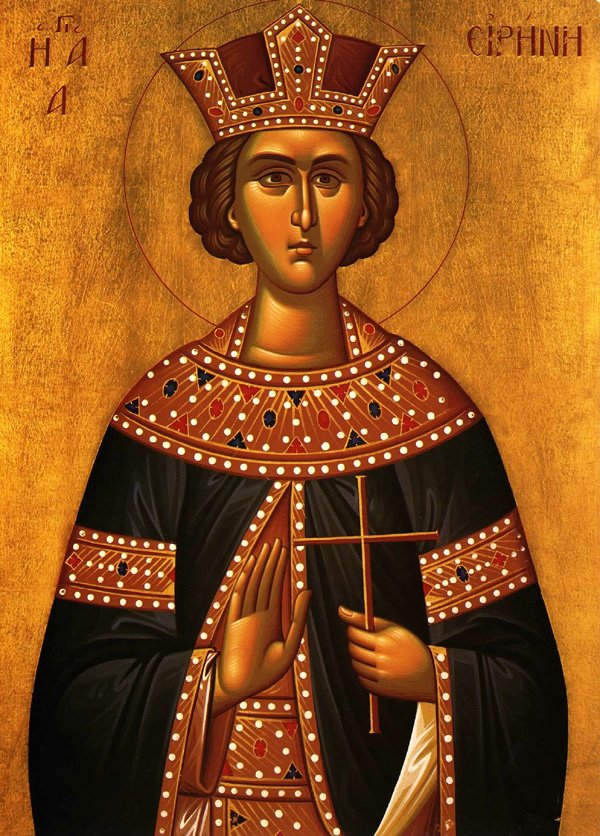
“Saint Irene was the daughter of a princelet called Licinius; named Penelope by her parents, through a divine revelation she was brought to faith in Christ and at Baptism was renamed Irene. In her zeal for piety she broke in pieces all the idols of her father, who commanded that she be trampled underfoot by horses. But while she remained unharmed, one of the horses rose up and cast down her father, killing him. By her prayer she raised him to life again, and he believed and was baptized. Afterwards, in many journeyings, Saint Irene suffered torments and punishments for her faith, but was preserved by the power of God, while working dread miracles and converting many thousands of souls. At last she came to Ephesus, where she fell asleep in peace, in the first half of the fourth century. Two days after her death, her gravestone was found lifted off, and her grave empty. At least two churches were dedicated to St Irene in Constantinople, and she is the patroness of the Aegean island of Thera, which is commonly called Santorini, a corruption of “Saint Irene.” (Great Horologion)
Note: The most famous Agia Irene church in Constantinople is not named after her, but for the Holy Peace (Greek Irene) of God, which is Christ.
The Prologue’s account differs in several details. St Nikolai places St Irene in the Balkans in the town of Magedon, in apostolic times rather than the 3rd-4th century. In his account Irene learned the Christian faith from her teacher, Appelianus, and was baptised by the Apostle Timothy himself. He attributes the anger of Irene’s father to her refusal to marry rather than her smashing the family idols (though of course she might have done both).
Uncovering of the relics of Venerable James, Abbot of Zhelezny Bor
Saint James of Zhelezny Bor. Today we celebrate the Uncovering of the Relics of the Kostroma Wonderworker. See his Life under April 11, the day of his repose.
Troparion - Tone 8
By a flood of tears you made the desert fertile, / and your longing for God brought forth fruits in abundance. / By the radiance of miracles you illumined the whole universe! / O our holy father James, pray to Christ our God to save our souls!
New Martyr Ephraim
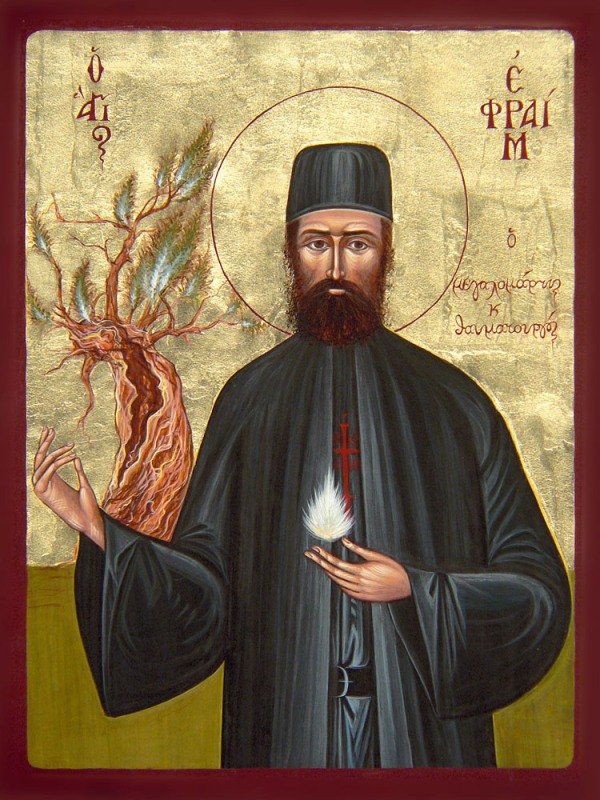
The holy New Martyr and wonderworker Ephraim was born in Greece on September 14, 1384. His father died when the saint was young, and his pious mother was left to care for seven children by herself.
When Ephraim reached the age of fourteen, the all-good God directed his steps to a monastery on the mountain of Amoman near Nea Makri in Attica.
The holy New Martyr and wonderworker Ephraim was born in Greece on September 14, 1384. His father died when the saint was young, and his pious mother was left to care for seven children by herself.
When Ephraim reached the age of fourteen, the all-good God directed his steps to a monastery on the mountain of Amoman near Nea Makri in Attica. The monastery was dedicated to the Annunciation and also to Saint Paraskevḗ. Here he took on his shoulders the Cross of Christ, which all His followers must bear (Matt. 16:24). Being enflamed with love for God, Saint Ephraim eagerly placed himself under the monastic discipline. For nearly twenty-seven years he imitated the life of the great Fathers and ascetics of the desert. With divine zeal, he followed Christ and turned away from the attractions of this world. By the grace of God, he purified himself from soul-destroying passions and became an abode of the All-Holy Spirit. He was also found worthy to receive the grace of the priesthood, and served at the altar with great reverence and compunction.
On September 14, 1425, the barbarous Turks launched an invasion by sea, destroying the monastery and and looting the surrounding area. Saint Ephraim was one of the victims of their frenzied hatred. Many of the monks had been tortured and beheaded, but Saint Ephraim remained calm. This infuriated the Turks, so they imprisoned him in order to torture him and force him to deny Christ.
They locked him in a small cell without food or water, and they beat him every day, hoping to convince him to become a Moslem. For several months, he endured horrible torments. When the Turks realized that the saint remained faithful to Christ, they decided to put him to death. On Tuesday May 5, 1426, they led him from his cell. They turned him upside down and tied him to a mulberry tree, then they beat him and mocked him. “Where is your God,” they asked, “and why doesn’t he help you?” The saint did not lose courage, but prayed, “O God, do not listen to the words of these men, but may Thy will be done as Thou hast ordained.”
The barbarians pulled the saint’s beard and tortured him until his strength ebbed. His blood flowed, and his clothes were in tatters. His body was almost naked and covered with many wounds. Still the Hagarenes were not satisfied, but wished to torture him even more. One of them took a flaming stick and plunged it violently into the saint’s navel. His screams were heart-rending, so great was his pain. The blood flowed from his stomach, but the Turks did not stop. They repeated the same painful torments many times. His body writhed, and all his limbs were convulsed. Soon, the saint grew too weak to speak, so he prayed silently asking God to forgive his sins. Blood and saliva ran from his mouth, and the ground was soaked with his blood. Then he lapsed into unconsciousness.
Thinking that he had died, the Turks cut the ropes which bound him to the tree, and the saint’s body fell to the ground. Their rage was still not diminished, so they continued to kick and beat him. After a while, the saint opened his eyes and prayed, “Lord, I give up my spirit to Thee.” About nine o’clock in the morning, the martyr’s soul was separated from his body.
These things remained forgotten for nearly 500 years, hidden in the depths of silence and oblivion until January 3, 1950. By then a women’s monastery had sprung up on the site of the old monastery. Abbess Makaria (+ April 23, 1999) was wandering through the ruins of the monastery, thinking of the martyrs whose bones had been scattered over that ground, and whose blood had watered the tree of Orthodoxy. She realized that this was a holy place, and she prayed that God would permit her to behold one of the Fathers who had lived there.
After some time, she seemed to sense an inner voice telling her to dig in a certain spot. She indicated the place to a workman whom she had hired to make repairs at the old monastery. The man was unwilling to dig there, for he wanted to dig somewhere else. Because the man was so insistent, Mother Makaria let him go where he wished. She prayed that the man would not be able to dig there, and so he struck rock. Although he tried to dig in three or four places, he met with the same results. Finally, he agreed to dig where the abbess had first indicated.
In the ruins of an old cell, he cleared away the rubble and began to dig in an angry manner. The abbess told him to slow down, for she did not want him to damage the body that she expected to find there. He mocked her because she expected to find the relics of a saint. When he reached the depth of six feet, however, he unearthed the head of the man of God. At that moment an ineffable fragrance filled the air. The workman turned pale and was unable to speak. Mother Makaria told him to go and leave her there by herself. She knelt and reverently kissed the body. As she cleared away more earth, she saw the sleeves of the saint’s rasson. The cloth was thick and appeared to have been woven on the loom of an earlier time. She uncovered the rest of the body and began to remove the bones, which appeared to be those of a martyr.
Mother Makaria was still in that holy place when evening fell, so she read the service of Vespers. Suddenly she heard footsteps coming from the grave, moving across the courtyard toward the door of the church. The footsteps were strong and steady, like those of a man of strong character. The nun was afraid to turn around and look, but then she heard a voice say, “How long are you going to leave me here?”
She saw a tall monk with small, round eyes, whose beard reached his chest. In his left hand was a bright light, and he gave a blessing with his right hand. Mother Makaria was filled with joy and her fear disappeared. “Forgive me,” she said, “I will take care of you tomorrow as soon as God makes the day dawn.” The saint disappeared, and the abbess continued to read Vespers.
In the morning after Matins, Mother Makaria cleaned the bones and placed them in a niche in the altar area of the church, lighting a candle before them. That night Saint Ephraim appeared to her in a dream. He thanked her for caring for his relics, then he said, “My name is Saint Ephraim.” From his own lips, she heard the story of his life and martyrdom.
Since Saint Ephraim glorified God in his life and by his death, the Lord granted him the grace of working miracles. Those who venerate his holy relics with faith and love have been healed of all kinds of illnesses and infirmities, and he is quick to answer the prayers of those who call upon him.
Saint Ephraim is also commemorated on January 3.
Inexhastible Chalice Icon of the Mother of God
According to the iconographic models, the Inexhaustible Chalice Icon of the Mother of God belongs to the Orans type -the Mother of God is depicted with her hands upraised, before her is the Divine Infant standing in the chalice. This is the Communion Chalice – an inexhaustible source of spiritual joy and consolation. T
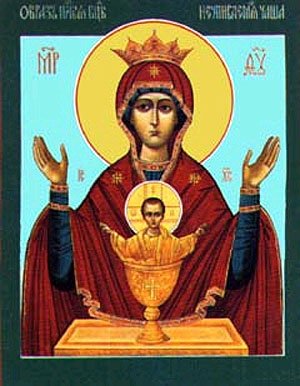
According to the iconographic models, the Inexhaustible Chalice Icon of the Mother of God belongs to the Orans type -the Mother of God is depicted with her hands upraised, before her is the Divine Infant standing in the chalice. This is the Communion Chalice – an inexhaustible source of spiritual joy and consolation. The Most Holy Theotokos prays for all sinners, and declares that the Inexhaustible Chalice of heavenly help and mercy is prepared for every sufferer.
The Icon's appearance was preceded by an unusual incident which occurred in 1878 in Tula Province. A retired soldier was possessed by the passion of drunkenness. He drank everything that he had, and soon he became a beggar. His legs were paralyzed from abusing alcohol, but that didn't stop him, and he continued to drink. Once, in a dream, the former soldier, now a peasant, saw an Elder who ordered him to go to the city of Serpukhov to the Monastery of the Sovereign Lady Theotokos, where the Inexhaustible Chalice Icon of the Mother of God was located, and to have a Moleben served before it.
Since he had no money, and his legs were paralyzed, the peasant was unable to go. Then the Holy Elder appeared to him a second and a third time, menacingly commanding him to do as he was told. The retired soldier crawled to Serpukhov on all fours, stopping in one of the villages along the way to rest. To alleviate the man's pain and suffering, the old landlady rubbed his legs and laid him on the stove. The next day the soldier felt better, but the woman kept him for another night, rubbing his sore legs again. Leaning on two sticks, and then just one, the peasant slowly reached Serpukhov.
In the Monastery of the Sovereign Lady, he told the nuns about his wondrous dreams and asked that a Moleben be served before the Inexhaustible Chalice Icon of the Mother of God. His request confused the nuns, for no one in the Monastery knew of such an icon. Only after some time did they find the Icon hanging in the passage from the temple to the sacristy. On the reverse side was the inscription "Inexhaustible Chalice." In the countenence of Saint Barlaam of Serpukhov (May 5), the disciple of the Metropolitan Alexei, the peasant recognized the Holy Elder who had appeared to him in his dreams. The former soldier returned home from Serpukhov already freed from his pernicious passion.
News of the wonderworking Icon quickly spread throughout Russia. People suffering from drunkenness, as well as their relatives and friends, hastened to offer prayers to the Most Holy Theotokos asking her to heal them of their affliction. Many came afterward to thank the Sovereign Lady for her great mercy.
The wonderworking Inexhaustible Chalice Icon was kept in the Monastery of the Sovereign Lady until 1919, and after its closure, it was moved to the Cathedral of Saint Nicholas the White on Kaluzhskaya Street. The further fate of the original Icon is unknown.
In 1993, in Serpukhov's Vysotsk Monastery, and in 1995 in the revived Monastery of the Sovereign Lady, copies of the wonderworking Icon were made, and all the proportions and style characteristic of the original were preserved. All this marked the beginning of the revival of the Icon's veneration after many years of atheism.
People come from all over Russia, and from other countries, to venerate the Inexhaustible Chalice Icon. The wonderworking Icon is renowned as a speedy healier of those suffering from the ailments of drug addiction, alcoholism, and smoking. Notice that the Icon not only heals, but also helps to change a person's way of life, leading him to acknowledge his sins, repent, and return to a godly life.
Unfortunately, the exact day on which the Icon was revealed is not known. In the XIX century, the celebration in honor of the Inexhaustible Chalice Icon took place on November 27 (the same day as the icon of the Mother of God of the Sign) since both of these icons are similar in appearance.
At the end of the XX century, after the restoration of veneration of the Inexhaustible Chalice Icon, its celebration was made to coincide with the Feast Day of Venerable Barlaam of Serpukhov (May 5), since the revelation of the wonderworking Icon occurred through the intercession of that Saint. In 1997, with the blessing of His Holiness Patriarch Alexei II, it was decided to celebrate the Church-wide Feast of the Inexhaustible Chalice Icon of the Mother of God on May 5.
Troparion - Tone 4
O believers, let us turn today to the Divine and wonderworking Icon of the Most Holy Mother of God, / who fills the hearts of the faithful with her mercy from the heavenly Ineffable Chalice, and shows them miracles; / seeing and hearing about these, / we celebrate spiritually and fervently exclaim: / “Most merciful Sovereign Lady, / heal our illnesses and passions, / entreating your Son Christ God to save our souls.”
Kontakion - Tone 4
Your womb was a Holy Throne, containing Christ God, the Heavenly Bread,1 / whoever eats it will not die;2 as the Nourisher of all, / the Theotokos, has said.1 John 6:35.
2 John 6:54.
Venerable Barlaam of Serpukhov
No information available at this time.
Troparion - Tone 3
Taught to please God by Metropolitan Alexei, / you adorned your soul with virtues, and therefore you were the chosen one of the Mother of God, / and you founded a monastery dedicated to the Entry of the Mother of God into the Temple, / for the salvation of many human souls. / As a good instructor of monastics, and a fervent intercessor with God for us, / O Venerable Barlaam, our Father, / pray for the salvation of our souls.
Kontakion - Tone 8
O Venerable Father Barlaam, although your revered relics are kept hidden, / they pour forth bright rays of miracles and healings / for all who turn to you with faith and pray zealously to you; / for you appeared as a true God-pleaser, / ever interceding for all who lovingly honor your holy memory.
Scripture Readings
☩Epistle
Acts 10:21-33
21
Then Peter went down to the men which were sent unto him from Cornelius; and said, Behold, I am he whom ye seek: what is the cause wherefore ye are come?
22
And they said, Cornelius the centurion, a just man, and one that feareth God, and of good report among all the nation of the Jews, was warned from God by an holy angel to send for thee into his house, and to hear words of thee.
23
Then called he them in, and lodged them. And on the morrow Peter went away with them, and certain brethren from Joppa accompanied him.
24
And the morrow after they entered into Cesarea. And Cornelius waited for them, and had called together his kinsmen and near friends.
25
And as Peter was coming in, Cornelius met him, and fell down at his feet, and worshipped him.
26
But Peter took him up, saying, Stand up; I myself also am a man.
27
And as he talked with him, he went in, and found many that were come together.
28
And he said unto them, Ye know how that it is an unlawful thing for a man that is a Jew to keep company, or come unto one of another nation; but God hath shewed me that I should not call any man common or unclean.
29
Therefore came I unto you without gainsaying, as soon as I was sent for: I ask therefore for what intent ye have sent for me?
30
And Cornelius said, Four days ago I was fasting until this hour; and at the ninth hour I prayed in my house, and, behold, a man stood before me in bright clothing,
31
And said, Cornelius, thy prayer is heard, and thine alms are had in remembrance in the sight of God.
32
Send therefore to Joppa, and call hither Simon, whose surname is Peter; he is lodged in the house of one Simon a tanner by the sea side: who, when he cometh, shall speak unto thee.
33
Immediately therefore I sent to thee; and thou hast well done that thou art come. Now therefore are we all here present before God, to hear all things that are commanded thee of God.
☩Gospel
John 7:1-13
1
After these things Jesus walked in Galilee: for he would not walk in Jewry, because the Jews sought to kill him.
2
Now the Jews’ feast of tabernacles was at hand.
3
His brethren therefore said unto him, Depart hence, and go into Judea, that thy disciples also may see the works that thou doest.
4
For there is no man that doeth any thing in secret, and he himself seeketh to be known openly. If thou do these things, shew thyself to the world.
5
For neither did his brethren believe in him.
6
Then Jesus said unto them, My time is not yet come: but your time is alway ready.
7
The world cannot hate you; but me it hateth, because I testify of it, that the works thereof are evil.
8
Go ye up unto this feast: I go not up yet unto this feast; for my time is not yet full come.
9
When he had said these words unto them, he abode still in Galilee.
10
But when his brethren were gone up, then went he also up unto the feast, not openly, but as it were in secret.
11
Then the Jews sought him at the feast, and said, Where is he?
12
And there was much murmuring among the people concerning him: for some said, He is a good man: others said, Nay; but he deceiveth the people.
13
Howbeit no man spake openly of him for fear of the Jews.
 Meat
Allowed
Meat
Allowed
 Fish
Allowed
Fish
Allowed
 Dairy
Allowed
Dairy
Allowed
 Oil
Allowed
Oil
Allowed
 Wine
Allowed
Wine
Allowed