Fasting Rules
 Meat
Abstain
Meat
Abstain
 Fish
Abstain
Fish
Abstain
 Dairy
Abstain
Dairy
Abstain
 Oil
Allowed
Oil
Allowed
 Wine
Allowed
Wine
Allowed
Saints & Commemorations
Hieromartyr Therapon, Bishop of Sardis
For boldly preaching Christ and bringing many to the Faith, he was seized and tortured by the pagans. After imprisoning and starving him, his persecutors bound him to four posts and flogged him until the flesh was stripped from his bones. But he remained alive, and the four dead posts to which he was tied sprouted into tall, green trees, from which many received healing.
For boldly preaching Christ and bringing many to the Faith, he was seized and tortured by the pagans. After imprisoning and starving him, his persecutors bound him to four posts and flogged him until the flesh was stripped from his bones. But he remained alive, and the four dead posts to which he was tied sprouted into tall, green trees, from which many received healing. At last St Therapon was slain by the sword, during the reign of the Emperor Valerian.
Troparion - Tone 4
By sharing in the ways of the Apostles, you became a successor to their throne. / Through the practice of virtue, / you found the way to divine contemplation, O inspired one of God; / by teaching the word of truth without error, / you defended the Faith, even to the shedding of your blood. / Hieromartyr Therapon, entreat Christ God to save our souls.
(The Typikon does not prescribe a Kontakion.)
Kontakion
(The Typikon does not prescribe a Kontakion.)
Trans. Rel. Ven. Nilus of Stolbensk
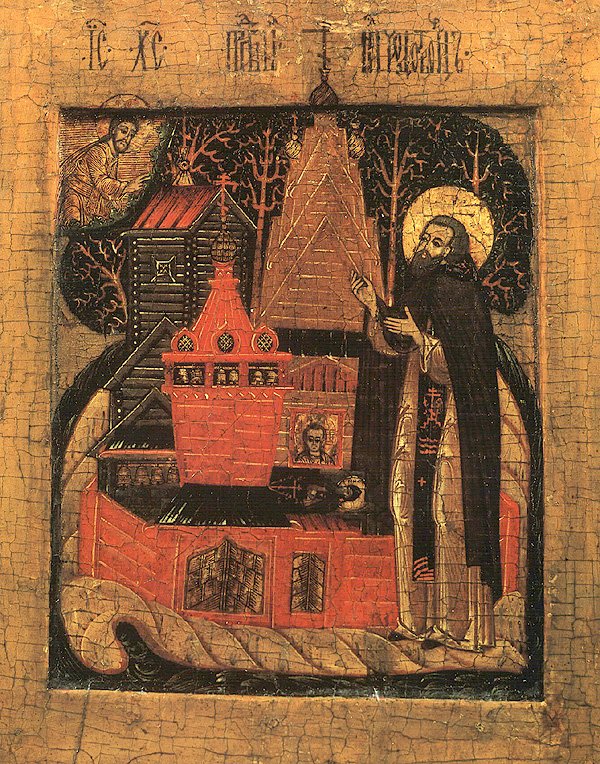
Translation of the relics of Venerable Nilus of Stolobensk
Saint Nilus of Stolobensk reposed on December 7, 1554 (see his Life under December 7).
Many years afterwards, hieromonk Germanus came to the island of Lake Seliger, where the holy ascetic had struggled, and immediately after him the hill-dweller and wanderer Boris. They settled together on the island and built a church in honor of the Theophany, with a chapel dedicated to Saint Basil of Moscow (August 2).
Saint Nilus of Stolobensk reposed on December 7, 1554 (see his Life under December 7).
Many years afterwards, hieromonk Germanus came to the island of Lake Seliger, where the holy ascetic had struggled, and immediately after him the hill-dweller and wanderer Boris. They settled together on the island and built a church in honor of the Theophany, with a chapel dedicated to Saint Basil of Moscow (August 2).
On the site where Saint Nilus had struggled, a monastery named for him was built. An icon of Saint Nilus was painted by the monks of the Orshin monastery, and numerous miracles of healings of the sick began to occur at the saint’s grave.
Later, Saint Nectarius, Archbishop of Sibirsk and Tobolsk lived at the monastery, and he decided to build a stone church to replace the former wooden one. When the foundations were dug, the earth crumbled away and revealed the incorrupt relics of Saint Nilus. The Uncovering of the Relics occurred on May 27, 1667, and a Feast day was established in honor of the event.
Troparion - Tone 8
By a flood of tears you made the desert fertile, / and your longing for God brought forth fruits in abundance. / By the radiance of miracles you illumined the whole universe! / O our holy father Nilus, pray to Christ our God to save our souls!
Holy Martyrs Theodora and Didymus (304)
“In the reign of the wicked Emperor Maximilian, there lived in Alexandria a maiden, Theodora, well-educated and of noble lineage. She was brought to trial before the pagans for her Christian faith. After long interrogation and torture for the Faith, the prince, her tormentor, ordered that she be thrown into a brothel and the soldiers given free access to her to indulge their carnal lusts. T
“In the reign of the wicked Emperor Maximilian, there lived in Alexandria a maiden, Theodora, well-educated and of noble lineage. She was brought to trial before the pagans for her Christian faith. After long interrogation and torture for the Faith, the prince, her tormentor, ordered that she be thrown into a brothel and the soldiers given free access to her to indulge their carnal lusts. Theodora prayed fervently to God to save her from defilement, and, when she had prayed, a soldier called Didymus came in to her and told her that he was a servant of Christ. He dressed her in his soldier’s garb and himself in her dress, then let her out and remained in the brothel himself. He was seized and brought before the judge, where he acknowledged that he was a Christian and had saved Theodora, and was now prepared to die for Christ. He was condemned to death and taken out to the place of execution. Theodora ran up to him there and cried out: ‘Although you saved my honour, I did not ask you to save me from death. Yield the martyr’s death to me!’ Didymus replied: ‘My beloved sister, do not hinder my death for Christ, nor the washing of my sins in my blood.’ Hearing this exchange, the pagans condemned them both to death, and they were beheaded and their bodies burned. They suffered with honour and received eternal wreaths of glory in Alexandria in the year 304.” (Prologue)
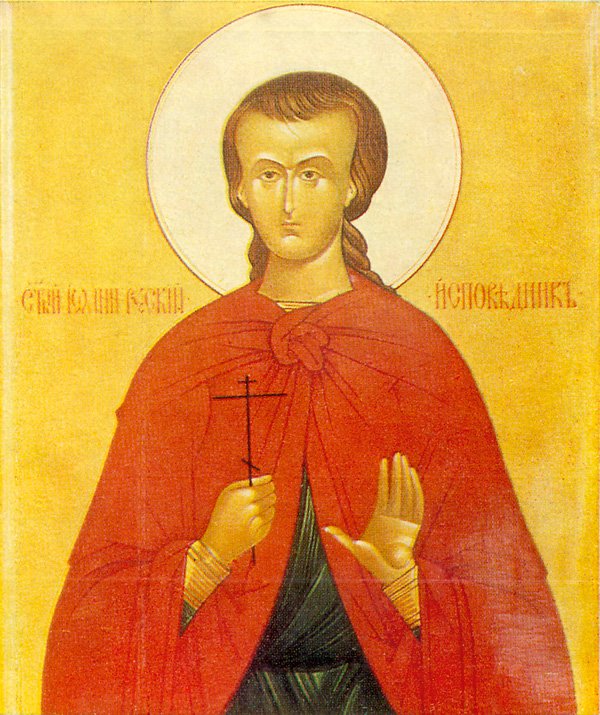
Saint John the Russian and Confessor, whose relics are on the island of Euboia
The Holy Confessor John the Russian was born in Little Russia around 1690, and was raised in piety and love for the Church of God. Upon attaining the age of maturity he was called to military service, and he served as a simple soldier in the army of Peter I and took part in the Russo-Turkish War. During the Prutsk Campaign of 1711 he and other soldiers were captured by the Tatars, who handed him over to the commander of the Turkish cavalry.
The Holy Confessor John the Russian was born in Little Russia around 1690, and was raised in piety and love for the Church of God. Upon attaining the age of maturity he was called to military service, and he served as a simple soldier in the army of Peter I and took part in the Russo-Turkish War. During the Prutsk Campaign of 1711 he and other soldiers were captured by the Tatars, who handed him over to the commander of the Turkish cavalry. He took his Russian captive home with him to Asia Minor, to the village of Prokopion.
The Turks tried to convert the Christian soldiers to the Moslem faith with threats and flattery, but those who resisted were beaten and tortured. Some, alas, denied Christ and became Moslems, hoping to improve their lot. Saint John was not swayed by the promise of earthly delights, and he bravely endured the humiliation and beatings.
His master tortured him often in the hope that his slave would accept Islam. Saint John resolutely resisted the will of his master saying, “You cannot turn me from my holy Faith by threats, nor with promises of riches and pleasures. I will obey your orders willingly, if you will leave me free to follow my religion. I would rather surrender my head to you than to change my faith. I was born a Christian, and I shall die a Christian.”
Saint John’s bold words and firm faith, as well as his humility and meekness, finally softened the fierce heart of his master. He left John in peace, and no longer tried to make him renounce Christianity. The saint lived in the stable and took care of his master’s animals, rejoicing because his bed was a manger such as the one in which the Savior was born.
From morning until late evening the saint served his Turkish master, fulfilling all his commands. He performed his duties in the winter cold and summer heat, half naked and barefoot. Other slaves frequently mocked him, seeing his zeal. Saint John never became angry with them, but on the contrary, he helped them when he could, and comforted them in their misfortune.
The saint’s kindness and gentle nature had its effect on the souls of both the master and the slaves. The Agha and his wife came to love him, and offered him a small room near the hayloft. Saint John did not accept it, preferring to remain in the stable with the animals. Here he slept on the hay, covered only by an old coat. So the stable became his hermitage, where he prayed and chanted Psalms.
Saint John brought a blessing to his master simply by living in his household. The cavalry officer became rich, and was soon one of the most powerful men in Prokopion. He knew very well why his home had been blessed, and he did not hesitate to tell others.
Sometimes Saint John left the stable at night and went to the church of the Great Martyr George, where he kept vigil in the narthex. On Saturdays and Feast days, he received the Holy Mysteries of Christ.
During this time Saint John continued to serve his master as before, and despite his own poverty, he always helped the needy and the sick, and shared his meager food with them.
One day, the officer left Prokopion and went to Mecca on pilgrimage. A few days later, his wife gave a banquet and invited her husband’s friends and relatives, asking them to pray for her husband’s safe return. Saint John served at the table, and he put down a dish of pilaf, his master’s favorite food. The hostess said, “How much pleasure your master would have if he could be here to eat this pilaf with us.” Saint John asked for a dish of pilaf, saying that he would send it to his master in Mecca. The guests laughed when they heard his words. The mistress, however, ordered the cook to give him a dish of pilaf, thinking he would eat it himself, or give it to some poor family.
Taking the dish, Saint John went into the stable and prayed that God would send it to his master. He had no doubt that God would send the pilaf to his master in a supernatual manner. The plate disappeared before his eyes, and he went into the house to tell his mistress that he had sent the pilaf to his master.
After some time, the master returned home with the copper plate which had held the pilaf. He told his household that on a certain day (the very day of the banquet), he returned from the mosque to the home where he was staying. Although the room was locked, he found a plate of steaming pilaf on the table. Unable to explain who had brought the food, or how anyone could enter the locked room, the officer examined the plate. To his amazement, he saw his own name engraved on the copper plate. In spite of his confusion, he ate the meal with great relish.
When the officer’s family heard this story, they marveled. His wife told him of how John had asked for a plate of pilaf to send to his master in Mecca, and how they all laughed when John came back and said that it had been sent. Now they saw that what the saint had said was true (Compare the story of Habakkuk, who miraculously brought a dish of pottage to Daniel in the lions’ den [Dan. 14:33-39], in the Septuagint).
Toward the end of his difficult life Saint John fell ill, and sensed the nearness of his end. He summoned the priest so that he could receive Holy Communion. The priest, fearing to go to the residence of the Turkish commander openly with the Holy Gifts, enclosed the life-giving Mysteries in an apple and brought them to Saint John.
Saint John glorified the Lord, received the Body and Blood of Christ, and then reposed. The holy Confessor John the Russian went to the Lord Whom he loved on May 27, 1730. When they reported to the master that his servant John had died, he summoned the priests and gave them the body of Saint John for Christian burial. Almost all the Christian inhabitants of Prokopion came to the funeral, and they accompanied the body of the saint to the Christian cemetery.
Three and a half years later the priest was miraculously informed in a dream that the relics of Saint John had remained incorrupt. Soon the relics of the saint were transferred to the church of the holy Great Martyr George and placed in a special reliquary. The new saint of God began to be glorified by countless miracles of grace, accounts of which spread to the remote cities and villages. Christian believers from various places came to Prokopion to venerate the holy relics of Saint John the Russian and they received healing through his prayers. The new saint came to be venerated not only by Orthodox Christians, but also by Armenians, and even Turks, who prayed to the Russian saint, “Servant of God, in your mercy, do not disdain us.”
In the year 1881 a portion of the relics of Saint John were transferred to the Russian monastery of the holy Great Martyr Panteleimon by the monks of Mount Athos, after they were miraculously saved by the saint during a dangerous journey.
Construction of a new church was begun in 1886, through the contributions of the monastery and the inhabitants of Prokopion. This was necessary because the church of the holy Great Martyr George, where the relics of Saint John were enshrined, had fallen into disrepair.
On August 15, 1898 the new church dedicated to Saint John the Russian was consecrated by the Metropolitan John of Caesarea, with the blessing of the Ecumenical Patriarch Constantine V.
In 1924, an exchange of the populations of Greece and Turkey took place. Many Moslems moved out of Greece, and many Christians moved out of Turkey. The inhabitants of Prokopion, when they moved to the island of Euboia, took with them part of the relics of Saint John the Russian.
For several decades the relics were in the church of Saints Constantine and Helen at New Prokopion on Euboia, and in 1951 they were transferred into a new church dedicated to Saint John the Russian. Thousands of pilgrims flocked here from all the corners of Greece, particularly on his Feast, May 27. Saint John the Russian is widely venerated on Mount Athos, particularly in the Russian monastery of Saint Panteleimon.
Saint John’s help is sought by travelers, and by those transporting things.
Troparion - Tone 4
O Righteous Father John, / the holy memory of your illustrious contests has come today, / gladdening the souls of those who honor you with reverence and faith.
Holy New Confessor John the Russian (1730)
He was captured during a Russian campaign against the Turks in 1711, and sold into slavery in Asia Minor. As a slave he strove to serve God faithfully, while serving his earthly master in everything honorable. Despite many enticements offered by the Muslims to renounce his faith, he remained steadfast, and was permitted to work miracles through his prayers.
He was captured during a Russian campaign against the Turks in 1711, and sold into slavery in Asia Minor. As a slave he strove to serve God faithfully, while serving his earthly master in everything honorable. Despite many enticements offered by the Muslims to renounce his faith, he remained steadfast, and was permitted to work miracles through his prayers. He reposed in peace in 1730. His relics remained incorrupt.
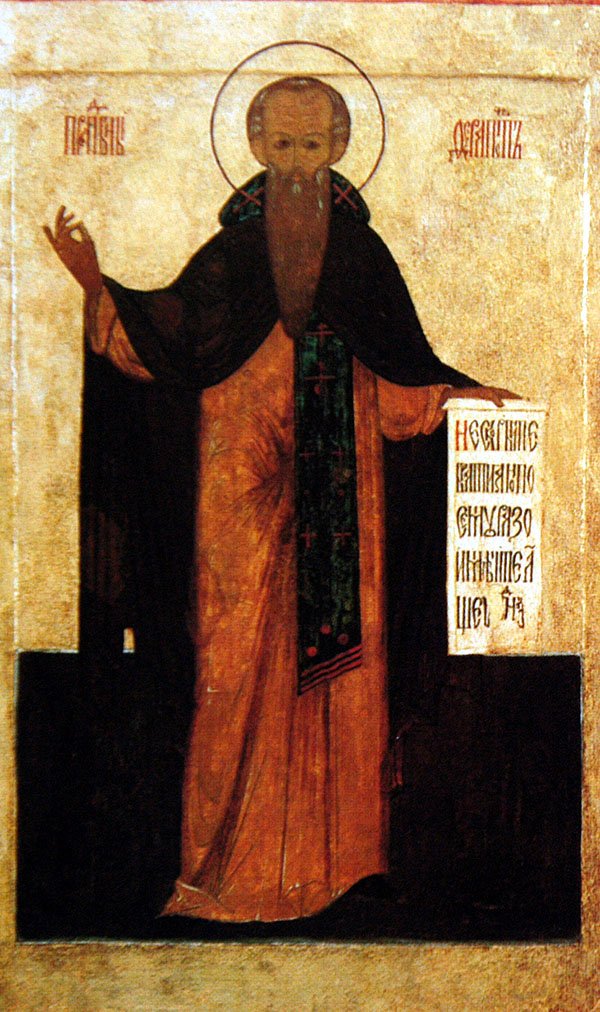
Venerable Therapon, Abbot of White Lake
Saint Therapon of White Lake, Wonderworker of Luzhetsk, in the world Theodore, was born in the year 1337 at Volokolamsk into the noble Poskochin family. From his childhood, he was raised in faith and piety, which he displayed throughout his life as a holy ascetic.
At the age of forty he was tonsured a monk by the igumen of Moscow’s Simonov monastery, Saint Theodore, a nephew of Saint Sergius (November 28). A
Saint Therapon of White Lake, Wonderworker of Luzhetsk, in the world Theodore, was born in the year 1337 at Volokolamsk into the noble Poskochin family. From his childhood, he was raised in faith and piety, which he displayed throughout his life as a holy ascetic.
At the age of forty he was tonsured a monk by the igumen of Moscow’s Simonov monastery, Saint Theodore, a nephew of Saint Sergius (November 28). As a monk in this monastery Therapon became close to Saint Cyril of White Lake (June 9). Together they passed through their ascetic struggles of prayer and fasting. They were under the spiritual guidance of Saint Sergius of Radonezh (September 25 and July 5), who visited the monastery to instruct the brethren. Saint Therapon went north, to the frontier of White Lake, on monastery matters. The harsh northern land attracted the ascetic, and he decided to remain there for his ascetic endeavors.
After returning with Saint Cyril, to whom the Mother of God had appeared, also ordering him to go to the north, Saint Therapon received the blessing of the igumen to go to White Lake. For a while the ascetics lived together in a cell that they had built, but later and by mutual consent, Saint Therapon moved to another place fifteen versts away from Cyril, between two lakes, Borodava and Pava.
Having cleared a small plot for a garden, and building a cell in the deep forest near a river, Saint Therapon continued his ascetic efforts as a hermit in silence. At first he endured much deprivation and tribulation in his solitude. More than once he was set upon by robbers, who tried to chase away or even kill the ascetic. In time monks began to gather to the saint, and the wilderness place was gradually transformed into a monastery, afterwards called the Theraponov.
In 1398 Saint Therapon built a wooden church in honor of the Nativity of the Most Holy Theotokos, and the monastery was gradually set in order. The monks toiled together with their saintly guide building cells, copying books, and adorning the church. (At the end of the fifteenth century on the place of the former wooden church a stone cathedral was built in honor of the Nativity of the Most Holy Theotokos. It was painted in the years 1500-1501 by the renowned Russian iconographer Dionysius and his sons, Vladimir and Theodosius. The frescoes are devoted to the Praise of the Most Holy Theotokos. The unique frescoes of the Saint Therapon monastery have been preserved up to the present time and are an outstanding memorial of Russian church art and painting, having world significance).
A cenobitic monastic rule was introduced at the monastery, strictly observed by the monks. Saint Therapon declined to head the monastery out of humility, and instead entrusted the position of igumen to one of his disciples. The holy ascetic, endowed with the gift of counsel, turned to his friend, Saint Cyril of White Lake for spiritual guidance just as before. News about the ascetic deeds of the saint spread far beyond the White Lake frontier.
At the beginning of the fifteenth century, the lands on which the Saint Cyril and Saint Therapon monasteries were built, were part of the holdings of the Mozhaisk prince Andrew (1382-1432), son of Great Prince Demetrius Donskoy (1363-1389). In the year 1408 Prince Andrew Dimitrievich, learning of the high level of spiritual life of the White Lake ascetic, asked the monastic Elder Therapon to establish a monastery in the city of Mozhaisk.
It was difficult for the saint to leave his own monastery, where he had labored for more than ten years. Saint Therapon was met at Mozhaisk with great honor. Soon, not far from Mozhaisk, in the locality of Lushko, Saint Therapon founded his second monastery on a hilly part of the right bank of the Moscow River. Its chief temple was in honor of the Nativity of the Most Holy Theotokos, in memory of the White Lake monastery. Prince Andrew, esteeming the saint for his true humility, provided generous help in the construction and establishment of the monastery. With the blessing of Saint Photius, Metropolitan of Moscow (July 2 and May 27), the monastery was to be headed by an archimandrite, and Saint Therapon was elevated to the rank of archimandrite.
Saint Therapon dwelt at this new monastery for eighteen years. He reposed at an advanced age, on May 27, 1426. His body was buried at the north wall of the cathedral of the Nativity of the Most Holy Theotokos. Over his grave a church was built in honor of Saint John of the Ladder (March 30), and renamed in 1730 for Saint Therapon.
Veneration of the saint began soon after his death. In 1514, the incorrupt relics of the holy ascetic were uncovered and glorified by numerous miracles. After the Moscow Council of 1547 the canonization of Saint Therapon of Mozhaisk took place after the igumen of the Saint Therapon monastery brought to Metropolitan Macarius (1543-1564) a Life of the saint.
Among the numerous disciples and conversers of Saint Sergius of Radonezh, the Russian Church venerates the memory of Saint Therapon, who in following the counsel of his great teacher and guide, combined the ascetic feats of silence and solitude with active service to his neighbor and the spiritual enlightenment of his Fatherland.
The memory of Saint Therapon is celebrated twice, May 27 (his repose in 1426), and December 27 (Uncovering of his relics, 1514).
Troparion - Tone 4
Enlightened by a pure way of life, / in prayers and fasting you were shown as a beautiful shoot in the
wilderness; / following your spiritual teacher, you directed your thoughts to Heaven, / you were the instructor of your flock; / therefore we entreat you, O Father Therapon, "Pray to Christ God for the salvation of our souls."
Kontakion - Tone 4
Christ, our Most Blessed Savior has multiplied His mercy toward us, / by giving our Venerable Father Therápon as an intercessor and a healer he illumines us with the light of his holy life; / and now, by his prayers, he protects his temple from enemies, and from destruction; / this land from hell, and from a vain death; / and all those who honor his memory from sickness, and from fierce passions.
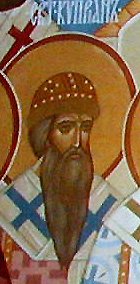
Translation of the relics of Saints Cyprian, Photius, and Jonah, Metropolitans of Moscow and All Russia
The Uncovering and Transfer of Relics of Holy Hierarchs Cyprian, Photius and Jonah occured on May 27, 1472 during the construction of the new stone Dormition cathedral in the Kremlin, under Metropolitan Philip (January 9) and Great Prince Ivan III (1462-1505). The saints are also commemorated separately: Metropolitan Cyprian (September 16),
The Uncovering and Transfer of Relics of Holy Hierarchs Cyprian, Photius and Jonah occured on May 27, 1472 during the construction of the new stone Dormition cathedral in the Kremlin, under Metropolitan Philip (January 9) and Great Prince Ivan III (1462-1505). The saints are also commemorated separately: Metropolitan Cyprian (September 16), Metropolitan Photius (July 2), Metropolitan Jonah (March 31).
Troparion - Tone 4
In truth you were revealed to your flocks as a rule of faith, / images of humility and teachers of abstinence; / your humility exalted you; / your poverty enriched you. / Hierarch Fathers Cyprian, Photius, and Jonah, / entreat Christ our God / that our souls may be saved.
Saint David of Garesjei (6th c.)
“This David is one of the thirteen Georgian Fathers (May 7). He is thus named for the Garajeli desert near Tiflis, where he lived the ascetic life. In old age, David decided to visit the Holy Land with several of his disciples. He left the direction of the monastery to two elders, Lucian and Dodo, and set out on the way. W
“This David is one of the thirteen Georgian Fathers (May 7). He is thus named for the Garajeli desert near Tiflis, where he lived the ascetic life. In old age, David decided to visit the Holy Land with several of his disciples. He left the direction of the monastery to two elders, Lucian and Dodo, and set out on the way. When they came to a hill from which Jerusalem was visible, David burst into tears and said: ‘How can I dare to walk in the steps of God incarnate with these sinful feet?’, and he told his disciples to go and worship at the holy places, but he himself took up three stones and set off to return. But the Lord did not let such humility remain hidden from the world, and an angel appeared to Elias, the Patriarch of Jerusalem, and said to him: ‘Send at once for the elder who is even now returning to Syria; he has taken with him three stones, and is carrying with him all the Holy Land’s grace. One stone is a sufficient blessing for him; let him return the other two to Jerusalem. He is called Abba David of Garesjei.’ The Patriarch quickly sent men off to overtake the elder. They took two stones from him, and let him go on his way. The third stone lies on his grave to this day, and possesses miraculous healing power.” (Prologue)
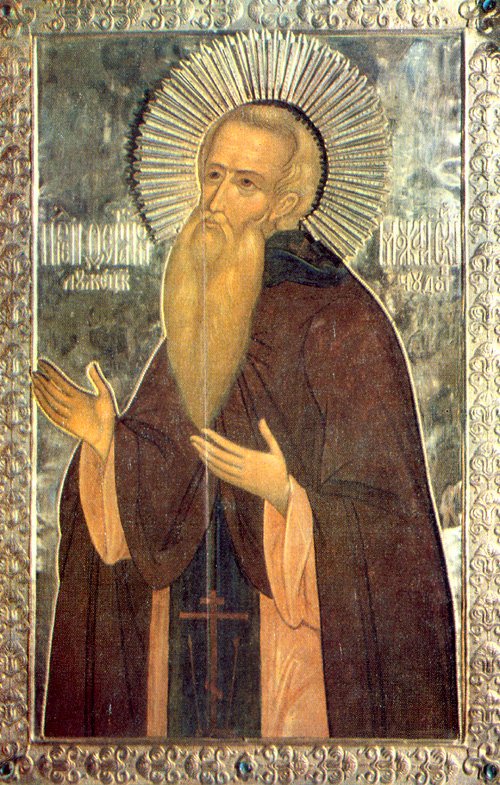
Venerable Therapon, Abbot of Monza
There is no information about the Saint's birth and early years of his life. He began his contests (podvigs) in Moscow (it is likely that he was a Holy Fool, emulating Blessed Basil of Moscow), then he went to the Monastery of the Universal Exaltation of the Holy Cross at Kostroma, where, after his monastic tonsure, he lived for thirteen years.
There is no information about the Saint's birth and early years of his life. He began his contests (podvigs) in Moscow (it is likely that he was a Holy Fool, emulating Blessed Basil of Moscow), then he went to the Monastery of the Universal Exaltation of the Holy Cross at Kostroma, where, after his monastic tonsure, he lived for thirteen years. Even during his lifetime, the Saint was renowned for his miracles.
One day the Venerable Therapon (Therápon) appeared in a dream to two monks of the Saint Paul of Obnora Monastery, Paphnoutios and Addrian. and ordered them to found a Monastery on the banks of the Monza River (near Soligalich). Avoiding the glory of man, Father Therapon retired from the Holy Cross Monastery and lived for some time as a hermit. When the Monastery on the Monza River was built by Elder Adrian (May 5), the monk glorified him by two miracles: appearing in a dream to a fisherman from Soligalich and to the blacksmith from Bui, whose sons were sick, he predicted that their children would be healed in the newly built Monastery of the Annunciation on the Monza River. And, indeed, brought to the monastery, both young men were healed.
After some time Father Therapon himself came to the Annunciation Monastery and asked the Igoumen, Elder Adrian, to become his Spiritual Father. During Confession, Adrian was shocked by Therapon's spiritual purity and by the power of his faith. The two years of Therápon's sojourn in the Monastery of Monza were a time of great humility, meekness and ascetic feats. Annunciation Monastery was always dear to Father Therapon: he was wondrous, he contributed to his arrangement and transfer to a new place, protected him from ill-wishers, miraculously sought him out means for its maintenance.
Foreseeing the day of his death, the Saint bade farewell to the brethren and reposed peacefully on December 12, 1597. He asked that he, who had already died, be given the Holy Water from Theophany. Granting the Saint's request, he was given the Holy Water, and he swallowed it. The Monastery Chronicle describes numerous healings which took place at the Saint's tomb. Once the Saint saved some ships from destruction while they were passing through the rapids on the Kostroma River, directly opposite Annunciation Monastery, and some saw a handsome old man sitting on the stern every plow and ruler in a dangerous place. Saint Therapon also appeared in a dream to the Igoumen of the Monastery, and predicted the famine of 1601 and ordered that more bread to be stored.
Twenty years after the Saint's repose, his incorrupt relics were discovered, and even his vestments were intact.
Saint Therapon is commemorated on May 27 (His Name Day), February 5 (Synaxis of the Kostroma Saints), and December 12 (Repose).
Troparion - Tone 8
Having been enlightened with the love of Christ, O divinely-wise one, / you emulated the virtues of Basil the Blessed in all things, / and despising bodily pleasure, you dwelt in the wilderness, / there you especially labored in prayerful singing, vigil and fasting. / Therefore, Christ has enriched you with the gift of miracles. / Remember us who honor your most illustrious memory, O Venerable Father Therápon, / and pray to Christ God for the salvation of our souls.
Kontakion - Tone 8
Having devoted yourself to God from your youth, O Venerable one, / loving Him most of all, you followed Him with all your heart and love, / you disdained perishable earthly goods, you dwelt in the wilderness, / and in it you struggled well against the intrigues of invisible enemies / and, like a shining sun, shone within the boundaries of the Galich land, / from there, rejoicing, you passed to the Heavenly abodes, / and now, standing with the Angels before the throne of the Master, / remember us, who honor your memory, that we may cry out to you: “Rejoice, Therápon, our Father.”
Virgin Martyr Theodora and Martyr Didymus the Soldier, of Alexandria
The Holy Martyrs Theodora the Virgin and Didymus the Soldier suffered for Christ during the persecution against Christians under the emperor Diocletian (284-305), in the city of Alexandria in either the year 303 or 304.
The Virgin Martyr Theodora, standing trial before the prefect Eustratius of Alexandria, bravely confessed herself a Christian.
The Holy Martyrs Theodora the Virgin and Didymus the Soldier suffered for Christ during the persecution against Christians under the emperor Diocletian (284-305), in the city of Alexandria in either the year 303 or 304.
The Virgin Martyr Theodora, standing trial before the prefect Eustratius of Alexandria, bravely confessed herself a Christian. When the prefect asked why she had not married, the saint replied that she had dedicated herself to God, and had resolved to remain a virgin for the name of Christ.
Eustratius ordered the holy virgin to be taken to prison, giving her three days to make up her mind, and he threatened to have her taken to a brothel if she persisted in her disobedience. Brought again to trial three days later, Saint Theodora remained as resolute in her faith as before.
The saint was taken to the brothel, where dissolute youths began to argue which of them should be the first to have her. At this moment the Christian Didymus, dressed in soldier’s garb, entered the brothel without hindrance. He chased the frightened profligates out and saved the holy virgin, giving her his clothes so she could escape.
Upon learning what had happened, Eustratius interrogated Saint Didymus. Brought before the angry judge, Saint Didymus told how he had set the holy virgin free, and for this he was sentenced to death. Saint Theodora appeared at the place of execution, and said that she wanted to die with Saint Didymus. The prefect gave orders to execute both of them . The first to bend the neck beneath the sword was the holy martyr Theodora, and then the holy Martyr Didymus. The bodies of the martyrs were then burned.
Troparion - Tone 4
Your holy martyrs Theodora and Didymus, O Lord, / through their sufferings have received incorruptible crowns from You, our God. / For having Your strength, they laid low their adversaries, / and shattered the powerless boldness of demons. / Through their intercessions, save our souls!
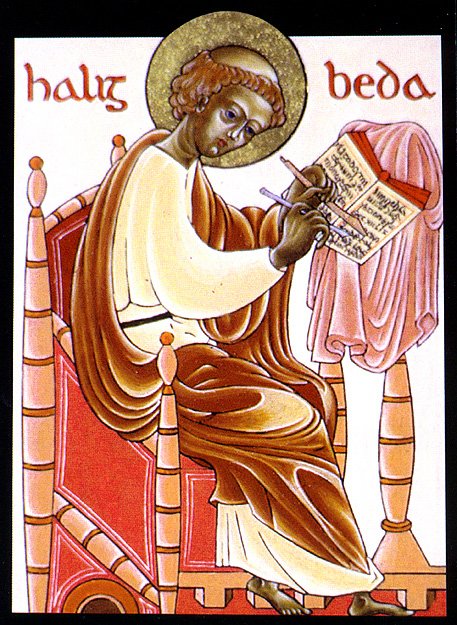
Venerable Bede, the Church Historian
He spent almost his entire life as a monk in England, and is known primarily for his many writings. He entered the monastery at Wearmouth at the age of seven, and later moved (perhaps as one of the founders) to the monastery of Jarrow, where he spent the remainder of his life. He was ordained to the priesthood in his thirtieth year.
He spent almost his entire life as a monk in England, and is known primarily for his many writings. He entered the monastery at Wearmouth at the age of seven, and later moved (perhaps as one of the founders) to the monastery of Jarrow, where he spent the remainder of his life. He was ordained to the priesthood in his thirtieth year. In addition to many works of biblical exegesis, very popular in the middle ages, he compiled the Ecclesiastical History, still the primary source for the history of Christianity’s establishment in the British isles. He reposed in peace.
A problem: Bede lived during the time of the undivided Church, but was only canonized, in the west, in 1899, centuries after the Great Schism. Presumably, then, he has never been formally glorified by the Orthodox Church. Is he a Saint of the Church? We leave the answer to wiser heads.
Troparion - Tone 8
By a flood of tears you made the desert fertile, / and your longing for God brought forth fruits in abundance. / By the radiance of miracles you illumined the whole universe! / O our holy father Bede, pray to Christ our God to save our souls!
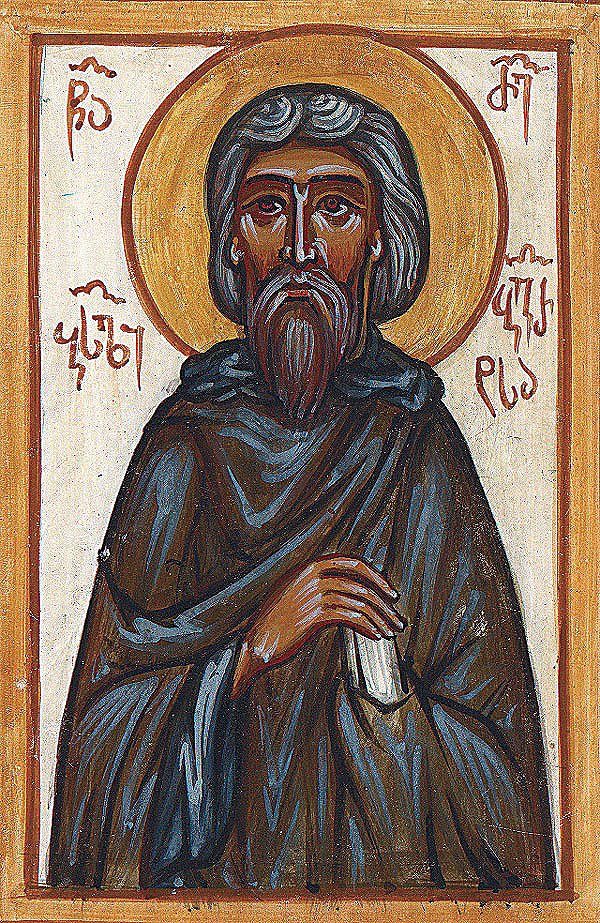
Saint Basil of Georgia, son of King Bagrat III
Saint Basil, the son of King Bagrat III, lived in the 11th century and labored at Khakhuli Monastery (in southwestern Georgia, present-day Turkey). He was a major figure in the spiritual and educational life of southern Georgia.
The famous 19th-century scholar Prince John Bagrationi describes Saint Basil in his work Kalmasoba: (the tradition of monks journeying throughout the land to collect alms for the Church.
Saint Basil, the son of King Bagrat III, lived in the 11th century and labored at Khakhuli Monastery (in southwestern Georgia, present-day Turkey). He was a major figure in the spiritual and educational life of southern Georgia.
The famous 19th-century scholar Prince John Bagrationi describes Saint Basil in his work Kalmasoba: (the tradition of monks journeying throughout the land to collect alms for the Church. In his book Prince John follows a fictional monk traveling throughout the country on kalmasoba. With this literary device he describes the contemporary situation, the life of the people, diverse branches of knowledge, and Georgian literature and folk culture, creating a veritable Georgian encyclopedia.) “Basil Bagrationi was highly educated in philosophy and theology. He was fluent in several languages and translated many books. He was the composer of many distinguished rhetorical works. Perfected in the monastic life and in the spiritual learning of the Church, our Holy Father Basil was known among the people as the ‘Jewel of the Georgian Church.’”
The 18th-century historian and geographer Prince Vakhushti Bagrationi examined the cultural development of Georgia during the rule of King Bagrat IV in his book The Ancient History of Georgia , and Basil is among the major Church figures he mentions: “The great translators of the time were Basil, son of Bagrat....” In his work The Life of Saint Giorgi of the Holy Mountain , Giorgi the Lesser recalls the pious laborer of Khakhuli Monastery: “The great Basil, son of King Bagrat III, shepherd and enlightener of our country at that time.”
Saint Basil eventually moved from Georgia to Mt. Athos and labored there until his death. It was there that he composed his “Praises to Holy Father Ekvtime.”
Troparion - Tone 8
In you the image was preserved with exactness, O Father, / for taking up your cross, you followed after Christ. / By so doing, you taught us to disregard the flesh, for it passes away, / but to care instead for the soul, since it is immortal. / Therefore, most venerable Father Basil your spirit rejoices with the Angels.
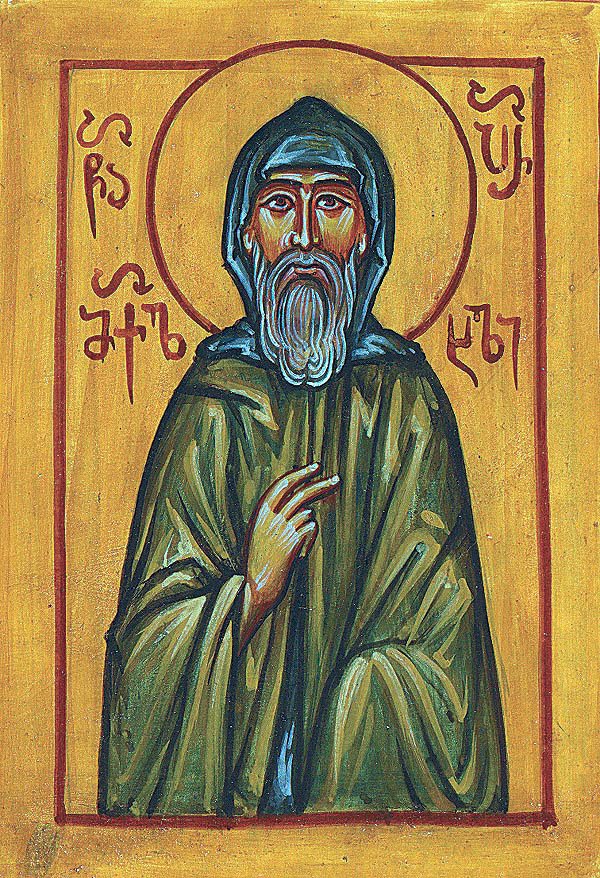
Venerable Michael of Parekhi
Saint Michael of Parekhi was a native of the village of Norgiali in the Shavsheti region of southern Georgia. He was tonsured a monk in the Midznadzori Wilderness.
Fr. Michael journeyed to Khandzta Monastery, and with the blessing of the brotherhood, he built a small chapel and dwelling for the monks nearby.
Saint Michael of Parekhi was a native of the village of Norgiali in the Shavsheti region of southern Georgia. He was tonsured a monk in the Midznadzori Wilderness.
Fr. Michael journeyed to Khandzta Monastery, and with the blessing of the brotherhood, he built a small chapel and dwelling for the monks nearby. Built in a cave on the side of a cliff, Saint Michael’s establishment was difficult to reach (the new monastery was called “Parekhi,” or “Cave”). God was pleased with his good works, and He granted Saint Michael the gift of working wonders. In a divine revelation, Saint Michael was instructed to send his disciples Serapion and John to the region of Samtskhe. There they established a beautiful monastery in the village of Zarzma.
After some time Father Michael abandoned his cell and settled at the top of a large boulder. Once the devil caused him to stumble off the rock, but the Lord protected him and he remained unharmed.
Frightened by the incident, Michael sent his disciples to bring Saint Gregory of Khandzta, and he related to him all that had happened. The blessed Gregory assuaged his brother’s fears, erected a cross on either side of Michael’s cell, and told him, “These two crosses of Christ will protect you, and the mercy of the Most Holy Trinity and the Precious Cross will be upon you.”
Saint Michael lived to an old age, and he was buried at Parekhi Monastery. Many faithful pilgrims who have visited his grave have been healed of their infirmities.
According to Basil of Zarzma, Saint Michael’s disciples wrote accounts of his labors, wisdom, and miracles after his repose, but these works have unfortunately not been preserved. What we know about the life of Saint Michael of Parekhi was preserved in the hagiographical writings of the 10th and 11th centuries.
Troparion - Tone 8
By a flood of tears you made the desert fertile, / and your longing for God brought forth fruits in abundance. / By the radiance of miracles you illumined the whole universe! / O our holy father Michael, pray to Christ our God to save our souls!
Kontakion - Tone 2
In you the image was preserved with exactness, O Father, / for taking up your cross, you followed after Christ. / By so doing, you taught us to disregard the flesh, for it passes away, / but to care instead for the soul, since it is immortal. / Therefore, most venerable Father Michael your spirit rejoices with the Angels.
Venerable Matthew of Zaransk
Venerable Matthew of Zaransk (in the world Mētrophánēs Kuzmich Svetov) was born in 1861, in the city of Vyatka. His father was a shoemaker and the Saint engaged in commerce when he was young.
In 1891, Mētrophánēs was tonsured in the monastery of Saint Alexander and received the name Matthew. Here he labored in asceticism and obedience, and taught unceasing prayer. God b
Venerable Matthew of Zaransk (in the world Mētrophánēs Kuzmich Svetov) was born in 1861, in the city of Vyatka. His father was a shoemaker and the Saint engaged in commerce when he was young.
In 1891, Mētrophánēs was tonsured in the monastery of Saint Alexander and received the name Matthew. Here he labored in asceticism and obedience, and taught unceasing prayer. God bestowed upon him the gift of working miracles, and the Saint became a spiritual refuge and consolation for the people of God.
Thus, after a godly life, the Saint reposed peacefully in 1927.
Troparion - Tone 8
In you, O Father, was preserved with exactness what was according to the image; / for you took up the Cross and followed Christ. / By so doing, you taught us to disregard the flesh, for it passes away; / but to care for the soul, since it is immortal. / Therefore, O Venerable Matthew, your spirit rejoices with the Angels.
Kontakion - Tone 2
Finding delight in abstinence, / you subdued the desires of the flesh. / Revealed as one nurtured in the Faith, / you blossomed like the Tree of Life in Paradise, / O Venerable Father Matthew.
Scripture Readings
☩Epistle
Acts 23:1-11
1
And Paul, earnestly beholding the council, said, Men and brethren, I have lived in all good conscience before God until this day.
2
And the high priest Ananias commanded them that stood by him to smite him on the mouth.
3
Then said Paul unto him, God shall smite thee, thou whited wall: for sittest thou to judge me after the law, and commandest me to be smitten contrary to the law?
4
And they that stood by said, Revilest thou God’s high priest?
5
Then said Paul, I wist not, brethren, that he was the high priest: for it is written, Thou shalt not speak evil of the ruler of thy people.
6
But when Paul perceived that the one part were Sadducees, and the other Pharisees, he cried out in the council, Men and brethren, I am a Pharisee, the son of a Pharisee: of the hope and resurrection of the dead I am called in question.
7
And when he had so said, there arose a dissension between the Pharisees and the Sadducees: and the multitude was divided.
8
For the Sadducees say that there is no resurrection, neither angel, nor spirit: but the Pharisees confess both.
9
And there arose a great cry: and the scribes that were of the Pharisees’ part arose, and strove, saying, We find no evil in this man: but if a spirit or an angel hath spoken to him, let us not fight against God.
10
And when there arose a great dissension, the chief captain, fearing lest Paul should have been pulled in pieces of them, commanded the soldiers to go down, and to take him by force from among them, and to bring him into the castle.
11
And the night following the Lord stood by him, and said, Be of good cheer, Paul: for as thou hast testified of me in Jerusalem, so must thou bear witness also at Rome.
☩Gospel
John 16:15-23
15
All things that the Father hath are mine: therefore said I, that he shall take of mine, and shall shew it unto you.
16
A little while, and ye shall not see me: and again, a little while, and ye shall see me, because I go to the Father.
17
Then said some of his disciples among themselves, What is this that he saith unto us, A little while, and ye shall not see me: and again, a little while, and ye shall see me: and, Because I go to the Father?
18
They said therefore, What is this that he saith, A little while? we cannot tell what he saith.
19
Now Jesus knew that they were desirous to ask him, and said unto them, Do ye enquire among yourselves of that I said, A little while, and ye shall not see me: and again, a little while, and ye shall see me?
20
Verily, verily, I say unto you, That ye shall weep and lament, but the world shall rejoice: and ye shall be sorrowful, but your sorrow shall be turned into joy.
21
A woman when she is in travail hath sorrow, because her hour is come: but as soon as she is delivered of the child, she remembereth no more the anguish, for joy that a man is born into the world.
22
And ye now therefore have sorrow: but I will see you again, and your heart shall rejoice, and your joy no man taketh from you.
23
And in that day ye shall ask me nothing. Verily, verily, I say unto you, Whatsoever ye shall ask the Father in my name, he will give it you.
Liturgical data sourced from OCA.org and orthocal.info