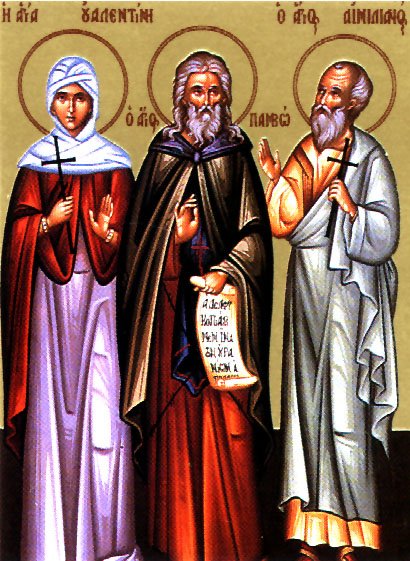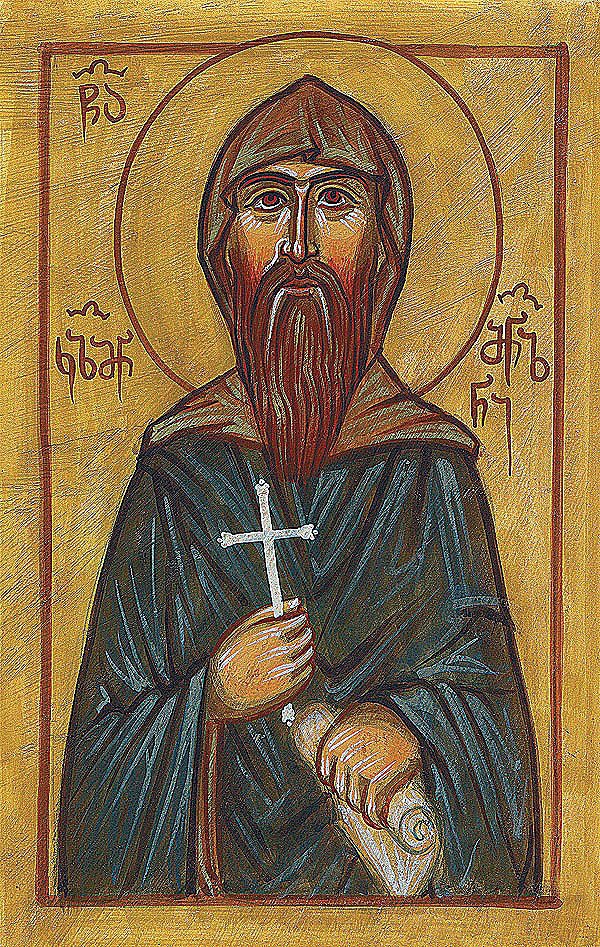
The Holy Martyr Emilian, who was a Slav, suffered for Christ during the reign of Emperor Julian the Apostate (361-363). Julian wanted to restore the cult of the pagan gods throughout the Roman Empire, and he issued an edict, according to which all Christians who failed to honor the pagan gods would be subject to death.
Saint Emilian lived in the Thracian city of Dorostolum on the banks of the River Dunaj (Danube).The imperial edict was read in the city square, but the people of Dorostolum declared that there were no Christians in the city.
Saint Emilian was a slave of a cruel and fanatical idolater, and was a secret Christian. Some sources state that he was the son of a local officer named Sabbatianus. When the father learned that Emilian believed in Christ, he was so enraged that he insulted him with vulgar words and had him whipped. He pointed out that he could expect even worse things to happen to him if he remained a Christian.
Instead of being intimidated by these threats, Saint Emilian’s faith in Christ was strengthened. The next day he went into a pagan temple and smashed the statues with a hammer.
An angry crowd started to beat a certain Christian, who was passing by. Saint Emilian then shouted out loudly that they should not harm that innocent man, since he himself was the one who had damaged the pagan temple.
The saint was seized and brought to Capitolinus the governor for judgment. In spite of further threats, Saint Emilian would not deny Christ. “He is my Lord, and I will never deny Him,” the martyr exclaimed. The governor ordered that Saint Emilian be beaten mercilessly, and then to be burned alive. He did not perish when he was thrown into the fire, but instead the flames consumed many of the pagans who were standing about. When the fire had gone out, Saint Emilian lay down upon the dying embers, and gave up his soul to the Lord. The wife of the pagan ruler was also a secret Christian, and she gathered up the saint’s relics and buried them. Afterward, a church dedicated to the holy Martyr Emilian was built at Constantinople, where his relics were transferred.
Troparion - Tone 4
Holy martyr Emilian, / you defended the Church against the idolatry of the pagans. / Because of your faith in Christ, / you were martyred by fire and through a glorious death received your crown. / Pray to Christ God that He may grant us great mercy.
Kontakion - Tone 3
You did not fear the fire, your fellow-servant, / for you were enflamed with divine zeal. / You willingly entered the flames, unconsumed by the fury, / offering yourself in sacrifice to the Lord. / Glorious martyr Emilian, entreat Christ God to grant us His great mercy.
Martyr Hyacinthus of Amastridea
The Holy Martyr Hyacinthus was born into a pious Christian family in the city of Amastridea (now Amastra in Anatolia). An angel which appeared gave him his name. As a three-year-old boy Saint Hyacinthus asked God that a dead infant might be resurrected. The Lord hearkened to his childish prayer, and the dead one arose.
The Holy Martyr Hyacinthus was born into a pious Christian family in the city of Amastridea (now Amastra in Anatolia). An angel which appeared gave him his name. As a three-year-old boy Saint Hyacinthus asked God that a dead infant might be resurrected. The Lord hearkened to his childish prayer, and the dead one arose. Both lads afterwards grew up together, and they lived an ascetic life.
Saint Hyacinthus once noticed how the pagans were worshipping a tree, and so he chopped it down. For this they subjected him to harsh tortures. They smashed out all his teeth, and having bound him with rope, they dragged him along the ground and threw him in prison. It was there that the holy sufferer departed to the Lord.
Troparion - Tone 3
Your holy martyr Hyacinthus, O Lord, / through his sufferings has received an incorruptible crown from You, our God. / For having Your strength, he laid low his adversaries, / and shattered the powerless boldness of demons. / Through his intercessions, save our souls!
Venerable John the Long-Suffering of the Kiev Near Caves
Saint John the Much-Suffering pursued asceticism at the Kiev Caves Lavra, accepting many sorrows for the sake of virginity.
The ascetic recalled that from the time of his youth he had suffered much, tormented by fleshly lust, and nothing could deliver him from it, neither hunger nor thirst nor heavy chains.
Saint John the Much-Suffering pursued asceticism at the Kiev Caves Lavra, accepting many sorrows for the sake of virginity.
The ascetic recalled that from the time of his youth he had suffered much, tormented by fleshly lust, and nothing could deliver him from it, neither hunger nor thirst nor heavy chains. He then went into the cave where the relics of Saint Anthony rested, and he fervently prayed to the holy Abba. After a day and a night the much-suffering John heard a voice: “John! It is necessary for you to become a recluse, in order to weaken the vexation by silence and seclusion, and the Lord shall help you by the prayers of His monastic saints.” The saint settled into the cave from that time, and only after thirty years did he conquer the fleshly passions.
Tense and fierce was the struggle upon the thorny way on which the monk went to victory. Sometimes the desire took hold of him to forsake his seclusion, but then he resolved on still greater effort. The holy warrior of Christ dug out a pit and with the onset of Great Lent he climbed into it, and he covered himself up to the shoulders with ground. He spent the whole of Lent in such a position, but the burning of his former passions did not leave him. The enemy of salvation brought terror upon the ascetic, wishing to expel him from the cave: a fearsome serpent, breathing fire and sparks, tried to swallow the saint. For several days these evil doings continued.
On the night of the Resurrection of Christ the serpent seized the head of the monk in its jaws. Then Saint John cried out from the depths of his heart: “O Lord my God and my Savior! Why have You forsaken me? Have mercy upon me, only Lover of Mankind; deliver me from my foul iniquity, so that I am not trapped in the snares of the Evil one. Deliver me from the mouth of my enemy: send down a flash of lightning and drive it away.” Suddenly a bolt of lightning flashed, and the serpent vanished. A Divine light shone upon the ascetic, and a Voice was heard: “John! Here is help for you. Be attentive from now on, that nothing worse happen to you, and that you do not suffer in the age to come.”
The saint prostrated himself and said: “Lord! Why did You leave me for so long in torment?” “I tried you according to the power of your endurance,” was the answer. “I brought upon you temptation, so that you might be purified like gold. It is to the strong and powerful servants that a master assigns the heavy work, and the easy tasks to the infirm and to the weak. Therefore pray to the one buried here (Moses the Hungarian), he can help you in this struggle, for he did greater deeds than Joseph the Fair” (March 31). The monk died in the year 1160, having acquired grace against profligate passions. His holy relics rest in the Caves of Saint Anthony.
We pray to Saint John for deliverance from sexual impurity.
Troparion - Tone 8
By a flood of tears you made the desert fertile, / and your longing for God brought forth fruits in abundance. / By the radiance of miracles you illumined the whole universe! / O our holy father John, pray to Christ our God to save our souls!
Venerable Pambo the Recluse of the Kiev Far Caves
Hieromonk Pambo, Hermit of the Kiev Caves, was a confessor for the Faith. Captured while on a monastic obedience, he was taken off by Tatars and for many years suffered from them for his refusal to renounce the Christian Faith. The monk was afterwards miraculously transported from captivity and put within his own cell. He died in seclusion in 1241. His relics rest in the Caves of Saint Theodosius.
Troparion - Tone 8
By a flood of tears you made the desert fertile, / and your longing for God brought forth fruits in abundance. / By the radiance of miracles you illumined the whole universe! / O our holy father Pambo, pray to Christ our God to save our souls!
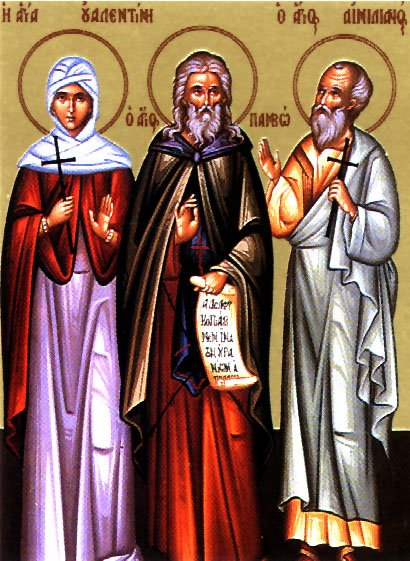
Venerable Pambo the Hermit of Egypt
Abba Pambo was a contemporary of St Anthony the Great and one of the greatest of the Desert Fathers. He would only eat bread which he had earned by his own labors, plaiting baskets and mats out of reeds. In his later years, he became in appearance like an angel of God: his face shone so that the monks could not look on it.
Abba Pambo was a contemporary of St Anthony the Great and one of the greatest of the Desert Fathers. He would only eat bread which he had earned by his own labors, plaiting baskets and mats out of reeds. In his later years, he became in appearance like an angel of God: his face shone so that the monks could not look on it. Through long ascetic labor, he was enabled to control his tongue so that no unnecessary word ever passed his lips. He never gave an immediate answer to even the simplest question, but always prayed and pondered on the question first. Once, when Theophilus, Patriarch of Alexandria, was visiting the monks, they begged Abba Pambo to give the Patriarch a word. He answered: ‘If my silence is no help to him, neither will my words be.’ He reposed in peace, some say in 374, others in 386.
Troparion - Tone 8
By a flood of tears you made the desert fertile, / and your longing for God brought forth fruits in abundance. / By the radiance of miracles you illumined the whole universe! / O our holy father Pambo, pray to Christ our God to save our souls!
Grand Duchess Elizabeth
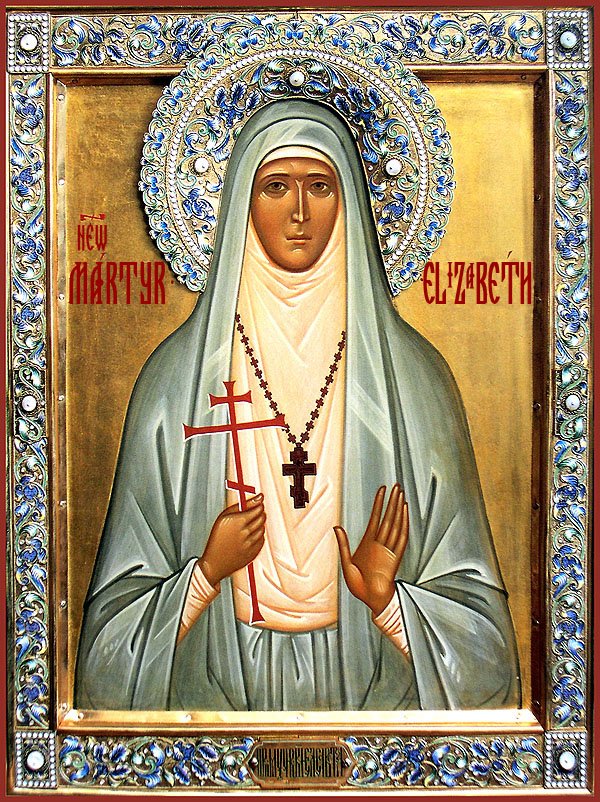
Saint Elizabeth was the older sister of Tsarina Alexandra, and was married to the Grand Duke Sergius, the governor of Moscow. She converted to Orthodoxy from Protestantism of her own free will, and organized women from all levels of society to help the soldiers at the front and in the hospitals.
Grand Duke Sergius was killed by an assassin’s bomb on February 4, 1905, just as Saint Elizabeth was leaving for her workshops. R
Saint Elizabeth was the older sister of Tsarina Alexandra, and was married to the Grand Duke Sergius, the governor of Moscow. She converted to Orthodoxy from Protestantism of her own free will, and organized women from all levels of society to help the soldiers at the front and in the hospitals.
Grand Duke Sergius was killed by an assassin’s bomb on February 4, 1905, just as Saint Elizabeth was leaving for her workshops. Remarkably, she visited her husband’s killer in prison and urged him to repent.
After this, she began to withdraw from her former social life. She devoted herself to the Convent of Saints Martha and Mary, a community of nuns which focused on worshiping God and also helping the poor. She moved out of the palace into a building she purchased on Ordinka. Women from the nobility, and also from the common people, were attracted to the convent.
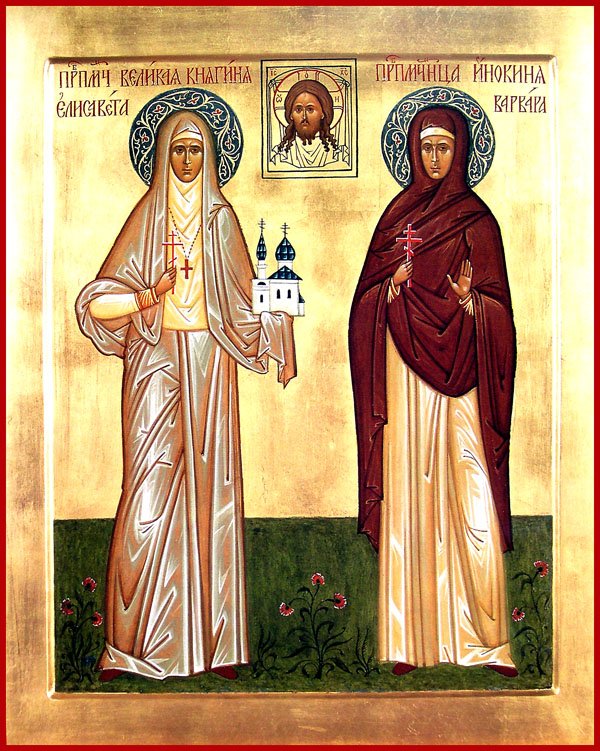
Saint Elizabeth nursed sick and wounded soldiers in the hospitals and on the battle front. On Pascha of 1918, the Communists ordered her to leave Moscow, and join the royal family near Ekaterinburg. She left with a novice, Sister Barbara, and an escort of Latvian guards.
After arriving in Ekaterinburg, Saint Elizabeth was denied access to the Tsar’s family. She was placed in a convent, where she was warmly received by the sisters.
At the end of May Saint Elizabeth was moved to nearby Alopaevsk with the Grand Dukes Sergius, John, and Constantine, and the young Count Vladimir Paley. They were all housed in a schoolhouse on the edge of town. Saint Elizabeth was under guard, but was permitted to go to church and work in the garden.
On the night of July 5, they were all taken to a place twelve miles from Alopaevsk, and executed. The Grand Duke Sergius was shot, but the others were thrown down a mineshaft, then grenades were tossed after them. Saint Elizabeth lived for several hours, and could be heard singing hymns.
The bodies of Saint Elizabeth and Saint Barbara were taken to Jerusalem in 1920, and buried in the church of Saint Mary Magdalene.
Troparion - Tone 4
Emulating the Lord’s self-abasement on the earth, / you gave up royal mansions to serve the poor and disdained, / overflowing with compassion for the suffering. / And taking up a martyr’s cross, / in your meekness / you perfected the Saviour’s image within yourself, / therefore, with Barbara, entreat Him to save us all, O wise Elizabeth.
Kontakion - Tone 3
In the midst of worldliness, / thy mournful heart dwelt in Heaven; / in barbaric godlessness, / your valiant soul was not troubled; / you longed to meet your Bridegroom as a confessor, / and He found you worthy of your martyric purpose. / O Elizabeth, with Barbara, / your brave companion, / pray to your Bridegroom for us.
Nun-martyr Barbara
Saint Barbara died with Saint Elizabeth on July 5, 1918, the day after the murder of Tsar Nicholas and his family. The two nuns were thrown into a mineshaft, and grenades were tossed in after them. Saint Elizabeth remained alive for several hours, and could be heard singing hymns.
The bodies of Saint Barbara and Saint Elizabeth were taken to
Saint Barbara died with Saint Elizabeth on July 5, 1918, the day after the murder of Tsar Nicholas and his family. The two nuns were thrown into a mineshaft, and grenades were tossed in after them. Saint Elizabeth remained alive for several hours, and could be heard singing hymns.
The bodies of Saint Barbara and Saint Elizabeth were taken to Jerusalem in 1920, and buried in the church of Saint Mary Magdalene.
Troparion - Tone 4
Emulating the Lord’s self-abasement on the earth, / you gave up royal mansions to serve the poor and disdained, / overflowing with compassion for the suffering. / And taking up a martyr’s cross, / in your meekness / you perfected the Saviour’s image within yourself, / therefore, with Barbara, entreat / Him to save us all, O wise Elizabeth.
Kontakion - Tone 3
In the midst of worldliness, / thy mournful heart dwelt in Heaven; / in barbaric godlessness, / Your valiant soul was not troubled; / you longed to meet your Bridegroom / as a confessor, / and He found you worthy of your martyric purpose. / O Elizabeth, with Barbara, / your brave companion, / pray to your Bridegroom for us.
Icon of the Mother of God of Tolga
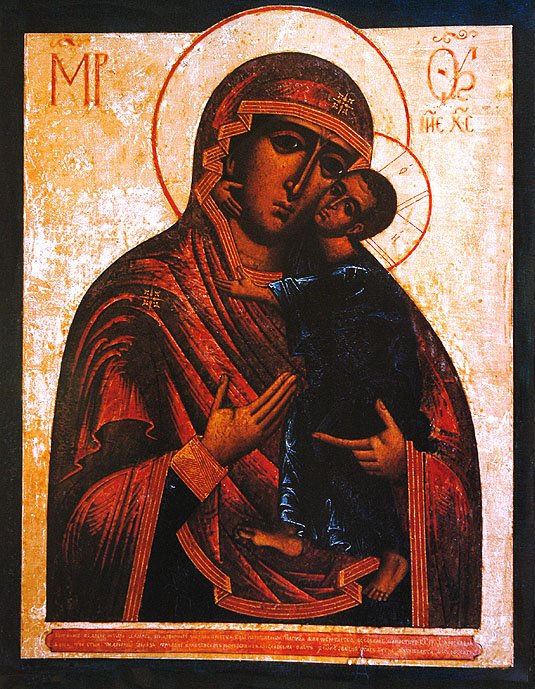
The Tolga Icon of the Most Holy Theotokos appeared on August 8, 1314 to the Rostov hierarch Prochorus (Tryphon in schema). Going about his diocese, the saint visited the environs of White Lake and from there traveled along the banks of the Rivers Sheksna and Volga, to Yaroslavl. Having stopped with the approach of night 7 versts distant from Yaroslavl, at the right bank of the Volga River there flows opposite into it the River Tolga.
At midnight, when everyone was asleep, the saint awoke and saw a bright light illuminating the area. The light proceeded from a fiery column on the other bank of the river, to which there stretched a bridge. Taking up his staff, the saint went across to the other bank, and having approached the fiery column, he beheld on it the icon of the Most Holy Theotokos, suspended in the air. Astonished at the miracle, the saint prayed for a long time, and when he went back, he forgot to take his staff.
The next day, after serving Matins, when Saint Prochorus was preparing to continue his journey by boat, they began to search for his staff, but they were not able to find it anywhere. The saint then remembered that he had forgotten his staff on the other side of the river, where he had gone across on the miraculous bridge. He then revealed what had occurred, and sent servants across on a boat to the other shore. They came back and reported that in the forest they had seen an icon of the Mother of God suspended in the branches of a tree, next to his bishop’s staff.
The saint quickly crossed over with all his retinue to the opposite shore, and he recognized the icon that had appeared to him. Then after fervent prayer before the icon, they cleared the forest at that place, and put down the foundations of a church. When the people of Yaroslavl learned of this, they came out to the indicated spot. By midday the church was already built, and in the evening the saint consecrated it in honor of the Entrance into the Temple of the Most Holy Theotokos, and having installed the icon there he established a Feast on the day of its appearance. Saint Prochorus later built the Tolga monastery near this church. Saint Prochorus died on September 7, 1328.
The Tolga Icon of the Most Holy Theotokos is also commemorated on August 8.
Troparion - Tone 4
Today, O Most Pure Virgin Theotokos, your Icon shines radiantly upon Tolga, and as a never-setting sun, it always appears to the faithful. / Seeing it in the heavens, invisibly supported by Angels, / His Grace Bishop Tryphon of Rostov came to the luminous pillar of fire which appeared, / and walking on the water as if on dry land, / he prayed to you with faith for his flock and for all people. / And turning to you we cry out: / “Most Holy Virgin Theotokos, we glorify you with faith, / save our land, save the Hierarchs, / and deliver us all from misfortune, / according to your great mercy.”
Kontakion - Tone 8
The miraculous and divinely inspired appearance of your luminous Icon, O Most Pure Virgin, / is for those who look upon it with faith the undoubted hope of salvation; / for as a pillar of fire you show your protection, tirelessly and ardently for us, / and you entreat God, by which you deliver us from all misfortunes, / and with joyful voices we pray and cry out to you: / “Rejoice, O Intercessor for our eternal blessedness.”
Hieromartyr Kozman
Over the centuries the monastic complex founded by Saint David of Gareji became a spiritual and cultural center for all of Georgia. Many of the faithful flocked there with a desire to serve Christ.
Among them was the hieromonk Kozman, who would end his earthly life as a martyr.
Few details of the life of Holy Martyr Kozman have been preserved.
Over the centuries the monastic complex founded by Saint David of Gareji became a spiritual and cultural center for all of Georgia. Many of the faithful flocked there with a desire to serve Christ.
Among them was the hieromonk Kozman, who would end his earthly life as a martyr.
Few details of the life of Holy Martyr Kozman have been preserved. According to the Georgian catholicos Anton, Saint Kozman was a learned and righteous ascetic, well-versed in the canons of the Orthodox Church.
Saint Kozman composed a set of “Hymns to the Great-Martyr Queen Ketevan” but his work has not been preserved. According to the 19th-century historian Platon Ioseliani, Hieromonk Kozman was taken captive and tortured to death in the year 1630, when the Dagestanis were carrying out a raid on the Davit-Gareji Wilderness.
Troparion - Tone 4
By sharing in the ways of the Apostles, / you became a successor to their throne. / Through the practice of virtue, you found the way to divine contemplation, O inspired one of God; / by teaching the word of truth without error, you defended the Faith, / even to the shedding of your blood. / Hieromartyr Kozman, entreat Christ God to save our souls.
Scripture Readings
☩Epistle
Romans 12:1-3
1
I beseech you therefore, brethren, by the mercies of God, that ye present your bodies a living sacrifice, holy, acceptable unto God, which is your reasonable service.
2
And be not conformed to this world: but be ye transformed by the renewing of your mind, that ye may prove what is that good, and acceptable, and perfect, will of God.
3
For I say, through the grace given unto me, to every man that is among you, not to think of himself more highly than he ought to think; but to think soberly, according as God hath dealt to every man the measure of faith.
☩Gospel
Matthew 10:37-11:1
37
He that loveth father or mother more than me is not worthy of me: and he that loveth son or daughter more than me is not worthy of me.
38
And he that taketh not his cross, and followeth after me, is not worthy of me.
39
He that findeth his life shall lose it: and he that loseth his life for my sake shall find it.
40
He that receiveth you receiveth me, and he that receiveth me receiveth him that sent me.
41
He that receiveth a prophet in the name of a prophet shall receive a prophet’s reward; and he that receiveth a righteous man in the name of a righteous man shall receive a righteous man’s reward.
42
And whosoever shall give to drink unto one of these little ones a cup of cold water only in the name of a disciple, verily I say unto you, he shall in no wise lose his reward.
1
And it came to pass, when Jesus had made an end of commanding his twelve disciples, he departed thence to teach and to preach in their cities.