Fasting Rules

Meat not allowed Meat Abstain
Fish allowed Fish Allowed
Dairy not allowed Dairy Abstain
Oil allowed Oil Allowed
Wine allowed Wine Allowed

Saints & Commemorations

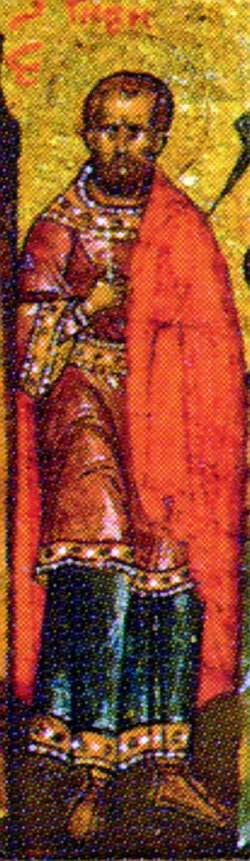
Martyr Eusignius of Antioch

Martyr Eusignius of Antioch

The Martyr Eusignius was born at Antioch in the mid-third century. For sixty years he served in the Roman armies of the emperors Diocletian, Maximian Hercules, Constantius Chlorus, Constantine the Great and his sons. Saint Eusignius was a companion of Saint Basiliscus (March 3 and May 22), and he provided an account of his martyrdom. The Martyr Eusignius was born at Antioch in the mid-third century. For sixty years he served in the Roman armies of the emperors Diocletian, Maximian Hercules, Constantius Chlorus, Constantine the Great and his sons. Saint Eusignius was a companion of Saint Basiliscus (March 3 and May 22), and he provided an account of his martyrdom. At the beginning of the reign of Saint Constantine the Great, Saint Eusignius was a witness to the appearance of the Cross in the sky, a prediction of victory. Saint Eusignius retired in his old age from military service and returned to his own country. There he spent his time in prayer, fasting, and attending the church of God. So he lived until the reign of Julian the Apostate (361-363), who yearned for a return to paganism. Through the denunciation of one of the Antiochian citizens, Saint Eusignius stood trial as a Christian before the emperor Julian in the year 362. He fearlessly accused the emperor of apostasy from Christ, and reproached him with the example of his relative, Constantine the Great, and he described in detail how he himself had been an eyewitness to the appearance of the sign of the Cross in the sky. Julian did not spare the aged Saint Eusignius, then 110 years old, but ordered him beheaded.

Troparion - Tone 8

Today the Church honors a man martyred for his piety and devotion: / The sincere and Godly-minded Eusignius the Wise. / She glorifies his spiritual struggles, and cries out fervently: / O Most Merciful One, guard Your servants through his intercessions!

Holy Hieromartyr Fabian, Pope of Rome (250)

He was born in Rome and became a humble village priest; but when he was attending the election of a new Pope, a white dove was seen to descend on him and he was chosen to be Pope. Though humble and gentle, he was fearless for the faith, gathering the bodies of the martyrs, giving them burial, and building churches and shrines over their relics. He was born in Rome and became a humble village priest; but when he was attending the election of a new Pope, a white dove was seen to descend on him and he was chosen to be Pope. Though humble and gentle, he was fearless for the faith, gathering the bodies of the martyrs, giving them burial, and building churches and shrines over their relics. According to the Prologue, he baptized the Emperor Philip and his son, also named Philip, as well as the senator Pontius; thus there were Christian emperors before St Constantine the Great. When Decius became Emperor, the persecution of Christians returned with terrible force, and Fabian was beheaded.

Troparion - Tone 4

By sharing in the ways of the Apostles, / you became a successor to their throne. / Through the practice of virtue, you found the way to divine contemplation, O inspired one of God; / by teaching the word of truth without error, you defended the Faith, / even to the shedding of your blood. / Hieromartyr Urban, entreat Christ God to save our souls.

Righteous Nonna (374), Mother of St Gregory the Theologian

In her own lifetime she was a wonderworker through her holy prayers. She brought her husband back from idolatry to Christian faith; he later became bishop of Nazianzus. Her son Gregory’s profound and devout writings bespeak the Christian upbringing she gave him. By her prayers she once saved St Gregory from perishing in a storm. She was a deaconess, and reposed in peace in 374.

Scripture Readings

Epistle

1 Corinthians 16:4-12

4 And if it be meet that I go also, they shall go with me. Now I will come unto you, when I shall pass through Macedonia: for I do pass through Macedonia. And it may be that I will abide, yea, and winter with you, that ye may bring me on my journey whithersoever I go. For I will not see you now by the way; but I trust to tarry a while with you, if the Lord permit. But I will tarry at Ephesus until Pentecost. For a great door and effectual is opened unto me, and there are many adversaries. Now if Timotheus come, see that he may be with you without fear: for he worketh the work of the Lord, as I also do. Let no man therefore despise him: but conduct him forth in peace, that he may come unto me: for I look for him with the brethren. As touching our brother Apollos, I greatly desired him to come unto you with the brethren: but his will was not at all to come at this time; but he will come when he shall have convenient time.

Gospel

Matthew 21:28-32

28 But what think ye? A certain man had two sons; and he came to the first, and said, Son, go work to day in my vineyard. He answered and said, I will not: but afterward he repented, and went. And he came to the second, and said likewise. And he answered and said, I go, sir: and went not. Whether of them twain did the will of his father? They say unto him, The first. Jesus saith unto them, Verily I say unto you, That the publicans and the harlots go into the kingdom of God before you. For John came unto you in the way of righteousness, and ye believed him not: but the publicans and the harlots believed him: and ye, when ye had seen it, repented not afterward, that ye might believe him.

Liturgical data sourced from OCA.org and orthocal.info