Fasting Rules
 Meat
Abstain
Meat
Abstain
 Fish
Allowed
Fish
Allowed
 Dairy
Abstain
Dairy
Abstain
 Oil
Allowed
Oil
Allowed
 Wine
Allowed
Wine
Allowed
Saints & Commemorations
Afterfeast of the Transfiguration
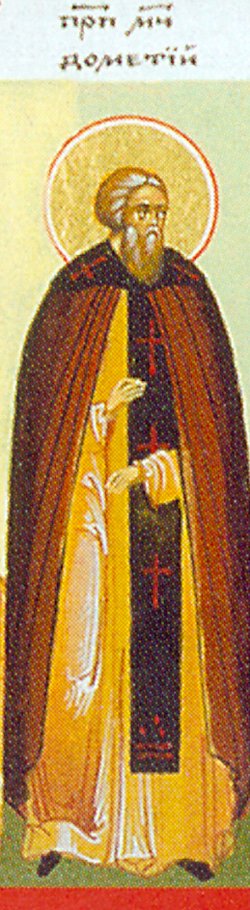
Martyr Dometius of Persia
“Born a pagan in Persia in the time of the Emperor Constantine, he came to know the Christian faith as a young man, forsook his paganism and received baptism. He was so enchanted with the true Faith that he left all worldly things and became a monk in a monastery near the town of Nisibis. He lived among the brethren for some time, then withdrew into silence, going to Archimandrite Urbel, of whom it is said that, for sixty years, he never ate anything cooked. U
“Born a pagan in Persia in the time of the Emperor Constantine, he came to know the Christian faith as a young man, forsook his paganism and received baptism. He was so enchanted with the true Faith that he left all worldly things and became a monk in a monastery near the town of Nisibis. He lived among the brethren for some time, then withdrew into silence, going to Archimandrite Urbel, of whom it is said that, for sixty years, he never ate anything cooked. Urbel made him a deacon, but, when he wanted to make him a priest, Dometius fled to a distant mountain and settled in a cave there. He attained such perfection through fasting, prayer, vigils and meditation that he was able to heal the sick. When Julian the Apostate came to that place, he heard of Dometius and sent men to wall him up alive in the came, with two of his disciples. Thus died this saint of God, in 363, and went to the Kingdom of God.” (Prologue). The Great Horologion says that Dometius and his disciples were stoned to death.
Troparion - Tone 4
Preparing yourself through prayer and fasting on the mountain, / you destroyed the hosts of spiritual enemies with the weapon of the Cross. / And then courageously preparing yourself for martyrdom, / you were crowned by God for both your life and death, / O ever-memorable venerable martyr Dometius.
Kontakion - Tone 6
Despising corruption and degrading philosophies, / O venerable martyr Dometius, / you became a great guide of monks. / You did not fear the wrath of the king, / who did not wish to honor Christ the true God. / Therefore in death You did raise the hymn: / God is with me, and no one will be against me.
Martyr Dometius of Persia (363) and two disciples
“Born a pagan in Persia in the time of the Emperor Constantine, he came to know the Christian faith as a young man, forsook his paganism and received baptism. He was so enchanted with the true Faith that he left all worldly things and became a monk in a monastery near the town of Nisibis. He lived among the brethren for some time, then withdrew into silence, going to Archimandrite Urbel, of whom it is said that, for sixty years, he never ate anything cooked. U
“Born a pagan in Persia in the time of the Emperor Constantine, he came to know the Christian faith as a young man, forsook his paganism and received baptism. He was so enchanted with the true Faith that he left all worldly things and became a monk in a monastery near the town of Nisibis. He lived among the brethren for some time, then withdrew into silence, going to Archimandrite Urbel, of whom it is said that, for sixty years, he never ate anything cooked. Urbel made him a deacon, but, when he wanted to make him a priest, Dometius fled to a distant mountain and settled in a cave there. He attained such perfection through fasting, prayer, vigils and meditation that he was able to heal the sick. When Julian the Apostate came to that place, he heard of Dometius and sent men to wall him up alive in the came, with two of his disciples. Thus died this saint of God, in 363, and went to the Kingdom of God.” (Prologue). The Great Horologion says that Dometius and his disciples were stoned to death.
Theodosius the New
Holy Martyrs Marinus the Soldier and Asterius the Senator (260)
Marinus was a soldier in the Roman army, serving in Caesarea in Palestine. During a persecution under the Emperor Gallienus, he was arrested and beheaded for his Christian faith. The senator Asterius, also a Christian, was present at his execution. Asterius took off his senatorial toga, wrapped the martyr’s body in it, and carried the holy body away to bury it. For this he too was beheaded.
Narcissus the Hieromartyr of Jerusalem
Our Holy Father Or (Horus) of the Thebaid (390)
He was a native of Egypt; his name is that of one of the Egyptian gods. He fled to the desert to live as a hermit, but after many years he became a well-known spiritual guide and founded several monastic communities. A first-hand account of him, by Rufinus, says ‘In appearance he is like an angel of God; an old man of ninety with a long snow-white beard. T
He was a native of Egypt; his name is that of one of the Egyptian gods. He fled to the desert to live as a hermit, but after many years he became a well-known spiritual guide and founded several monastic communities. A first-hand account of him, by Rufinus, says ‘In appearance he is like an angel of God; an old man of ninety with a long snow-white beard. The impression left by his presence is delightful. His gaze is imbued with more-than-human radiance.’ He received communion every day. So detached was he from the world that his disciples once had to remind him that Pascha had come. Hearing this, he went outside, raised his hands to heaven and prayed without ceasing for three days. When he had done he said to his disciples ‘This is the monk’s celebration of Pascha: the lifting up of the mind to unity with God.’ He reposed in peace at a great age.
Our Holy Father Pimen the Much-Ailing (1110)
“He was sickly from his youth, and from his youth desired monasticism. Brought to the Monastery of the Caves for healing, he remained there till his death. He prayed more for sickness than for health. One night, angels appeared to him and tonsured him as a monk, telling him at the same time that he would be sick until his death, and would be healed at that moment. A
“He was sickly from his youth, and from his youth desired monasticism. Brought to the Monastery of the Caves for healing, he remained there till his death. He prayed more for sickness than for health. One night, angels appeared to him and tonsured him as a monk, telling him at the same time that he would be sick until his death, and would be healed at that moment. And so it was; he lay sick for twenty years, working wonders even during his lifetime and being possessed of a rare gift of discernment. At the time of his death, he got up from his bed completely healed, immediately prepared his grave and entered into rest in the Lord, in the year 1110.” (Prologue)
Scripture Readings
☩Epistle
2 Corinthians 1:12-20
12
For our rejoicing is this, the testimony of our conscience, that in simplicity and godly sincerity, not with fleshly wisdom, but by the grace of God, we have had our conversation in the world, and more abundantly to you-ward.
13
For we write none other things unto you, than what ye read or acknowledge; and I trust ye shall acknowledge even to the end;
14
As also ye have acknowledged us in part, that we are your rejoicing, even as ye also are ours in the day of the Lord Jesus.
15
And in this confidence I was minded to come unto you before, that ye might have a second benefit;
16
And to pass by you into Macedonia, and to come again out of Macedonia unto you, and of you to be brought on my way toward Judea.
17
When I therefore was thus minded, did I use lightness? or the things that I purpose, do I purpose according to the flesh, that with me there should be yea yea, and nay nay?
18
But as God is true, our word toward you was not yea and nay.
19
For the Son of God, Jesus Christ, who was preached among you by us, even by me and Silvanus and Timotheus, was not yea and nay, but in him was yea.
20
For all the promises of God in him are yea, and in him Amen, unto the glory of God by us.
☩Gospel
Matthew 22:23-33
23
The same day came to him the Sadducees, which say that there is no resurrection, and asked him,
24
Saying, Master, Moses said, If a man die, having no children, his brother shall marry his wife, and raise up seed unto his brother.
25
Now there were with us seven brethren: and the first, when he had married a wife, deceased, and, having no issue, left his wife unto his brother:
26
Likewise the second also, and the third, unto the seventh.
27
And last of all the woman died also.
28
Therefore in the resurrection whose wife shall she be of the seven? for they all had her.
29
Jesus answered and said unto them, Ye do err, not knowing the scriptures, nor the power of God.
30
For in the resurrection they neither marry, nor are given in marriage, but are as the angels of God in heaven.
31
But as touching the resurrection of the dead, have ye not read that which was spoken unto you by God, saying,
32
I am the God of Abraham, and the God of Isaac, and the God of Jacob? God is not the God of the dead, but of the living.
33
And when the multitude heard this, they were astonished at his doctrine.
Liturgical data sourced from OCA.org and orthocal.info