Fasting Rules
 Meat
Allowed
Meat
Allowed
 Fish
Allowed
Fish
Allowed
 Dairy
Allowed
Dairy
Allowed
 Oil
Allowed
Oil
Allowed
 Wine
Allowed
Wine
Allowed
Saints & Commemorations
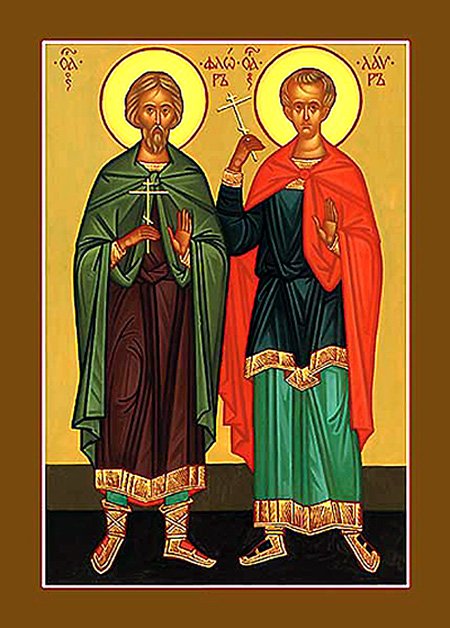
Martyrs Florus and Laurus of Illyria
“Brothers in both the flesh and the spirit, they were both zealous Christians, and stonemasons by craft. They lived in Illyria. Some pagan prince set them to build a pagan temple. It happened during the course of their work that a fragment of stone splintered off and flew into the eye of the pagan priest’s son, who was watching the building work with curiosity. See
“Brothers in both the flesh and the spirit, they were both zealous Christians, and stonemasons by craft. They lived in Illyria. Some pagan prince set them to build a pagan temple. It happened during the course of their work that a fragment of stone splintered off and flew into the eye of the pagan priest’s son, who was watching the building work with curiosity. Seeing his son blinded and bleeding, the priest shouted at Florus and Laurus and tried to thrash them. Then the holy brothers told him that, if he would believe in the God in whom they believed, his son would be restored to health. The priest promised. Florus and Laurus prayed to the one, living Lord with tears and made the sign of the Cross over the child’s stricken eye. The child was healed instantly and his eye became whole as it had been before. Then the priest, Merentius, and his son were baptised, and they both very soon suffered for Christ in the flames. But Florus and Laurus, when they had finished the temple, put a Cross on it, called together all the Christians, and consecrated it in the name of the Lord Jesus with an all-night vigil of hymns. Hearing of this, the governor of Illyria burned many of these Christians by fire and had Florus and Laurus thrown alive into a well, which was then filled with earth. Their relics were later discovered and taken to Constantinople. These two wonderful brothers suffered for Christ, and were glorified by Him, in the second century.” (Prologue)
Troparion - Tone 4
Let us praise as is meet, O you faithful, / the most comely, radiant and divinely wise martyrs: / Most blessed Florus and all venerable Laurus, / who proclaimed to all the uncreated Trinity. / Suffering unto bloodshed, / they were adorned with brilliant crowns. / Entreat Christ our God to save our souls.
Kontakion - Tone 8
Today all the world honors in glory the divinely wise Florus and Laurus, / as pious martyrs who suffered for Christ. / Through their prayers may we receive grace and mercy / and be delivered from calamity and temptation, / and from wrath and sorrow on the Day of Judgment.
Our Holy Father John, Abbot of Rila (946)
He was born near Sophia in Bulgaria during the reign of the Emperor Boris. When his parents died he withdrew from the world to a cave high in the mountains, where he gave himself to the ascetical struggle. There the Prologue says that he ‘endured many assaults both by demons and men, from robbers and from his kinsmen.’ In time he moved to the mountain of Rila, where he lived in a hollow tree, eating only the wild herbs and fruits there. On
He was born near Sophia in Bulgaria during the reign of the Emperor Boris. When his parents died he withdrew from the world to a cave high in the mountains, where he gave himself to the ascetical struggle. There the Prologue says that he ‘endured many assaults both by demons and men, from robbers and from his kinsmen.’ In time he moved to the mountain of Rila, where he lived in a hollow tree, eating only the wild herbs and fruits there. On Rila he saw no human being for many years, but was eventually discovered by a shepherd, after which his fame spread quickly: many came to him for counsel and for the healing of diseases, and Peter, King of Bulgaria, visited him for advice. Many people seeking their salvation settled near him, and soon a church and monastery developed around him. St John reposed in 946 and appeared to his disciples after his death. His relics are venerated at the monastery of Rila, which has for centuries been a lighthouse of Orthodox spirituality in Bulgaria.
Scripture Readings
☩Epistle
2 Corinthians 5:15-21
15
And that he died for all, that they which live should not henceforth live unto themselves, but unto him which died for them, and rose again.
16
Wherefore henceforth know we no man after the flesh: yea, though we have known Christ after the flesh, yet now henceforth know we him no more.
17
Therefore if any man be in Christ, he is a new creature: old things are passed away; behold, all things are become new.
18
And all things are of God, who hath reconciled us to himself by Jesus Christ, and hath given to us the ministry of reconciliation;
19
To wit, that God was in Christ, reconciling the world unto himself, not imputing their trespasses unto them; and hath committed unto us the word of reconciliation.
20
Now then we are ambassadors for Christ, as though God did beseech you by us: we pray you in Christ’s stead, be ye reconciled to God.
21
For he hath made him to be sin for us, who knew no sin; that we might be made the righteousness of God in him.
☩Gospel
Mark 1:16-22
16
Now as he walked by the sea of Galilee, he saw Simon and Andrew his brother casting a net into the sea: for they were fishers.
17
And Jesus said unto them, Come ye after me, and I will make you to become fishers of men.
18
And straightway they forsook their nets, and followed him.
19
And when he had gone a little further thence, he saw James the son of Zebedee, and John his brother, who also were in the ship mending their nets.
20
And straightway he called them: and they left their father Zebedee in the ship with the hired servants, and went after him.
21
And they went into Capernaum; and straightway on the sabbath day he entered into the synagogue, and taught.
22
And they were astonished at his doctrine: for he taught them as one that had authority, and not as the scribes.
Liturgical data sourced from OCA.org and orthocal.info