Fasting Rules
Saints & Commemorations
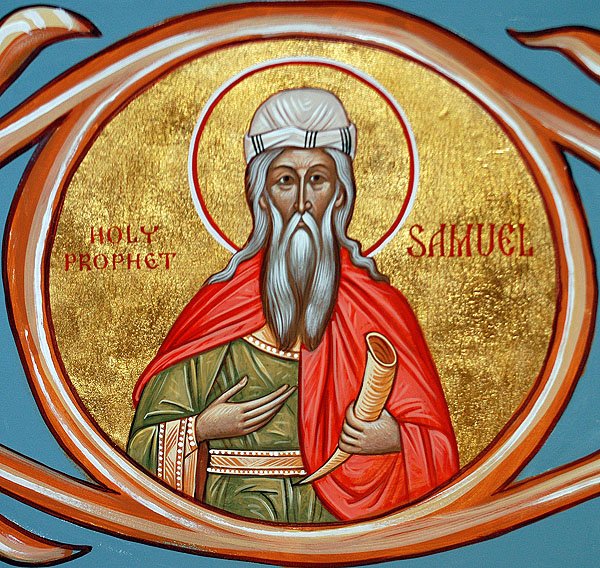
Prophet Samuel
The Prophet Samuel was the fifteenth and last of the Judges of Israel, living more than 1146 years before the Birth of Christ. He was descended from the Tribe of Levi, and was the son of Elkanah from Ramathaim-Zophim of Mount Ephraim. He was born, having been besought from the Lord through the prayers of his mother Hannah (therefore he received the name Samuel, which means “besought from God”). Eve
The Prophet Samuel was the fifteenth and last of the Judges of Israel, living more than 1146 years before the Birth of Christ. He was descended from the Tribe of Levi, and was the son of Elkanah from Ramathaim-Zophim of Mount Ephraim. He was born, having been besought from the Lord through the prayers of his mother Hannah (therefore he received the name Samuel, which means “besought from God”). Even before birth, he was dedicated to God. Her song, “My heart exults in the Lord,” is the third Old Testament ode of the Canon (1 Sam/1 Kings 2:1-10).
When the boy reached the age of three, his mother went with him to Shiloh and in accord with her vow dedicated him to the worship of God. She gave him into the care of the High Priest Eli, who at this time was a judge over Israel. The prophet grew in the fear of God, and at twelve years of age he had a revelation that God would punish the house of the High Priest Eli, because he did not restrain the impiety of his sons. Eli’s whole family was wiped out in a single day.
The prophecy was fulfilled when the Philistines, having slain in battle 30,000 Israelites (among them Hophni and Phinees, the sons of Eli the High Priest), gained victory and captured the Ark of the Covenant. Hearing this, the High Priest Eli fell backwards from his seat at the gate, and breaking his back, he died. The wife of Phinees, upon hearing what had happened in this very hour, gave birth to a son (Ichabod) and died with the words: “The glory has departed from Israel, for the Ark of God is taken away” (1 Sam/1 Kgs 4: 22).
Upon the death of Eli, Samuel became the judge of the nation of Israel. The Ark of God was returned by the Philistines on their own initiative. After returning to God, the Israelites returned to all the cities that the Philistines had taken. In his old age, the Prophet Samuel made his sons Joel and Abiah judges over Israel, but they did not follow the integrity and righteous judgment of their father, since they were motivated by greed.
Then the elders of Israel, wanting the nation of God to be “like other nations” (1 Sam/1 Kgs 8: 20), demanded of the Prophet Samuel that they have a king. The Prophet Samuel anointed Saul as king, but saw in this a downfall of the people, whom God Himself had governed until this time, announcing His will through “judges,” His chosen saints. Resigning the position of judge, the Prophet Samuel asked the people if they consented to his continued governance, but no one stepped forward for him.
After denouncing the first king, Saul, for his disobedience to God, the Prophet Samuel anointed David as king. He had offered David asylum, saving him from the pursuit of King Saul. The Prophet Samuel died in extreme old age. His life is recorded in the Bible (1 Sam/1 Kgs; Sirach 46:13-20).
In the year 406 A.D. the relics of the Prophet Samuel were transferred from Judea to Constantinople.
Troparion - Tone 2
You were given to a barren womb as a most precious gift, / and were sacrificed to your Lord as a whole burnt offering. / You served Him with holiness and righteousness; / therefore O Samuel, God's Prophet, we honor you as an intercessor for our souls.
Kontakion - Tone 8
You arrived by your mother's prayers, bearing the name “God has heard.” / You were called by the Lord from infancy, O revered Prophet Samuel, / you shepherded the rebellious people well and became the founder of the kingdom of Israel; / entreat the True God for us who honor you with faith / that He may save our souls.
Hieromartyr Philip, Bishop of Heraklion, and those with him (2nd c.)
He served in Thrace in the time of Diocletian’s persecutions. When the pagans were about to burn a Christian church, he came forward and said to them: ‘Do you think that God is shut within walls? He lives in men’s hearts.’ The church was burned and all its clergy were taken to Jedrene where, after long imprisonment and torture, they were drowned in the river Maritsa. The hol
He served in Thrace in the time of Diocletian’s persecutions. When the pagans were about to burn a Christian church, he came forward and said to them: ‘Do you think that God is shut within walls? He lives in men’s hearts.’ The church was burned and all its clergy were taken to Jedrene where, after long imprisonment and torture, they were drowned in the river Maritsa. The holy bishop Philip, his priest Severus, his deacon Hermes, and thirty-eight other Christians all received the martyr’s crown.
Scripture Readings
☩Epistle
2 Corinthians 7:1-10
1
Having therefore these promises, dearly beloved, let us cleanse ourselves from all filthiness of the flesh and spirit, perfecting holiness in the fear of God. Receive us; we have wronged no man, we have corrupted no man, we have defrauded no man. I speak not this to condemn you: for I have said before, that ye are in our hearts to die and live with you. Great is my boldness of speech toward you, great is my glorying of you: I am filled with comfort, I am exceeding joyful in all our tribulation. For, when we were come into Macedonia, our flesh had no rest, but we were troubled on every side; without were fightings, within were fears. Nevertheless God, that comforteth those that are cast down, comforted us by the coming of Titus; And not by his coming only, but by the consolation wherewith he was comforted in you, when he told us your earnest desire, your mourning, your fervent mind toward me; so that I rejoiced the more. For though I made you sorry with a letter, I do not repent, though I did repent: for I perceive that the same epistle hath made you sorry, though it were but for a season. Now I rejoice, not that ye were made sorry, but that ye sorrowed to repentance: for ye were made sorry after a godly manner, that ye might receive damage by us in nothing. For godly sorrow worketh repentance to salvation not to be repented of: but the sorrow of the world worketh death.
☩Gospel
Mark 1:29-35
29
And forthwith, when they were come out of the synagogue, they entered into the house of Simon and Andrew, with James and John. But Simon’s wife’s mother lay sick of a fever, and anon they tell him of her. And he came and took her by the hand, and lifted her up; and immediately the fever left her, and she ministered unto them. And at even, when the sun did set, they brought unto him all that were diseased, and them that were possessed with devils. And all the city was gathered together at the door. And he healed many that were sick of divers diseases, and cast out many devils; and suffered not the devils to speak, because they knew him. And in the morning, rising up a great while before day, he went out, and departed into a solitary place, and there prayed.
Liturgical data sourced from OCA.org and orthocal.info