Fasting Rules
 Meat
Abstain
Meat
Abstain
 Fish
Abstain
Fish
Abstain
 Dairy
Abstain
Dairy
Abstain
 Oil
Abstain
Oil
Abstain
 Wine
Abstain
Wine
Abstain
Saints & Commemorations
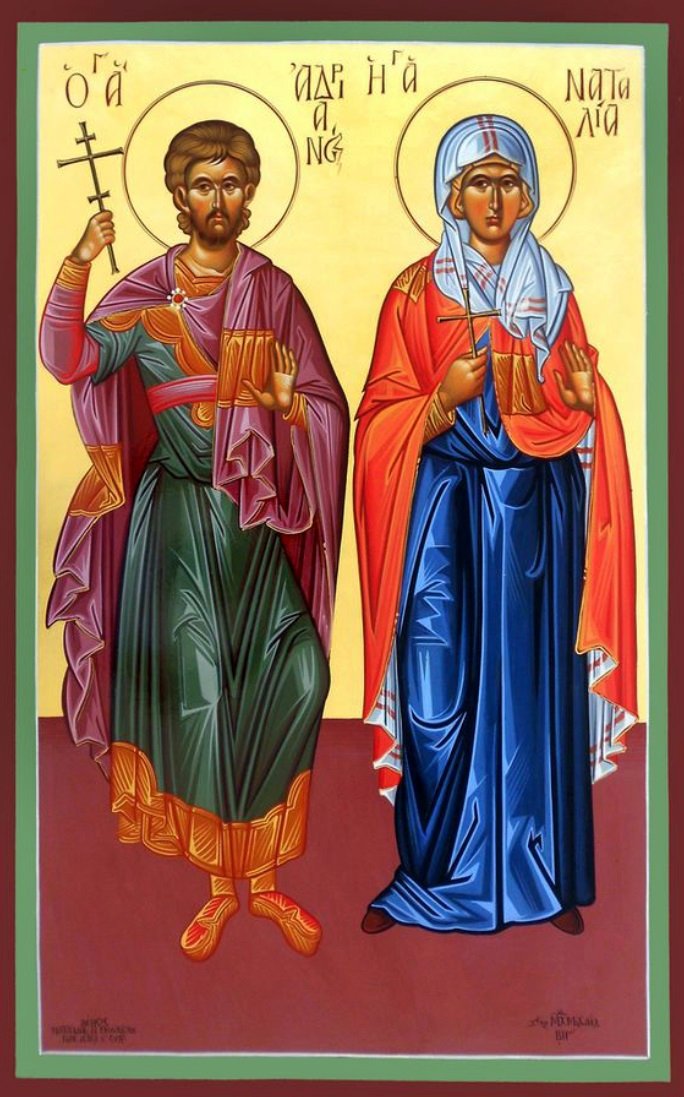
Martyrs Adrian and Natalia
“Husband and wife, they were both of noble and wealthy families in Nicomedia. Adrian was the governor of the Praetorium and a pagan, and Natalia was a secret Christian. They were both young, and had lived in wedlock for thirteen months in all before their martyrdom. When the wicked Emperor Maximian visited Nicomedia, he ordered that the Christians be seized and put to torture. T
“Husband and wife, they were both of noble and wealthy families in Nicomedia. Adrian was the governor of the Praetorium and a pagan, and Natalia was a secret Christian. They were both young, and had lived in wedlock for thirteen months in all before their martyrdom. When the wicked Emperor Maximian visited Nicomedia, he ordered that the Christians be seized and put to torture. There were twenty-three Christians hidden in a cave near the city. Someone handed them over to the authorities and they were cruelly flogged with leather whips and staves, and thrown into prison. They were then taken from prison and brought before the Praetor for their names to be noted. Adrian looked a these people, tortured but unbowed, peaceful and meek, and he put them under oath to say what they hoped for from their God, that they should undergo such tortures. They spoke to him of the blessedness of the righteous in the Kingdom of God. Hearing this, and again looking at these people, Adrian suddenly turned to the scribe and said: ‘Write my name along with those of these saints; I also am a Christian.’ When the Emperor heard of this, he asked him: ‘Have you lost your mind?’ Adrian replied: ‘I haven’t lost it, but found it!’ Hearing this, Natalia rejoiced greatly, and, when Adrian sat chained with the others in prison, came and ministered to them all. When they flogged her husband and put him to various tortures, she encouraged him to endure to the end. After long torture and imprisonment, the Emperor ordered that they be taken to the prison anvil, for their arms and legs to be broken with hammers. This was done and Adrian, along with the twenty-three others, breathed his last under the vicious tortures. Natalia took their relics to Constantinople and there buried them. After several days, Adrian appeared to her, bathed in light and beauty and calling her to come to God, and she peacefully gave her soul into her Lord’s hands.” (Prologue)
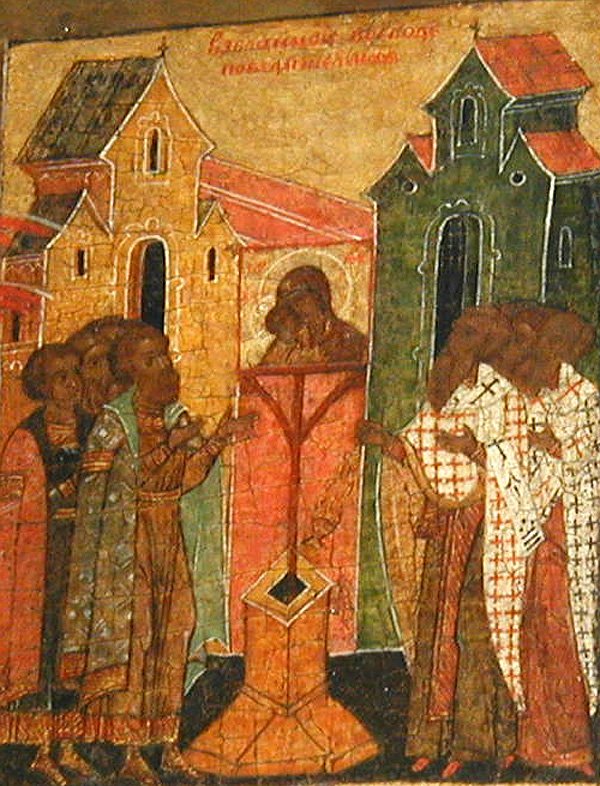
Vladimir Icon
The Vladimir Icon of the Mother of God was painted by the Evangelist Luke on a board from the table at which the Savior ate together with His All-Pure Mother and Righteous Joseph. The Mother of God, upon seeing this image, exclaimed, “Henceforth, all generations shall call Me blessed. The grace of both My Son and Me shall be with this icon.”
In the year 1131, the icon was sent from Constantinople to Rus to holy Prince Mstislav (April 15) and was installed in the Devichi monastery in Vyshgorod, the ancient appanage city of the holy Equal of the Apostles Princess Olga.
Th
The Vladimir Icon of the Mother of God was painted by the Evangelist Luke on a board from the table at which the Savior ate together with His All-Pure Mother and Righteous Joseph. The Mother of God, upon seeing this image, exclaimed, “Henceforth, all generations shall call Me blessed. The grace of both My Son and Me shall be with this icon.”
In the year 1131, the icon was sent from Constantinople to Rus to holy Prince Mstislav (April 15) and was installed in the Devichi monastery in Vyshgorod, the ancient appanage city of the holy Equal of the Apostles Princess Olga.
The son of George Dolgoruky, Saint Andrew Bogoliubsky, brought the icon to the city of Vladimir in 1155 and installed it in the renowned Dormition cathedral which he built. At this time the icon received its name of “the Vladimir Icon.” The icon was first brought to Moscow in the year 1395. Thus, the blessing of the Mother of God established the spiritual bonds of Byzantium and Rus via Kiev, Vladimir and Moscow.
The festal celebration of the Vladimir Icon of the Most Holy Theotokos occurs several times during the year (21 May, 23 June and 26 August). The most solemn celebration occurs on August 26, the Feast established in honor of the Meeting of the Vladimir Icon upon its Transfer from Vladimir to Moscow.
In the year 1395, the fearsome conqueror Khan Tamerlane (Temir-Aksak) reached the Ryazan frontier, took the city of Elets and advancing towards Moscow he came near the banks of the River Don. Great Prince Basil Dimitrievich went with an army to Kolomna and halted at the banks of the River Oka. He prayed to the holy Hierarchs of Moscow and Saint Sergius for the deliverance of the Fatherland, and he wrote to the Metropolitan of Moscow Saint Cyprian (September 16), that the pending Dormition Fast should be devoted to zealous prayers for mercy and repentance.
Clergy were sent to Vladimir, where the famed wonderworking Vladimir Icon was. After Divine Liturgy and a Molieben on the feast of the Dormition, they clergy took the icon and brought it to Moscow. Along the way, on both sides of the road, countless people prayed kneeling: “O Mother of God, save the land of Russia!” At that same hour, when the people of Moscow were meeting the Vladimir Icon on Kuchkov Field, Tamerlane was sleeping in his tent. Suddenly, he saw in a dream a great mountain, at the summit of which were the holy hierarchs with golden staffs coming towards him. Above them, in a brilliant radiance, was a Majestic Woman. She commanded him to leave the domains of Russia.
Awakening in fright, Tamerlane asked the meaning of the vision. The experts answered that the Radiant Lady was the Mother of God, the great Protectress of Christians. Tamerlane then gave the order for his troops to retreat. In memory of this miraculous deliverance of the Russian Land from Tamerlane, they built the monastery of the Meeting on Kuchkov Field, where the Meeting of the Vladimir Icon took place. On August 26, the all-Russian celebration in honor of the Meeting of the Vladimir Icon of the Most Holy Mother of God was established.
Very important events in Russian Church history have occurred before the Vladimir Icon of the Mother of God: the election and elevation of Saint Jonah, advocate of an Autocephalous Russian Church (1448), and of Saint Job, first Patriarch of Moscow and All Russia (1589), and of His Holiness Patriarch Saint Tikhon (1917). The enthronement of His Holiness Pimen, Patriarch of Moscow and All Russia, occurred on a day of celebration in honor of the Vladimir Icon of the Mother of God on May 21 (O.S.), 1971.
The historical days of 21 May, 23 June and 26 August, connected with this holy icon, have become memorable days for the Russian Orthodox Church.
Troparion - Tone 4
Today the most glorious city of Moscow rejoices resplendently, / perceiving your wonderworking Icon as the radiance of the sun, O Sovereign Lady. / Now, having come to it, we pray to you and cry: “O most wondrous Lady Theotokos, / pray to Christ our God, Who was incarnate of you, / that He may deliver this city and all Christian cities and countries, preserving them unharmed from every intrigue of the enemy, / and that He may save our souls, for He is merciful.”
Our Holy Father Tithoës of the Thebaid (4th c.)
One of the great Egyptian Desert Fathers, he was a disciple of St Pachomius the Great and served as abbot of Tabennisi. Through his years of struggle in prayer, he attained to such purity of heart that whenever he raised his hands in prayer, his spirit was instantly caught up in pure contemplation of God.
One of the great Egyptian Desert Fathers, he was a disciple of St Pachomius the Great and served as abbot of Tabennisi. Through his years of struggle in prayer, he attained to such purity of heart that whenever he raised his hands in prayer, his spirit was instantly caught up in pure contemplation of God. When one of the brethren asked him what path leads to humility, he answered ‘The path of humility is abstinence, prayer and considering oneself as the least of all creatures.’ He reposed in peace.
Scripture Readings
☩Epistle
2 Corinthians 9:12-10:7
12
For the administration of this service not only supplieth the want of the saints, but is abundant also by many thanksgivings unto God;
13
Whiles by the experiment of this ministration they glorify God for your professed subjection unto the gospel of Christ, and for your liberal distribution unto them, and unto all men;
14
And by their prayer for you, which long after you for the exceeding grace of God in you.
15
Thanks be unto God for his unspeakable gift.
1
Now I Paul myself beseech you by the meekness and gentleness of Christ, who in presence am base among you, but being absent am bold toward you:
2
But I beseech you, that I may not be bold when I am present with that confidence, wherewith I think to be bold against some, which think of us as if we walked according to the flesh.
3
For though we walk in the flesh, we do not war after the flesh:
4
(For the weapons of our warfare are not carnal, but mighty through God to the pulling down of strong holds;)
5
Casting down imaginations, and every high thing that exalteth itself against the knowledge of God, and bringing into captivity every thought to the obedience of Christ;
6
And having in a readiness to revenge all disobedience, when your obedience is fulfilled.
7
Do ye look on things after the outward appearance? If any man trust to himself that he is Christ’s, let him of himself think this again, that, as he is Christ’s, even so are we Christ’s.
☩Gospel
Mark 3:19-27
19
And Judas Iscariot, which also betrayed him: and they went into an house.
20
And the multitude cometh together again, so that they could not so much as eat bread.
21
And when his friends heard of it, they went out to lay hold on him: for they said, He is beside himself.
22
And the scribes which came down from Jerusalem said, He hath Beelzebub, and by the prince of the devils casteth he out devils.
23
And he called them unto him, and said unto them in parables, How can Satan cast out Satan?
24
And if a kingdom be divided against itself, that kingdom cannot stand.
25
And if a house be divided against itself, that house cannot stand.
26
And if Satan rise up against himself, and be divided, he cannot stand, but hath an end.
27
No man can enter into a strong man’s house, and spoil his goods, except he will first bind the strong man; and then he will spoil his house.
Liturgical data sourced from OCA.org and orthocal.info