Fasting Rules
 Meat
Allowed
Meat
Allowed
 Fish
Allowed
Fish
Allowed
 Dairy
Allowed
Dairy
Allowed
 Oil
Allowed
Oil
Allowed
 Wine
Allowed
Wine
Allowed
Saints & Commemorations
Forefeast of Nativity
Martyr Sozon of Cilicia
He began life as a pagan shepherd in Lycaonia. Coming to faith in Christ, he was baptized and received the name Sozon (“Save”). Thereafter he took every opportunity to proclaim the Gospel to his countrymen and to urge them to give up their idols. Entering a temple of Artemis in Cilicia, he cut off its golden hand, broke it into pieces, and distributed the gold to the poor. Whe
He began life as a pagan shepherd in Lycaonia. Coming to faith in Christ, he was baptized and received the name Sozon (“Save”). Thereafter he took every opportunity to proclaim the Gospel to his countrymen and to urge them to give up their idols. Entering a temple of Artemis in Cilicia, he cut off its golden hand, broke it into pieces, and distributed the gold to the poor. When he learned that because of this some were being punished unjustly for theft, he gave himself up to the governor Maximian. He was beaten to death with rods, by some accounts in 288, by others in 304.
St John, Archbishop of Novgorod
“He was first a married priest and then, from 1163, bishop in Novgorod, building seven churches during his lifetime. He had a vision of the holy Mother of God and a rare power over demons, making them obey him, and he once miraculously preserved Novgorod from an attack by seventy-two princes. He suffered from diabolical temptations, but overcame them all by the power of the Cross and by prayer. R
“He was first a married priest and then, from 1163, bishop in Novgorod, building seven churches during his lifetime. He had a vision of the holy Mother of God and a rare power over demons, making them obey him, and he once miraculously preserved Novgorod from an attack by seventy-two princes. He suffered from diabolical temptations, but overcame them all by the power of the Cross and by prayer. Retiring to a monastery in old age, he received the Great Habit and entered peacefully into rest in the Lord on September 7th, 1185.” (Prologue)
Martyr Sozon of Cilicia (208/304)
He began life as a pagan shepherd in Lycaonia. Coming to faith in Christ, he was baptized and received the name Sozon (“Save”). Thereafter he took every opportunity to proclaim the Gospel to his countrymen and to urge them to give up their idols. Entering a temple of Artemis in Cilicia, he cut off its golden hand, broke it into pieces, and distributed the gold to the poor. Whe
He began life as a pagan shepherd in Lycaonia. Coming to faith in Christ, he was baptized and received the name Sozon (“Save”). Thereafter he took every opportunity to proclaim the Gospel to his countrymen and to urge them to give up their idols. Entering a temple of Artemis in Cilicia, he cut off its golden hand, broke it into pieces, and distributed the gold to the poor. When he learned that because of this some were being punished unjustly for theft, he gave himself up to the governor Maximian. He was beaten to death with rods, by some accounts in 288, by others in 304.
Holy Apostles Evodus and Onesiphorus of the Seventy
St Evodus (or Evodius) is mentioned by St Ignatios of Antioch. He was a disciple of the Apostle Peter and succeeded him as Bishop of Antioch. It is said that the name “Christians” for members of the Church was given by Evodus. He was martyred during a visit by the Emperor Vespasian to Antioch. St Onesiphorus is mentioned by the Apostle Paul in his second epistle to St Timothy, where he calls Onesiphorus a friend and helper. He
St Evodus (or Evodius) is mentioned by St Ignatios of Antioch. He was a disciple of the Apostle Peter and succeeded him as Bishop of Antioch. It is said that the name “Christians” for members of the Church was given by Evodus. He was martyred during a visit by the Emperor Vespasian to Antioch. St Onesiphorus is mentioned by the Apostle Paul in his second epistle to St Timothy, where he calls Onesiphorus a friend and helper. He was a bishop in Colophon in Asia Minor, where he met martyrdom for Christ.
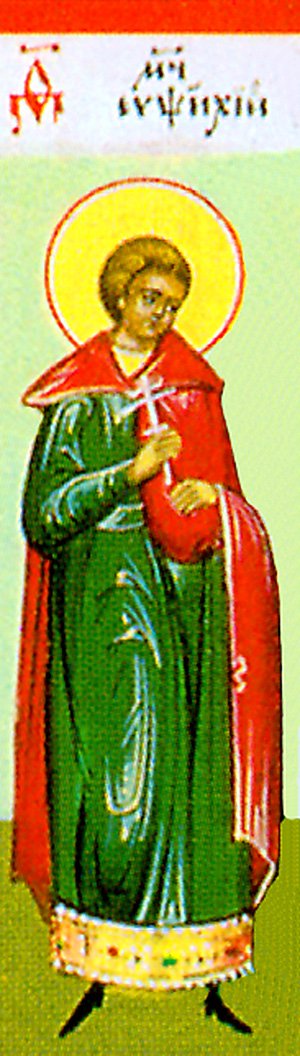
Holy Martyr Eupsychyius of Caesarea (2nd c.)
The Holy Martyr Eupsychius was born in the city of Caesarea in Cappadocia and received a Christian upbringing by his illustrious parents.
During the reign of Julian the Apostate (361-363), Saint Eupsychius entered into a Christian marriage.
At Caesarea there was a pagan temple to the goddess Fortuna, whom Julian the Apostate revered.
The Holy Martyr Eupsychius was born in the city of Caesarea in Cappadocia and received a Christian upbringing by his illustrious parents.
During the reign of Julian the Apostate (361-363), Saint Eupsychius entered into a Christian marriage.
At Caesarea there was a pagan temple to the goddess Fortuna, whom Julian the Apostate revered. As Eupsychius was going to his wedding, the pagans were offering sacrifice to the goddess Fortuna.
Saint Eupsychius was filled with zeal for the Lord, and he destroyed the temple. He knew that this would inevitably result in his punishment. Saint Eupsychius distributed all his possessions to the poor and prepared himself for martyrdom.
The enraged emperor Julian loosed his wrath not only upon Saint Eupsychius, but against all the inhabitants of this city. Some of the citizens were executed, while the more respectable were sent into exile. Christian clergy were drafted into military service, and he looted the churches of anything valuable. The city was deprived of its title Caesarea [i.e. “Imperial”] and resumed its original name of Maza. He also imposed a severe tax on the inhabitants. The emperor threatened to annihilate the city altogether, if the people did not build a new pagan temple in place of the one destroyed.
Julian tried to compel Saint Eupsychius to offer sacrifice to idols. For many days they tormented the saint on a rack, and also with iron claws. But his faith was firm, and the judge sentenced the martyr to be beheaded with a sword.
Then Julian embarked on a campaign against the Persians, marching through Cappadocia and approaching Caesarea. Danger threatened the city, since the emperor intended to raze it to its foundations. But then Saint Basil the Great (January 1), showing Julian the proper respect as sovereign authority, came out to meet him carrying with him three loaves of barley bread, which he ate. The emperor ordered his retainers to take the loaves, and to give Saint Basil a pinch of hay saying, “You have given us barley, cattle fodder. Now receive hay from us in return.”
The saint answered, “O Emperor, we bring you that which we ourselves eat, and you give us cattle feed. You mock us, since you, by your might, are not able to transform hay into bread, the essential food of mankind.”
Julian angrily retorted, “I’ll shove this hay down your throat when I return here from Persia. I shall raze this city to its very foundations, and plow over this ground and turn it into a field. I know that it was on your advice that the people dared to destroy the statues and temple of Fortuna.”
After this the emperor continued on his way, but soon perished in his campaign against the Persians. He was struck down in the year 363 by the holy Great Martyr Mercurius (November 24).
After the emperor’s demise, the Christians of the city of Caesarea built a splendid church over the grave of Saint Eupsychius, and from his holy relics they received help and healing.
Troparion - Tone 3
With steadfast heart you finished your course and cast down the wily foe, / for you were armed with the power of the Cross, blest Eupsychius. / You were numbered with the host of martyrs and have attained eternal glory. / Always entreat Christ our God to save us who honor you.
Kontakion - Tone 2
As a living temple of Christ the Lord / you destroyed the ungodly temple, / and through your steadfast toils, Martyr Eupsychius, / you built a dwelling in Paradise.
St Kassia (Kassiani) the Hymnographer (9th c.)
She was born in Constantinople to a noble family, and grew to be unusually beautiful and learned — so much so that she was chosen to participate in a ‘bride show’, at which the Emperor Theophilos was to choose a wife. Struck by Kassia’s beauty, the Emperor approached her and said ‘Through a woman came forth the baser things,’ referring to Eve’s transgression. Kassia respon
She was born in Constantinople to a noble family, and grew to be unusually beautiful and learned — so much so that she was chosen to participate in a ‘bride show’, at which the Emperor Theophilos was to choose a wife. Struck by Kassia’s beauty, the Emperor approached her and said ‘Through a woman came forth the baser things,’ referring to Eve’s transgression. Kassia responded, ‘Through a woman came forth the better things’, referring to the Incarnation of Christ through His Most Pure Mother. Stung by her reply, the Emperor rejected her and chose Theodora as his wife. Kassia entered monastic life and founded a women’s monastery in Constantinople, closely allied with the Stoudion Monastery. Serving as abbess of the monastery, she wrote many liturgical hymns, at least twenty of which are included in the services of the Church. Best-known (or at least most closely associated with her) is the Hymn of Kassiani, sung at Matins on Holy Wednesday. She reposed in peace.
Scripture Readings
☩Epistle
Galatians 2:11-16
11
But when Peter was come to Antioch, I withstood him to the face, because he was to be blamed.
12
For before that certain came from James, he did eat with the Gentiles: but when they were come, he withdrew and separated himself, fearing them which were of the circumcision.
13
And the other Jews dissembled likewise with him; insomuch that Barnabas also was carried away with their dissimulation.
14
But when I saw that they walked not uprightly according to the truth of the gospel, I said unto Peter before them all, If thou, being a Jew, livest after the manner of Gentiles, and not as do the Jews, why compellest thou the Gentiles to live as do the Jews?
15
We who are Jews by nature, and not sinners of the Gentiles,
16
Knowing that a man is not justified by the works of the law, but by the faith of Jesus Christ, even we have believed in Jesus Christ, that we might be justified by the faith of Christ, and not by the works of the law: for by the works of the law shall no flesh be justified.
☩Gospel
Mark 5:24-34
24
And Jesus went with him; and much people followed him, and thronged him.
25
And a certain woman, which had an issue of blood twelve years,
26
And had suffered many things of many physicians, and had spent all that she had, and was nothing bettered, but rather grew worse,
27
When she had heard of Jesus, came in the press behind, and touched his garment.
28
For she said, If I may touch but his clothes, I shall be whole.
29
And straightway the fountain of her blood was dried up; and she felt in her body that she was healed of that plague.
30
And Jesus, immediately knowing in himself that virtue had gone out of him, turned him about in the press, and said, Who touched my clothes?
31
And his disciples said unto him, Thou seest the multitude thronging thee, and sayest thou, Who touched me?
32
And he looked round about to see her that had done this thing.
33
But the woman fearing and trembling, knowing what was done in her, came and fell down before him, and told him all the truth.
34
And he said unto her, Daughter, thy faith hath made thee whole; go in peace, and be whole of thy plague.
Liturgical data sourced from OCA.org and orthocal.info