Fasting Rules
 Meat
Allowed
Meat
Allowed
 Fish
Allowed
Fish
Allowed
 Dairy
Allowed
Dairy
Allowed
 Oil
Allowed
Oil
Allowed
 Wine
Allowed
Wine
Allowed
Saints & Commemorations
St Romanos the Melodist of Constantinople (556)
He was born in Emessa in Syria, probably of Jewish parents. He served as a deacon in Beirut, then in Constantinople at the time of Patriarch Euphemius (490-496). He was illiterate, had no musical training, and was a poor singer; thus he was despised by many of the more cultivated clergy. One night, after Romanos had prayed to the Mother of God, she appeared to him in a dream, held out a piece of paper and told him to swallow it.
He was born in Emessa in Syria, probably of Jewish parents. He served as a deacon in Beirut, then in Constantinople at the time of Patriarch Euphemius (490-496). He was illiterate, had no musical training, and was a poor singer; thus he was despised by many of the more cultivated clergy. One night, after Romanos had prayed to the Mother of God, she appeared to him in a dream, held out a piece of paper and told him to swallow it. On the following day, the Nativity of Christ, Romanos went to the ambon and, with an angelic voice, sang ‘Today the Virgin…’, which is still sung as the Kontakion of the Feast. All present were amazed at the completely unexpected beauty of the hymn and of Romanos’ singing. St Romanos went on to compose more than a thousand Kontakia (which were once long hymns, not the short verses used in church today). He is almost certainly the author of the sublime Akathist Hymn to the Mother of God, which has served as the model for all other Akathists. He reposed in peace, while still a deacon of the Great Church in Constantinople. Many of his hymns were inspired by the hymns of St Ephraim of Syria.
The influence of Middle Eastern music on the hymnography of the Church is incalculable. Many of those who established the form of the Church’s music were Syrians: two noted examples are St Romanos and St John of Damascus, who composed the Octoechos, the Pascha service, and the Funeral Service. Their music was in turn modeled on the music of the Hebrew temple. The Byzantine musical tradition has descended without break from the music sung in Christ’s time, and presumably by Christ Himself.
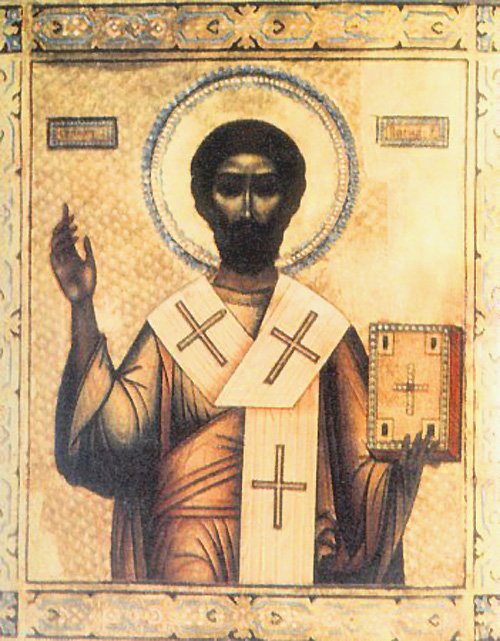
Holy Apostle Ananias of the Seventy
Holy Apostle Barnabas of the Seventy was born on the island of Cyprus into the family of the tribe of Levi, and he was named Joseph. He received his education at Jerusalem, being raised with his friend and fellow student Saul (the future Apostle Paul) under the renowned teacher of the Law, Gamaliel. Joseph was pious, he frequented the Temple, he strictly observed the fasts and avoided youthful distractions.
Holy Apostle Barnabas of the Seventy was born on the island of Cyprus into the family of the tribe of Levi, and he was named Joseph. He received his education at Jerusalem, being raised with his friend and fellow student Saul (the future Apostle Paul) under the renowned teacher of the Law, Gamaliel. Joseph was pious, he frequented the Temple, he strictly observed the fasts and avoided youthful distractions. During this time period our Lord Jesus Christ began His public ministry. Seeing the Lord and hearing His Divine Words, Joseph believed in Him as the Messiah. Filled with ardent love for the Savior, he followed Him. The Lord chose him to be one of His Seventy Apostles. The other Apostles called him Barnabas, which means “son of consolation.” After the Ascension of the Lord to Heaven, Barnabas sold land belonging to him near Jerusalem and he brought the money to the feet of the Apostles, leaving nothing for himself (Acts 4:36-37).
When Saul arrived in Jerusalem after his conversion and sought to join the followers of Christ, everyone there was afraid of him since he had persecuted the Church only a short while before. Barnabas, however, came with him to the Apostles and reported how the Lord had appeared to Saul on the road to Damascus (Acts 9:26-28).
Saint Barnabas went to Antioch to encourage the believers, “Having come and having seen the grace of God, he rejoiced and he urged all to cleave to the Lord with sincerity of heart” (Acts 11:23). Then he went to Tarsus, and brought the Apostle Paul to Antioch, where for about a year they taught the people. It was here that the disciples first began to be called Christians (Acts 11:26). With the onset of famine, and taking along generous alms, Paul and Barnabas returned to Jerusalem. When King Herod killed Saint James the son of Zebedee, and had the Apostle Peter put under guard in prison to please the Jews, Saints Barnabas and Paul and Peter were led out of the prison by an angel of the Lord.
They hid out at the house of Barnabas’ aunt Maria. Later, when the persecution had quieted down, they returned to Antioch, taking with them Maria’s son John, surnamed Mark. Under the inspiration of the Holy Spirit, the prophets and teachers there imposed hands upon Barnabas and Paul, and sent them off to do the work to which the Lord had called them (Acts 13:2-3). Arriving in Seleucia, they sailed off to Cyprus and in the city of Salamis they preached the Word of God in the Jewish synagogues.
On Paphos they came across a sorcerer and false prophet named Bar-Jesus, who was close with the proconsul Sergius. Wishing to hear the Word of God, the proconsul invited the saints to come to him. The sorcerer attempted to sway the proconsul from the Faith, but the Apostle Paul denounced the sorcerer, who through his words suddenly fell blind. The proconsul believed in Christ (Acts 13:6-12).
From Paphos Barnabas and Paul set sail for Pergamum of Pamphylia, and then they preached to the Jews and the Gentiles at Pisidian Antioch and throughout all that region. The Jews rioted and expelled Paul and Barnabas. The saints arrived in Iconium, but learning that the Jews wanted to stone them, they withdrew to Lystra and Derben. There the Apostle Paul healed a man, crippled in the legs from birth. The people assumed them to be the gods Zeus and Hermes and wanted to offer them sacrifice. The saints just barely persuaded them not to do this (Acts 14:8-18).
When the question arose whether those converted from the Gentiles should accept circumcision, Barnabas and Paul went to Jerusalem. There they were warmly received by the Apostles and elders. The preachers related “what God had wrought with them and how He had opened the door of faith to the Gentiles” (Acts 14:27).
After long deliberations the Apostles collectively resolved not to impose any sort of burden upon Gentile Christians except what was necessary: to refrain from the pollutions of idols, and from fornication, and from things strangled, and from blood (Acts 15:19-20). Letters were sent with Barnabas and Paul, and they again preached at Antioch, and after a certain while they decided to visit the other cities where they had visited earlier. Saint Barnabas wanted to take Mark along with him, but Saint Paul did not want to, since earlier he had left them. A quarrel arose, and they separated. Paul took Silas with him and went to Syria and Cilicia, while Barnabas took Mark with him to Cyprus (Acts 15:36-41).
Having multiplied the number of believers, Saint Barnabas traveled to Rome, where he was perhaps the first to preach Christ.
Saint Barnabas founded the episcopal see at Mediolanum (now Milan), and upon his return to Cyprus he continued to preach about Christ the Savior. Then the enraged Jews incited the pagans against Barnabas, and they led him out beyond the city and stoned him, and then built a fire to burn the body. Later on, having come upon this spot, Mark took up the unharmed body of Saint Barnabas and buried it in a cave, placing upon the saint’s bosom, in accord with his final wishes, the Gospel of Matthew which he had copied in his own hand.
Saint Barnabas died in about the year 62, at age seventy-six. In time, the burial spot was forgotten, but numerous signs took place at this spot. In the year 448, during the time of the emperor Zeno, Saint Barnabas appeared three times in a dream to Archbishop Anthimus of Cyprus and indicated the place where his relics were buried. Starting to dig at the indicated spot, Christians found the incorrupt body of the saint, and upon his chest was the Holy Gospel.
It was during this time that the Church of Cyprus began to be regarded as Apostolic in origin, and received the right of choosing its head. Thus Saint Barnabas defended Cyprus against the pretensions of the opponent of the Fourth Ecumenical Council, the heretic surnamed Knapheios, who had usurped the patriarchal throne at Antioch and tried to gain dominion over the Church of Cyprus.
Troparion - Tone 3
Holy Apostles Bartholomew and Barnabas, / entreat the merciful God / to grant our souls forgiveness of transgressions.
Kontakion - Tone 3
You became a true servant of the Lord / and appeared as the first among the Seventy Apostles; / together with Paul you set your preaching in a clear light / revealing Christ as Savior to all; / therefore with hymns we celebrate your godly memory, O Barnabas.
Our Holy Father Gregory the Choirmaster (Domestikos) of the Great Lavra (1355)
He was a cantor at the Great Lavra on Mt Athos. Once, on the eve of Theophany, he was inspired to sing the hymn O full of grace, thou who art the joy of all creation instead of the usual It is truly meet to bless thee during the Divine Liturgy. When he did this, the most holy Theotokos appeared to him, thanked him and gave him a gold coin as a sign of her favor.
He was a cantor at the Great Lavra on Mt Athos. Once, on the eve of Theophany, he was inspired to sing the hymn O full of grace, thou who art the joy of all creation instead of the usual It is truly meet to bless thee during the Divine Liturgy. When he did this, the most holy Theotokos appeared to him, thanked him and gave him a gold coin as a sign of her favor. The coin is still kept at the Lavra. He reposed in peace. St Gregory’s hymn has been sung since that time as part of the Divine Liturgy of St Basil.
Saint Remigius, Bishop of Rheims, Apostle to the Franks (533)
He was born in 438 in northern Gaul. After devoting himself for awhile to secular and sacred learning, he withdrew to a small house near Laon, to live in reclusion and prayer. But when a bishop was needed in Rheims, the clergy and people carried him off from his hermitage and made him their bishop. He was only twenty-two years old at the time.
He was born in 438 in northern Gaul. After devoting himself for awhile to secular and sacred learning, he withdrew to a small house near Laon, to live in reclusion and prayer. But when a bishop was needed in Rheims, the clergy and people carried him off from his hermitage and made him their bishop. He was only twenty-two years old at the time.
The holy bishop soon became renowned throughout northern Gaul. He converted heretics, brought Arian heretics back to the Orthodox Faith, and cared for the many who suffered at the hands of barbarian marauders. Wherever he went, miracles attended him. He healed the sick and demonized and once, when a town was on fire, threw himself into the flames and quenched them. Birds would come to his table whenever he ate, and he would share his meal with them.
In 482 the young warrior Clovis became leader of the Frankish tribes in that region. Though he was a pagan, he knew and admired St Remigius, and was married to a Christian, St Clotilde (June 3). Once, when his army faced defeat by the Alemanii, Clovis prayed to ‘the God of Clotilde and Remigius’ and won a great victory. This answer to his prayers convinced him of the truth of the Christian Faith, and he asked St Remigius to instruct him. Two years later he gathered all his chieftains in Rheims to attend his baptism. The baptism was accompanied by many miracles, seen by all in attendance. Two of the king’s sisters and three thousand of his lords and soldiers were baptized at the ceremony. This event is considered the birth of France as a Christian nation.
In great old age, St Remigius went blind, but miraculously recovered his sight. He reposed in peace at the age of 105, immediately after serving the Divine Liturgy.
Protection (Pokrov) of the Most-Holy Theotokos
Scripture Readings
☩Epistle
Ephesians 5:33-6:9
33
Nevertheless let every one of you in particular so love his wife even as himself; and the wife see that she reverence her husband.
1
Children, obey your parents in the Lord: for this is right.
2
Honour thy father and mother; (which is the first commandment with promise;)
3
That it may be well with thee, and thou mayest live long on the earth.
4
And, ye fathers, provoke not your children to wrath: but bring them up in the nurture and admonition of the Lord.
5
Servants, be obedient to them that are your masters according to the flesh, with fear and trembling, in singleness of your heart, as unto Christ;
6
Not with eyeservice, as menpleasers; but as the servants of Christ, doing the will of God from the heart;
7
With good will doing service, as to the Lord, and not to men:
8
Knowing that whatsoever good thing any man doeth, the same shall he receive of the Lord, whether he be bond or free.
9
And, ye masters, do the same things unto them, forbearing threatening: knowing that your Master also is in heaven; neither is there respect of persons with him.
☩Gospel
Luke 6:12-19
12
And it came to pass in those days, that he went out into a mountain to pray, and continued all night in prayer to God.
13
And when it was day, he called unto him his disciples: and of them he chose twelve, whom also he named apostles;
14
Simon, (whom he also named Peter,) and Andrew his brother, James and John, Philip and Bartholomew,
15
Matthew and Thomas, James the son of Alpheus, and Simon called Zelotes,
16
And Judas the brother of James, and Judas Iscariot, which also was the traitor.
17
And he came down with them, and stood in the plain, and the company of his disciples, and a great multitude of people out of all Judea and Jerusalem, and from the sea coast of Tyre and Sidon, which came to hear him, and to be healed of their diseases;
18
And they that were vexed with unclean spirits: and they were healed.
19
And the whole multitude sought to touch him: for there went virtue out of him, and healed them all.
Liturgical data sourced from OCA.org and orthocal.info