Fasting Rules
 Meat
Allowed
Meat
Allowed
 Fish
Allowed
Fish
Allowed
 Dairy
Allowed
Dairy
Allowed
 Oil
Allowed
Oil
Allowed
 Wine
Allowed
Wine
Allowed
Saints & Commemorations
Martyr Arethas and Companions
‘These Martyrs contested for piety’s sake in the year 524 in Najran, a city of Arabia Felix (present-day Yemen). When Dhu Nuwas, ruler of the Himyarite tribe in south Arabia, and a Judaizer, took power, he sought to blot out Christianity, especially at Najran, a Christian city. Against the counsels of Arethas, chief man of Najran, the city surrendered to Dhu Nuwas, who immediately broke the word he had given and sought to compel the city to renounce Christ. Led
‘These Martyrs contested for piety’s sake in the year 524 in Najran, a city of Arabia Felix (present-day Yemen). When Dhu Nuwas, ruler of the Himyarite tribe in south Arabia, and a Judaizer, took power, he sought to blot out Christianity, especially at Najran, a Christian city. Against the counsels of Arethas, chief man of Najran, the city surrendered to Dhu Nuwas, who immediately broke the word he had given and sought to compel the city to renounce Christ. Led by Saint Arethas, hundreds of martyrs, including women, children, and babes, valiantly withstood his threats, and were beheaded and burned. After the men had been slain, all the free-born Christian women of Najran were brought before the tyrant and commanded to abjure Christ or die; yet they rebuked the persecutor with such boldness that he said even the men had not insulted him so contemptuously. So great was their faith that not one woman was found to deny Christ in all Najran, although some of them suffered torments more bitter than most of the men. In alliance with Byzantium, the Ethiopian King Elesbaan liberated Najran from Dhu Nuwas soon after and raised up churches in honour of the Martyrs. Najran became a place of pilgrimage until the rise of Islam a century later. At the end of his life King Elesbaan, who was also called Caleb, retired into solitude as a hermit; he sent his crown to Jerusalem as an offering to the Church of the Holy Sepulchre. He also is commemorated on this day as a saint. Saint Arethas’ name in Arabic, Harith, means “plowman, tiller,” much the same as “George” in Greek.’ (Great Horologion)
Ethiopia is still a Christian nation, surrounded by Islamic states. The late Emperor Haile Selasse’s name means, in Ethiopian, “Power of the Trinity.”
Memorial (Demetrius) Saturday
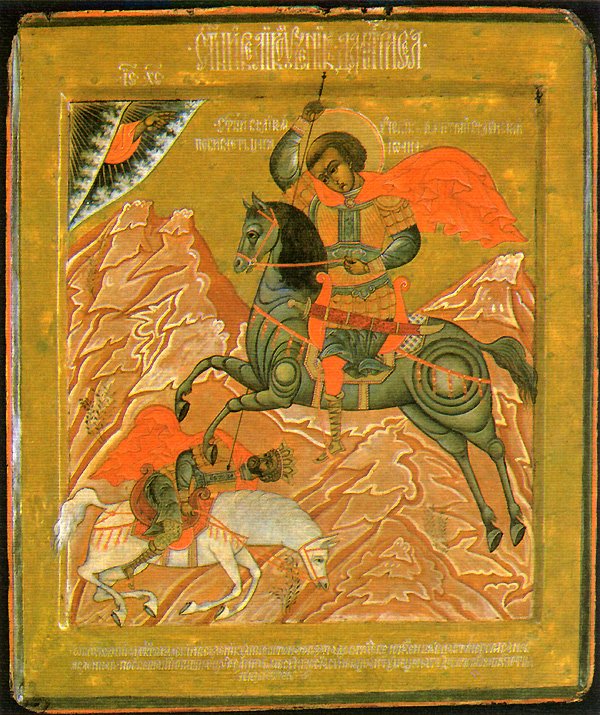
In the spiritual experience of the Russian Church, veneration of the holy Great Martyr Demetrius of Thessalonica is closely linked with the memory of the defense of the nation and Church by the Great Prince of Moscow, Demetrius of the Don (May 19).
Saint Demetrius of the Don smashed the military might of the Golden Horde at the Battle of Kulikovo Field on September 8, 1380 (the Feast of the Nativity of the Most Holy Theotokos), set between the Rivers Don and Nepryadva.
In the spiritual experience of the Russian Church, veneration of the holy Great Martyr Demetrius of Thessalonica is closely linked with the memory of the defense of the nation and Church by the Great Prince of Moscow, Demetrius of the Don (May 19).
Saint Demetrius of the Don smashed the military might of the Golden Horde at the Battle of Kulikovo Field on September 8, 1380 (the Feast of the Nativity of the Most Holy Theotokos), set between the Rivers Don and Nepryadva. The Battle of Kulikovo, for which the nation calls him Demetrius of the Don, became the first Russian national deed, rallying the spiritual power of the Russian nation around Moscow. The “Zadonschina,” an inspiring historic poem written by the priest Sophronius of Ryazem (1381), is devoted to this event.
Prince Demetrius of the Don was greatly devoted to the holy Great Martyr Demetrius. In 1380, on the eve of the Battle of Kulikovo, he solemnly transferred from Vladimir to Moscow the most holy object in the Dimitriev cathedral of Vladimir: the icon of the Great Martyr Demetrius of Thessalonica, painted on a piece of wood from the saint’s grave. A chapel in honor of the Great Martyr Demetrius was built at Moscow’s Dormition Cathedral.
The Saint Demetrius Memorial Saturday was established for the churchwide remembrance of the soldiers who fell in the Battle of Kulikovo. This memorial service was held for the first time at the Trinity-Saint Sergius monastery on October 20, 1380 by Saint Sergius of Radonezh, in the presence of Great Prince Demetrius of the Don. It is an annual remembrance of the heroes of the Battle of Kulikovo, among whom are the schemamonks Alexander (Peresvet) and Andrew (Oslyab).
Scripture Readings
☩Epistle
2 Corinthians 3:12-18
12
Seeing then that we have such hope, we use great plainness of speech:
13
And not as Moses, which put a vail over his face, that the children of Israel could not stedfastly look to the end of that which is abolished:
14
But their minds were blinded: for until this day remaineth the same vail untaken away in the reading of the old testament; which vail is done away in Christ.
15
But even unto this day, when Moses is read, the vail is upon their heart.
16
Nevertheless when it shall turn to the Lord, the vail shall be taken away.
17
Now the Lord is that Spirit: and where the Spirit of the Lord is, there is liberty.
18
But we all, with open face beholding as in a glass the glory of the Lord, are changed into the same image from glory to glory, even as by the Spirit of the Lord.
☩Gospel
Luke 7:1-10
1
Now when he had ended all his sayings in the audience of the people, he entered into Capernaum.
2
And a certain centurion’s servant, who was dear unto him, was sick, and ready to die.
3
And when he heard of Jesus, he sent unto him the elders of the Jews, beseeching him that he would come and heal his servant.
4
And when they came to Jesus, they besought him instantly, saying, That he was worthy for whom he should do this:
5
For he loveth our nation, and he hath built us a synagogue.
6
Then Jesus went with them. And when he was now not far from the house, the centurion sent friends to him, saying unto him, Lord, trouble not thyself: for I am not worthy that thou shouldest enter under my roof:
7
Wherefore neither thought I myself worthy to come unto thee: but say in a word, and my servant shall be healed.
8
For I also am a man set under authority, having under me soldiers, and I say unto one, Go, and he goeth; and to another, Come, and he cometh; and to my servant, Do this, and he doeth it.
9
When Jesus heard these things, he marvelled at him, and turned him about, and said unto the people that followed him, I say unto you, I have not found so great faith, no, not in Israel.
10
And they that were sent, returning to the house, found the servant whole that had been sick.
Liturgical data sourced from OCA.org and orthocal.info