Fasting Rules

Meat not allowed Meat Abstain
Fish not allowed Fish Abstain
Dairy not allowed Dairy Abstain
Oil not allowed Oil Abstain
Wine not allowed Wine Abstain

Saints & Commemorations

Beginning of Great Lent
Beginning of Great Lent

In the Orthodox Church, the last Sunday before Great Lent—the day on which, at Vespers, Lent is liturgically announced and inaugurated—is called Forgiveness Sunday. On the morning of that Sunday, at the Divine Liturgy, we hear the words of Christ: “If you forgive men their trespasses, your heavenly Father will also forgive you, but if you forgive not men their trespasses, neither will your Father forgive your trespasses...” (Mark 6:14-15). Then a In the Orthodox Church, the last Sunday before Great Lent—the day on which, at Vespers, Lent is liturgically announced and inaugurated—is called Forgiveness Sunday. On the morning of that Sunday, at the Divine Liturgy, we hear the words of Christ: “If you forgive men their trespasses, your heavenly Father will also forgive you, but if you forgive not men their trespasses, neither will your Father forgive your trespasses...” (Mark 6:14-15). Then after Vespers—after hearing the announcement of Lent in the Great Prokeimenon: “Turn not away Thy face from Thy child, for I am afflicted! Hear me speedily! Draw near unto my soul and deliver it!”, after making our entrance into Lenten worship, with its special melodies, with the prayer of Saint Ephraim the Syrian, with its prostrations—we ask forgiveness from each other, we perform the rite of forgiveness and reconciliation. And as we approach each other with words of reconciliation, the choir intones the Paschal hymns, filling the church with the anticipation of Paschal joy. What is the meaning of this rite? Why is it that the Church wants us to begin the Lenten season with forgiveness and reconciliation? These questions are in order because for too many people Lent means primarily, and almost exclusively, a change of diet, the compliance with ecclesiastical regulations concerning fasting. They understand fasting as an end in itself, as a “good deed” required by God and carrying in itself its merit and its reward. But the Church spares no effort in revealing to us that fasting is but a means, one among many, towards a higher goal: the spiritual renewal of man, his return to God, true repentance and, therefore, true reconciliation. The Church spares no effort in warning us against a hypocritical and pharisaic fasting, against the reduction of religion to mere external obligations. As a Lenten hymn says: “In vain do you rejoice in not eating, O soul! For you abstain from food, But from passions you are not purified. If you persevere in sin, you will perform a useless fast!” Now, forgiveness stands at the very center of Christian faith and of Christian life because Christianity itself is, above all, the religion of forgiveness. God forgives us, and His forgiveness is in Christ, His Son, whom He sends to us so that by sharing in His humanity we may share in His love and be truly reconciled with God. Indeed, Christianity has no other content but love. And it is primarily the renewal of that love, a growth in it, that we seek in Great Lent, in fasting and prayer, in the entire spirit and the entire effort of that season. Thus, truly forgiveness is both the beginning of, and the proper condition for, the Lenten season. One may ask, however: Why should I perform this rite when I have no “enemies?” Why should I ask forgiveness from people who have done nothing to me, and whom I hardly know? To ask these questions is to misunderstand the Orthodox teaching concerning forgiveness. It is true that open enmity, personal hatred, real animosity may be absent from our life, though if we experience them, it may be easier for us to repent, for these feelings openly contradict Divine commandments. But the Church reveals to us that there are much subtler ways of offending Divine Love. These are indifference, selfishness, lack of interest in other people, of any real concern for them—in short, that wall which we usually erect around ourselves, thinking that by being “polite” and “friendly” we fulfill God’s commandments. The rite of forgiveness is so important precisely because it makes us realize—be it only for one minute—that our entire relationship to other men is wrong, makes us experience that encounter of one child of God with another, of one person created by God with another, makes us feel that mutual “recognition” which is so terribly lacking in our cold and dehumanized world. On that unique evening, listening to the joyful Paschal hymns we are called to make a spiritual discovery: to taste of another mode of life and relationship with people, of life whose essence is love. We can discover that always and everywhere Christ, the Divine Love Himself, stands in the midst of us, transforming our mutual alienation into brotherhood. As I advance towards the other, as the other comes to me—we begin to realize that it is Christ who brings us together by His love for both of us. And because we make this discovery—and because this discovery is that of the Kingdom of God itself: the Kingdom of Peace and Love, of reconciliation with God and, in Him, with all that exists—we hear the hymns of that Feast, which once a year “opens to us the doors of Paradise.” We know why we shall fast and pray, what we shall seek during the long Lenten pilgrimage. Forgiveness Sunday: the day on which we acquire the power to make our fasting—true fasting; our effort—true effort; our reconciliation with God—true reconciliation.
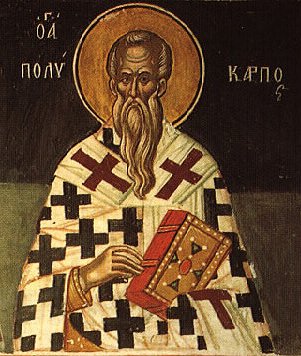
Hieromartyr Polycarp, Bishop of Smyrna

Hieromartyr Polycarp, Bishop of Smyrna

He was born at Ephesus around the year 70. St Irenaeus of Lyons, his disciple, says that St Polycarp was ‘a disciple of the Apostles and acquainted with those who had seen the Lord.’ His parents died as martyrs, and he was given into the care of a devout lady named Callista. As a child, the Saint was so eager to follow the commandments of Christ that he repeatedly emptied his foster-mother’s pantry to feed the poor. Since He was born at Ephesus around the year 70. St Irenaeus of Lyons, his disciple, says that St Polycarp was ‘a disciple of the Apostles and acquainted with those who had seen the Lord.’ His parents died as martyrs, and he was given into the care of a devout lady named Callista. As a child, the Saint was so eager to follow the commandments of Christ that he repeatedly emptied his foster-mother’s pantry to feed the poor. Since her supplies were always miraculously renewed, Callista changed his name from Pancratius to Polykarpos, meaning ‘Much fruit.’ When grown, Polycarp became a disciple of St John the Theologian, and in time became Bishop of Smyrna; it is told that the messages to the Church at Smyrna in the Book of Revelation are addressed to St Polycarp and his flock. He knew St Ignatius of Antioch personally, and some of their correspondence is preserved. Polycarp led his Church in holiness for more than fifty years, and became known throughout the Christian world as a true shepherd and standard-bearer of the Faith. About the year 154 he traveled to Rome and consulted with Pope Anacletus on the defense of the Faith. Not long after he returned to Smyrna, a fierce persecution was unleashed against Christians in Asia Minor; along with many others, St Polycarp was arrested, having predicted his imminent martyrdom. (The account of his martyrdom that follows is based on eyewitness accounts gathered immediately after his death.) On the evening of Holy Friday, soldiers burst into the farmhouse where he was staying. The Bishop welcomed them cheerfully, and ordered that a meal be prepared for them. He was granted some time to pray, and for two hours stood commemorating everyone that he had known and praying for the Church throughout the world. His captors sorrowed that they had come to take such a venerable man, and reluctantly took him to the Proconsul. When urged to deny Christ and save his life, the aged Saint replied, ‘For eighty-six years I have been his servant, and he has wronged me in nothing; how can I blaspheme my King and Savior?’ Told that he would die by fire if he did not apostatize, Polycarp replied ‘You threaten me with a fire that burns for a short time and then goes out, while you know nothing of the fire of the judgment to come and of the everlasting torment awaiting the wicked. Why wait any longer? Do what you will!’ Placed on the pyre, Polycarp lifted his eyes heavenward and gave thanks to God for finding him worthy to share with the holy Martyrs of the cup of Christ. When he had said his Amen, the executioners lit the fire. The eyewitnesses write that the fire sprang up around him like a curtain, and that he stood in its midst glowing like gold and sending forth a delightful scent of incense. Seeing that the fire was not harming him, the executioners stabbed him with a sword. His blood flowed so copiously that it put out the fire, and he gave back his soul to God. His relics were burned by the persecutors, but Christians rescued a few fragments of bone, which were venerated for many generations on the anniversary of his repose.

Venerable Polycarp of Briansk

Saint Polycarp of Briansk, in the world, was Prince Peter Ivanovich Boryatinsky, a descendant of Saint Michael, Prince of Chernigov (September 20). This supposition has been put forward because Boryatinsky is connected with the destiny of the Briansk Savior Transfiguration monastery. The name of Prince Peter Boryatinsky is often encountered in documents of the sixteenth century. Saint Polycarp of Briansk, in the world, was Prince Peter Ivanovich Boryatinsky, a descendant of Saint Michael, Prince of Chernigov (September 20). This supposition has been put forward because Boryatinsky is connected with the destiny of the Briansk Savior Transfiguration monastery. The name of Prince Peter Boryatinsky is often encountered in documents of the sixteenth century. Thus, he was among those sent off to wage war against the Swedish king at the river Sestra. In 1576, he was named voevod at Tula. In 1580, Boryatinsky, having been appointed voevod at Kholm, was captured by the Lithuanians under a siege headed by Panin. Upon his release from captivity under Boris Godinov, Boryatinsky returned home in disgrace. In 1591 he was named voevod at Tiumen, but after several years he left the world, settled at Briansk and received monastic tonsure with the name Polycarp. From his means the monk built a monastery of the Transfiguration of the Lord and established in it a Rule of strict ascetical life. Saint Polycarp was the first Superior of this monastery. He died and was buried there in 1620 or 1621.

Troparion - Tone 8

By a flood of tears you made the desert fertile, / and your longing for God brought forth fruits in abundance. / By the radiance of miracles you illumined the whole universe! / O our holy father Polycarp, pray to Christ our God to save our souls!
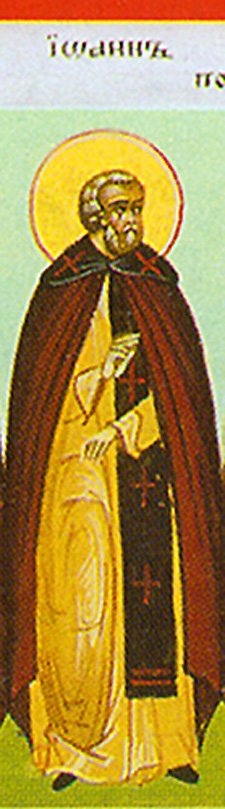
Venerable John, Ascetic of the Syrian Deserts

Venerable John, Ascetic of the Syrian Deserts

Saint John, disciple of Saint Limnaeus (February 22), lived in Syria in the fifth century, and chose for himself the ascetic struggle of “a shelterless life.” He settled on a hill, sheltered from the wind on all sides, and lived there for twenty-five years. He ate only bread and salt, and he exhausted his body under heavy chains. Whe Saint John, disciple of Saint Limnaeus (February 22), lived in Syria in the fifth century, and chose for himself the ascetic struggle of “a shelterless life.” He settled on a hill, sheltered from the wind on all sides, and lived there for twenty-five years. He ate only bread and salt, and he exhausted his body under heavy chains. When one of the nearby ascetics planted an almond tree on the hill so that Saint John could enjoy its shade and get out of the vicious heat, the saint told him to cut it down. This he did in order to deny his body any respite.

Troparion - Tone 8

By a flood of tears you made the desert fertile, / and your longing for God brought forth fruits in abundance. / By the radiance of miracles you illumined the whole universe! / O our holy father John, pray to Christ our God to save our souls!
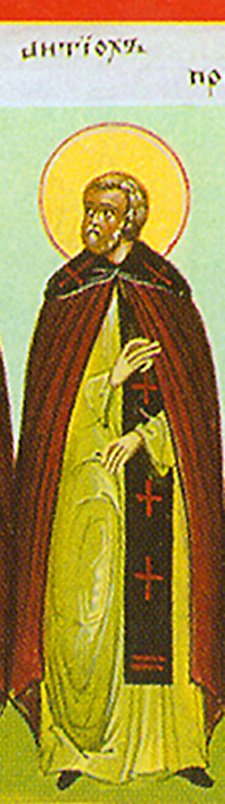
Venerable Antiochus and Antoninus, ascetics of the Syrian Deserts

Venerable Antiochus and Antoninus, ascetics of the Syrian Deserts

Saints Antiochus and Antoninus also lived in asceticism with Saint John. They continued their ascetical struggles until they reached an advanced age, offering an example of spiritual strength, and overcoming every obstacle.

Troparion - Tone 8

By a flood of tears you made the desert fertile, / and your longing for God brought forth fruits in abundance. / By the radiance of miracles you illumined the whole universe! / O our holy father Antiochus, pray to Christ our God to save our souls!
Venerable Moses, Ascetic of the Syrian Deserts

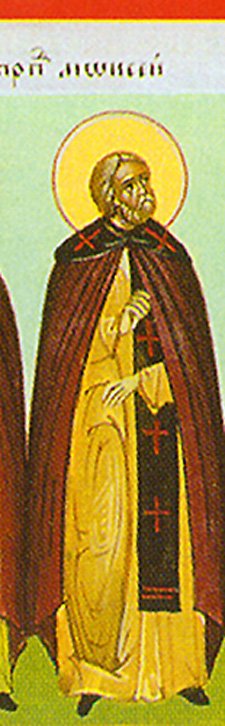
Venerable Moses, Ascetic of the Syrian Deserts

Saint Moses lived in Syria in the fifth century. Imitating Saint John, he settled on a high mountain near the village of Rama. He was a disciple of Saint Polychronius, and lived with him. Emulating his Elder in everything, Saint Moses was the very model of an austere ascetical life. Saint Moses died in Syria in the fifth century.

Troparion - Tone 8

By a flood of tears you made the desert fertile, / and your longing for God brought forth fruits in abundance. / By the radiance of miracles you illumined the whole universe! / O our holy father Moses, pray to Christ our God to save our souls!
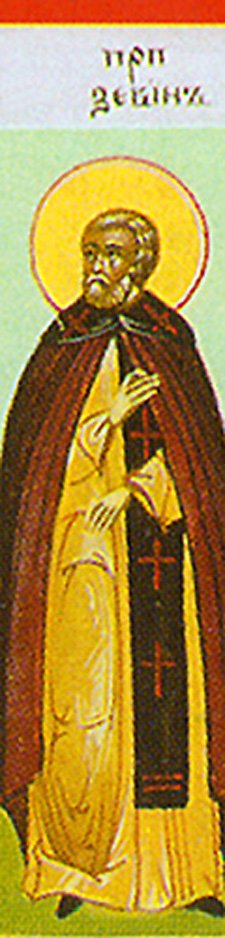
Venerable Zebinas, Ascetic of the Syrian Deserts

Venerable Zebinas, Ascetic of the Syrian Deserts

Saint Zebinas lived in Syria during the fifth century. He lived an ascetical life on the same mountain as Saint Moses. He never sat down during his Rule of prayer, but sometimes he leaned on his staff. The neighboring inhabitants venerated Saint Zebinas, and they received great help in their sorrows and needs through his prayers. He reached a great old age, then departed to the Lord.

Troparion - Tone 8

By a flood of tears you made the desert fertile, / and your longing for God brought forth fruits in abundance. / By the radiance of miracles you illumined the whole universe! / O our holy father Zebinas, pray to Christ our God to save our souls!
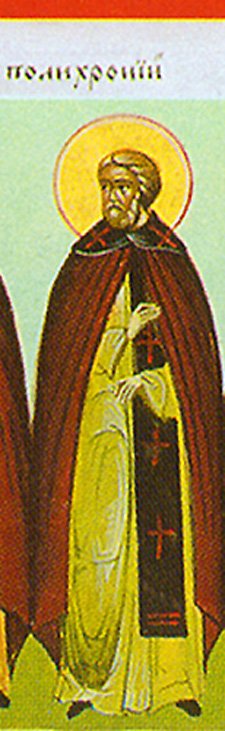
Venerable Polychronius, Ascetic of the Syrian Deserts

Venerable Polychronius, Ascetic of the Syrian Deserts

Saint Polychronius lived in Syria in the fifth century. He was the disciple of Saint Zebinas, and imitated the life of his Elder, spending both day and night in fasting and vigil. Saint Polychronius had no chains, but he dug up a heavy oaken root from the earth and carried it on his shoulders when he prayed. Saint Polychronius lived in Syria in the fifth century. He was the disciple of Saint Zebinas, and imitated the life of his Elder, spending both day and night in fasting and vigil. Saint Polychronius had no chains, but he dug up a heavy oaken root from the earth and carried it on his shoulders when he prayed. Saint Polychronius asked God to send rain during a drought, and he filled up a stone vessel with oil for the needy.

Troparion - Tone 8

By a flood of tears you made the desert fertile, / and your longing for God brought forth fruits in abundance. / By the radiance of miracles you illumined the whole universe! / O our holy father Polychronius, pray to Christ our God to save our souls!
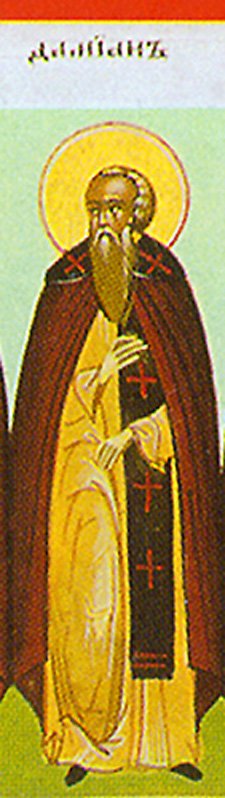
Venerable Damian, Ascetic of the Syrian Deserts

Venerable Damian, Ascetic of the Syrian Deserts

Saint Damian lived in Syria in the fifth century. He withdrew to a monastery named Ieros and lived there in asceticism. In his cell he had only a small box of lentils from which he ate.

Troparion - Tone 8

By a flood of tears you made the desert fertile, / and your longing for God brought forth fruits in abundance. / By the radiance of miracles you illumined the whole universe! / O our holy father Damian, pray to Christ our God to save our souls!
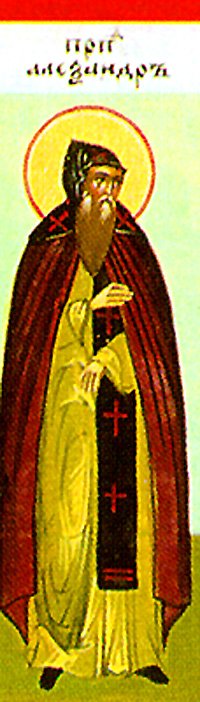
Venerable Alexander, founder of the Monastery of the “Unsleeping Ones”

Venerable Alexander, founder of the Monastery of the “Unsleeping Ones”

He was born sometime in the mid-fourth century on an island in the Aegean. For a time he lived successfully in the world, receiving a good education in Constantinople, then serving for a time for the Prefect of the Praetorium. But, becoming aware of the vanity of worldly things, he answered Christ’s call, gave away all his goods to the poor and entered a monastery in Syria. A He was born sometime in the mid-fourth century on an island in the Aegean. For a time he lived successfully in the world, receiving a good education in Constantinople, then serving for a time for the Prefect of the Praetorium. But, becoming aware of the vanity of worldly things, he answered Christ’s call, gave away all his goods to the poor and entered a monastery in Syria. After four years in obedience, he came to feel that the security of monastic life was inconsistent with the Gospel command to take no thought for the morrow; so he withdrew to the desert, taking with him only his garment and the Book of the Gospel. There he lived alone for seven years. At the end of this period he set out on an apostolic mission to Mesopotamia, where he brought many to Christ: the city prefect Rabbula was converted after Alexander brought down fire from heaven, and a band of brigands who accosted the Saint on the road were transformed into a monastic community. He finally fled the city when the Christians there rose up demanding that he be made bishop. He once again took up a solitary life in the desert beyond the Euphrates, spending the day in prayer and part of the night sheltered in a barrel. There he remained for forty years. His holiness gradually attracted more than four hundred disciples, whom Alexander organized into a monastic community. Each disciple owned only one tunic, and was required to give away anything that they did not need for that day. Despite this threadbare life, the monastery was able to set up and run a hospice for the poor! Alexander was perplexed as to how the admonition Pray without ceasing (1 Thess. 5:17) could be fulfilled by frail human flesh, but after three years of fasting and prayer, God showed him a method. He organized his monks into four groups according to whether their native language was Greek, Latin, Syriac or Coptic, and the groups prayed in shifts throughout the day and night. Twenty-four divine services were appointed each day, and the monks would chant from the Psalter between services. The community henceforth came to be known as the Akoimetoi, the Unsleeping Ones. (Similar communities later sprang up in the West, practicing what was there called Laus Perennis; St Columban founded many of these.) Always desiring to spread the holy Gospel, Saint Alexander sent companies of missionaries to the pagans of southern Egypt. He and a company of 150 disciples set out as a kind of traveling monastery, living entirely on the charity of the villages they visited. Eventually they settled in some abandoned baths in Antioch, setting up a there a monastery dedicated to the unceasing praise of God; but a jealous bishop drove them from the city. Making his way to Constantinople, he settled there with four monks. In a few days, more than four hundred monks had left their monasteries to join his community. The Saint organized them into three companies — Greeks, Latins and Syrians — and restored the program of unsleeping prayer that his community had practiced in Mesopotamia. Not surprisingly, his success aroused the envy and anger of the abbots whose monasteries had been nearly emptied; they managed to have him condemned as a Messalian at a council held in 426. (The Messalians were an over-spiritualizing sect who believed that the Christian life consisted exclusively of prayer.) Alexander was sent back to Syria, and most of his monks were imprisoned; but as soon as they were released, most fled the city to join him again. The Saint spent his last years traveling from place to place, founding monasteries, often persecuted, until he reposed in 430, ‘to join the Angelic choirs which he had so well imitated on earth.’ (Synaxarion) The practice of unceasing praise, established by St Alexander, spread throughout the Empire. The Monastery of the Akoimetoi, founded by a St Marcellus, a successor of Alexander, was established in Constantinople and became a beacon to the Christian world. ‘Even though it has not been retained in today’s practice, the unceasing praise established by Saint Alexander was influential in the formation of the daily cycle of liturgical offices in the East and even more so in the West.’ (Synaxarion)

Troparion - Tone 8

By a flood of tears you made the desert fertile, / and your longing for God brought forth fruits in abundance. / By the radiance of miracles you illumined the whole universe! / O our holy father Alexander, pray to Christ our God to save our souls!

Venerable Damian of Esphigmenou of Mount Athos

Saint Damian lived in the thirteenth century. He was a hesychast on Mt. Athos, and struggled in the skete of Esphigmenou monastery, on a mountain called Samareia, between the monasteries of Hilandar and Esphigmenou, and also in one of the caves where the Father of Russian Monasticism, Saint Anthony of the Caves (July 10), had lived in asceticism. Saint Damian lived in the thirteenth century. He was a hesychast on Mt. Athos, and struggled in the skete of Esphigmenou monastery, on a mountain called Samareia, between the monasteries of Hilandar and Esphigmenou, and also in one of the caves where the Father of Russian Monasticism, Saint Anthony of the Caves (July 10), had lived in asceticism. Known for his ascetic life and for the miracles he performed, he was truly obedient and kept the injunctions of the Fathers. Saint Damian reposed in his cell in the year 1280, and a miraculous fragrance issued from his grave for forty days. His Life was written by his friend Saint Cosmas of Zographou Monastery (September 22).

Troparion - Tone 8

By a flood of tears you made the desert fertile, / and your longing for God brought forth fruits in abundance. / By the radiance of miracles you illumined the whole universe! / O our holy father Damian, pray to Christ our God to save our souls!

Monastic Martyr Damian of Philotheou

Saint Damian of Philotheou was a disciple of Saint Dometius (August 7). He was from the village of Richovon (Merichovon) near Agrapha. He went to Mt. Athos when he was quite young, and received the monastic tonsure at Philotheou Monastery. After spending some time there, he withdrew to a hermitage under the guidance of an Elder named Dometius. Saint Damian of Philotheou was a disciple of Saint Dometius (August 7). He was from the village of Richovon (Merichovon) near Agrapha. He went to Mt. Athos when he was quite young, and received the monastic tonsure at Philotheou Monastery. After spending some time there, he withdrew to a hermitage under the guidance of an Elder named Dometius. After three years, he heard a voice telling him to go forth and teach. He obeyed these instructions, preaching in many areas of Greece. He urged his fellow Christians to repent of their sins, to abstain from all vices, to obey God’s commandments, and to devote themselves to God-pleasing works. As he was on his way to a village, Saint Damian was arrested by the Turks and thrown into prison. After fifteen days of torture, he was hanged and then thrown into a fire. Saint Damian received the crown of martyrdom on February 23, 1568.

Troparion - Tone 1

The image of God was truly preserved in you, O Father, / for you took up the Cross and followed Christ. / By so doing you taught us to disregard the flesh for it passes away / but to care instead for the soul, since it is immortal. / Therefore your spirit, venerable Damian, rejoices with the angels.

Kontakion - Tone 2

As a venerable and proven ascetic, as an honorable and renowned martyr, / and as a model of the desert life, O most exalted Damian, / we sing hymns of praise to you, / for you have trampled upon serpents.
New Hieromartyr Nicholas (Dmitrov) of Tver

New Hieromartyr Nicholas (Dmitrov) of Tver

No information available at this time.

Troparion - Tone 4

By sharing in the ways of the Apostles, / you became a successor to their throne. / Through the practice of virtue, you found the way to divine contemplation, O inspired one of God; / by teaching the word of truth without error, you defended the Faith, / even to the shedding of your blood. / Hieromartyr Nicholas, entreat Christ God to save our souls.

Saint Gorgonia, Sister of Saint Gregory the Theologian

She was the elder sister of St Gregory the Theologian (Jan. 25), and the daughter of St Gregory Nazianzen the Elder (January 1) and St Nonna (August 5). She married Alypius, a citizen of Iconium, and with him had three daughters. She became a holy guide to countless Christians whose lot it was to live out their Faith in the world. She was the elder sister of St Gregory the Theologian (Jan. 25), and the daughter of St Gregory Nazianzen the Elder (January 1) and St Nonna (August 5). She married Alypius, a citizen of Iconium, and with him had three daughters. She became a holy guide to countless Christians whose lot it was to live out their Faith in the world. The Synaxarion says, “Her wisdom and knowledge of all that pertains to godliness made her the very model of a Christian wife. Her relatives, fellow-citizens, and numerous strangers relied on her as a counsellor who would indicate the Christian response in any of the knotty problems which they encountered while living in the world. She was foremost in her care for the churches of God, and in her respect for the priests and clergy, to whom the doors of her house were always open. Neither had she her equal in almsgiving nor in compassion for all the afflicted, so that you could well say that, like righteous Job, she was eyes to the blind, feet to the lame, a mother to the orphans.” She received holy Baptism late in life, as was common at that time, and soon afterward the day of her death was revealed to her. She fell ill on the appointed day and, gathering her family and friends around her bed, gave them her final counsels. She then reposed in peace.

Scripture Readings

View scripture readings for this date on OCA.org.

View readings on OCA.org

Notes

["Great Canon"]

Liturgical data sourced from OCA.org and orthocal.info