Fasting Rules
 Meat
Abstain
Meat
Abstain
 Fish
Abstain
Fish
Abstain
 Dairy
Abstain
Dairy
Abstain
 Oil
Abstain
Oil
Abstain
 Wine
Abstain
Wine
Abstain
Saints & Commemorations
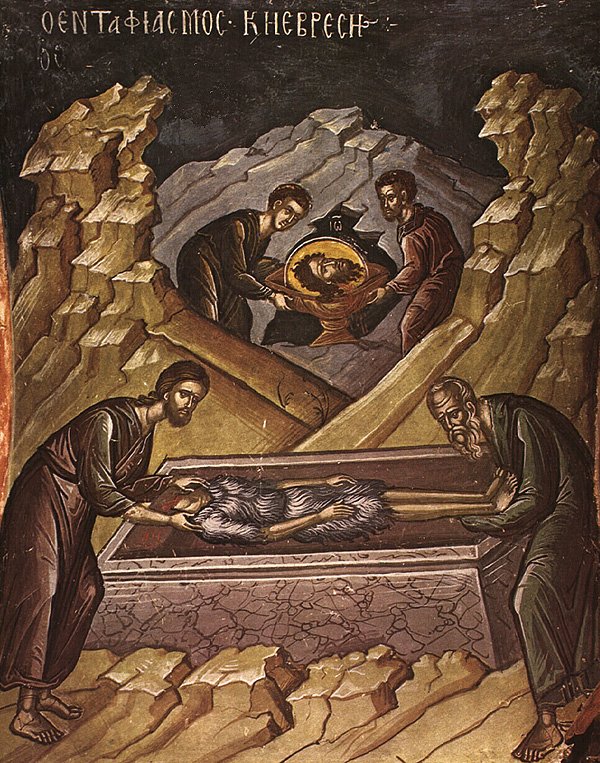
First and second finding of the Honorable Head of the Holy Glorious Prophet, Forerunner, and Baptist of the Lord, John
After the Beheading of the Holy Prophet, Forerunner and Baptist John (August 29), his body was buried by disciples in the Samarian city of Sebaste, and his venerable head was hidden by Herodias in an unclean place. Saint Joanna (June 27), the wife of King Herod’s steward Chuza (Luke 8:3), secretly took the holy head and placed it into a vessel and buried it on the Mount of Olives in one of Herod’s properties.
Af
After the Beheading of the Holy Prophet, Forerunner and Baptist John (August 29), his body was buried by disciples in the Samarian city of Sebaste, and his venerable head was hidden by Herodias in an unclean place. Saint Joanna (June 27), the wife of King Herod’s steward Chuza (Luke 8:3), secretly took the holy head and placed it into a vessel and buried it on the Mount of Olives in one of Herod’s properties.
After many years, this property passed into the possession of a government official who became a monk with the name of Innocent. He built a church and a cell there. When they started to dig the foundation, the vessel with the venerable head of John the Baptist was uncovered. Innocent recognized its great holiness from the signs of grace emanating from it. Thus occurred the First Finding of the Head. Innocent preserved it with great piety, but fearful that the holy relic might be abused by unbelievers, before his own death he again hid it in that same place, where it was found. Upon his death the church fell into ruin and was destroyed.
During the days of Saint Constantine the Great (May 21), when Christianity began to flourish, the holy Forerunner appeared twice to two monks journeying to Jerusalem on pilgrimage to the holy places, and he revealed the location of his venerable head.
The monks uncovered the holy relic and, placing it into a sack of camel-hair, they proceeded homewards. Along the way they encountered an unnamed potter and gave him the precious burden to carry. Not knowing what he was carrying, the potter continued on his way. But the holy Forerunner appeared to him and ordered him to flee from the careless and lazy monks, with what he held in his hands. The potter concealed himself from the monks and at home he preserved the venerable head with reverence. Before his death he placed it in a water jug and gave it to his sister.
From that time the venerable head was successively preserved by devout Christians, until the priest Eustathius (infected with the Arian heresy) came into possession of it. He beguiled a multitude of the infirm who had been healed by the holy head, ascribing their cures to the fact that it was in the possession of an Arian. When his blasphemy was uncovered, he was compelled to flee. After he buried the holy relic in a cave, near Emesa, the heretic intended to return later and use it for disseminating falsehood. God, however, did not permit this. Pious monks settled in the cave, and then a monastery arose at this place. In the year 452 Saint John the Baptist appeared to Archimandrite Marcellus of this monastery, and indicated where his head was hidden. This became celebrated as the Second Finding. The holy relic was transferred to Emesa, and later to Constantinople.
Troparion - Tone 4
The head of the Forerunner rose from the earth as a star, / brilliant with rays of healing and immortality. / It gathers the choirs of angels in heaven, / and assembles the human race on earth / to sing with one voice the glory of Christ our God.
Kontakion - Tone 3
O Prophet of God and Forerunner of Grace, / your head has blossomed from the earth as a sacred rose. / We are ever being healed, / for as of old, You preach repentance to the world.
Saint Aethelberht (Ethelbert), first Christian King of Kent (616)
In 597, a party of forty missionary monks, led by St Augustine of Canterbury (May 28), was sent to Britain by the holy Pope Gregory the Great, to bring the blessed Gospel of Jesus Christ to the English people. Aethelberht, who had been King of Kent for thirty-six years, received the monks favorably, allowed them to preach in his kingdom, and invited them to establish their headquarters in Canterbury, his capital city, which already contained a small, ruined church dedicated to St Martin of Tours in Roman times.
In 597, a party of forty missionary monks, led by St Augustine of Canterbury (May 28), was sent to Britain by the holy Pope Gregory the Great, to bring the blessed Gospel of Jesus Christ to the English people. Aethelberht, who had been King of Kent for thirty-six years, received the monks favorably, allowed them to preach in his kingdom, and invited them to establish their headquarters in Canterbury, his capital city, which already contained a small, ruined church dedicated to St Martin of Tours in Roman times.
The king himself was converted and received holy Baptism at the hands of St Augustine; a crowd of his subjects followed his example. When St Augustine was consecrated bishop, Aethelberht allowed him to be made Archbishop of Canterbury and gave his own palace to serve as a monastery. The king worked steadily for the conversion of the neighboring kindoms, and in 604 established an episcopal see in London. Unlike some Christian rulers, he refused to see anyone converted forcibly.
Saint Aethelberht reposed in peace in 616, after reigning for fifty-six years. He was buried in the Church of Saints Peter and Paul, which he had established. Many miracles were worked at his tomb, where a lamp was kept lit perpetually until the monastery was disbanded by the Protestants in 1538.
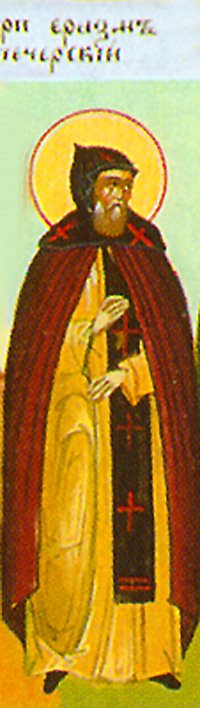
Venerable Erasmus of the Kiev Near Caves
Saint Erasmus of the Kiev Caves Saint Simon, Bishop of Vladimir (May 10), wrote about him to his friend Saint Polycarp (July 24): “At the Caves was Erasmus the black-robed. He acquired a legacy of fame because he used everything he possessed for the adornment of the monastery church. He donated many icons, which even now may be seen over the altar.
Saint Erasmus of the Kiev Caves Saint Simon, Bishop of Vladimir (May 10), wrote about him to his friend Saint Polycarp (July 24): “At the Caves was Erasmus the black-robed. He acquired a legacy of fame because he used everything he possessed for the adornment of the monastery church. He donated many icons, which even now may be seen over the altar.
“The saint experienced great temptations after he had given away his wealth. The Evil One began to suggest to him that he should have given the money to the poor, rather than spend it on the beautification of the church. Saint Erasmus did not understand such thoughts, so he fell into despondency and began to live in a careless manner. Because of his former virtue the gracious and merciful God saved him. He sent him a grievous illness, and the monk lay near death.
“In this sickness Erasmus lay for seven days, unable to see or speak, and hardly breathing. On the eighth day the brethren came to him and, seeing the difficulty of his approaching death, said, ‘Woe to the soul of this brother, for he lived in idleness and in sin. Now his soul beholds something and tarries, not having the strength to leave the body.’
“Erasmus suddenly got up, as though he had not been ill, and said to the monks, ‘Fathers and brethren! It is true that I am a sinner, and have not repented, as you said. Today, however, our monastic fathers Anthony and Theodosius have appeared to me, and said: “We have prayed for you, and the Lord has given you time for repentance.” Then I saw the All-Pure Mother of God with Christ in Her arms, and She said to me, “Erasmus, since you adorned My Church with icons, I will also adorn you and exalt you in the Kingdom of my Son! Arise, repent, take the angelic schema, and on the third day you will be taken from this life.”’
“Having said this, Erasmus began to confess his sins before all without shame, then went to church and was clothed in the schema, and on the third day he died.” Saint Erasmus was buried in the Near Caves. His memory is also celebrated on September 28 and on the second Sunday of Great Lent.
Troparion - Tone 8
By a flood of tears you made the desert fertile, / and your longing for God brought forth fruits in abundance. / By the radiance of miracles you illumined the whole universe! / O our holy father Erasmus, pray to Christ our God to save our souls!
Scripture Readings
☩Epistle
2 Corinthians 4:6-15
6
For God, who commanded the light to shine out of darkness, hath shined in our hearts, to give the light of the knowledge of the glory of God in the face of Jesus Christ.
7
But we have this treasure in earthen vessels, that the excellency of the power may be of God, and not of us.
8
We are troubled on every side, yet not distressed; we are perplexed, but not in despair;
9
Persecuted, but not forsaken; cast down, but not destroyed;
10
Always bearing about in the body the dying of the Lord Jesus, that the life also of Jesus might be made manifest in our body.
11
For we which live are alway delivered unto death for Jesus’ sake, that the life also of Jesus might be made manifest in our mortal flesh.
12
So then death worketh in us, but life in you.
13
We having the same spirit of faith, according as it is written, I believed, and therefore have I spoken; we also believe, and therefore speak;
14
Knowing that he which raised up the Lord Jesus shall raise up us also by Jesus, and shall present us with you.
15
For all things are for your sakes, that the abundant grace might through the thanksgiving of many redound to the glory of God.
☩Gospel
Matthew 11:2-15
2
Now when John had heard in the prison the works of Christ, he sent two of his disciples,
3
And said unto him, Art thou he that should come, or do we look for another?
4
Jesus answered and said unto them, Go and shew John again those things which ye do hear and see:
5
The blind receive their sight, and the lame walk, the lepers are cleansed, and the deaf hear, the dead are raised up, and the poor have the gospel preached to them.
6
And blessed is he, whosoever shall not be offended in me.
7
And as they departed, Jesus began to say unto the multitudes concerning John, What went ye out into the wilderness to see? A reed shaken with the wind?
8
But what went ye out for to see? A man clothed in soft raiment? behold, they that wear soft clothing are in kings’ houses.
9
But what went ye out for to see? A prophet? yea, I say unto you, and more than a prophet.
10
For this is he, of whom it is written, Behold, I send my messenger before thy face, which shall prepare thy way before thee.
11
Verily I say unto you, Among them that are born of women there hath not risen a greater than John the Baptist: notwithstanding he that is least in the kingdom of heaven is greater than he.
12
And from the days of John the Baptist until now the kingdom of heaven suffereth violence, and the violent take it by force.
13
For all the prophets and the law prophesied until John.
14
And if ye will receive it, this is Elias, which was for to come.
15
He that hath ears to hear, let him hear.
Notes
["Great Canon"]
Liturgical data sourced from OCA.org and orthocal.info