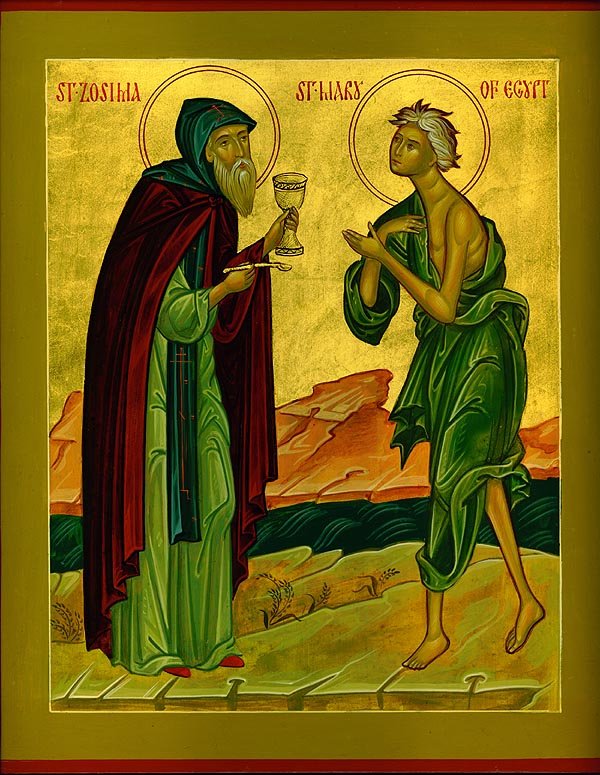
Her radiant life is also commemorated on the Fifth Sunday of the Great Fast. The Life of St Mary of Egypt, written by St Sophronios of Jerusalem, is read in its entirety on the Thursday of the Great Canon during Lent. Click on the link to read it.
The date of her repose is very unclear: it is given variously as 378, 437, and 522.
Troparion - Tone 8
In you, O Mother, was preserved with exactness what was according to the image; / for you took up the Cross and followed Christ. / By so doing, you taught us to disregard the flesh, for it passes away; / but to care for the soul, since it is immortal. / Therefore, O Venerable Mary, your spirit rejoices with the Angels.
Kontakion - Tone 3
Having been a sinful woman, / you became a Bride of Christ through repentance. / Having attained the angelic life, / you defeated demons by the weapon of the Cross; / therefore, O most glorious Mary you are a Bride of the Kingdom.
Venerable Euthymius of Suzdal
Saint Euthymius of Suzdal was born in the year 1316 at Nizhni-Novgorod. From early childhood he was taught his letters and received a spiritual upbringing. He received monastic tonsure at the Nizhegorod Caves monastery under its founder, Saint Dionysius (later the Archbishop of Suzdal, commemorated June 26 and October 15).
Saint Euthymius of Suzdal was born in the year 1316 at Nizhni-Novgorod. From early childhood he was taught his letters and received a spiritual upbringing. He received monastic tonsure at the Nizhegorod Caves monastery under its founder, Saint Dionysius (later the Archbishop of Suzdal, commemorated June 26 and October 15).
The ascetic struggles of Saint Euthymius were so great that Saint Dionysius advised him to lessen them. In 1352 Prince Boris of Suzdal sought to establish a men’s monastery in his city, and he requested the Nizhegorod Caves monastery to send a monk to establish the monastery. The choice of the saintly igumen fell upon Saint Euthymius.
After the arrival of Saint Euthymius in the northern part of the city beyond the Kamenka River, Saint John of Suzdal (October 15) set up a cross on the site of the future monastery cathedral before a tremendous crowd of people. The prince himself began to dig the ground for the foundation, and Saint Euthymius made three grave stones for himself, vowing to remain in the new monastery until the very end of his life.
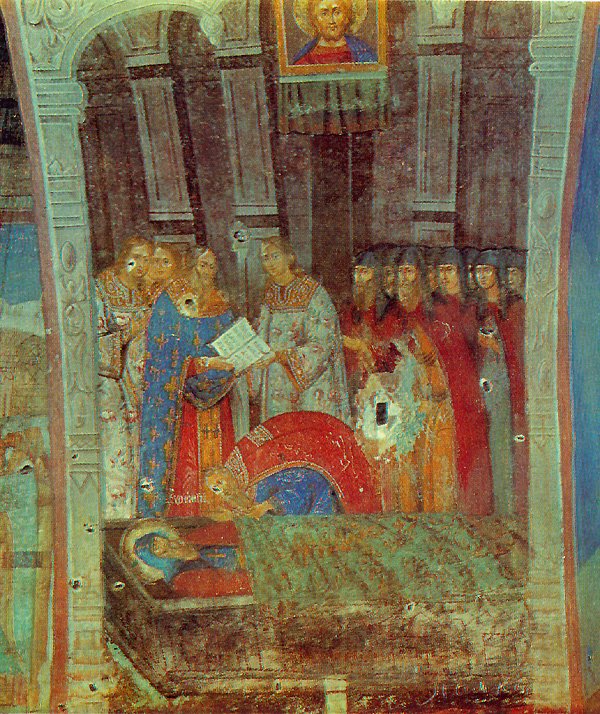
So, the the Savior-Euthymius monastery was founded, where soon more than three hundred monks gathered under the guidance of the saint. The monastery adopted the cenobitic rule. The saint insisted that each of the monks be prepared to fulfill whatever obedience they were given. Saint Euthymius went often to the Trinity-Sergiev monastery to Saint Sergius of Radonezh (September 25 and July 5). Saint Euthymius was a strict ascetic and a great man of prayer. He toiled incessantly for the benefit of all the brethren. Saint Euthymius died on April 1, 1404.
On July 4, 1507 while a foundation trench was being dug for a new cathedral church, his incorrupt relics were uncovered. The saint was glorified at a Council in 1549.
Troparion - Tone 3
Like a shining star, you came from the east to the west, / leaving your homeland, Nizhny Novgorod, and reaching the God-saved city of Suzdal, / you founded a monastery there and gathered many monks, / and received the gift of working miracles from God, / O Father Euthymios, you were of one mind with Christ and an ascetic equal to the Venerable Sergius. / With him, entreat Christ God to grant us health, salvation, and great mercy to our souls.
Kontakion - Tone 2
Passing dry through many storms, / you drowned your bodiless enemies with the streams of your tears, O divinely wise Euthymios, / therefore, you received the gift of miracles, / pray unceasingly for all of us.
Martyr Abraham of Bulgaria
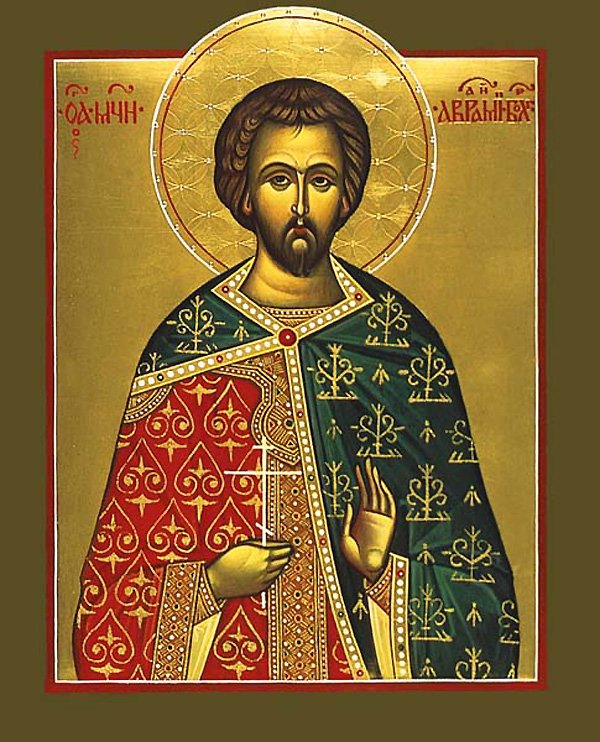
The Holy Martyr Abraham the Bulgar, Vladimir Wonderworker, lived during the thirteenth century, and was descended from the Kamska Bulgars and brought up as a Moslem. He was good and kindly towards the destitute, and when the Lord enlightened him with the light of reason, he accepted Christianity.
In the city of Bolgara, on the lower stretches of the Volga, Saint Abraham began to preach to his fellow countrymen about the true God.
The Holy Martyr Abraham the Bulgar, Vladimir Wonderworker, lived during the thirteenth century, and was descended from the Kamska Bulgars and brought up as a Moslem. He was good and kindly towards the destitute, and when the Lord enlightened him with the light of reason, he accepted Christianity.
In the city of Bolgara, on the lower stretches of the Volga, Saint Abraham began to preach to his fellow countrymen about the true God. They seized him and tried to force him to renounce Christ, but the saint remained firm in his confession. They tortured the martyr fiercely and for a long while, but he endured everything with unshakable patience.
On April 1, 1229 they quartered the holy Martyr Abraham, and then cut off his venerable head. Russian Christians living in the city buried the saint’s body in the Christian cemetery. On March 6, 1230, the relics of Saint Abraham were transferred by the Great Prince Saint George Vsevolodovich of Vladimir (February 4) to the Dormition cathedral of the Knyaginin (Princess) monastery. His memory began to be celebrated from that time.
Troparion - Tone 3
Your holy martyr Abraham, O Lord, / through his suffering has received an incorruptible crown from You, our God. / For having Your strength, he laid low his adversaries, / and shattered the powerless boldness of demons. / Through his intercessions, save our souls!
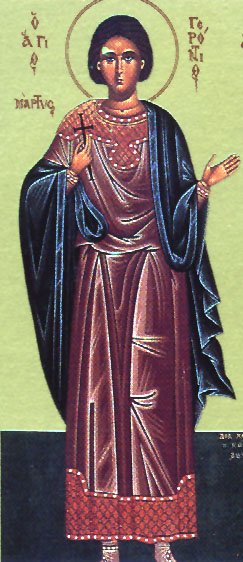
Venerable Gerontius the Canonarch of the Kiev Far Caves
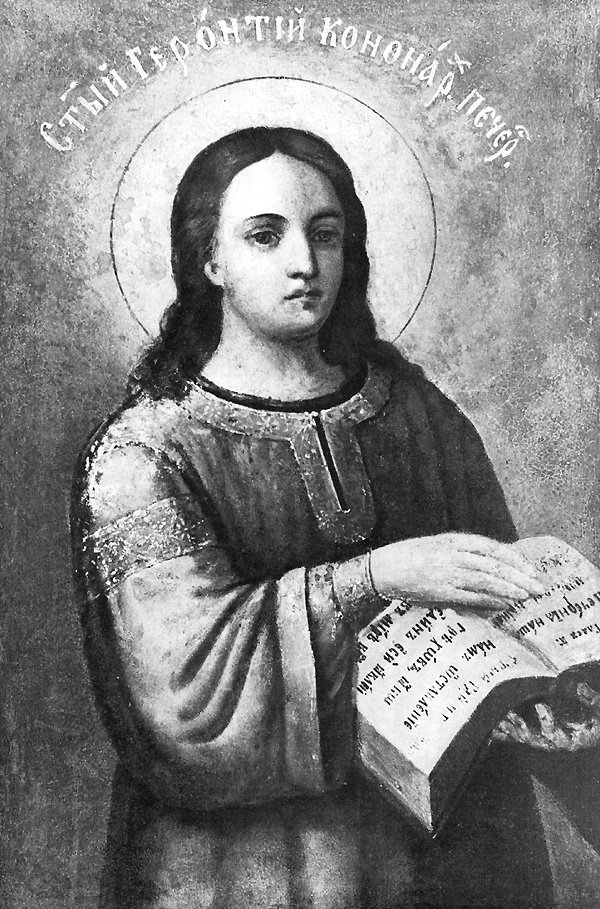
Saint Gerontius lived during the fourteenth century. He was a monk of the Kiev Caves Monastery and fulfilled the obedience of canonarch (leader of church singing). He spent all his life at the monastery, in ascetic deeds of abstinence, obedience, and prayer.
Saint Gerontius was buried in the Far Caves.
Saint Gerontius lived during the fourteenth century. He was a monk of the Kiev Caves Monastery and fulfilled the obedience of canonarch (leader of church singing). He spent all his life at the monastery, in ascetic deeds of abstinence, obedience, and prayer.
Saint Gerontius was buried in the Far Caves. His memory is celebrated also together with the Synaxis of the Saints of the Far Caves, on August 28.
Troparion - Tone 8
By a flood of tears you made the desert fertile, / and your longing for God brought forth fruits in abundance. / By the radiance of miracles you illumined the whole universe! / O our holy father Gerontius, pray to Christ our God to save our souls!
Venerable Makarios, Igoumen of Pelēketḗ
Saint Makarios (Christóphoros in the world) was born at Constantinople in 785. He lost both his parents when he was still a child, and a pious uncle assumed responsibility for his upbringing and education, and also taught him to love God. In a short time his knowledge of Holy Scripture increased, and he realized that there are earthly and corruptible things, and also things which are heavenly, incorruptible, and eternal.
Saint Makarios (Christóphoros in the world) was born at Constantinople in 785. He lost both his parents when he was still a child, and a pious uncle assumed responsibility for his upbringing and education, and also taught him to love God. In a short time his knowledge of Holy Scripture increased, and he realized that there are earthly and corruptible things, and also things which are heavenly, incorruptible, and eternal.
Since he was drawn to the monastic life, he forsook the world and fled to the monastery of Saint John the Theologian, also called Pelēketḗ, at Triglia of Proussa in Bithynia, where the renowned ascetic, Saint Hilarion (March 28) was the Igoumen. After receiving the monastic tonsure, he was given the name Makarios. The young monk began to engage in ascetical struggles and prayer. Later, by God's will, Saint Makarios was chosen as the Igoumen of the Monastery after Saint Hilarion's repose.
Saint Makarios became a Spiritual Father for all, not only for the monks, but also for the faithful, who flocked to him seeking his advice, his prayers, and for the healing of both soul and body, since God had given him the extraordinary gift (χάρισμα) of working miracles.
Patriarch Tarasios (784 – 806) was aware of the Saint's reputation, so he sent to him to the patrician Paul, who was suffering from an incurable illness. Saint Makarios healed him, and later he healed Paul's wife of the same illness. After that, Patriarch Tarasios took the Saint to Constantinople, and ordained him to the holy priesthood. The holy Elder submitted to the Patriarch's will because, as he said himself, "I hate disobedience and love obedience."
The heresy of iconoclasm erupted during the reign of the Byzantine Emperors Leo V the Armenian (813-820) and Michael II the Stammerer (820-829). Leo exiled the holy Patriarch Nikēphóros, and he had many monks and priests tortured, exiled, or thrown into prison.
Saint Makarios also suffered as a confessor because of his veneration of the Holy Icons. Since he was loved and respected, he was sentenced to prison, where he remained until Leo's death. Emperor Michael the Stammerer succeeded Leo in the year 820, and released the Elder from prison. He was an iconoclast, however; therefore, he tried to flatter the Saint, urging him to condemn the veneration of icons, but he remained steadfast in his faith.
Seeing that torture and threats were ineffective, Michael had the Saint exiled to the small island of Aphousia, which is in the Sea of Marmara, near Alona. There he lived in hardship and deprivation for many years continually giving thanks to God.
Saint Makarios went to the Lord around the year 830, and was succeeded as Igoumen by the monk Sergius the Solitary, who wrote his Life.
Troparion - Tone 4
You imitated the zeal of Elias the Tishbite, / and the characteristics of the Baptist; / and with inspired words, O Father Makarios, / you rebuked the impious Emperors, strengthening the faithful in piety. / Therefore, having been tested by your afflictions, you went gloriously to God.
Martyrs Gerontius and Basilides
The Martyrs Gerontius and Basilides suffered martyrdom for Christ in the third century. They were beheaded by the sword.
Troparion - Tone 4
Your holy martyrs Gerontius and Basilides, O Lord, / through their sufferings have received incorruptible crowns from You, our God. / For having Your strength, they laid low their adversaries, / and shattered the powerless boldness of demons. / Through their intercessions, save our souls!
Righteous Achaz (Ahaz)
No information available at this time.
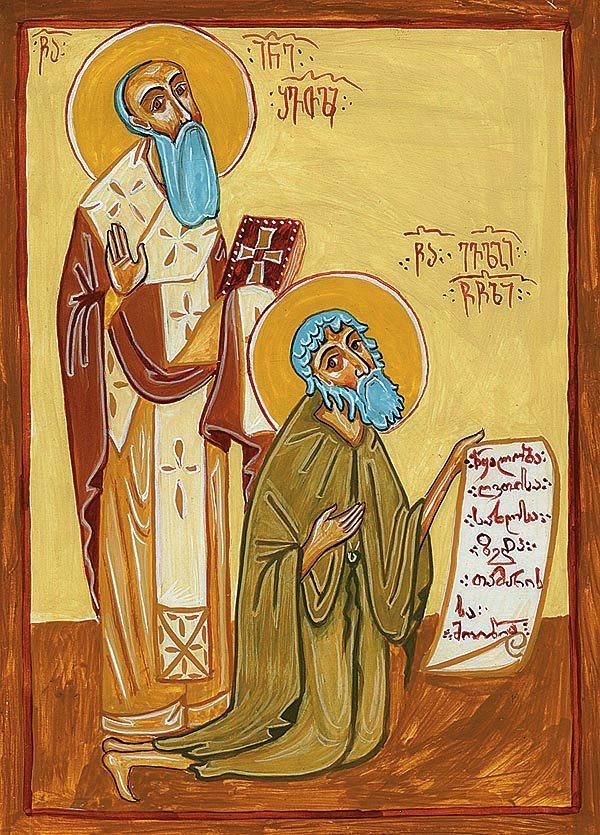
Saint John Shavteli, Bishop of Gaenati and Saint Eulogius, Prophet and Fool-for-Christ of Salosi
The great Georgian hymnographer, philosopher, and orator Saint John of Shavta labored in the 12th and 13th centuries, during the reign of the holy queen Tamar. Few details of his life have been preserved, but we know that he received his education at Gelati Academy, where he studied theology, ancient and Arabic history, philosophy, and literature.
The great Georgian hymnographer, philosopher, and orator Saint John of Shavta labored in the 12th and 13th centuries, during the reign of the holy queen Tamar. Few details of his life have been preserved, but we know that he received his education at Gelati Academy, where he studied theology, ancient and Arabic history, philosophy, and literature. He was later tonsured a monk and labored at Vardzia Monastery.
When the Georgian army under the command of Queen Tamar’s husband, Davit Soslan, entered into battle (The Battle of Basiani (ca. 1203)) with the sultan Rukn al-Din, Queen Tamar journeyed to Odzrkhe Monastery to pray for help. Catholicos Tevdore of Kartli and many hierarchs and monastics accompanied her there. Among them, Saint John of Shavta stood out as a wise theologian and philosopher and a brilliant hymnographer.
During the Liturgy at Odzrkhe Monastery a miracle occurred: endowed by God with the gift of prophecy, Saint Eulogius the Fool for-Christ fell to his knees, lifted his hands to the heavens and cried out: “Glory to God! Almighty Christ!...Do not fear the Persians, but rather depart in peace, for the mercy of God has descended upon the house of Tamar!”
Eulogius’s words were clearly a divine revelation. Saint John of Shavta turned to Queen Tamar, rejoicing, “Your Highness! The Almighty has made known to us our victory in the war from the lips of a fool-for-Christ!” Eulogius confided his secret to Saint John: disguised as a fool, he had been concealing his God-given gift. But now it seemed that the gift would become apparent to all, so Eulogius quickly disappeared out of sight to escape the people’s attention.
Saint John of Shavta composed his “Hymns to the Theotokos of Vardzia” in thanksgiving for Georgia’s victory in the Battle of Basiani. He is also recognized as the composer of “Abdul-Messiah,” (Abdul-Messiah: servant of Christ) a famous ode to the holy queen Tamar.
Our Holy Father John of Shavta lived to an advanced age and was canonized soon after his repose.
Troparion - Tone 4
In truth you were revealed to your flock as a rule of faith, / an image of humility and a teacher of abstinence; / your humility exalted you; / your poverty enriched you. / Hierarch Father John, / entreat Christ our God / that our souls may be saved.
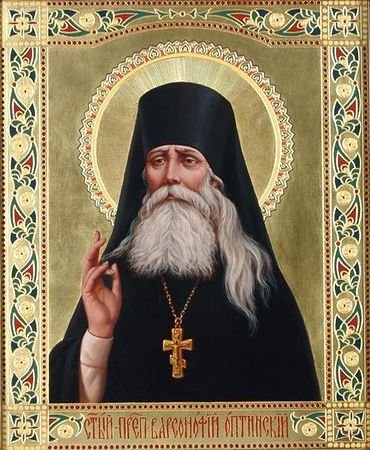
Venerable Barsanuphius of Optina
Paul I. Plikhanov was born in the city of Samara on July 5,1845, the son of John and Natalia Plikhanov. His mother died in childbirth, and his father later remarried so that his son would have a mother. Although his stepmother was very strict, she was a real mother to him, and he loved her very much.
Paul I. Plikhanov was born in the city of Samara on July 5,1845, the son of John and Natalia Plikhanov. His mother died in childbirth, and his father later remarried so that his son would have a mother. Although his stepmother was very strict, she was a real mother to him, and he loved her very much.
As a descendant of the Orenburg Cossacks, Paul was enrolled in the Polotsk Cadet Corps. He completed his studies at the Orenburg Military School and received an officer’s commission. He later graduated from the Petersburg Cossack Staff Officers’ School, and also served at the headquarters of the Kazan military district and eventually rose to the rank of colonel.
Once, as he was sick with pneumonia, Paul sensed that he was about to die. He asked his orderly to read the Gospel to him, and passed out. Then he had a vision in which the heavens seemed to open, and he was afraid because of the great light. His whole sinful life passed before him, and he was overcome with repentance. A voice told him he should go to Optina Monastery, but the doctors did not think he would recover. His health did improve, however, and the colonel visited Optina. In August 1889 the Elder of the Monastery was Saint Ambrose (October 10), who told Paul to set his worldly affairs in order. Two years later, Saint Ambrose blessed him to cut all ties to the world and told him to enter Optina within three months.
It was not easy for the colonel to resign his commission within the specified three month period, because obstacles were placed in his way. In fact, he was offered a promotion to the rank of general, and was asked to delay his retirement. Some people even tried to arrange a marriage for him, laughing at his intention to go to the monastery. Only his stepmother was happy that he wished to become a monk. On the very last day of the three months he concluded his affairs and arrived at Optina. However, Saint Ambrose was already laid out in his coffin in the church.
Saint Anatole I (January 25) succeeded Father Ambrose as Elder, and he assigned Paul to Hieromonk Nectarius (April 29) as his cell attendant. He was accepted as a novice in 1892, and tonsured as a rassophore in 1893. Over the next ten years he advanced through the various stages of monastic life, including ordination as deacon (1902), and as priest (1903). The monk Paul was secretly tonsured into the mantiya in December of 1900 because of a serious illness. When they asked him what name he wished to receive, he said it did not matter. They named him in honor of Saint Barsanuphius of Tver and Kazan (April 11). Although he recovered, they did not give him the mantiya until December of 1902 after the Liturgy when it was revealed that he had been tonsured on his sickbed.
On September 1, 1903 Father Barsanuphius was appointed to assist Elder Joseph, the skete Superior, in the spiritual direction of the skete brethren and the sisters of the Shamordino convent.
At the beginning of the Russo-Japanese war in 1904, Father Barsanuphius was sent to the Far East as a military chaplain, where he ministered to wounded soldiers. The war ended in August 1905, and Saint Barsanuphius returned to Optina on November 1, 1905.
Since Elder Joseph had become too old and frail to administer the skete’s affairs, Father Barsanuphius was appointed as Superior of the skete in his place. Father Barsanuphius soon reestablished order and discipline, paid off debts, repaired buildings, etc. As Superior, he combined strictness with paternal concern and tenderness for those under him.
Saint Barsanuphius, like the other Elders of Optina, possessed the gifts of clairvoyance and of healing people afflicted with physical and spiritual ailments. One of his spiritual sons, Father Innocent Pavlov, recalled his first Confession with the Elder. He became fearful because Father Barsanuphius seemed to know his innermost thoughts, reminding him of people and events which he had forgotten. The saint spoke gently and told him that it was God who had revealed to him these things about Father Innocent. “During my lifetime, do not tell anyone about what you are experiencing now,” he said, “but you may speak of it after my death.”
Saint Barsanuphius loved spiritual books, especially the Lives of the Saints. He often told people that those who read these Lives with faith benefit greatly from doing so. The answers to many of life’s questions can be found by reading the Lives of the Saints, he said. They teach us how to overcome obstacles and difficulties, how to stand firm in our faith, and how to struggle against evil and emerge victorious. Although the Lives of the Saints were widely available, it saddened the Elder that more people did not read them.
Saint Barsanuphius commemorated many saints each day during his Rule of prayer, and this was not accidental. Each saint, he once explained, had some particular importance in his life. If, for example, some significant event took place, he would look to see which saints were commemorated on that day, then he would begin to commemorate them each day. Later he noticed that on their Feast Day, they would often deliver him from some danger or trouble. On December 17, 1891, the commemoration of the Prophet Daniel and the three holy youths, he left Kazan and never returned. That was the day he decided to leave the world, and Saint Barsanuphius felt that God had delivered him from a furnace of passions. Just as the three youths were delivered from the fiery furnace because they would not bow down before idols, the Elder always believed that he left the world unharmed because he refused to bow down before the idols of lust, pride, gluttony, etc.
By 1908, Saint Barsanuphius seemed to fall ill more frequently, and began to speak of his approaching death. In April of that year, someone sent him a package containing the Great Schema. Father Barsanuphius had long desired to be tonsured into the Great Schema before his death, but he had told no one of this except for the archimandrite. Therefore, he regarded this as a sign that he would soon die.
One night in July 1910, the Elder became so ill that he had to leave church during Vigil and return to his cell. The next morning, July 11, he was so weak that he could not sit up by himself. That evening he was tonsured into the Great Schema.
Father Barsanuphius began to recover, but there were new problems in the monastery. New monks came in from spiritually lax environments. They did not understand the ascetical nature of monasticism or the whole notion of eldership, and so they began to clamor for reform and change. They wanted to assume positions of authority, and to close the skete. Because of their complaints, Father Barsanuphius was removed from Optina and assigned as igumen of the Golutvinsky Monastery. When he arrived to take up his duties, Father Barsanuphius found the monastery in a state of physical and spiritual decline. Nevertheless, he did not lose heart, and soon the monastery began to revive. More people began to visit, once they heard that an Optina Elder had come to Goluvinsky, and the monastery’s financial position also began to improve. However, the rebellious brethren caused him great sorrow, and he had to expel some of them
At the beginning of 1913, Saint Barsanuphius became ill again and asked Metropolitan Macarius of Moscow for permission to retire to Optina, but that was not to be. He fell asleep in the Lord on April 1, and his body remained in the church of Golotvino until April 6 (which was also Lazarus Saturday). After the funeral, his body was placed on a train and sent to Optina for burial. The train arrived at Kozelsk Station on April 8, and the coffin was carried to Optina by clergy.
The Moscow Patriarchate authorized local veneration of the Optina Elders on June 13, 1996. The work of uncovering the relics of Saints Leonid, Macarius, Hilarion, Ambrose, Anatole I, Barsanuphius and Anatole II began on June 24/July 7, 1998 and was concluded the next day. However, because of the church Feasts (Nativity of Saint John the Baptist, etc.) associated with the actual dates of the uncovering of the relics, Patriarch Alexey II designated June 27/July 10 as the date for commemorating this event. The relics of the holy Elders now rest in the new church of the Vladimir Icon of the Mother of God.
The Optina Elders were glorified by the Moscow Patriarchate for universal veneration on August 7, 2000.
Troparion - Tone 8
In you, O Father, was preserved with exactness what was according to the image; / for you took up the Cross and followed Christ. / By so doing, you taught us to disregard the flesh, for it passes away; / but to care for the soul, since it is immortal. / Therefore, O Venerable Barsanouphios, your spirit rejoices with the Angels.
 Meat
Abstain
Meat
Abstain
 Fish
Abstain
Fish
Abstain
 Dairy
Abstain
Dairy
Abstain
 Oil
Abstain
Oil
Abstain
 Wine
Abstain
Wine
Abstain