Fasting Rules

Meat allowed Meat Allowed
Fish allowed Fish Allowed
Dairy allowed Dairy Allowed
Oil allowed Oil Allowed
Wine allowed Wine Allowed

Saints & Commemorations
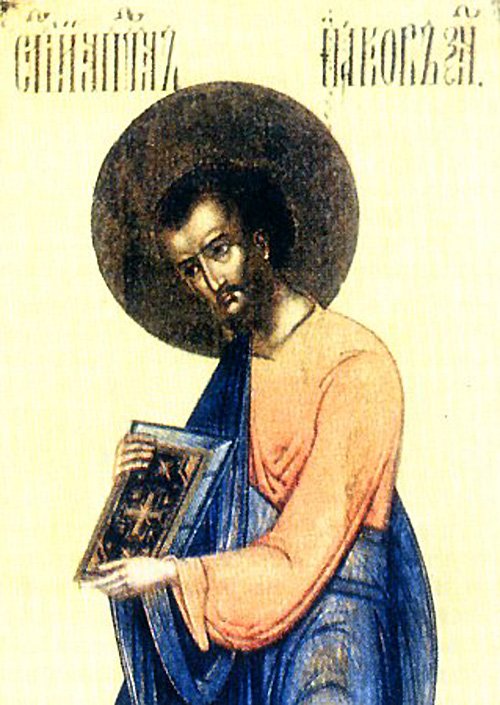
Apostle James the Brother of Saint John the Theologian

Apostle James the Brother of Saint John the Theologian

The Holy Apostle James, the son of Zebedee, was the brother of Saint John the Theologian, and one of the Twelve Apostles. He and his brother, Saint John, were called to be Apostles by our Lord Jesus Christ, Who called them the “Sons of Thunder” (Mark 3:17). It was this James, with John and Peter, who witnessed the Raising of the Daughter of Jairus, the Lord’s Transfiguration on Mount Tabor, and His agony in the Garden of Gethsemane. Sain The Holy Apostle James, the son of Zebedee, was the brother of Saint John the Theologian, and one of the Twelve Apostles. He and his brother, Saint John, were called to be Apostles by our Lord Jesus Christ, Who called them the “Sons of Thunder” (Mark 3:17). It was this James, with John and Peter, who witnessed the Raising of the Daughter of Jairus, the Lord’s Transfiguration on Mount Tabor, and His agony in the Garden of Gethsemane. Saint James, after the Descent of the Holy Spirit, preached in Spain and in other lands, and then he returned to Jerusalem. He openly and boldly preached Jesus Christ as the Savior of the world, and he denounced the Pharisees and the Scribes with the words of Holy Scripture, reproaching them for their malice of heart and unbelief. The Jews could not prevail against Saint James, and so they hired the sorcerer Hermogenes to dispute with the apostle and refute his arguments that Christ was the promised Messiah Who had come into the world. The sorcerer sent to the apostle his pupil Philip, who was converted to belief in Christ. Then Hermogenes himself became persuaded of the power of God, he burned his books of magic, accepted holy Baptism and became a true follower of Christ. The Jews persuaded Herod Agrippa (40-44) to arrest the Apostle James and sentence him to death (Acts 12:1-2). Eusebius provides some of the details of the saint’s execution (CHURCH HISTORY II, 9). Saint James calmly heard the death sentence and continued to bear witness to Christ. One of the false witnesses, whose name was Josiah, was struck by the courage of Saint James. He came to believe in Jesus Christ as the Messiah. When they led the apostle forth to execution, Josiah fell at his feet, repenting of his sin and asking forgiveness. The apostle embraced him, gave him a kiss and said, “Peace and forgiveness to you.” Then Josiah confessed his faith in Christ before everyone, and he was beheaded with Saint James in the year 44 at Jerusalem. Saint James was the first of the Apostles to die as a martyr.

Troparion - Tone 8

As a soldier of the Lord you were ranked among the choir of Apostles. / Together with your brother, O James, you clung wholeheartedly to the Savior. / Armed with the power of the Spirit you proclaimed Him to all, and were slain by the sword. / Therefore, we sing your praises.

Kontakion - Tone 2

You were a chosen Apostle of Christ / and the only brother of the beloved Theologian. / O most praised James, entreat Him to grant the remission of sins and great mercy / to those who sing hymns to you.
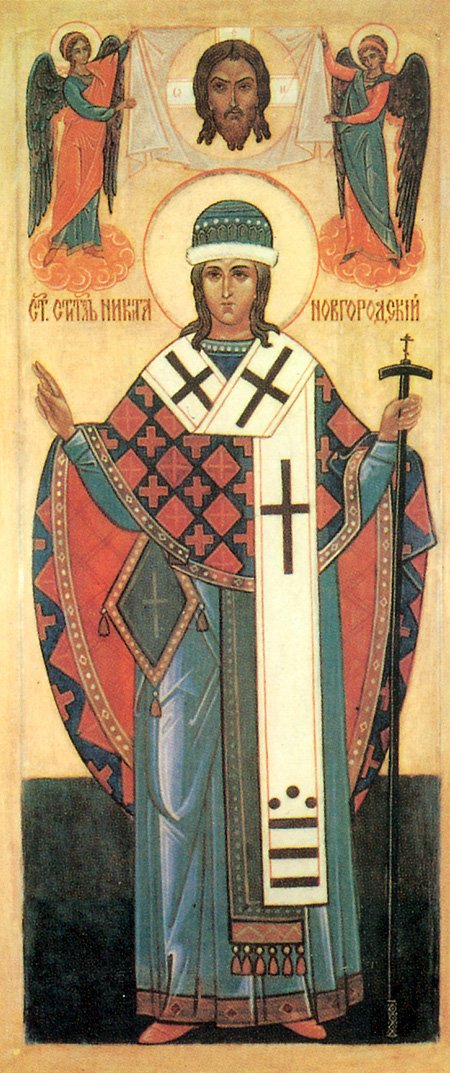
Uncovering of the relics of Saint Nikḗtas, Bishop of Novgorod

Uncovering of the relics of Saint Nikḗtas, Bishop of Novgorod

Saint Nikḗtas the former Recluse of the Kiev Caves fell asleep in the Lord in 1109, after serving as Bishop of Novgorod for thirteen years. Bishop Nikḗtas was glorified as a saint during the reign of Tsar Ivan Vasilievich, and his holy relics, dressed in full vestments, were uncovered on April 30, 1558. Tha Saint Nikḗtas the former Recluse of the Kiev Caves fell asleep in the Lord in 1109, after serving as Bishop of Novgorod for thirteen years. Bishop Nikḗtas was glorified as a saint during the reign of Tsar Ivan Vasilievich, and his holy relics, dressed in full vestments, were uncovered on April 30, 1558. That day was marked by the healing of many people. His relics now rest in the cathedral of the holy Apostle Philip in Novgorod. Saint Nikḗtas of Novgorod is also commemorated on January 31, the day of his repose, and on May 14.

Troparion - Tone 4

In truth you were revealed to your flock as a rule of faith, / an image of humility and a teacher of abstinence; / your humility exalted you; / your poverty enriched you. / Hierarch Father Nikita, / entreat Christ our God / that our souls may be saved.
Saint Donatus, Bishop of Euroea in Epirus

Saint Donatus, Bishop of Euroea in Epirus

Saint Donatus lived during the reign of the holy Emperor Theodosius the Great (379-397) and was bishop of the city of Euroea (in Albania). Not far from this city, in the vicinity of Soreia, was a brackish spring of water. When the saint learned of this, he went with clergy to the spring and cast out a monstrous serpent, which died. Saint Donatus lived during the reign of the holy Emperor Theodosius the Great (379-397) and was bishop of the city of Euroea (in Albania). Not far from this city, in the vicinity of Soreia, was a brackish spring of water. When the saint learned of this, he went with clergy to the spring and cast out a monstrous serpent, which died. The saint prayed, he blessed the spring and drank the water without harm. Seeing this miracle, the people glorified God. Another time, Saint Donatus prayed and brought forth water from a dry and rocky place, and during a drought he entreated the Lord to send rain to the parched land. The daughter of the holy Emperor Theodosius fell terribly ill and was afflicted by an unclean spirit. Saint Donatus came to the palace, and as soon as he arrived the devil left and the sick woman was healed. A certain man, shortly before his death, repaid a loan to a money-lender. The creditor tried to extort the money a second time from the dead man’s widow. The saint resurrected the dead man, who told where and when the loan had been repaid. After obtaining a receipt from the creditor, the man fell asleep in the Lord. Saint Donatus reposed in peace about the year 387.

Troparion - Tone 4

In truth you were revealed to your flock as a rule of faith, / an image of humility and a teacher of abstinence; / your humility exalted you; / your poverty enriched you. / Hierarch Father Donatus, / entreat Christ our God / that our souls may be saved.
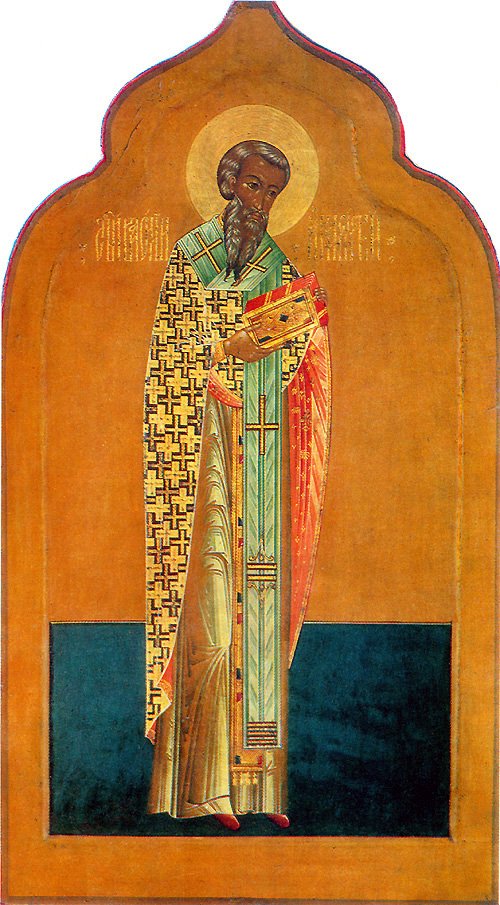
Uncovering of the relics of Saint Basil, Bishop of Amasea

Uncovering of the relics of Saint Basil, Bishop of Amasea

The Hieromartyr Basil, Bishop of Amasea, lived at the beginning of the fourth century in the Pontine city of Amasea. He encouraged and comforted the Christians suffering persecution by the pagans. During this time the Eastern part of the Roman Empire was ruled by Licinius (311-324), the brother-in-law of the holy emperor Constantine the Great (May 21). The Hieromartyr Basil, Bishop of Amasea, lived at the beginning of the fourth century in the Pontine city of Amasea. He encouraged and comforted the Christians suffering persecution by the pagans. During this time the Eastern part of the Roman Empire was ruled by Licinius (311-324), the brother-in-law of the holy emperor Constantine the Great (May 21). Licinius deceitfully signed Saint Constantine’s Edict of Milan (313), which granted religious toleration to Christians, but he hated them and continued to persecute them.

Troparion - Tone 4

In truth you were revealed to your flock as a rule of faith, / an image of humility and a teacher of abstinence; / your humility exalted you; / your poverty enriched you. / Hierarch Father Basil, / entreat Christ our God / that our souls may be saved.
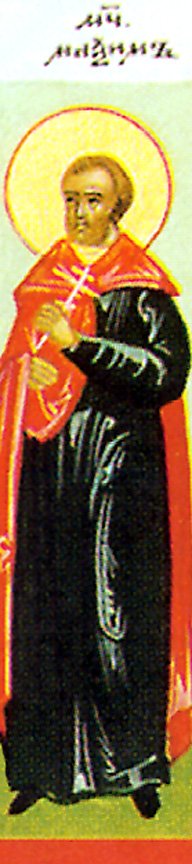
Martyr Maximus of Ephesus

Martyr Maximus of Ephesus

The Holy Martyr Maximus suffered for his faith in Christ, and was run through with a sword.

Troparion - Tone 3

Your holy martyr Maximus, O Lord, / through his sufferings has received an incorruptible crown from You, our God. / For having Your strength, he laid low his adversaries, / and shattered the powerless boldness of demons. / Through his intercessions, save our souls!
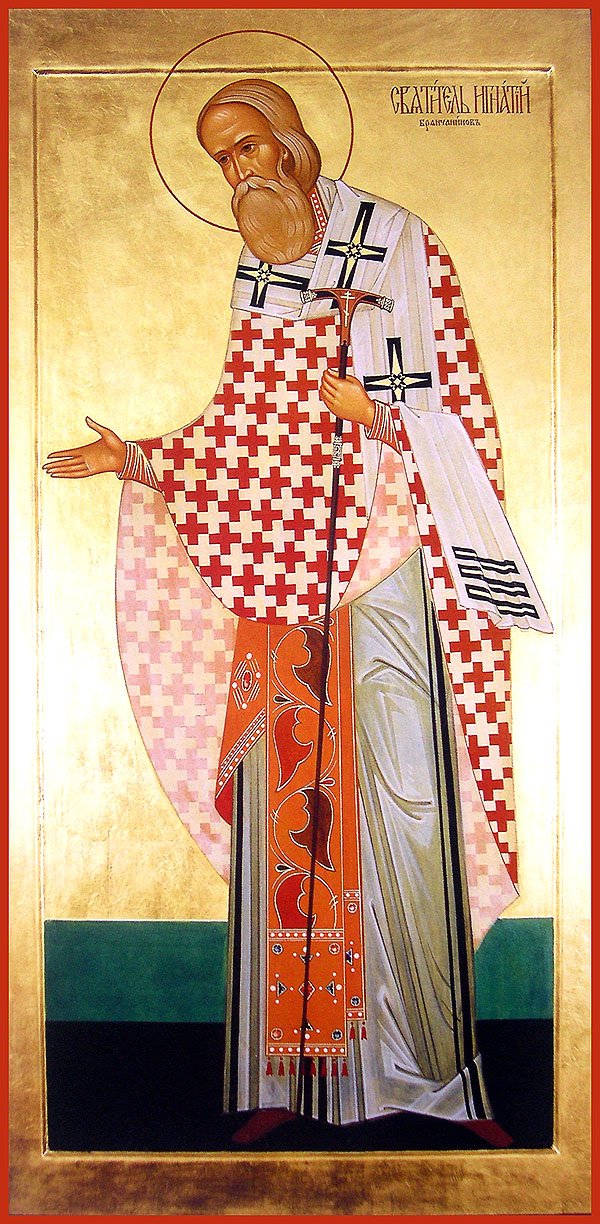
Saint Ignatius Brianchaninov, Bishop of the Caucasus and Stavropol

Saint Ignatius Brianchaninov, Bishop of the Caucasus and Stavropol

He was born in 1807 into Russian aristocracy — his father was a wealthy provincial gentleman. From a very early age he felt strongly called to monastic life, but at that time it was almost unheard of for a nobleman to take such a path, and Dimitri (as he was called in baptism) entered the Pioneer Military School in St Petersburg. T He was born in 1807 into Russian aristocracy — his father was a wealthy provincial gentleman. From a very early age he felt strongly called to monastic life, but at that time it was almost unheard of for a nobleman to take such a path, and Dimitri (as he was called in baptism) entered the Pioneer Military School in St Petersburg. There he distinguished himself, and even attracted the attention of Grand Duke Nicholas Pavlovich, an event which would profoundly affect his later life. Despite his excellent record at the academy, young Dimitri still longed only for the things of God. In 1827 he graduated from the school and was commissioned as an officer in the army, but soon fell critically ill, and was granted a discharge. This proved to be providential: when he recovered his health, he immediately became a novice, living at several different monasteries and coming under the spiritual care of Starets Leonid, one of the celebrated fathers of the Optina monastery. In 1821 he took his monastic vows and received the name Ignatius. Soon afterwards he was ordained to the priesthood. Soon after the newly-professed Fr Ignatius had entered the seclusion that he sought, Tsar Nicholas I — the former Grand Duke Nicholas — visited the Pioneer Military School and asked what had become of the promising cadet he had met a few years before. When the Tsar learned that the former Dimitri was now a monk, he sought him out, had him elevated to the rank of Archimandrite (at age 26!) and made him Superior of the St Sergius Monastery in St Petersburg. Tsar Nicholas instructed him to make the monastery a model for all Russian religious communities. Though he had desired only a life of solitude and prayer, the new Archimandrite devoted himself conscientiously to fulfilling the Tsar’s charge. The monastery did in fact become a kind of standard for Russian monasticism, and its abbot acquired many spiritual children, not only among his monks but among the laity in the capital. After twenty-four years as superior of the monastery, St Iganatius was elevated to the episcopate in 1857, first as Bishop of Stavropol, then as Bishop of Kavkaz. Only four years later (aged 54) he resigned and spent the rest of his life in reclusion at the Nicolo-Babaevsky Monastery in the diocese of Kostromo. There he continued the large body of spiritual writings for which he is well known. His printed Works fills five volumes; of these, at least two major works have been translated into English: On the Prayer of Jesus and The Arena: an offering to contemporary monasticism. Both are gems of spiritual writing, profitable to every serious Orthodox Christian. St Ignatius reposed in peace in 1867. He was glorified in 1988 by the Moscow Patriarchate, during the millennial celebrations in that year. Saints Andrei Rublev, Xenia of Petersburg, Theophan the Recluse and others were glorified in the same observances.

Troparion - Tone 8

You were shown as the chosen beloved of Christ, united to Him by many afflictions and unceasing prayer; / and having received the grace of the Holy Spirit, you were an exemplary teacher for the people. / Remember us, O holy hierarch Ignatius, God-bearer of Russia, / that by your teachings and prayers, we may find saving repentance, / and, with heartfelt love, be found in Christ.* * Philippians 3:8

Kontakion - Tone 8

You were shown as the chosen beloved of Christ, united to Him by many afflictions and unceasing prayer; / and having received the grace of the Holy Spirit, you were an exemplary teacher for the people. / Remember us, O holy hierarch Ignatius, God-bearer of Russia, / that by your teachings and prayers, we may find saving repentance, / and, with heartfelt love, be found in Christ.*

New Martyr Argyra

The holy New Martyr Argyra lived in Proussa, Bithynia, and came from a pious family. She was a beautiful and virtuous woman. When she was eighteen, she married a pious Christian, and they moved into a neighborhood inhabited by many Moslems. After only a few days, she was approached by a Turkish neighbor, the son of the Cadi (magistrate). The holy New Martyr Argyra lived in Proussa, Bithynia, and came from a pious family. She was a beautiful and virtuous woman. When she was eighteen, she married a pious Christian, and they moved into a neighborhood inhabited by many Moslems. After only a few days, she was approached by a Turkish neighbor, the son of the Cadi (magistrate). He boldly declared his love for her, and tried to convert her to his religion. She rejected his advances, saying that she would rather die than be married to a Moslem. She did not tell her husband, fearing that he would go after the Turk and then be punished for it. The Moslem brought her to trial and testified that she had assented to his advances, but then had laughed and said she was only joking. His lies were corroborated by false witnesses, and Argyra was sent to prison. The saint’s husband, hoping to get her a fair trial, appealed to Constantinople. There the accuser repeated his lies before the judge. Saint Argyra said that she was a Christian, and that she would never deny Christ. The judge ordered her to be flogged, then sentenced her to life in prison. She was often taken from her cell, interrogated, beaten, then returned to prison. This continued for seventeen years. The saint was also insulted and tormented by the Moslem women who were incarcerated for their evil deeds. The Evil One incited them to annoy Saint Argyra with these torments and afflictions, but she endured all these things with great courage and patience. According to the testimony of many Christian women who were in prison with her, she humbled her body through fasting. Her heart was filled with such love for Christ that she regarded her hardships as comforts. A pious Christian named Manolis Kiourtzibasis sent her word that he would try to have her released, but Saint Argyra would not consent to this. She completed her earthly pilgrimage in the prison, receiving the crown of martyrdom on April 5, 1721. After a few years her body was exhumed, and was found to be whole and incorrupt, emitting an ineffable fragrance. Pious priests and laymen took her body to the church of Saint Paraskeve on April 30, 1735 with the permission of Patriarch Paisius II. Her relics remain there to this day, where they are venerated by Orthodox Christians from all walks of life, to the glory of the Father, the Son, and the Holy Spirit. Saint Argyra’s name comes from the Greek word for silver (argyre). THE NEW MARTYR ARGYRA 1688-1721 by P. Philippidou (which also contains a Service to the saint) was published in Constantinople in 1912.

Troparion - Tone 3

Your holy martyr Argyra, O Lord, / through her sufferings has received an incorruptible crown from You, our God. / For having Your strength, she laid low her adversaries, / and shattered the powerless boldness of demons. / Through her intercessions, save our souls!

Scripture Readings

Epistle

Acts 8:26-39

26 And the angel of the Lord spake unto Philip, saying, Arise, and go toward the south unto the way that goeth down from Jerusalem unto Gaza, which is desert.
27 And he arose and went: and, behold, a man of Ethiopia, an eunuch of great authority under Candace queen of the Ethiopians, who had the charge of all her treasure, and had come to Jerusalem for to worship,
28 Was returning, and sitting in his chariot read Esaias the prophet.
29 Then the Spirit said unto Philip, Go near, and join thyself to this chariot.
30 And Philip ran thither to him, and heard him read the prophet Esaias, and said, Understandest thou what thou readest?
31 And he said, How can I, except some man should guide me? And he desired Philip that he would come up and sit with him.
32 The place of the scripture which he read was this, He was led as a sheep to the slaughter; and like a lamb dumb before his shearer, so opened he not his mouth:
33 In his humiliation his judgment was taken away: and who shall declare his generation? for his life is taken from the earth.
34 And the eunuch answered Philip, and said, I pray thee, of whom speaketh the prophet this? of himself, or of some other man?
35 Then Philip opened his mouth, and began at the same scripture, and preached unto him Jesus.
36 And as they went on their way, they came unto a certain water: and the eunuch said, See, here is water; what doth hinder me to be baptized?
37 And Philip said, If thou believest with all thine heart, thou mayest. And he answered and said, I believe that Jesus Christ is the Son of God.
38 And he commanded the chariot to stand still: and they went down both into the water, both Philip and the eunuch; and he baptized him.
39 And when they were come up out of the water, the Spirit of the Lord caught away Philip, that the eunuch saw him no more: and he went on his way rejoicing.

Gospel

John 6:40-44

40 And this is the will of him that sent me, that every one which seeth the Son, and believeth on him, may have everlasting life: and I will raise him up at the last day.
41 The Jews then murmured at him, because he said, I am the bread which came down from heaven.
42 And they said, Is not this Jesus, the son of Joseph, whose father and mother we know? how is it then that he saith, I came down from heaven?
43 Jesus therefore answered and said unto them, Murmur not among yourselves.
44 No man can come to me, except the Father which hath sent me draw him: and I will raise him up at the last day.

Liturgical data sourced from OCA.org and orthocal.info