Fasting Rules

Meat not allowed Meat Abstain
Fish not allowed Fish Abstain
Dairy not allowed Dairy Abstain
Oil allowed Oil Allowed
Wine allowed Wine Allowed

Saints & Commemorations
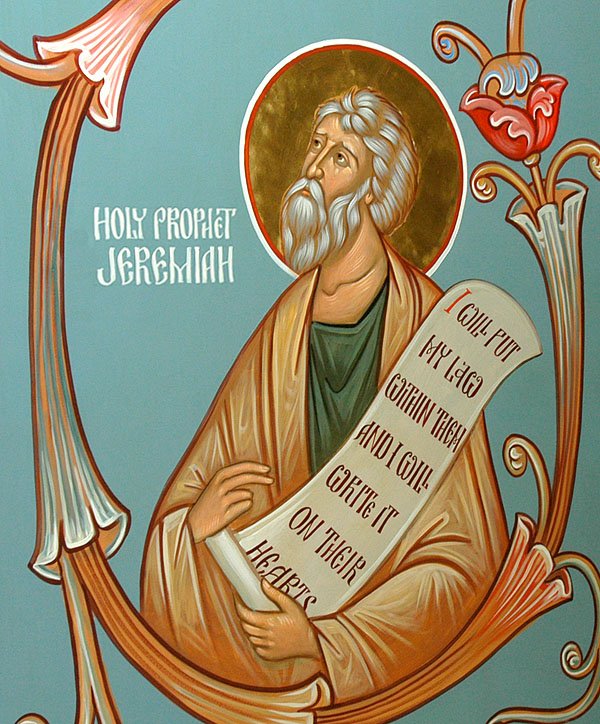
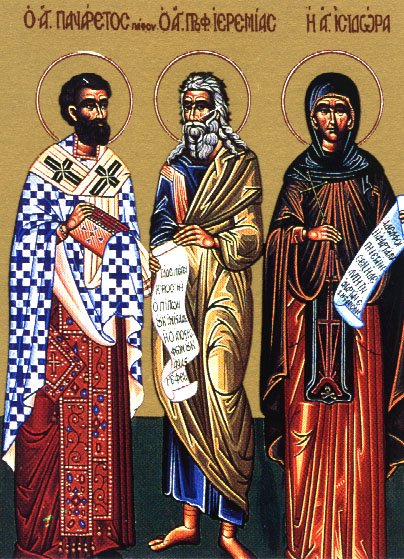
Prophet Jeremiah

Prophet Jeremiah

He is the author of the Old Testament book that bears his name and of the Book of Lamentations; and Baruch, his scribe and disciple, composed the Old Testament book that bears his own name. Jeremiah was the son of Helkiah, of the tribe of Levi, from the city of Anathoth in the land of Benjamin. He prophesied for thirty years, from 613 to 583 BC. He is the author of the Old Testament book that bears his name and of the Book of Lamentations; and Baruch, his scribe and disciple, composed the Old Testament book that bears his own name. Jeremiah was the son of Helkiah, of the tribe of Levi, from the city of Anathoth in the land of Benjamin. He prophesied for thirty years, from 613 to 583 BC. When the Hebrew people were taken into captivity in the reigh of Zedekiah, the Prophet remained behind and mourned the downfall of the Jerusalem: this is the origin of the book of Lamentations. The Jews who remained fled into Egypt, forcibly taking Jeremiah and his scribe Baruch with them. In Egypt, his prophecies continued to disturb his own people, who stoned him to death by in 583. His name means “The Lord is exalted.” He is ranked second among the great Prophets, after Isaiah. The holy Prophets and Forefathers, who lived before Christ’s coming in the flesh are counted as Saints of the Church because they foresaw His coming, spoke of it in their prophecies, looked forward to it with Joy, and greeted Jesus as their Savior when he descended into Hades before his Resurrection.

Troparion - Tone 2

Celebrating the memory / of Your Prophet Jeremiah, O Lord, / for his sake, we entreat You to save our souls.

Kontakion - Tone 3

Cleansing your radiant heart through the Spirit, / O great Prophet and Martyr, / glorious Jeremiah, / you received from on high the gift of prophecy. / You cried out with a great voice to the nations: / This is our God, and there is none other beside Him / Who became incarnate and appeared on earth.
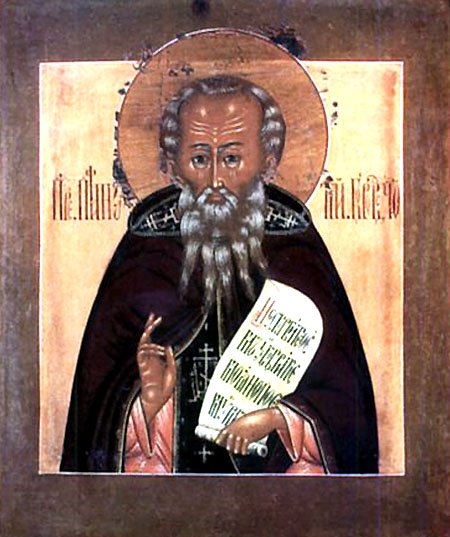
Venerable Paphnutius, Abbot of Borov

Venerable Paphnutius, Abbot of Borov

Saint Paphnutius of Borov was born in 1394 in the village of Kudinovo, not far from Borov, and at Baptism he was named Parthenius. His father John was the son of a baptized Tatar, a “baskak” (“tax-collector”) named Martin, and his mother was named Photina. At the age of twenty, Parthenius left his home and received monastic tonsure in 1414 with the name Paphnutius at the Vyosky-Protection Monastery near Borov under its abbot, Marcellus. Saint P Saint Paphnutius of Borov was born in 1394 in the village of Kudinovo, not far from Borov, and at Baptism he was named Parthenius. His father John was the son of a baptized Tatar, a “baskak” (“tax-collector”) named Martin, and his mother was named Photina. At the age of twenty, Parthenius left his home and received monastic tonsure in 1414 with the name Paphnutius at the Vyosky-Protection Monastery near Borov under its abbot, Marcellus. Saint Paphnutius struggled for many years at the monastery, and when Igumen Marcellus died, the brethren chose him as his successor. Saint Photius, Metropolitan of Kiev (July 2), ordained him to the priesthood around the year 1426. The monk spent thirty years at the Protection Monastery, where he was igumen, Elder, and Father-confessor. At fifty-one years of age he fell grievously ill, gave up his position as igumen and was tonsured into the Great Schema. After recovering his health on April 23, 1444 (the Feast of the holy Great Martyr George the Victory-Bearer), he left the monastery and settled with one monk on the left bank of the River Protva, where it meets the River Isterma. Soon brethren began to gather to him at this new place, and the number of the monks quickly grew. A new stone church was built in place of the former wooden one, in honor of the Nativity of the Most Holy Theotokos. The finest iconographers of those times, Dionysius, Metrophanes, and their assistants were invited to adorn the church with icons and frescoes. Saint Paphnutius was an example to the brethren, leading a strict life. His cell was the poorest of all, and he chose the worst morsels of food. On Mondays and Fridays he ate nothing at all, and on Wednesdays he only ate dry food. He did the most difficult tasks himself. He chopped and carried fire wood, dug and cultivated the garden, yet he was always the first to arrive for church services. Saint Paphnutius earned the deep respect and love not only of the brethren of his own monastery, but also of other monasteries. Through the providence of God a twenty-year-old youth, John Sanin was guided to the monastery. After testing him for a time, Paphnutius tonsured him into monasticism with the name Joseph. Later on Saint Joseph of Volokolamsk (Sept. 9) defended the purity of the Orthodox Faith and entered into struggle against the heresy of the Judaizers, condemned at the Council of 1504. Saint Paphnutius blessed the young man in his endeavors. A week before his death, the saint foretold his end. After he had prayed and blessed the brethren, he fell asleep in the Lord on May 1, 1477. Saint Paphnutius was a disciple of Saint Sergius of Radonezh (Sept. 25).

Troparion - Tone 4

By your radiant life, you illumined your homeland; / through prayers and fasting, you were filled with the gifts of the Divine Spirit, / and, contending valiantly in this temporal life, you struggled well, / revealing to all those who mourn, the mercy of compassion, and you were a protector of paupers. / Therefore we pray to you, Father Paphnoutios: “Entreat Christ God, that He may save our souls.”

Kontakion - Tone 8

Having been enlightened by God's divine light, O Father, / you attained the life of fasting, O Venerable one, / you excelled as a guide of monks and adornment of fasters. / Therefore, beholding your labors, the Lord has enriched you with the gift of miracles, for you grant healing. / We rejoice and cry out to you, “Rejoice, Father Paphnoutios.”

Ven. Paphnutius of Borovsk

New Martyr Euthymius of Mount Athos

This holy New Martyr of Christ was born in Demitsana in the Peloponnesos. His parents were Panagiotes and Maria, and he was given the name Eleutherius in Baptism. Eleutherius was the youngest of five children (the others were George, Christos, John, and Katerina). After attending school in Demetsana, Eleutherius and John traveled to Constantinople to enroll in the Patriarchal Academy. This holy New Martyr of Christ was born in Demitsana in the Peloponnesos. His parents were Panagiotes and Maria, and he was given the name Eleutherius in Baptism. Eleutherius was the youngest of five children (the others were George, Christos, John, and Katerina). After attending school in Demetsana, Eleutherius and John traveled to Constantinople to enroll in the Patriarchal Academy. Later, they went to Jassy, Romania where their father and brothers were in business. Some time afterwards, Eleutherius decided to go to Mt. Athos to become a monk. Because of a war between Russia and Turkey, he was able to travel only as far as Bucharest. There he stayed with the French consul, then with an employee of the Russian consul. Eleutherius began to pursue a life of pleasure, putting aside his thoughts of monasticism. When hostilities ceased, Eleutherius made his way to Constantinople in the company of some Moslems. On the way, he turned from Orthodoxy and embraced Islam. He was circumcised and given the name Reschid. Soon his conscience began to torment him for his denial of Christ. The other Moslems began to notice a change in his attitude, so they restricted his movements and kept a close watch on him. One day Eleutherius was seen wearing a cross, so the others reported him to the master of the house, Rais Efendi. The master favored Eleutherius, which made the others jealous. He told them it was still too early for Eleutherius to give up all his Christian ways. Rais Efendi and his household journeyed to Adrianople, arriving on a Saturday. Metropolitan Cyril, who later became Patriarch of Constantinople, was serving Vespers in one of the city’s churches. Eleutherius pretended to have letters for Metropolitan Cyril, but he sent someone else to receive them. When Eleutherius told this man that he wanted Christian clothes, he became suspicious and sent him away. Back in Constantinople, Rais Efendi gave Eleutherius costly presents, hoping to influence him to remain a Moslem. Eleutherius, however, prayed that God would permit him to escape. He ran off at the first opportunity, seeking out a priest from the Peloponnesos who lived near the Patriarchate. After relating his story, Eleutherius asked the priest to help him get away. The priest refused to assist him, fearing reprisals if he should be caught. He gave Eleutherius some advice, then sent him away. With some assistance from the Russian embassy, Eleutherius boarded a ship and sailed to Mt. Athos. At the Great Lavra Eleutherius was chrismated and received back into the Orthodox Church, and also became a monk with the name Euthymius. Euthymius read the New Martyrologion of Saint Νikόdēmos (July 14), and was inspired by the example of the New Martyrs. He then became consumed with a desire to wipe out his apostasy with the blood of martyrdom. Saint Euthymius went to Constantinople with a monk named Gregory, arriving on March 19, 1814. A few days later, on Palm Sunday, he received Holy Communion. Removing his monastic garb, he dressed himself as a Moslem and went to the palace of the Grand Vizier, Rusud Pasha. Saint Euthymius, holding palms in his hand, confessed that he was an Orthodox Christian, and wished to die for Christ. He denounced Mohammed and the Moslem religion, then trampled upon the turban he had worn on his head, which led the Vizier to believe that he was either drunk or crazy. The valiant warrior of Christ assured the Vizier that he was in his right mind, and was not drunk. Euthymius was thrown into a dark cell and bound with chains. After an hour or so, they brought him out again. With flattery and promises of wealth, the Vizier tried to convince Euthymius to return to the Moslem faith. The saint boldly declared that Islam was a religion based on fables and falsehood, and that he would not deny Christ again even if he were to be tortured and slain. The Grand Vizier ordered the saint to be beaten and returned to prison. After three hours, Saint Euthymius was brought before Rusud Pasha, who said to him, “Have you reconsidered, or do you remain stubborn?” Euthymius replied, “There is only one true Faith, that of the Orthodox Christians. How can I believe in your false prophet Mohammed?” Now the Vizier realized that he would never convince Euthymius to return to Islam, so he ordered him to be put to death by the sword. When the executioner attempted to tie the saint’s hands he said, “I came here voluntarily, so there is no need to bind my hands.Allow me to meet my death untied.” Saint Euthymius was allowed to walk to the place of execution unbound. He went joyfully and unafraid, holding a cross in his right hand, and palms in his left. When they arrived at the site, Euthymius faced east and began to pray. He thanked God for making him worthy of martyrdom for His sake. He also prayed for his family and friends, asking God to grant all their petitions which are unto salvation. Then Saint Euthymius kissed the cross he was holding, then knelt and bent his neck. The executioner struck a fierce blow with the sword, but this did not behead him. He struck again, and failed to kill him. Finally, he took a knife and slit the martyr’s throat. Saint Euthymius was killed about noon on March 22, 1814 in Constantinople, thereby earning a place in the heavenly Kingdom where he glorifies the holy, consubstantial, and life-creating Trinity, the Father, the Son, and the Holy Spirit, forevermore. The head of Saint Euthymius is in the Monastery of Saint Panteleimon on Mt. Athos.

Troparion - Tone 8

The image of God was truly preserved in you, O Father, / for you took up the Cross and followed Christ. / By so doing you taught us to disregard the flesh for it passes away / but to care instead for the soul, since it is immortal. / Therefore your spirit, venerable Euthymius, rejoices with the angels.

New Martyr Ignatius the Martyr of Mount Athos

The holy New Martyr Ignatius was born in the village of Eski Zagora in the Trnovo region of Bulgaria, and was named John in Baptism. While he was still a young child, his parents George and Maria moved to the city of Philippopolis and enrolled him in a school there. Although he did well at school, he had a strong desire for the monastic life. The holy New Martyr Ignatius was born in the village of Eski Zagora in the Trnovo region of Bulgaria, and was named John in Baptism. While he was still a young child, his parents George and Maria moved to the city of Philippopolis and enrolled him in a school there. Although he did well at school, he had a strong desire for the monastic life. Upon reaching adulthood, he entered the Rila monastery in western Bulgaria. There he was assigned to an Elder, with whom he lived in obedience for six years. When the Elder’s strictness became unbearable, John returned home. About that time the Serbs rose in revolt against the Moslem government. John’s father was asked to take command of an Ottoman brigade, but he refused to fight against other Orthodox Christians. The Moslems attacked George with furious anger. He was stabbed and then beheaded. John’s mother and sisters were also taken by the Hagarenes, and they ultimately agreed to convert to Islam. John fled and hid in the home of an elderly Orthodox woman. His mother and sisters learned where he was hiding, and they told the Moslems. Those sent to capture him did not know what he looked like, so the old woman told them she did not know him. The woman helped him escape to Bucharest, Romania, where he became acquainted with Saint Euthymius, who would also endure martyrdom. John did not wish to stay in Bucharest, however, and so he left for Mt. Athos. On the way he visited the village of Soumla, where he ran into his friend Father Euthymius again. Learning that Euthymius had denied Christ and become a Moslem, John became very sad and left the village. He had not gotten very far when Turkish soldiers stopped him and took all his possessions. They demanded that he convert to Islam, and in his fright he told them that he would do so. Satisfied with this reply, they let him go. John reached the village of Eski Zagora, where he met an Athonite monk from the monastery of Grigoriou. They journeyed to the Holy Mountain together, and John settled in the Skete of Saint Anna. There he met Father Basil. One day John and Father Basil traveled to Thessalonica on monastery business. While they were there the monks David and Euthymius of Demetsana suffered martyrdom because they were Christians. John was inflamed with the desire for martyrdom. Father Basil, however, urged him to postpone his intention, and so they returned to the Holy Mountain. A short time after this, Father Basil died. When a monk from the Skete of Saint Anna told him of the martyrdom of the New Martyr Euthymius (March 22), John was once more filled with zeal for martyrdom. He was placed under the spiritual direction of the Elder Acacius, who prescribed for him prayer, prostrations, and reading the Gospel. In time, John was found worthy of monastic tonsure, and was given the new name Ignatius. The Elder Acacius blessed him to travel to Constantinople with the monk Gregory in order to bear witness to Christ. After receiving the Holy Mysteries in Constantinople, Ignatius felt he was ready for his ordeal. Dressed in Moslem garb, Ignatius went before the kadi and proclaimed his faith in Christ. He told him how he had promised to become a Moslem when he was younger, but now he threw his turban at the kadi’s feet and said that he would never deny Christ. Thinking that Ignatius was insane, the kadi warned him that if he did not come to his senses he would endure horrible torments before being put to death. On the other hand, if he embraced Islam, he would receive rich gifts and great honor from them. The courageous martyr told the kadi to keep his gifts, for they were merely temporal gifts. “Your threats of torture and death are nothing new,” he said, “and I knew of them before I came here. In fact, I came here because of them, so that I might die for my Christ.” Saint Ignatius went on to call Mohammed “a false prophet, a teacher of perdition, and a friend of the devil.” Then he invited the Moslems to believe in Christ, the only true God. The kadi then became so angry he could not speak, so he motioned for a servant to lead Saint Ignatius out of the room. Ignatius turned and struck the servant, then knelt before the kadi and bent his neck, as if inviting him to behead him then and there. Other servants entered the room, however, and dragged him off to prison. Later, Ignatius was brought before the kadi for questioning. When asked who had brought him to Constantinople, he replied, “My Lord Jesus Christ brought me here.” Again the kadi urged him to reconsider, for he was about to experience unimaginable tortures. “Do not expect to be beheaded so that the Christians can collect your blood as a blessing,” he said, “for I intend to hang you.” Ignatius replied, “You will be doing me a great service whether you hang me or put me to the sword. I accept everything for the love of Christ.” Seeing that he could not turn Ignatius from his Christian Faith, the kadi ordered him to be hanged. He was taken to a place called Daktyloporta, where the sentence was carried out. The martyr’s body remained hanging there for three days, then some pious Christians paid a ransom for it and took it to the island of Prote for burial. Saint Ignatius gave his life for Christ in October of 1814. He is also commemorated on May 1 together with Saints Acacius and Euthymius. The head of Saint Ignatius is in the Monastery of Saint Panteleimon on Mt Athos.

Troparion - Tone 8

The image of God was truly preserved in you, O Father, / for you took up the Cross and followed Christ. / By so doing you taught us to disregard the flesh for it passes away / but to care instead for the soul, since it is immortal. / Therefore your spirit, venerable Ignatius, rejoices with the angels.

Synaxis of the Three New Righteous Martyrs of the Holy Mountain, Euthymius, Ignatius, and Acacius (1814-1815)

All three were monks on Mt Athos. All three had renounced Christ in their youth and embraced Islam, but had repented and pursued the Christian life with fervor. All three, at different times, returned to Constantinople and declared themselves Christians, dooming themselves to death under Islamic law. All three were monks on Mt Athos. All three had renounced Christ in their youth and embraced Islam, but had repented and pursued the Christian life with fervor. All three, at different times, returned to Constantinople and declared themselves Christians, dooming themselves to death under Islamic law. Acacius’s poor and pious mother told him, ‘As you voluntarily denied the Lord, so you must now voluntarily and courageously receive martyrdom for our sweet Jesus.’ All three were beheaded in Constantinople. The holy relics of all three are kept at the Skete of the Venerable Forerunner on the Holy Mountain, where they had been monks.

New Martyr Acacius, Martyr of Mount Athos and Seres

The holy New Martyr Acacius was born at Neochorion, Macedonia near Thessalonica in the eighteenth century. The oldest son of Bulgarian peasants, he was named Athanasius at his baptism. When he was nine years old, his family moved to the city of Serres. Athanasius was apprenticed to a cobbler, who frequently beat him. The holy New Martyr Acacius was born at Neochorion, Macedonia near Thessalonica in the eighteenth century. The oldest son of Bulgarian peasants, he was named Athanasius at his baptism. When he was nine years old, his family moved to the city of Serres. Athanasius was apprenticed to a cobbler, who frequently beat him. On the night of Holy Friday, after a particularly severe beating, he wandered onto the street and two Moslem women comforted him, brought him home and fed him. Pretending sympathy, they urged him to deny Christ, the bread which came down from heaven (John 6:41). They took the boy to Yusuf Bey, who adopted him, gave him a Moslem name, and had him circumcised. He lived in that home for nine years. At first, the wife of Yusuf Bey treated Athanasius with maternal love, but this later turned into a lustful passion. Just as the righteous Joseph (March 31) rejected the advances of Potiphar’s wife (Genesis 39:8-10), so did Athanasius spurn the advances of the Moslem woman. So she told her husband that Athanasius had tried to force himself on her. His Turkish father threw him out of the house, and the young man returned to Thessalonica to find his real parents. His mother told him it was too dangerous for him to stay with them, and so he went to Mt Athos. At first he lived at the Hilandar Monastery for a while, but he spent time in other monasteries as well. He confessed his apostasy to Father Nicholas at the Xenophontos Monastery, who read the prescribed prayers and received him back into the Church through Chrismation. Athanasius returned to Hilandar for about a year, then went to Ivḗron. While at the skete at Ivḗron he heard of Saints Euthymius and Ignatius, and desired to imitate their feat of martyrdom. He became filled with the desire to wipe out his sin by shedding his blood for Christ in the same place where he had denied Him. Athanasius revealed all this to Father Nikephorus, who had been the spiritual Father of Saints Ignatius and Euthymius. He was placed under the direction of the monk Acacius, who was to prepare him for his difficult struggle. Athanasius spent his time in ceaseless prayer, vigil, and fasting. This, of course, aroused the hatred of the devil, who sowed the seeds of doubt and uncertainty in his soul. After thirty-five days Athanasius became faint-hearted and ran away in the middle of the night. Athanasius went to Simonopetra Monastery, but found no peace there. He returned to Hilandar Monastery, but as a penance he had to live in the vineyard rather than in a cell. He soon became ill and was taken to Karyes, the capital of the Holy Mountain, but he refused medical treatment. Those who had brought him there were upset by this, and they said that he was neither a Christian nor a Moslem. Stung by their rebuke, Athanasius went into seclusion for forty days. At the end of that time, Athanasius returned to Father Nikephorus at Ivḗron and Elder Acacius was assigned to look after him again. He entered upon an intense program of prayer, prostrations, and vigil, and was granted the gift of tears. On the Fourth Sunday of Great Lent, seeing his repentance and progress in virtue, the Elder Acacius tonsured him with the name Acacius. Soon he left for Constantinople with the Elder Gregory, who had also accompanied Saints Ignatius and Euthymius on their way to martyrdom. They left Mt Athos on a ship, arriving in Constantinople thirteen days later. On April 22, Saint Acacius received Holy Communion at a church in Galata, then returned to the ship. He changed into Moslem clothing and went with Father Gregory to the Porte, where a doorkeeper asked them what they wanted. Saint Acacius related his story, saying that he had been deceived into renouncing Christianity and accepting Islam, but now he had come to his senses. Denouncing Mohammed as a false prophet, he loudly proclaimed that he was a Christian. Then he threw his turban on the floor, trampled it under his feet, and spit on it. Saint Acacius was seized, beaten, and thrown into prison. That night he was promised wealth and high position if he would return to Islam. When he refused, they began to beat him again. The next day, Saint Acacius was brought before the vizier and repeated his story, then was returned to prison. Father Gregory was able to send a messenger to bring Acacius a pyx containing the Holy Gifts, and he partook of the life-giving Mysteries of Christ. Soon after this, the holy martyr was led to a place called Parmak Kapi, where he was beheaded. Saint Acacius gave his life for Christ on May 1, 1816 at six o’clock in the evening. Some pious Christians ransomed the saint’s body from the Turks, and Father Gregory brought it back to Mt Athos. The holy relics were brought to Ivḗron and buried in a church dedicated to Saints Ignatius and Euthymius. Although some sources give the year of the saint’s martyrdom as 1815, there is a letter from Saint Acacius to a certain spiritual Father on Mt Athos dated April 27, 1816 which states that he is on his way to martyrdom. Thus, the year is 1816. The heads of Saints Acacius, Euthymius, and Ignatius are in the Russian monastery of Saint Panteleimon on the Holy Mountain.

Troparion - Tone 8

The image of God was truly preserved in you, O Father, / for you took up the Cross and followed Christ. / By so doing you taught us to disregard the flesh for it passes away / but to care instead for the soul, since it is immortal. / Therefore your spirit, venerable Acacius, rejoices with the angels.

Hieromartyr Macarius, Metropolitan of Kiev

The Hieromartyr Macarius, Metropolitan of Kiev, was earlier the archimandrite of the Vilensk Holy Trinity monastery. In 1495, after the death of Metropolitan Jonah of Kiev, Macarius was chosen and ordained in his place by an assembly of hierarchs; Vassian of Vladimir, Luke of Polotsk, Vassian of Turov and Jonah of Lutsk. The Hieromartyr Macarius, Metropolitan of Kiev, was earlier the archimandrite of the Vilensk Holy Trinity monastery. In 1495, after the death of Metropolitan Jonah of Kiev, Macarius was chosen and ordained in his place by an assembly of hierarchs; Vassian of Vladimir, Luke of Polotsk, Vassian of Turov and Jonah of Lutsk. Papers of blessing were sent from Constantinople by the Patriarch Niphon, confirming the election of Saint Macarius to the metropolitan See of Kiev. On May 1, 1497 Tatars invading Russia killed Metropolitan Macarius of Kiev and All Rus in the village of Strigolovo, at the River Vzhischa, where the saint was conducting divine services. Many of his flock were killed with him, or taken into captivity . The holy incorrupt relics of Saint Macarius, glorified by God with miracles, rest now at Kiev at the Vladimir cathedral church.

Troparion - Tone 4

By sharing in the ways of the Apostles, / you became a successor to their throne. / Through the practice of virtue, you found the way to divine contemplation, O inspired one of God; / by teaching the word of truth without error, you defended the Faith, / even to the shedding of your blood. / Hieromartyr Macarius, entreat Christ God to save our souls.

Martyr Bata the Persian

The Martyr Bata, a monastic, lived during the fourth century in Persia and labored there in one of the monasteries. The holy martyr was killed in the city of Nisibis for confessing the Christian Faith during a time of persecution against Christians initiated by the Persian emperor.

Troparion - Tone 8

The image of God was truly preserved in you, O Father, / for you took up the Cross and followed Christ. / By so doing, you taught us to disregard the flesh, for it passes away, / but to care instead for the soul, since it is immortal. / Therefore your spirit, O Holy Father Bata, rejoices with the Angels!
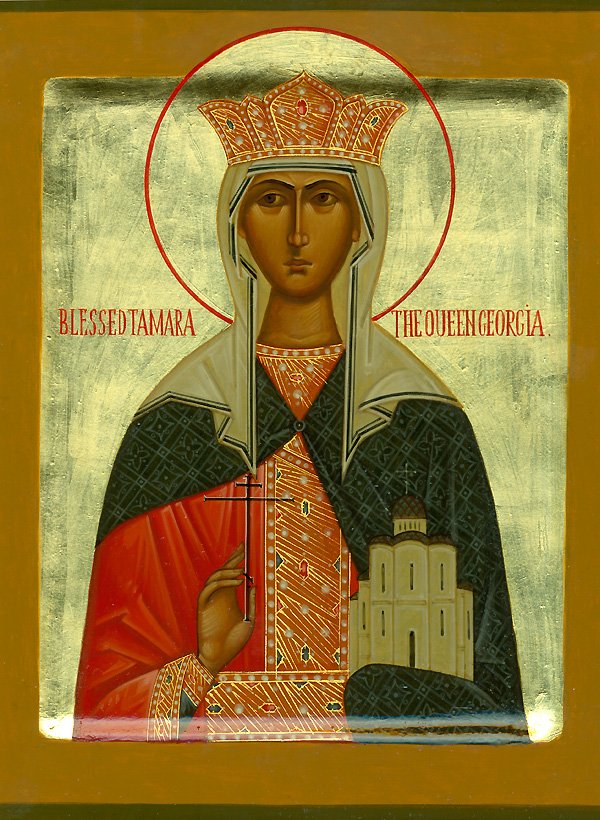
Right-believing Tamara, Queen of Georgia

Right-believing Tamara, Queen of Georgia

‘Saint Tamara was the only child of King George III. Upon his death in 1184, she became Queen at the age of twenty-four. Despite her youth, she ruled the country with such wisdom and godliness — leading it to unprecedented military triumphs over the neighboring Moslem countries in defence of her kingdom, fostering arts and letters, and zealously strengthening Orthodoxy — that her reign is known as the Golden Age of Georgia. After ‘Saint Tamara was the only child of King George III. Upon his death in 1184, she became Queen at the age of twenty-four. Despite her youth, she ruled the country with such wisdom and godliness — leading it to unprecedented military triumphs over the neighboring Moslem countries in defence of her kingdom, fostering arts and letters, and zealously strengthening Orthodoxy — that her reign is known as the Golden Age of Georgia. After her coronation, she convoked a local council to correct disorders in church life. When the bishops had assembled from all parts of her kingdom, she, like Saint Constantine at the First Ecumenical Council, honoured them as if she were a commoner, and they Angels of God; exhorting them to establish righteousness and redress abuses, she said in her humility, “Do away with every wickedness, beginning with me, for the prerogative of the throne is in no wise that of making war against God.” Saint Tamara called herself “the father of orphans and the judge of widows,” and her contemporaries called her “King” instead of “Queen.” She herself led her army against the Moslems and fearlessly defeated them; because of the reverence that even the enemies of Georgia had for her, entire mountain tribes renounced Islam and were baptized. She built countless churches and monasteries throughout her kingdom, and was a benefactress also to the Holy Land, Mount Athos, and holy places in Greece and Cyprus. She has always been much beloved by her people, who have memorialized her meekness, wisdom, piety, obedience, and peace-loving nature in innumerable legends, ballads, and songs; the poem written in her honor by Shota Rustaveli, “The Knight of the Panther Skin,” is the masterpiece of Georgian literature. The great Queen Tamara departed the earthly kingdom for the heavenly in the year 1212.’ (Great Horologion)

Troparion - Tone 1

Desiring heavenly sweetness, you drove base carnal pleasures far from yourself / and, during your reign, you lived an angelic life; / O blessed Queen Tamara, / pray to Christ God for the salvation of our souls.

Kontakion - Tone 8

O right-believing Queen Tamara, wondrous among the Saints, and luminary of Georgia, / who built temples upon the high mountains, so that in them you might offer prayers to the Lord; / your prayers which gave strength to the Christ-loving warriors of the land of Georgia. / By your right hand, you defeated the throngs of Hagarenes. / Pray to Christ God for the salvation of our souls.* * In several Russian sources this Troparion is listed as the Kontakion.

Venerable Nikēphóros of Chios

Saint Nikēphóros, the “most luminous star of the Church of Christ,” who delighted the hearts of the faithful “with divinely inspired teachings,” was born around 1750 at Kardamyla on the Greek island of Chios, and his family name was Georgios, or Georgos. When he was still very young, he became sick with a pestilential disease. His paren Saint Nikēphóros, the “most luminous star of the Church of Christ,” who delighted the hearts of the faithful “with divinely inspired teachings,” was born around 1750 at Kardamyla on the Greek island of Chios, and his family name was Georgios, or Georgos. When he was still very young, he became sick with a pestilential disease. His parents vowed that if he recovered, they would offer him to the Mother of God to serve Her at the famous Byzantine monastery of Nea Moni, which was dedicated to Her. He did get well, and so the parents took him to the monastery, where he was placed under the guidance of the venerable Elder Anthimus Hagiopateritis. Later, he was sent to the city of Chios to be educated in its schools by the priest Father Gabriel Astrakaris. Saint Nikēphóros remained close to this priest throughout the period of his education in the city, where he developed a love for learning, and a respect for those who taught others. He also met Saint Athanasius Parios (June 24), who was the Director of the school in the city of Chios. The greatest influence on his life was Saint Macarius of Corinth (April 17), whom he met even before he met Saint Athanasius. Saint Macarius was at Chios in 1780, left for a time, then returned in 1790. Saint Nikēphóros saw Saint Macarius frequently, and learned much from him. After finishing his education, Saint Nikēphóros returned to the monastery and was ordained a deacon. When Saint Athanasius Parios reorganized the school of Chios, he appointed Nikēphóros as one of its teachers. At the same time, he was also given a blessing to preach the Word of God at Nea Moni and elsewhere. While serving as a teacher, Saint Nikēphóros was called to become the Igumen of Nea Moni. Until 1802, the monks had managed the monastery’s affairs without any audits. In that year, however, the monastery was fined 600,000 piasters, and some of the monastery’s estates had to be sold to pay the amount. Suspecting that the affairs of the monastery were not being properly administered, the citizens asked that Father Nikēphóros be made Igumen. They knew he despised worldly possessions, and so they had full confidence in him. They also decided that an audit of the monastery accounts would be made every year. It was not easy for Saint Nikēphóros to assume this burden, for he was not familiar with the many responsibilities of a Superior. He would have preferred solitude and study, but he applied himself to his new duties. During the next two years, he tried to resolve conflicts, and to raise the moral spirit of the monks by teaching and by personal example. There were many people above him and below him who did not appreciate his efforts, however, and they plotted against him. Unaccustomed to quarrels and intrigues, he was unable to complete his two year term in office. Therefore, he left and sought refuge in the Hermitage of Saint George at Resta. Although he was unable to govern these monks, Saint Nikēphóros did excel in his personal life, and in guiding many people to virtue. He also composed church services and hymns to various saints, including Saints Nikḗtas, John, and Joseph (May 20), and Saint Matrona of Chios (October 20). The companions of Saint Nikēphóros at Resta were a retired priest (who had also been a teacher) called Father Joseph, and Saint Macarius of Corinth. Father Joseph had lived on Mount Athos for a while, then settled on Chios. He also composed church services, including one to the New Martyr Saint Nicholas the New (October 31), which had been published in Venice in 1791. In 1812, Saint Athanasius Parios retired as Director of the schools of Chios, and joined Saint Nikēphóros and the others at Resta. Saint Nikēphóros devoted himself to spiritual struggles, study, and writing. He also engaged in physical work of an agricultural nature. He planted olive and fig trees, cypresses, and pines. He also encouraged others to plant trees, for he understood that a lack of trees led to poverty, and that by planting trees one’s material resources could be improved. The saint would sometimes tell those who came to him for Confession to plant so many trees as a penance. In 1805, on his deathbed, Saint Macarius entrusted Saint Nikēphóros with the task of completing and publishing his book THE NEW LEIMONARION. This book contained the Lives and church services of various martyrs, ascetics, and other saints. It is remarkable in that three saints collaborated on this book about saints, Saint Macarius, Saint Nikēphóros, and Saint Athanasius Parios. By writing so many saints’ Lives and church services, Saint Nikēphóros showed that he considered them important and beneficial. Not only did he provide the biographical details about these saints, he also expressed the Orthodox view of God and man, the beauty of the virtues, and spiritual concepts such as theosis (divinization), inner attention, ceaseless prayer, purification, and asceticism in general. Like Saint Macarius of Corinth, Saint Nikēphóros was also known as a trainer of martyrs. Those who abandoned Christianity and embraced Islam, and later repented of their actions, went to him to confess their sin. He helped them to prepare to wash away their apostasy by shedding their blood as martyrs. Mindful of the Lord’s words, “Whoever shall deny Me before men, I will also deny him before My Father Who is in heaven” (Mt. 10:33) they believed that only after a public reaffirmation of their faith in Christ before the Moslem authorities (which inevitably resulted in a sentence of death) could their sin be forgiven. Saint Nikēphóros prepared them with prayer, fasting, prostrations, and by encouraging them to remain strong when they went to their deaths. Thus fortified, they endured the most horrible tortures with astonishing courage. Not only did the martyrs themselves receive grace and forgiveness from God, but their example encouraged others to remain firm in the Orthodox Faith. In addition to those whom he prepared personally, many others were also inspired to martyrdom through his published Lives and services to the martyrs. Although Saint Nikēphóros had the grace of working miracles, this is not the only reason that he is venerated as a saint. His holy life and character are also important considerations. A saint is one who is free from all vice and possesses all the virtues through divine grace. The people of Chios recognized that Saint Nikēphóros was humble, gentle, free from anger, and filled with love for others. That is why, even in his lifetime, they regarded him as a saint. Saint Nikēphóros was of medium height, with a pale and gentle face, and a large black beard. Although Saint Nikēphóros probably reposed in the summer of 1821, his Feast Day is designated as May 1. He died in a home near the church of Saint Paraskeve, where he sometimes stayed overnight when he was unable to get back to Resta. His body was brought back to Resta, and was placed in a grave where both Saint Athanasius Parius and the monk Nilus had once been buried. The holy relics of Saint Nikēphóros were uncovered in 1845 and brought to the metropolitan church of Chios. Many years later, the Guild of Tanners asked for the relics and placed them in the church of Saint George. In 1907, an icon of Saint Nikēphóros was painted, and a church service was composed in his honor.

Troparion - Tone 8

By a flood of tears you made the desert fertile, / and your longing for God brought forth fruits in abundance. / By the radiance of miracles you illumined the whole universe! / O our holy father Nicephorus, pray to Christ our God to save our souls!
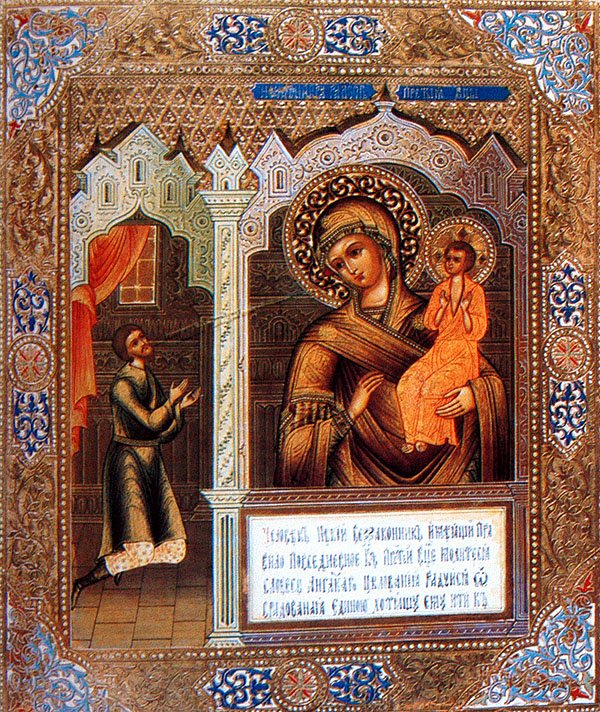
“Unexpected Joy” Icon of the Mother of God

“Unexpected Joy” Icon of the Mother of God

The “Unexpected Joy” Icon of the Most Holy Theotokos, is painted in this way: in a room is an icon of the Mother of God, and beneath it a youth is kneeling at prayer. The tradition about the healing of some youth from a bodily affliction through this holy icon is recorded in the book of Saint Demetrius of Rostov, The Fleece of Prayer [See Judges 6: 36-40]. Th The “Unexpected Joy” Icon of the Most Holy Theotokos, is painted in this way: in a room is an icon of the Mother of God, and beneath it a youth is kneeling at prayer. The tradition about the healing of some youth from a bodily affliction through this holy icon is recorded in the book of Saint Demetrius of Rostov, The Fleece of Prayer [See Judges 6: 36-40]. The sinful youth, who was nevertheless devoted to the Theotokos, was praying one day before the icon of the All-Pure Virgin before going out to commit a sin. Suddenly, he saw that wounds appeared on the Lord’s hands, feet, and side, and blood flowed from them. In horror he exclaimed, “O Lady, who has done this?” The Mother of God replied, “You and other sinners, because of your sins, crucify My Son anew.” Only then did he realize how great was the depth of his sinfulness. For a long time he prayed with tears to the All-Pure Mother of God and the Savior for mercy. Finally, he received the unexpected joy of the forgiveness of his sins. The “Unexpected Joy” icon is also commemorated on January 25 and December 9.

Troparion - Tone 4

Today the faithful people celebrate in spirit, glorifying the fervent helper of the Christian race; / and hastening to her most pure image, let us cry out to her: / "O most merciful Sovereign Lady Theotokos, / grant unexpected joy to us who are burdened by sins and many sorrows, and deliver us from all evil; / entreating your Son, Christ our God, to save our souls."

Kontakion - Tone 6

We have no other help, we have no other hope, but you, O Sovereign Lady. / Help us, for in you we hope, / and of you we boast, for we are your servants. / Let us not be put to shame.

“Myrrh-Bearing” Icon of the Mother of God
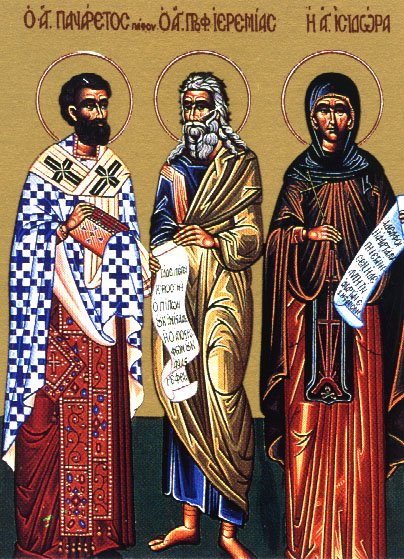
The “Myrrh-Bearing” Icon of the Mother of God of Tsarevokokshaisk (in the province of Kazan) appeared to the peasant Andrew Ivanov on May 1, 1647 near Bolshaya Kuznetsa, fifteen versts from the city of Tsarevokokshaisk in the Kazan region. Working in the field, Andrew noticed an icon lying on the ground and wanted to pick it up, but the icon became invisible. The The “Myrrh-Bearing” Icon of the Mother of God of Tsarevokokshaisk (in the province of Kazan) appeared to the peasant Andrew Ivanov on May 1, 1647 near Bolshaya Kuznetsa, fifteen versts from the city of Tsarevokokshaisk in the Kazan region. Working in the field, Andrew noticed an icon lying on the ground and wanted to pick it up, but the icon became invisible. The astonished peasant, looking around, noticed the icon in a tree, supported by an unseen force. He prayed and took the icon home, where it was glorified by miracles. Pilgrims thronged to the icon from all the surrounding villages. They carried the image to the city of Tsarevokokshaisk, and later to Moscow, and after a while, they returned home with it. A monastery was built at the place of its appearance. It is called “Myrrh-Bearing” because the Mother of God is depicted with the Myrrh-Bearing Women.
Saint Panaretus of Cyprus

Saint Panaretus of Cyprus

No information available.

Troparion - Tone 4

In truth you were revealed to your flock as a rule of faith, / an image of humility and a teacher of abstinence; / your humility exalted you; your poverty enriched you. / Hierarch Father Panaretus, / entreat Christ our God that our souls may be saved.

Saint Gerasimus of Boldino

Saint Gerasimus of Boldino, whose secular name was Gregory, was born in 1490 at Pereslav-Zalessk. In his early childhood, he often went to church to attend the divine services. When he heard about the holy life of Saint Daniel of Pereyaslavl (April 7), the thirteen-year-old Gregory tearfully begged the Elder to permit him to join him. Saint Gerasimus of Boldino, whose secular name was Gregory, was born in 1490 at Pereslav-Zalessk. In his early childhood, he often went to church to attend the divine services. When he heard about the holy life of Saint Daniel of Pereyaslavl (April 7), the thirteen-year-old Gregory tearfully begged the Elder to permit him to join him. The Elder accepted the boy as a novice and, after a short time, gave him monastic tonsure with the name Gerasimus. The new monk zealously fulfilled the labors of fasting and prayer, and soon he was known in Moscow as a strict ascetic. He even traveled to the capital with his teacher, and met the Tsar. Worldly fame was a burden for the ascetic and, after twenty-six years under Saint Daniel’s guidance, Saint Gerasimus obtained the blessing of his Elder to live the solitary life in the region of Smolensk. He settled near the city of Dorogobuzha in a wild forest inhabited by snakes and wild animals.The holy ascetic restrained his body (“the wild beast”) by subjecting it to heat and cold. The saint often had to endure the intrusion of brigands, but he bore all their outrages meekly and patiently, and he prayed for the malefactors. In a vision, he was instructed to go to Boldino Hill, where an immense oak stood by a spring. The local inhabitants beat him with sticks and wanted to drown him, but they became frightened and handed him over to the administrator of Dorogobuzha, who threw him into jail for vagrancy. Saint Gerasimus patiently endured the ridicule, keeping silence and devoting himself to prayer. During this time an imperial emissary from Moscow came to visit the administrator. Seeing Saint Gerasimus, he bowed down before him and asked his blessing. He recognized him because he had seen the saint before, with Saint Daniel, in the presence of the Tsar. The administrator became terrified, and immediately begged the saint’s forgiveness and promised to build an enclosure to protect him from robbers. From that time Saint Gerasimus received those who wished to embrace the monastic life, and sought permission at Moscow to build a monastery. In 1530 he built a church dedicated to the Most Holy Trinity, and he also built cells for the brethren. Besides the Boldino monastery, Saint Gerasimus founded another monastery in honor of Saint John the Forerunner at the city of Vyazma, and later on, in the Bryansk forest at the River Zhizdra, a monastery in honor of the Entry of the Most Holy Theotokos into the Temple. Peter Korostelev, a disciple of Saint Gerasimus, was made igumen of this monastery. Several ascetics were under the spiritual guidance of Saint Gerasimus: the igumen Anthony, who later became the Bishop of Vologda (Oct. 26), and Arcadius, a disciple of Saint Gerasimus, struggled as a hermit and was buried at the Boldino monastery. Before his death, Saint Gerasimus summoned the igumens and monks of the monasteries he had founded, told them of his life, and gave them his final instructions. This oral narrative of the saint was included in his Life, which was composed by Saint Anthony at the request of the Elders. The Rule, or Testament, of Saint Gerasimus is similar to the “Spiritual Deed” of Saint Joseph of Volokolamsk (September 9, October 18, February 13). From Saint Joseph he also borrowed the practice of having twelve Elders govern the monastery. There is an oral tradition that he may have converted Opta, the founder of Optina Monastery. It seems that he would convert the criminals in a given area, and then establish a monastery there. Saint Gerasimus reposed on May 1, 1554. He is also commemorated on July 20.

Troparion - Tone 8

By a flood of tears you made the desert fertile, / and your longing for God brought forth fruits in abundance. / By the radiance of miracles you illumined the whole universe! / O our holy father Gerasimus, pray to Christ our God to save our souls!
Martyr Isidora

Martyr Isidora

No information available at this time.

Troparion - Tone 4

Your holy martyr Isidora, O Lord, / through her sufferings has received an incorruptible crown from You, our God. / For having Your strength, she laid low his adversaries, / and shattered the powerless boldness of demons. / Through her intercessions, save our souls!
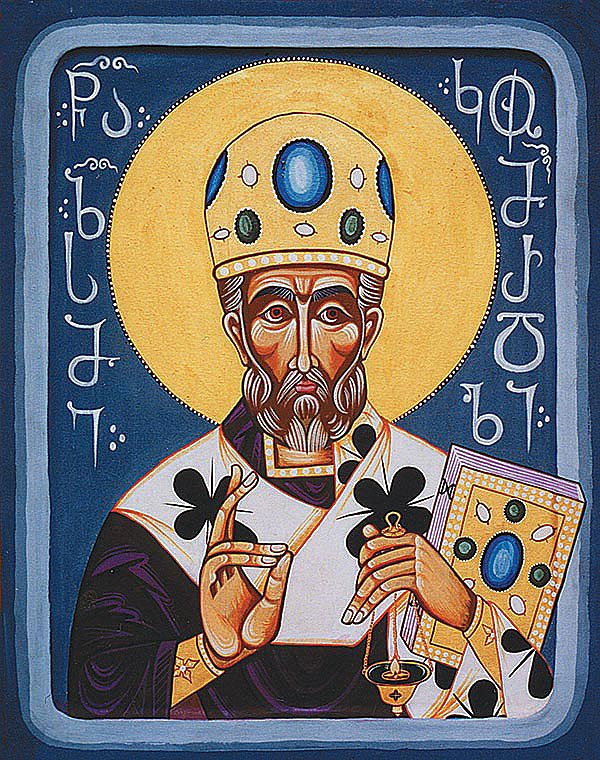
Saint Zosimas II of Kumurdo

Saint Zosimas II of Kumurdo

Saint Zosimas of Kumurdo lived and labored from the end of the 15th century through the first half of the 16th century. To the world he was known as Zebede. He was raised by Princess Ketevan, the daughter of King George VIII (1446-1466). In 1515 Zebede was tonsured a monk and given the new name Zosimas. Saint Zosimas of Kumurdo lived and labored from the end of the 15th century through the first half of the 16th century. To the world he was known as Zebede. He was raised by Princess Ketevan, the daughter of King George VIII (1446-1466). In 1515 Zebede was tonsured a monk and given the new name Zosimas. It is believed that in the same year he was also consecrated a bishop. An inscription at Kumurdo Church attests to his hierarchical rank: “May the Lord have mercy on Zosimas, bishop of Kumurdo. Amen.” Saint Zosimas is credited with compiling a handwritten anthology of prayers, homilies, and other writings in the year 1537. The anthology concludes with two of the holy father’s own wills. In addition to his pastoral, educational and church-building activity in the Kumurdo diocese, Saint Zosimas also performed many important works in the Holy Land of Jerusalem. In the 15th and 16th centuries the struggle between Orthodox Christians and Roman Catholics over whom God had appointed heir to the holy hill of Golgotha became particularly acute, and the Orthodox Church was forced to defend the rights that it had acquired in previous centuries. At that time, Saint Zosimas arrived in the Holy Land and joined the struggle to liberate Golgotha from the Catholics. In honor of his valiant efforts, two vigil lamps were later hung in his name in the churches at Golgotha and the Holy Cross Monastery. It is significant to note that from the 15th century the names of the bishops of Kumurdo have been inscribed in an important chronicle called Ertgulebis Tsigni , or The Book of Faith . Throughout history the hierarchs of Kumurdo have defended the unity of the Georgian Church and stood steadfast as pillars of national-religious sentiment and examples of faith. On October 17, 2002, the Georgian Church canonized the holy hierarch Zosimas of Kumurdo and reinstated the bishopric of ancient Kumurdo.

Troparion - Tone 4

In truth you were revealed to your flock as a rule of faith, / an image of humility and a teacher of abstinence; / your humility exalted you; / your poverty enriched you. / Hierarch Father Zosimas, / entreat Christ our God / that our souls may be saved.

Scripture Readings

Epistle

Acts 8:40-9:19

40 But Philip was found at Azotus: and passing through he preached in all the cities, till he came to Cesarea.
1 And Saul, yet breathing out threatenings and slaughter against the disciples of the Lord, went unto the high priest,
2 And desired of him letters to Damascus to the synagogues, that if he found any of this way, whether they were men or women, he might bring them bound unto Jerusalem.
3 And as he journeyed, he came near Damascus: and suddenly there shined round about him a light from heaven:
4 And he fell to the earth, and heard a voice saying unto him, Saul, Saul, why persecutest thou me?
5 And he said, Who art thou, Lord? And the Lord said, I am Jesus whom thou persecutest: it is hard for thee to kick against the pricks.
6 And he trembling and astonished said, Lord, what wilt thou have me to do? And the Lord said unto him, Arise, and go into the city, and it shall be told thee what thou must do.
7 And the men which journeyed with him stood speechless, hearing a voice, but seeing no man.
8 And Saul arose from the earth; and when his eyes were opened, he saw no man: but they led him by the hand, and brought him into Damascus.
9 And he was three days without sight, and neither did eat nor drink.
10 And there was a certain disciple at Damascus, named Ananias; and to him said the Lord in a vision, Ananias. And he said, Behold, I am here, Lord.
11 And the Lord said unto him, Arise, and go into the street which is called Straight, and enquire in the house of Judas for one called Saul, of Tarsus: for, behold, he prayeth,
12 And hath seen in a vision a man named Ananias coming in, and putting his hand on him, that he might receive his sight.
13 Then Ananias answered, Lord, I have heard by many of this man, how much evil he hath done to thy saints at Jerusalem:
14 And here he hath authority from the chief priests to bind all that call on thy name.
15 But the Lord said unto him, Go thy way: for he is a chosen vessel unto me, to bear my name before the Gentiles, and kings, and the children of Israel:
16 For I will shew him how great things he must suffer for my name’s sake.
17 And Ananias went his way, and entered into the house; and putting his hands on him said, Brother Saul, the Lord, even Jesus, that appeared unto thee in the way as thou camest, hath sent me, that thou mightest receive thy sight, and be filled with the Holy Ghost.
18 And immediately there fell from his eyes as it had been scales: and he received sight forthwith, and arose, and was baptized.
19 And when he had received meat, he was strengthened. Then was Saul certain days with the disciples which were at Damascus.

Gospel

John 6:48-54

48 I am that bread of life.
49 Your fathers did eat manna in the wilderness, and are dead.
50 This is the bread which cometh down from heaven, that a man may eat thereof, and not die.
51 I am the living bread which came down from heaven: if any man eat of this bread, he shall live for ever: and the bread that I will give is my flesh, which I will give for the life of the world.
52 The Jews therefore strove among themselves, saying, How can this man give us his flesh to eat?
53 Then Jesus said unto them, Verily, verily, I say unto you, Except ye eat the flesh of the Son of man, and drink his blood, ye have no life in you.
54 Whoso eateth my flesh, and drinketh my blood, hath eternal life; and I will raise him up at the last day.

Liturgical data sourced from OCA.org and orthocal.info