Fasting Rules
 Meat
Abstain
Meat
Abstain
 Fish
Abstain
Fish
Abstain
 Dairy
Abstain
Dairy
Abstain
 Oil
Abstain
Oil
Abstain
 Wine
Abstain
Wine
Abstain
Saints & Commemorations
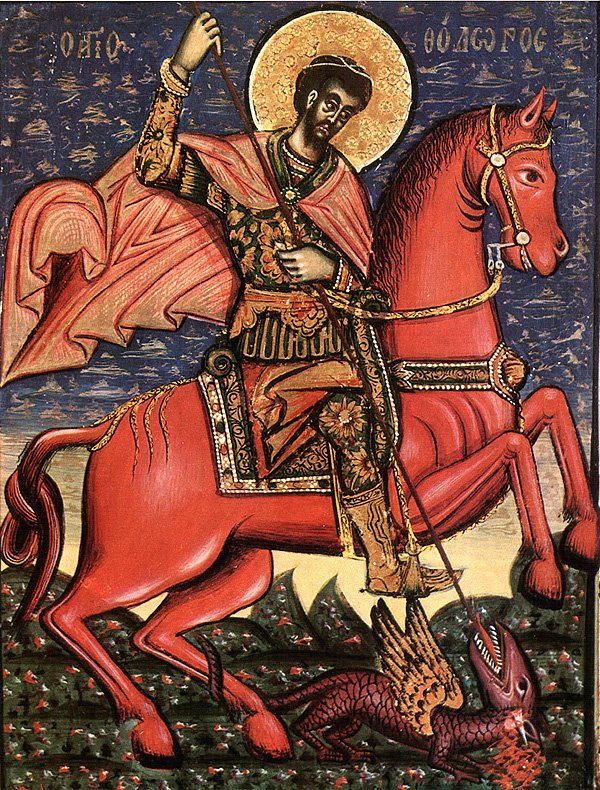
Translation of the relics of the Greatmartyr Theodore Stratelates
The Holy Great Martyr Theodore Stratelates suffered for Christ in Heraklea on February 8, 319. At the time of his sufferings the holy Great Martyr Theodore ordered his servant Varus to bury his body on the estate of his parents in Euchaita. The transfer of the relics of the Great Martyr Theodore took place on June 8, 319.
The Holy Great Martyr Theodore Stratelates suffered for Christ in Heraklea on February 8, 319. At the time of his sufferings the holy Great Martyr Theodore ordered his servant Varus to bury his body on the estate of his parents in Euchaita. The transfer of the relics of the Great Martyr Theodore took place on June 8, 319.
On this day we also recall a miracle of the icon of the Great Martyr Theodore in a church dedicated to him at a place called Karsat, near Damascus. A group of Saracens had turned this church into their residence. There was a fresco on the wall depicting Theodore. One of the Saracens shot an arrow into the icon of the Great Martyr. From the saint’s face, where the arrow had stuck into the wall, blood flowed before the eyes of everyone. A short while later, the Saracens who had settled in the church killed each other. Accounts of this miracle are given by Saints [or, “by the holy Fathers”] Anastasius of Mt. Sinai (April 20) and John of Damascus (December 4).
Troparion - Tone 4
Truly enlisted with the King of Heaven, / you became an outstanding general for Him, passion-bearer Theodore; / you armed yourself wisely with the weapons of faith / and conquered hordes of demons, revealing yourself as a victorious athlete. / Therefore, in faith we always call you blessed.
Trans. Rel. Theodore Stratelates
See his commemoration on February 8
Saint Theodore, first Bishop of Rostov and Suzdal
The great wonderworker Saint Theodore, who was a Greek by birth, was the first Bishop of Rostov. He was consecrated as a bishop in the year 991 or 992. At that time, most of the Rostov territory was still pagan, and Saint Theodore worked tirelessly to proclaim the Gospel to the people of that area.
The inhabitants subjected the hierarch to many insults, and they even drove him away on one occasion.
The great wonderworker Saint Theodore, who was a Greek by birth, was the first Bishop of Rostov. He was consecrated as a bishop in the year 991 or 992. At that time, most of the Rostov territory was still pagan, and Saint Theodore worked tirelessly to proclaim the Gospel to the people of that area.
The inhabitants subjected the hierarch to many insults, and they even drove him away on one occasion. Then Saint Theodore moved to Suzdal, where he brought many souls to Christ. He fell asleep in the Lord at Suzdal in 1023, resting from his fruitful apostolic labors. His holy relics are in Suzdal's Nativity of the Most Holy Theotokos Cathedral.
Portions of his holy relics are also kept in two other churches at Suzdal: that of the Kazan Icon, and that of Saints Constantine and Helen.
Saint Theodore is also commemorated at the Synaxis of the Saints of Rostov and Yaroslavl (May 23), and at the Synaxis of the Saints of Vladimir (June 23).
Today's saint should not be confused with Saint Theodore of Rostov (November 28), who reposed in 1395, and was the nephew of Saint Sergius of Radonezh (September 25).
Troparion - Tone 8
In prayerful vigil your heart has always ached for your flock, / and by your teachings you have enlightened all, O most wise Theodore; / therefore, on the day of your memorial, entreat Christ God to grant us great mercy.
Kontakion - Tone 3
O most wise Theodore, / your glorious memory shone as a great sun, / by which you give assistance to those who are in trouble, / and who come to you diligently, / by the grace with which Christ has endowed you, unto eternal life.
Our Holy Mother Melania the Elder (410)
She was a wealthy and noble lady, born in Spain. Her husband and two of her children died and, seeing the vanity of worldly things, she travelled to Egypt to visit the monks at Nitria. She gave away most of her great wealth to the needy, and to Egyptian Christians being persecuted by the Arians. It is said that in three days she fed some 5,000 people.
She was a wealthy and noble lady, born in Spain. Her husband and two of her children died and, seeing the vanity of worldly things, she travelled to Egypt to visit the monks at Nitria. She gave away most of her great wealth to the needy, and to Egyptian Christians being persecuted by the Arians. It is said that in three days she fed some 5,000 people. When the Orthodox in Egypt were exiled to Palestine, she went with them to Jerusalem, where she built a convent for virgins; she entered the convent herself, and reposed there in 410. Her grand-daughter, Melania the Younger, is commemorated on December 31.
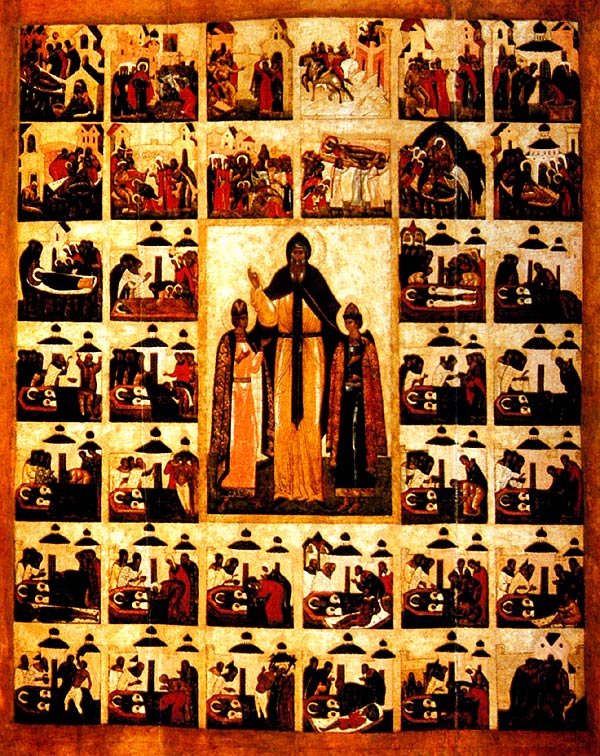
Finding of the Relics of Saints Basil and Constantine, Princes of Yaroslavl
The holy Princes Basil and Constantine Vsevolodovich of Yaroslavl.
In their youth they lost their father, Vsevolod, who fell in battle with the Tatars (Mongols). Saint Basil, the elder brother, succeeded to the throne. As prince, he had to face a multitude of concerns, tasks and sorrows. The city and the villages were devastated from the invasion of the Tatars, many households remained without shelter and food, and he had to concern himself about everything and about everyone.
The holy Princes Basil and Constantine Vsevolodovich of Yaroslavl.
In their youth they lost their father, Vsevolod, who fell in battle with the Tatars (Mongols). Saint Basil, the elder brother, succeeded to the throne. As prince, he had to face a multitude of concerns, tasks and sorrows. The city and the villages were devastated from the invasion of the Tatars, many households remained without shelter and food, and he had to concern himself about everything and about everyone. Besides this, it was necessary to gain the good will of the Tatar Khan, and the holy prince more than once journeyed for this reason to the Horde. He suffered also a family misfortune, the loss of his only son.
All his tribulations the holy prince suffered without complaint, and he ruled the princedom, like a true Christian. He did not enter into disputes with other princes, he concerned himself with the unfortunate among his subjects, and he built churches. But soon his life, filled with many sorrows, exhausted the strength of the prince, and he took sick and died in the year 1249.
After him holy Prince Constantine succeeded to the throne. He strove to imitate his brother, but to his great dismay, everywhere he saw pillage and murdering done by the Tatars. In 1257 the Tatars fell upon Yaroslavl itself. The prince came out to fight the enemy, but here in this battle he gave up his life for his country. In the year 1501 the incorrupt relics of the holy princes were uncovered and now rest in the Yaroslav cathedral.
Saint Ephraim, Patriarch of Antioch
Saint Ephraim, Patriarch of Antioch, a Syrian, was a military general under the emperors Anastasius (491-518) and Justin (518-527). The saint was distinguished for his virtue, piety, and compassion for all the destitute.
In the year 526 the Lord punished Antioch for Christians falling into the heresies of Nestorius and Eutyches: an earthquake destroyed this magnificent city.
Saint Ephraim, Patriarch of Antioch, a Syrian, was a military general under the emperors Anastasius (491-518) and Justin (518-527). The saint was distinguished for his virtue, piety, and compassion for all the destitute.
In the year 526 the Lord punished Antioch for Christians falling into the heresies of Nestorius and Eutyches: an earthquake destroyed this magnificent city. A large number of the inhabitants perished. Patriarch Euphrasios was crushed beneath a fallen column.
The emperor summoned Ephraim to oversee the restoration of the ruined city. Among the workers was a bishop who left his see for unknown reasons. He predicted to Ephraim his election to the patriarchal throne and asked him not to abandon deeds of charity, and to struggle firmly against the heretics. In the year 527 Ephraim was indeed elected to the patriarchal throne. He governed his flock firmly and wisely by the example of his life. He also defended it against heretical teachings through his sermons and letters.
The following event gives some idea of his faith. Near Herakleia was a stylite practicing asceticism, who had fallen into heresy. Learning about the ascetic, Ephraim went to him and urged him to be reunited to the Orthodox Church. The stylite was not agreeable. He decided to frighten the patriarch and he offered to kindle a large bonfire, so that they both might enter the fire. The bonfire was set, but the stylite did not dare to go into it. The patriarch prayed to the Lord Jesus Christ to show that his was the correct faith and, removing his omophorion, he put it in the bonfire. After three hours the firewood was consumed, but the omophorion of the saint was taken out unharmed. The stylite was converted from his heresy and reunited to the Church.
Ephraim fell asleep in the Lord in the year 545 AD.
Among his labors, Ephraim defended the teaching of the Orthodox Church on the union of two natures, the divine and the human, in the Person of our Lord Jesus Christ.
Troparion - Tone 4
In truth you were revealed to your flock as a rule of faith, / an image of humility and a teacher of abstinence; / your humility exalted you; / your poverty enriched you. / Hierarch Father Ephraim, / entreat Christ our God / that our souls may be saved.
St Zosimas, monk, of Phoenicia (Syria) (6th c.)
He labored in asceticism at a monastery near Tyre. Through his exceptional purity of life, he was granted the gift of prophecy. He foresaw the destruction of Antioch by earthquake and, like Abraham pleading for Sodom, prostrated himself on the ground and prayed that the city not be completely destroyed.
He labored in asceticism at a monastery near Tyre. Through his exceptional purity of life, he was granted the gift of prophecy. He foresaw the destruction of Antioch by earthquake and, like Abraham pleading for Sodom, prostrated himself on the ground and prayed that the city not be completely destroyed. Once he was traveling in a remote place and a lion attacked and killed his mule. He commanded the lion to serve him in the mule’s place; the lion immediately took up Zosimas’ pack and carried it to Caesarea, where Zosimas released it. St Zosimas reposed in peace.
Venerable Zosimus of Phoenicia, Syria
Saint Zosimus of Phoenicia was born in the Syrian village of Synda, near the city of Tyre. He accepted monasticism and was zealous in his fasting, prayer, labors and other virtues. The monk received from God the gift of clairvoyance. When he was at Caesarea, he foresaw the terrible earthquake which destroyed Antioch in the year 526.
Saint Zosimus of Phoenicia was born in the Syrian village of Synda, near the city of Tyre. He accepted monasticism and was zealous in his fasting, prayer, labors and other virtues. The monk received from God the gift of clairvoyance. When he was at Caesarea, he foresaw the terrible earthquake which destroyed Antioch in the year 526.
Once, the patrician Arkesilaos visited the monk. During this time a messenger informed Arkesilaos that his wife had punctured her eye with a needle and was in terrible pain. But the monk put his guest at ease and said that the holy Bishop John the Chozebite (October 3) had healed his wife.
Zosimus attained such a degree of spiritual accomplishment that wild beasts were submissive to him. Once on the way to Caesarea a hungry lion pounced upon the monk’s donkey, and dragged it away to eat it. Finding the beast, the monk said, “Friend, I have not the strength to carry the load because of old age. You carry it, and then return into the wilderness and again be fierce according to your nature.” The lion meekly carried the load to Caesarea, then the monk set him free.
Troparion - Tone 8
By a flood of tears you made the desert fertile, / and your longing for God brought forth fruits in abundance. / By the radiance of miracles you illumined the whole universe! / O our holy father Zosimus, pray to Christ our God to save our souls!
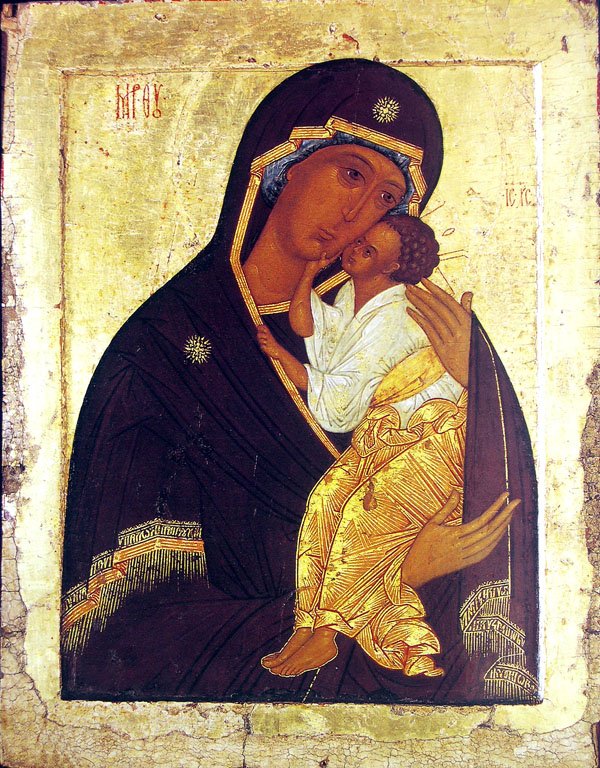
Icon of the Mother of God of Yaroslavl
The Yaroslavl Icon of the Mother of God became the first wonderworking Icon revealed by the Most Pure Theotokos during the Tatar-Mongol yoke. It was brought to Russia (probably from Kiev) almost immediately after Batu's invasions. In this way, the Icon of the Mother of God visited the Russian land and consoled the Orthodox people in their sorrow.
The Yaroslavl Icon of the Mother of God became the first wonderworking Icon revealed by the Most Pure Theotokos during the Tatar-Mongol yoke. It was brought to Russia (probably from Kiev) almost immediately after Batu's invasions. In this way, the Icon of the Mother of God visited the Russian land and consoled the Orthodox people in their sorrow. It is significant that this is an icon of the "Tenderness" type, filled with her maternal care and concern. 1
The Yaroslavl Icon was brought to that city by the holy right-believing Princes Basil and Constantine (July 3), and the lower church in the temple of the Prophet Elias was consecrated in honor of the wonderworking Yaroslavl Icon of the Mother of God.
In addition to this Icon, there are two more Yaroslavl Icons: the Yaroslavl-Kazan (June 8) and the Yaroslavl-Caves (see May 14).
1 Similarly, during the First World War, the Reigning Icon of the Mother of God (March 2) appeared on the very day that Tsar Nicholas II abdicated in 1917.
Troparion - Tone 4
Let all of us who are burdened with sins, fall on our knees before the Theotokos, / bowing before her wonderworking Tenderness Icon, / kissing it and crying aloud with tears: / “O Sovereign Lady, accept the prayer of your unworthy servants, / and grant to us who ask, your great mercy.”
Kontakion - Tone 6
We have no other help, we have no other hope but you, O Sovereign Lady. / Help us, for in you do we hope, / and of you do we boast, for we are your servants. / Let us not be put to shame.
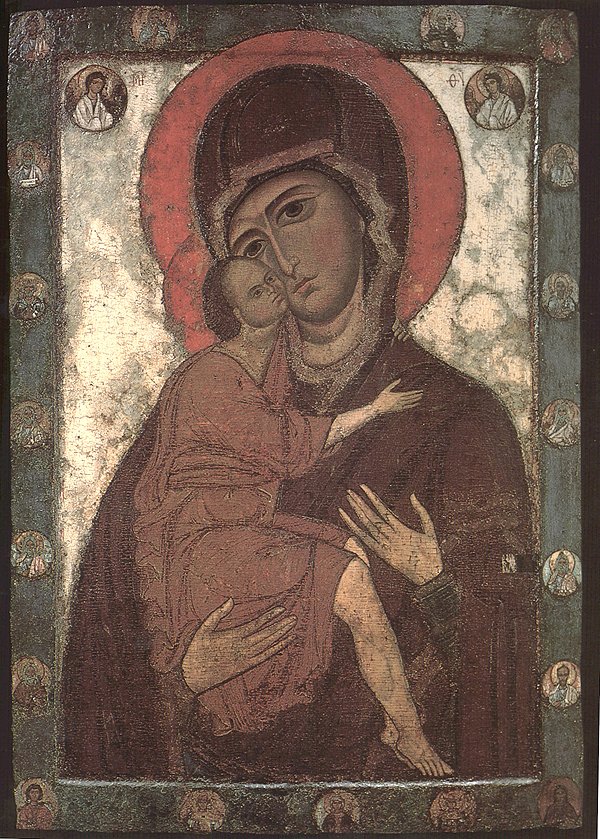
Icon of the Mother of God of White Lake
This holy icon belonged to Saint Cyril of White Lake (June 9), and he kept it in his cell.
Saint Cyril was living at the Simonov Monastery, but his soul yearned for solitude, and he asked the Mother of God to show him a place conducive for salvation. One night he was reading an Akathist in his cell before the Hodēgḗtria icon of the Mother of God, and had just reached the eighth Kontakion, “Seeing the strange Nativity, let us become strangers to the world and transport our minds to heaven.” Then he heard a voice say, “Go to White Lake (Belozersk), where I have prepared a place for you.”
He left the Simonov Monastery and at the desolate and sparsely populated White Lake, he found the place which he had seen in the vision. Saint Cyri
This holy icon belonged to Saint Cyril of White Lake (June 9), and he kept it in his cell.
Saint Cyril was living at the Simonov Monastery, but his soul yearned for solitude, and he asked the Mother of God to show him a place conducive for salvation. One night he was reading an Akathist in his cell before the Hodēgḗtria icon of the Mother of God, and had just reached the eighth Kontakion, “Seeing the strange Nativity, let us become strangers to the world and transport our minds to heaven.” Then he heard a voice say, “Go to White Lake (Belozersk), where I have prepared a place for you.”
He left the Simonov Monastery and at the desolate and sparsely populated White Lake, he found the place which he had seen in the vision. Saint Cyril and his companion Saint Therapon of White Lake and Mozhaisk (May 27), set up a cross and dug a cell in the ground near Mount Myaura at Siversk Lake.
The White Lake Icon is also commemorated on July 28.
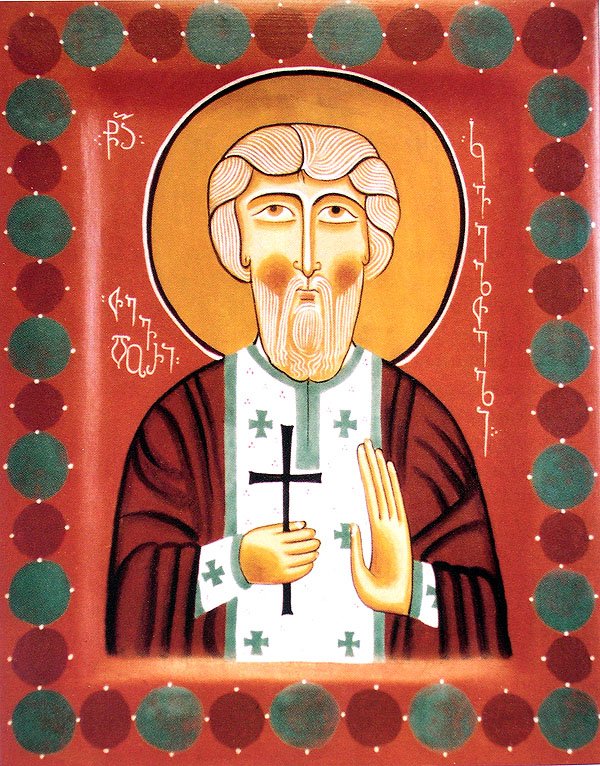
Hieromartyr Theodore (Tevdore) of Kvelta
Saint Tevdore was a simple priest who labored in the 16th century in the village of Kvelta. At that time the Ottoman Empire and Persia were locked in a bitter feud over control of the Near East. At the beginning of 1609 the Ottomans conquered first the city of Baghdadi, then part of Samtskhe in southern Georgia.
Saint Tevdore was a simple priest who labored in the 16th century in the village of Kvelta. At that time the Ottoman Empire and Persia were locked in a bitter feud over control of the Near East. At the beginning of 1609 the Ottomans conquered first the city of Baghdadi, then part of Samtskhe in southern Georgia. In June of that year they launched an attack on eastern Georgia.
At that time the Georgian ruler was the young King Luarsab II. When the Ottomans penetrated Kartli, the king was absent, abiding in his summer residence, Tskhireti Castle. But the Ottomans knew the location of his castle, and they also knew that his troops were small in number. They plotted to lay siege to the castle, capture the king, and ultimately annex all of Georgia.
The Ottomans quickly crossed the Trialeti mountain range and advanced into Manglisi, pillaging the lands and laying waste to the people as they went. Miraculously, the Manglisi Church of the Most Holy Mother of God remained unharmed. One chronicler wrote: “A dense fog surrounded the church and village, concealing it from the enemy.”
Saint Luarsab had received no warning of the attack, and the enemy was just minutes from his castle.
In the village of Kvelta, not far from Manglisi, the Turks captured the priest Tevdore, a man sincere before God and devoted to his king and motherland. Fr. Tevdore was unable to escape to the woods with the other villagers, so he locked the doors to the church and concealed its sacred treasures. When the Ottoman Turks found Fr. Tevdore, they commanded him to lead them to Tskhireti Castle and threatened to kill him if he refused.
Hoping to deceive them, Tevdore led the Ottomans along a narrow, rocky mountain path away from Tskhireti Castle. Many horses and soldiers fell from the path to their deaths.
But after some time the Ottomans realized that the priest had led them in the wrong direction. Embittered and hungry for revenge, they beheaded Fr. Tevdore.
As a result of Saint Tevdore’s great sacrifice, Saint Luarsab had time to strengthen his fortifications, assemble his armies, and finally annihilate the enemy.
Troparion - Tone 4
By sharing in the ways of the Apostles, / you became a successor to their throne. / Through the practice of virtue, you found the way to divine contemplation, O inspired one of God; / by teaching the word of truth without error, you defended the Faith, / even to the shedding of your blood. / Hieromartyr Theodore, entreat Christ God to save our souls.
Scripture Readings
☩Epistle
Romans 2:28-3:18
28
For he is not a Jew, which is one outwardly; neither is that circumcision, which is outward in the flesh:
29
But he is a Jew, which is one inwardly; and circumcision is that of the heart, in the spirit, and not in the letter; whose praise is not of men, but of God.
1
What advantage then hath the Jew? or what profit is there of circumcision?
2
Much every way: chiefly, because that unto them were committed the oracles of God.
3
For what if some did not believe? shall their unbelief make the faith of God without effect?
4
God forbid: yea, let God be true, but every man a liar; as it is written, That thou mightest be justified in thy sayings, and mightest overcome when thou art judged.
5
But if our unrighteousness commend the righteousness of God, what shall we say? Is God unrighteous who taketh vengeance? (I speak as a man)
6
God forbid: for then how shall God judge the world?
7
For if the truth of God hath more abounded through my lie unto his glory; why yet am I also judged as a sinner?
8
And not rather, (as we be slanderously reported, and as some affirm that we say,) Let us do evil, that good may come? whose damnation is just.
9
What then? are we better than they? No, in no wise: for we have before proved both Jews and Gentiles, that they are all under sin;
10
As it is written, There is none righteous, no, not one:
11
There is none that understandeth, there is none that seeketh after God.
12
They are all gone out of the way, they are together become unprofitable; there is none that doeth good, no, not one.
13
Their throat is an open sepulchre; with their tongues they have used deceit; the poison of asps is under their lips:
14
Whose mouth is full of cursing and bitterness:
15
Their feet are swift to shed blood:
16
Destruction and misery are in their ways:
17
And the way of peace have they not known:
18
There is no fear of God before their eyes.
☩Gospel
Matthew 6:31-34, 7:9-11
31
Therefore take no thought, saying, What shall we eat? or, What shall we drink? or, Wherewithal shall we be clothed?
32
(For after all these things do the Gentiles seek:) for your heavenly Father knoweth that ye have need of all these things.
33
But seek ye first the kingdom of God, and his righteousness; and all these things shall be added unto you.
34
Take therefore no thought for the morrow: for the morrow shall take thought for the things of itself. Sufficient unto the day is the evil thereof.
9
Or what man is there of you, whom if his son ask bread, will he give him a stone?
10
Or if he ask a fish, will he give him a serpent?
11
If ye then, being evil, know how to give good gifts unto your children, how much more shall your Father which is in heaven give good things to them that ask him?
Notes
["Beginning of Apostles' Fast"]
Liturgical data sourced from OCA.org and orthocal.info