Fasting Rules
 Meat
Abstain
Meat
Abstain
 Fish
Abstain
Fish
Abstain
 Dairy
Abstain
Dairy
Abstain
 Oil
Allowed
Oil
Allowed
 Wine
Allowed
Wine
Allowed
Saints & Commemorations
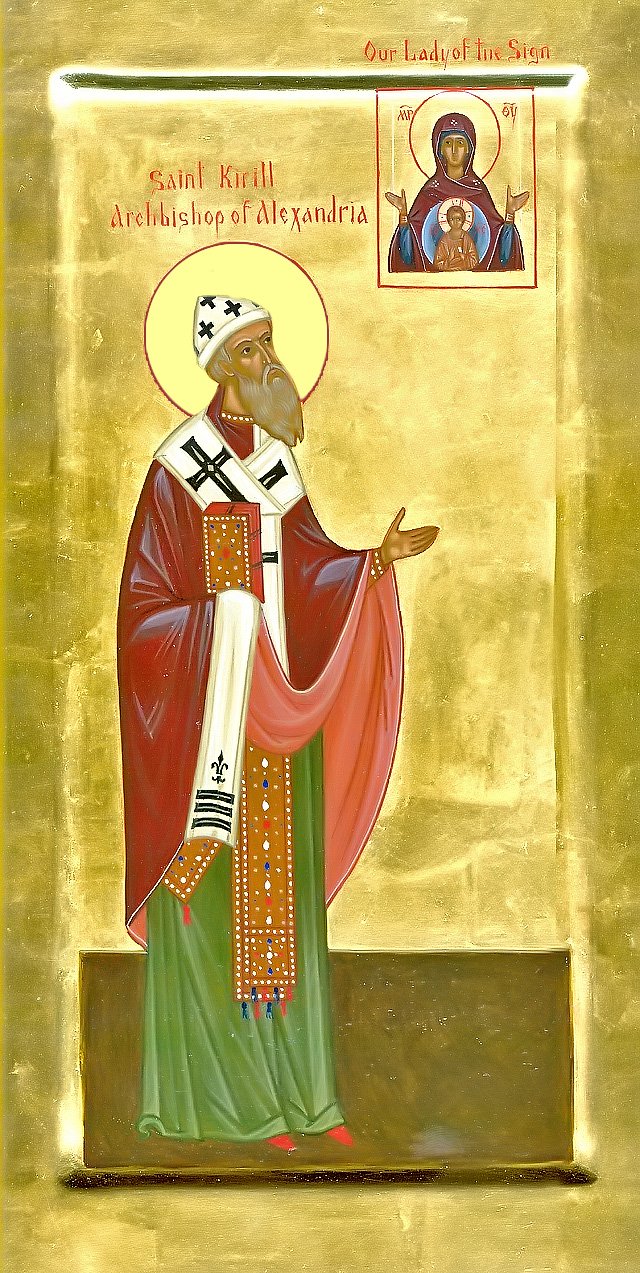
Saint Cyril, Archbishop of Alexandria
“St Cyril was… from Alexandria, born about the year 376, the nephew of Theophilus, Patriarch of Alexandria, who also instructed the Saint in his youth. Having first spent much time with the monks of Nitria, he later became the successor to his uncle’s throne in 412. In 429, when Cyril heard tidings of the teachings of the new Patriarch of Constantinople, Nestorius, he began attempting through private letters to bring Nestorius to renounce his heretical teachings about the Incarnation; and when the heresiarch did not repent, Saint Cyril, together with Pope Celestine of Rome, led the Orthodox opposition to his error. Saint
“St Cyril was… from Alexandria, born about the year 376, the nephew of Theophilus, Patriarch of Alexandria, who also instructed the Saint in his youth. Having first spent much time with the monks of Nitria, he later became the successor to his uncle’s throne in 412. In 429, when Cyril heard tidings of the teachings of the new Patriarch of Constantinople, Nestorius, he began attempting through private letters to bring Nestorius to renounce his heretical teachings about the Incarnation; and when the heresiarch did not repent, Saint Cyril, together with Pope Celestine of Rome, led the Orthodox opposition to his error. Saint Cyril presided over the Third Ecumenical Council of the 200 holy Fathers in the year 431, who gathered in Ephesus under Saint Theodosius the Younger. At this Council, by his most wise words he put to shame and convicted the impious doctrine of Nestorius, who, although he was in town, refused to appear before Cyril. Saint Cyril, besides overthrowing the error of Nestorius, has left to the Church full commentaries on the Gospels of Luke and John. Having shepherded the Church of Christ for thirty-two years, he reposed in 444.” (Great Horologion)
Today we commemorate St Cyril’s repose. He is also commemorated on January 18, the date of his restoration to his see in Alexandria after he had been driven out by Nestorians.
Troparion - Tone 1
With all reverence let us praise a light of the world, / the great orator and champion of the Mother of God. / For by his fiery teachings / he burned up the heresy of Nestorius; / therefore, let us cry out to him: / “Divine Cyril, intercede with Christ to strengthen the Orthodox Faith.”
Kontakion - Tone 6
You have openly poured out upon us the depth of the teachings of theology, / drawing from the well-springs of the Savior; / you drowned heresies / and saved your flock unharmed from triple waves. / Blessed and venerable Cyril, / you are shown to be a guide for all lands, revealing things divine
Ven. Kirill of Belozersk
He was born in Moscow in 1337, and took up the monastic life while young. Though he desired a life of strict silence and solitude, he was made abbot of the Simonov Monastery against his will. After a few years, obeying a revelation from the most holy Theotokos, he left his abbacy and went to the wilderness of Belozersk (White Lake) to live as a hermit.
He was born in Moscow in 1337, and took up the monastic life while young. Though he desired a life of strict silence and solitude, he was made abbot of the Simonov Monastery against his will. After a few years, obeying a revelation from the most holy Theotokos, he left his abbacy and went to the wilderness of Belozersk (White Lake) to live as a hermit. Others gathered there to live under his guidance, and in time the community became the Monastery of Belozersk. Saint Kyril was sought from far off as a staretz, or spiritual father, and was granted gifts of wonderworking. His humility was remarkable, as the following story shows.
Once one of his monks conceived a terrible hatred for Kyril, which tormented him for a whole year. Finally the monk worked up the courage to reveal his hatred to Kyril himself. Though the monk was full of shame and remorse at his malicious passion, Kyril comforted him and said, ‘All the others are in error about me; only you have perceived my unworthiness.’ Saint Kyril then forgave the man and sent him away with his blessing.
Saint Kyril reposed in peace in 1427, at the age of ninety.
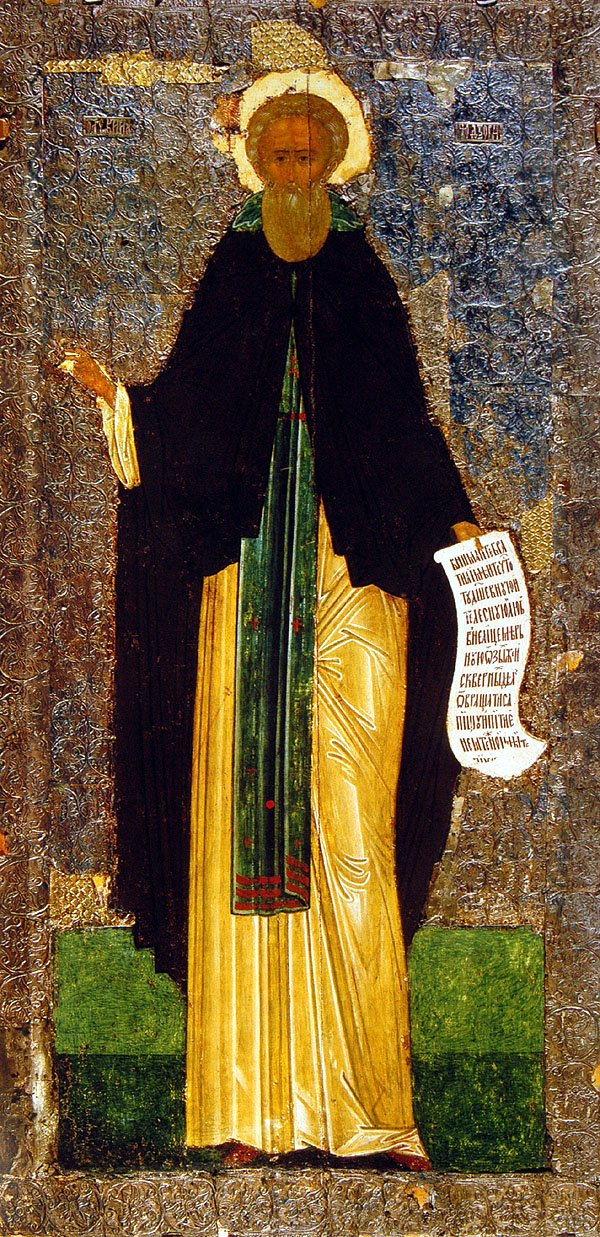
Venerable Cyril, Igoumen of White Lake
Saint Cyril, Igoumen of White Lake, (in the world Cosmas) was born in Moscow of pious parents. In his youth he was left an orphan and lived with his kinsman, the boyar (nobleman) Timothy Vasil’evich Vel’yaminov, in the surroundings of the court of the Great Prince Demetrius Donskoy (1363-1389). Secular life bored the youth. Kno
Saint Cyril, Igoumen of White Lake, (in the world Cosmas) was born in Moscow of pious parents. In his youth he was left an orphan and lived with his kinsman, the boyar (nobleman) Timothy Vasil’evich Vel’yaminov, in the surroundings of the court of the Great Prince Demetrius Donskoy (1363-1389). Secular life bored the youth. Knowing that Timothy would never consent to Cosmas to become a monk, Saint Stephen of Makhra (July 14), clothed him in the riasson and named him Cyril, leaving the rest to God's will.
Saint Stephen went to see Timothy, who was delighted by his visit. He met his guest at the door, asking for his blessing. The Saint replied, "Cyril, who entreats God for you, blesses you." The boyar asked who this Cyril was. Saint Stephen said, "Cosmas, your former kinsman, but now a monk laboring for the Lord, and praying for you."
At first, the boyar was very angry, and spoke harshly to Saint Stephen, who left the house. Timothy's wife reproached him for offending the Elder. The boyar repented and sent someone to ask him to return. Both men asked forgiveness of one another, and Timothy agreed to let Cosmas fulfill his heart's desire. Saint Stephen rejoiced, and told Cyril the good news. He gave away all his possessions to the poor, keeping nothing for himself.
Before returning to Makhra, Igoumen Stephen brought the new monk to Simonov Monastery, which had been established in a new place by Archimandrite Theodore (November 28), the nephew of Saint Sergius. He accepted Cyril into the Monastery and then tonsured him.
Cyril fulfilled his monastic obediences under the supervision of Elder Michael, who later became the Bishop of Smolensk. By night the Elder read the Psalter, and Cyril bowed and made prostrations, but at the first ringing of the bell, he went to the church for Matins.
He asked the Elder permission to partake of food every second or third day. The experienced Elder did not permit this, but blessed him instead to eat with the brethren, only not to the extent of satiety. Cyril fulfilled his obedience in the bakery: he carried water, chopped firewood, and distributed bread. When Saint Sergius of Radonezh came to the Simonov monastery to see his nephew Theodore, he would seek Cyril in the bakery and converse with him about spiritual matters before seeing anyone else.
After a while, Cyril was transferred from the bakery to the kitchen. He gazed into the burning fire and told himself, “Have patience, Cyril, so that by this fire you might save yourself from the eternal fire." Cyril toiled for nine years in the kitchen and God granted him such a tender heart that he was not able to eat the bread he baked without tears, and all the brethren regarded him not as a man, but as an Angel of God.
Fleeing the glory of man, he began to behave as a fool-for-Christ. As punishment for transgressing against propriety, the Superior of the monastery placed him on bread and water for forty days. Cyril underwent this punishment with joy. But the Saint could not conceal his spirituality, and the experienced Superior discovered that Cyril was not behaving as a fool out of pride, but out of humility. Against his will, they compelled him to accept ordination to the priesthood. When he was not serving in church, Cyril occupied himself with heavy work. When Theodore was made Archbishop of Rostov, the brethren chose Cyril as Archimandrite of the monastery in 1388.
Wealthy and important people began to visit the monk to hear his counsels. This disturbed the Saint's humble spirit. Despite the entreaties of the brethren, he would not remain as Igoumen, but secluded himself in his former cell. Even here he was disturbed by frequent visitors, and he went to the old Simonov Monastery of the Nativity of the Theotokos.
Saint Cyril’s soul yearned for solitude, and he asked the Mother of God to show him a place conducive for salvation. One night he was reading an Akathist in his cell before the Hodēgḗtria icon of the Mother of God, and had just reached the eighth Kontakion, “Seeing the strange Nativity, let us become strangers to the world and transport our minds to Heaven.” Then he heard a voice say, “Go to White Lake (Belozersk), where I have prepared a place for you.”
There at the desolate and sparsely populated White Lake, he found the place which he had seen in the vision. Saint Cyril and his companion Saint Therapon of White Lake and Mozhaisk (May 27), set up a cross and dug a cell in the ground near Mount Myaura at Siversk Lake.
Saint Therapon soon went to another place, and Saint Cyril remained where he was. However, he was not able to live in his underground cell for even one year.
Once Cyril, troubled by a strange dream, lay down to sleep under a pine tree, but just as he closed his eyes, he heard a voice cry, “Run, Cyril!” Cyril barely managed to jump away as the pine tree came crashing down. From this pine tree, the ascetic fashioned a cross.
Another time, Cyril nearly perished from flames and smoke when he was clearing the forest, but God preserved His Saint. A certain peasant attempted to burn down the monk's cell, but try as he might, he did not succeed. Then he repented with tears, and confessed his sin to Cyril, who tonsured him into monasticism.
Two monks whom Cyril loved, Zebediah and Dionysios, came to him from Simonov monastery, and then Nathanael, who afterward was steward of the monastery. Many began to come to him seeking to be tonsured. The holy Elder perceived that his time of silence was ended. In the year 1397 he constructed a temple in honor of the Dormition of the Mother of God.
When the number of brethren had multiplied, the monk gave the monastery a Rule of cenobitic life, which he sanctified by the example of his own life. Thus, no one could talk in church, and no one could leave before the end of services. They also came to venerate the Gospel according to seniority. At meals they sat at their own place, and there was silence. From the trapeza, each went quietly to his own cell. No one was able to receive either letters or gifts without having shown them to Cyril, nor did anyone write a letter without his blessing.
Money was kept in the monastery treasury, and no one had any personal possessions. They went to the trapeza even to drink water. The cells were not locked, and nothing was kept in them but icons and books. In the final years of Saint Cyril’s life, the boyar Roman decided to give the monastery a village and sent the deed. Cyril knew that if the monastery came to possess a village, the brethren would become concerned about the land and settlements would disrupt the monastic solitude, so he refused the gift.
The Lord rewarded His Saint with the gift of clairvoyance and healing. A certain Theodore desired to enter the monastery, but the Enemy of mankind instilled in him such hatred for Cyril that he could not look at him, nor listen to the sound of his voice. He approached Cyril’s cell and, seeing his grey hair, he was not able to say a word from shame. The Saint said to him, “Don’t be sad, my brother, for all are mistaken about me. You alone know the truth and my unworthiness. I am actually a worthless sinner.” Then Cyril blessed Theodore, promising that he would not be troubled by such thoughts in the future. From that time Theodore lived at peace in the monastery.
Once, there was no wine for the Divine Liturgy, and the priest told the Saint about this. Cyril ordered a monk to bring him the empty wine vessel, and when he opened it, it was full of wine. During a time of famine Cyril distributed bread to all the needy and he did not stop, even though the normal reserves hardly sufficed for the brethren. Despite this, the more that bread was distributed, the more it increased. The monks then realized that God would provide for their needs, through the prayers of Saint Cyril.
The Saint calmed a storm on the lake which threatened the fishermen. He predicted that none of the brethren would die until after his death, despite a plague that would rage. Then many would follow after him.
The Saint served his final Divine Liturgy on the day of Pentecost. After giving final instructions to the brethren to preserve love among themselves, 1 Saint Cyril reposed in the ninetieth year of his life on June 9, 1427 on the Feast day of his namesake Saint Cyril of Alexandria. Within a year after the Saint's death, more than thirty of the fifty-three brethren reposed. He often appeared to the survivors in dreams, offering advice and guidance.
Saint Cyril loved spiritual enlightenment and he instilled this love in his disciples. In 1635 there were more than two thousand books in the monastery, including sixteen “of the Wonderworker Cyril.” Three of his letters to Russian princes survive down to our time. They are remarkable specimens of his spiritual instruction, love, peace, and consolation.
The veneration of the holy ascetic began not later than 1447-1448. The Life of Saint Cyril was commissioned by Metropolitan Theodosios and Great Prince Basil the Dark. It was written by the Athonite monk Pakhomios the Logothete, who dwelt at the Cyrilov monastery in 1462 and met with many eyewitnesses and disciples of Saint Cyril. He learned the most from Martinian (January 12), who had lived with the Saint from his youth.
1 In the Icon of Saint Cyril, his words appear on the scroll in his hand: "Preserve love among yourselves."
Troparion - Tone 1
You blossomed like a flower in the desert, even as David,1 O Father Cyril, / uprooting the thorns of evil passions, / and there you gathered a multitude of disciples, who were instructed in the fear of God and in your teaching; / whom you, as a loving father, did not abandon until death, visiting them that we all may sing: / "Glory to Him Who gave you strength. / Glory to Him Who crowned you. / Glory to Him Who, through you, works healing for all.1 A possible reference to Psalm 101/102:15, or perhaps to Psalm 62/63, written when David was in the desert of Idumea.
Kontakion - Tone 8
You blossomed like a flower in the desert, even as David,1 O Father Cyril, / uprooting the thorns of evil passions, / and there you gathered a multitude of disciples, who were instructed in the fear of God and in your teaching; / whom you, as a loving father, did not abandon until death, visiting them that we all may sing: / "Glory to Him Who gave you strength. / Glory to Him Who crowned you. / Glory to Him Who, through you, works healing for all.
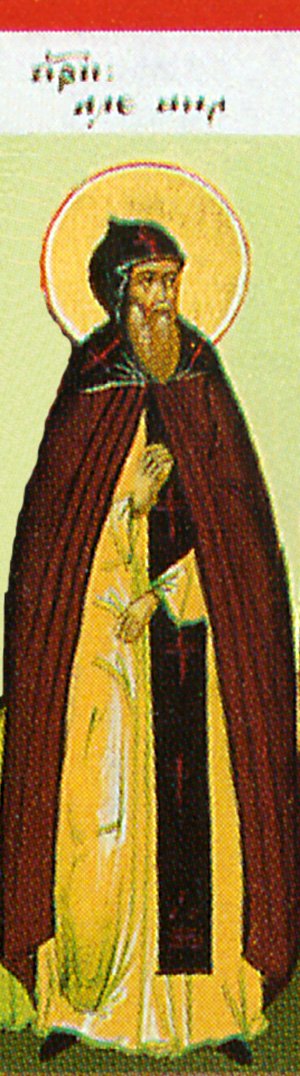
Venerable Alexander, Abbot of Kushta, Vologda
Saint Alexander, Hegoumen of Kushta Monastery in Vologda, was born about the year 1371, and his name in the world was Alexei. He was tonsured at the Savior-Stone (Spaso-Kamen) monastery by Hegoumen Dionysios of the Holy Mountain, who brought the Athonite Rule to the monastery. Later, he became the Archbishop of Rostov.
Saint Alexander, Hegoumen of Kushta Monastery in Vologda, was born about the year 1371, and his name in the world was Alexei. He was tonsured at the Savior-Stone (Spaso-Kamen) monastery by Hegoumen Dionysios of the Holy Mountain, who brought the Athonite Rule to the monastery. Later, he became the Archbishop of Rostov. Here Saint Alexander went through all the phases of obedience and strict fasting, and was ordained as a Hieromonk. He was constantly at work or at prayer. The brethren looked upon him as upon an angel of God, and this troubled Saint Alexander. He left the monastery secretly by night and came to the River Syazhem, where there was a thick forest and lake. Here he built a cell and lived his life in prayer and austere abstinence. Little by little, people started coming to him.
Saint Alexander went from this place to the shore of Lake Kuben, at the mouth of the River Kushta. At that time Saint Euthymios (April 11) was living there. Saint Alexander offered to exchange cells with him, and Saint Euthymios agreed to this. When they parted, he gave Saint Alexander his cross as a blessing. The quiet wilderness was very dear to Saint Alexander. Going to the lake, he immersed the cross in the water and prayed to God, asking that he might gather in this place those who were zealous for the way of the Cross. After some time, a certain Elder came to Saint Alexander, with whom he dwelt for five years. When a third brother arrived, Saint Alexander decided to build a church in honor of the Dormition of the Most Holy Theotokos. The saint journeyed to Rostov to see his former Hegoumen, Archbishop Dionysios (1418-1425), who blessed the construction of the temple.
One day, Tatars came when Prince Demetrios of Zaozersk was away, and five of them galloped up to the Kushta monastery. Saint Alexander met them calmly and he blessed them with the cross. The Tatars fell down as if they were dead; and they lay senseless for several hours, after which Saint Alexander roused them from their torpor in the name of the Life-creating Trinity.
When Prince Demetrios reposed, his widow, Princess Maria, who had great respect for Saint Alexander, offered a village for the support of the monastery in remembrance of her husband. Once she came to the monastery and went into the church, where Saint Alexander was reading the Psalter, while insects attacked his bare chest. The monk was distressed by her visit and said, “It is not necessary, O Princess, for you to observe our misery.” The princess humbly asked for pardon. The monk blessed her, but said, “Feed your poverty at home.” When she reached her home, the princess fell sick and asked him to pray for the recovery of her health. Saint Alexander foresaw her end and said, “Let her prepare for that life.” Princess Maria died twenty days later.
Wheat was gathered on the floor of the monastery; and a certain peasant decided to steal a sack, but he was not able to lift it. The saint happened upon him and said, “My son, it is in vain that you try to lift what is beyond your strength.” The astounded thief threw himself at the feet of the venerable one, asking his forgiveness, but Saint Alexander ordered him to add more wheat to the sack. After admonishing him not to steal from others in future, he blessed him to take the sack and to go with God. The peasant easily carried the burden which was blessed, and thanked the generous Elder.
Sensing that the time of his death was near, Saint Alexander said to those dwelling with him, “I am growing weak, but I urge you to endure in this place, preserving humility and mutual love.” On Sunday he served the Divine Liturgy, and partook of the Holy Mysteries. Then he prayed on his knees for himself and for his monastery, and at age of sixty-eight, he peacefully surrendered his soul to the Lord on June 9, 1439.
According to Saint Alexander’s last instructions in his will, his body was placed at the south side of the altar. A year afterward, a Rowan-berry tree grew up over his grave. Once, on the Feast of the Dormition of the Most Holy Theotokos, a peasant child broke off a branch from this tree and suddenly his hand began to hurt. His parents prayed and brought their son to the saint’s grave, and he was healed. From that time people began to pick berries from this tree for healing purposes. His disciples built a heated church in honor of Saint Nicholas over the saint’s grave and it was dedicated on the anniversary of his repose. Many of the sick who were brought to the church said that they saw Saint Alexander and Saint Nicholas praying together, or censing the temple. Many of the sick received healing at Saint Alexander’s grave.
Troparion - Tone 4
Desiring to serve God with your entire being, you settled in the wilderness, / and there with many labors and sweat, you attained a life similar to that of the Bodiless Angels, / having been seen by God, you were honored by the gift of miracles during your life and after your repose, / you received power to drive away unclean spirits from those who come to you with faith; / therefore, O Father Alexander, pray for us all, that our souls may be saved.
Kontakion - Tone 8
As an Angel in the flesh, contesting on earth with spiritual struggles, / you dwelt in the wilderness and lived with the animals, and were wholly Christ's. / You followed Him irrevocably, and were led to Heaven, following the Divine paths, / O blessed Father Alexander, as a wondrous one, you pour forth miracles, / driving away diseases from those who come to you with faith; / and as one having boldness before the Lord, remember us who honor your revered memory.
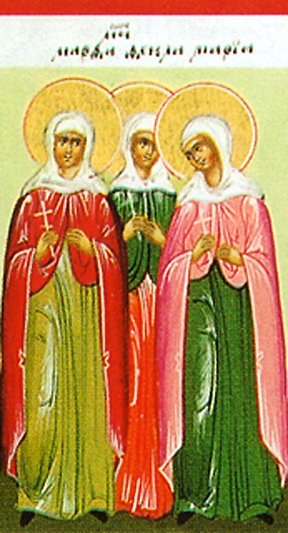
Five Nuns beheaded in Persia: Martyrs Thecla, Mariamne, Martha, Mary, and Ennatha
During the time of the Persian king Saphor II (ca. 330 A.D.), a priest by the name of Paul was living near the village of Aza. He was wealthy and a lover of money, and he had with him five women who had consecrated their virginity to God. Saints Thekla, Mariamne, Martha, Maria, and Ennatha were adorned with the splendor of virtues.
During the time of the Persian king Saphor II (ca. 330 A.D.), a priest by the name of Paul was living near the village of Aza. He was wealthy and a lover of money, and he had with him five women who had consecrated their virginity to God. Saints Thekla, Mariamne, Martha, Maria, and Ennatha were adorned with the splendor of virtues. They were wealthy, and they entrusted their Spiritual Father with all their money. The greedy man prayed and chanted the Psalms with them, but he kept their money for himself.
When they learned that the priest Paul was rich, the Persians threatened to kill him and the five virgins if he did not deny Christ and give them some of his treasure. Since he preferred earthly riches, he accepted the Persian religion. The holy virgins said that they would rather suffer torture and death than deny Christ. Paul beheaded the women with a sword when they refused to follow his treacherous example. He did not enjoy his wealth for very long, however. The Persians drowned him the following evening in order to obtain all of the money. The holy virgins received their incorruptible crowns of glory from Christ in the year 346.
The five Virgin Martyrs are also commemorated on September 26.
Troparion - Tone 1
As reasonable lambs, you were guided by Christ, the Chief Shepherd, / along the path of martyrdom. / You finished your course and kept the faith; / therefore, honored Thecla, Mariamne, Martha, Mary, and Ennatha, / with joyful hearts, we magnify Christ today, as we honor your holy memory!
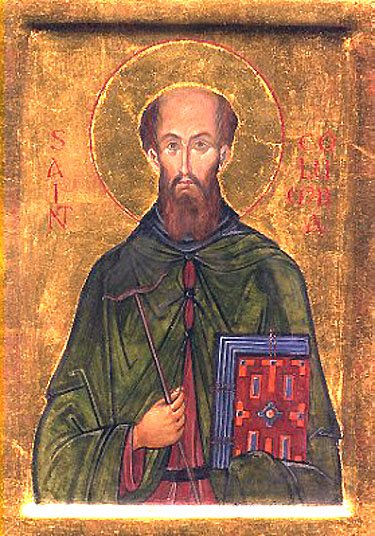
Saint Columba of Iona, Enlightener of Scotland
He was born to a prominent noble family, the Ui-Niall clan of Ireland, but he forsook all worldly things and became a monk at a young age. He founded the monasteries of Derry and Durrow, and traveled as a missionary in Ireland for almost twenty years. In 565 he settled on the island of Iona, off the coast of Scotland; there he remained for 32 years, establishing the famous monastery of Iona and continuing in his missionary labors.
He was born to a prominent noble family, the Ui-Niall clan of Ireland, but he forsook all worldly things and became a monk at a young age. He founded the monasteries of Derry and Durrow, and traveled as a missionary in Ireland for almost twenty years. In 565 he settled on the island of Iona, off the coast of Scotland; there he remained for 32 years, establishing the famous monastery of Iona and continuing in his missionary labors. He reposed in peace at Iona.
Troparion - Tone 5
By your God-inspired life / you embodied both the mission and the dispersion of the Church, / most glorious Father Columba. / Using your repentance and voluntary exile, / Christ our God raised you up as a beacon of the True Faith, / an apostle to the heathen and an indicator of the Way of salvation. / Wherefore O holy one, cease not to intercede for us / that our souls may be saved.
Saint John of Shavta-Gelati
The great Georgian hymnographer, philosopher, and orator Saint John of Shavta labored in the 12th and 13th centuries, during the reign of the holy queen Tamar. Few details of his life have been preserved, but we know that he received his education at Gelati Academy, where he studied theology, ancient and Arabic history, philosophy, and literature.
The great Georgian hymnographer, philosopher, and orator Saint John of Shavta labored in the 12th and 13th centuries, during the reign of the holy queen Tamar. Few details of his life have been preserved, but we know that he received his education at Gelati Academy, where he studied theology, ancient and Arabic history, philosophy, and literature. He was later tonsured a monk and labored at Vardzia Monastery.
When the Georgian army under the command of Queen Tamar’s husband, Davit Soslan, entered into battle [The Battle of Basiani (ca. 1203)] with the sultan Rukn al-Din, Queen Tamar journeyed to Odzrkhe Monastery to pray for help. Catholicos Tevdore of Kartli and many hierarchs and monastics accompanied her there. Among them, Saint John of Shavta stood out as a wise theologian and philosopher and a brilliant hymnographer.
During the Liturgy at Odzrkhe Monastery a miracle occurred: endowed by God with the gift of prophecy, Saint Eulogius the Fool for-Christ fell to his knees, lifted his hands to the heavens and cried out: “Glory to God! Almighty Christ!...Do not fear the Persians, but rather depart in peace, for the mercy of God has descended upon the house of Tamar!”
Eulogius’s words were clearly a divine revelation. Saint John of Shavta turned to Queen Tamar, rejoicing, “Your Highness! The Almighty has made known to us our victory in the war from the lips of a fool-for-Christ!” Eulogius confided his secret to Saint John: disguised as a fool, he had been concealing his God-given gift. But now it seemed that the gift would become apparent to all, so Eulogius quickly disappeared out of sight to escape the people’s attention.
Saint John of Shavta composed his “Hymns to the Theotokos of Vardzia” in thanksgiving for Georgia’s victory in the Battle of Basiani. He is also recognized as the composer of “Abdul-Messiah,” (Abdul-Messiah: servant of Christ) a famous ode to the holy queen Tamar.
Our Holy Father John of Shavta lived to an advanced age and was canonized soon after his repose.
Troparion - Tone 8
By a flood of tears you made the desert fertile, / and your longing for God brought forth fruits in abundance. / By the radiance of miracles you illumined the whole universe! / O our holy father John, pray to Christ our God to save our souls!
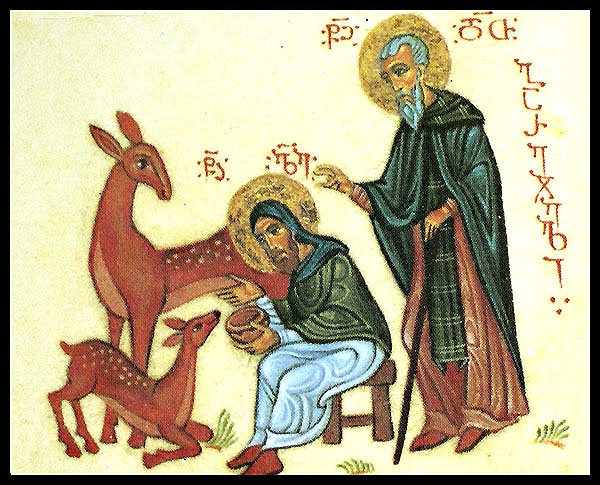
Saint David Gareji, and Venerable Lucian, spiritual son of Saint David
Saint David of Gareji was Syrian by birth. The future ascetic became a disciple of Saint John of Zedazeni and journeyed with him to Georgia. Saint David and his spiritual son Lucian settled on a mountain above Tbilisi, the capital of Kartli.
At that time Kartli was constantly under threat of the Persian fire-worshippers.
Saint David of Gareji was Syrian by birth. The future ascetic became a disciple of Saint John of Zedazeni and journeyed with him to Georgia. Saint David and his spiritual son Lucian settled on a mountain above Tbilisi, the capital of Kartli.
At that time Kartli was constantly under threat of the Persian fire-worshippers. Saint David would spend entire days in prayer, beseeching the Lord for forgiveness of the sins of those who dwelt in the city. When he was finished praying for the day, he would stand on the mountain and bless the whole city. Once a week Saints David and Lucian would go down into the city to preach. A church dedicated to Saint David was later built on the mountain where he labored.
Saint David’s authority and popularity alarmed the fire-worshippers, and they accused him of adultery, in an attempt to discredit him in the eyes of the people. As a “witness” they summoned a certain expectant prostitute, who accused him of being the child’s father. Hoping in God, the holy father touched his staff to the prostitute’s womb and ordered the unborn child to declare the truth. From out of the womb the infant uttered the name of his true father.
Outraged at this slander, the bystanders savagely stoned the woman to death. Saint David pleaded with them to stop, but he was unable to placate the furious crowd. Deeply disturbed by these events, Saint David departed the region with his disciple Lucian.
The holy fathers settled in a small cave in the wilderness and began to spend all their time in prayer. They ate nothing but herbs and the bark of trees. When the herbs withered from the summer heat, the Lord sent them deer. Lucian milked them and brought the milk to Saint David, and when the elder made the sign of the Cross over the milk it was miraculously transformed into cheese.
Shaken by the holy father’s miracle, Lucian told him, “Even if my body rots and wastes away from hunger and thirst, I will not permit myself to fret over the things of this temporal life.”
The fathers kept a strict fast on Wednesdays and Fridays—they ate nothing, and even the deer did not come to them on those days.
A frightful serpent inhabited a cave not far from where they lived and attacked all the animals around it. But at Saint David’s command the serpent deserted that place.
Once local hunters were tracking the fathers’ deer, and they caught sight of Lucian milking them as they stood there quietly, as though they were sheep. The hunters paid great respect to Saint David and, having returned to their homes, reported what they had seen.
Soon the Gareji wilderness filled with people who longed to draw nearer to Christ. A monastery was founded there, and for centuries it stood fast as a center and cornerstone of faith and learning in Georgia.
After some time Saint David set off on a pilgrimage to Jerusalem. He entrusted Lucian to fulfill his responsibilities at the monastery and took some of the other brothers with him. When the pilgrims were approaching the place called the “Ridge of Grace,” from which the holy city of Jerusalem becomes visible, Saint David fell to his knees and glorified God with tears. Judging himself unworthy to follow in the footsteps of Jesus Christ, he was satisfied to gaze upon the city from afar.
Then he stood at the city gates and prayed fervently while his companions entered the Holy City and venerated the holy places. Returning, Saint David took with him three stones from the “Ridge of Grace.” That night an angel appeared to the patriarch of Jerusalem and informed him that a certain pious man named David, who was visiting from afar, had taken with him all the holiness of Jerusalem.
The angel proceeded to tell him that the venerable one had marched through the city of Nablus, clothed in tatters and bearing on his shoulders an old sack in which he carried the three holy stones. The patriarch sent messengers after the stranger with a request that he return two of the stones and take only one for himself. Saint David returned the two stones, but he declined the patriarch’s invitation to visit him. He took the third stone back with him to the monastery, and to this day it has been full of the grace of miraculous healing.
After Saint David brought the miraculous stone from Jerusalem, the number of brothers at the monastery doubled. The venerable father ministered to all of them and encouraged them. He also visited the cells of the elder hermits to offer his solace. In accordance with his will, a monastery in the name of Saint John the Baptist was founded in the place called “Mravalmta” (the Rolling Mountains).
The Lord God informed Saint David of his imminent departure to the Kingdom of Heaven. Then he gathered the fathers of the wilderness and instructed them for the last time not to fall into confusion, but to be firm and ceaselessly entreat the Lord for the salvation of their souls.
He received Holy Communion, lifted up his hands to the Lord, and gave up his spirit.
Saint David’s holy relics have worked many miracles: approaching them, those blind from birth have received their sight. To this day, believers have been healed of every spiritual and bodily affliction at his grave.
Troparion - Tone 8
By a flood of tears you made the desert fertile, / and your longing for God brought forth fruits in abundance. / By the radiance of miracles you illumined the whole universe! / O our holy father David, pray to Christ our God to save our souls!
Scripture Readings
☩Epistle
Romans 4:4-12
4
Now to him that worketh is the reward not reckoned of grace, but of debt.
5
But to him that worketh not, but believeth on him that justifieth the ungodly, his faith is counted for righteousness.
6
Even as David also describeth the blessedness of the man, unto whom God imputeth righteousness without works,
7
Saying, Blessed are they whose iniquities are forgiven, and whose sins are covered.
8
Blessed is the man to whom the Lord will not impute sin.
9
Cometh this blessedness then upon the circumcision only, or upon the uncircumcision also? for we say that faith was reckoned to Abraham for righteousness.
10
How was it then reckoned? when he was in circumcision, or in uncircumcision? Not in circumcision, but in uncircumcision.
11
And he received the sign of circumcision, a seal of the righteousness of the faith which he had yet being uncircumcised: that he might be the father of all them that believe, though they be not circumcised; that righteousness might be imputed unto them also:
12
And the father of circumcision to them who are not of the circumcision only, but who also walk in the steps of that faith of our father Abraham, which he had being yet uncircumcised.
☩Gospel
Matthew 7:15-21
15
Beware of false prophets, which come to you in sheep’s clothing, but inwardly they are ravening wolves.
16
Ye shall know them by their fruits. Do men gather grapes of thorns, or figs of thistles?
17
Even so every good tree bringeth forth good fruit; but a corrupt tree bringeth forth evil fruit.
18
A good tree cannot bring forth evil fruit, neither can a corrupt tree bring forth good fruit.
19
Every tree that bringeth not forth good fruit is hewn down, and cast into the fire.
20
Wherefore by their fruits ye shall know them.
21
Not every one that saith unto me, Lord, Lord, shall enter into the kingdom of heaven; but he that doeth the will of my Father which is in heaven.
Liturgical data sourced from OCA.org and orthocal.info