Fasting Rules
 Meat
Abstain
Meat
Abstain
 Fish
Abstain
Fish
Abstain
 Dairy
Abstain
Dairy
Abstain
 Oil
Abstain
Oil
Abstain
 Wine
Abstain
Wine
Abstain
Saints & Commemorations
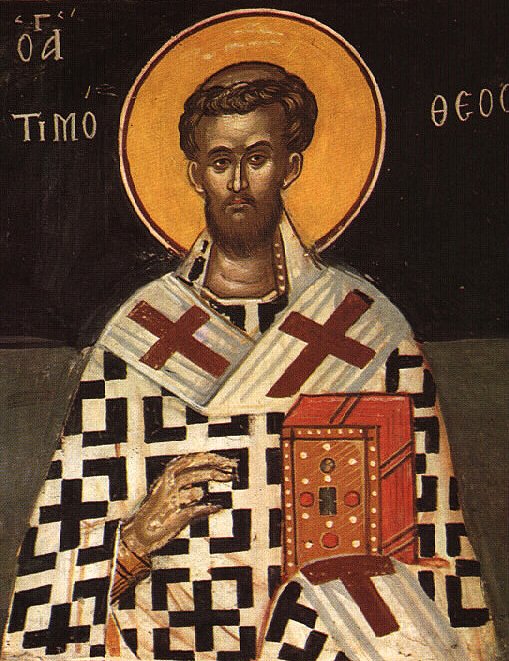
Hieromartyr Timothy, Bishop of Prusa
“For his great spiritual purity, God gave him the gift of wonderworking, and he healed all manner of diseases and pains among the people. During the reign of the evil Emperor Julian, who had renounced Christ, holy Timothy was thrown into prison. The faithful visited him there to listen to the wise teaching of their bishop. W
“For his great spiritual purity, God gave him the gift of wonderworking, and he healed all manner of diseases and pains among the people. During the reign of the evil Emperor Julian, who had renounced Christ, holy Timothy was thrown into prison. The faithful visited him there to listen to the wise teaching of their bishop. When this came to the Emperor’s ears, he commanded that the executioner behead the Saint in the prison. This was in 362, and his soul entered into Paradise while his relics remained, full of miraculous power, to help the people and declare the power of the Lord.” (Prologue [adapted])
Troparion - Tone 1
By sharing in the ways of the Apostles, / you became a successor to their throne. / Through the practice of virtue, / you found the way to divine contemplation, O divinely inspired one; / by rightly dividing the word of truth without error, / you defended the Faith, even to the shedding of your blood. / O Hieromartyr Timothy entreat Christ God to save our souls.
Venerable Silvanus the Schemamonk, of the Kiev Far Caves
The Holy Schemamonk Silvanus of the Kiev Caves labored in asceticism in the Far Caves during the thirteenth and fourteenth centuries. One time, by the power of his prayer, he held fast to the spot robbers, who had come into the monastery garden, and for three days they were not able to move. When they repented, the monk then freed them.
The Holy Schemamonk Silvanus of the Kiev Caves labored in asceticism in the Far Caves during the thirteenth and fourteenth centuries. One time, by the power of his prayer, he held fast to the spot robbers, who had come into the monastery garden, and for three days they were not able to move. When they repented, the monk then freed them. The memory of Saint Silvanus is celebrated also on August 28, and on the second Sunday of Great Lent.
Troparion - Tone 8
By a flood of tears you made the desert fertile, / and your longing for God brought forth fruits in abundance. / By the radiance of miracles you illumined the whole universe! / O our holy father Silvanus, pray to Christ our God to save our souls!
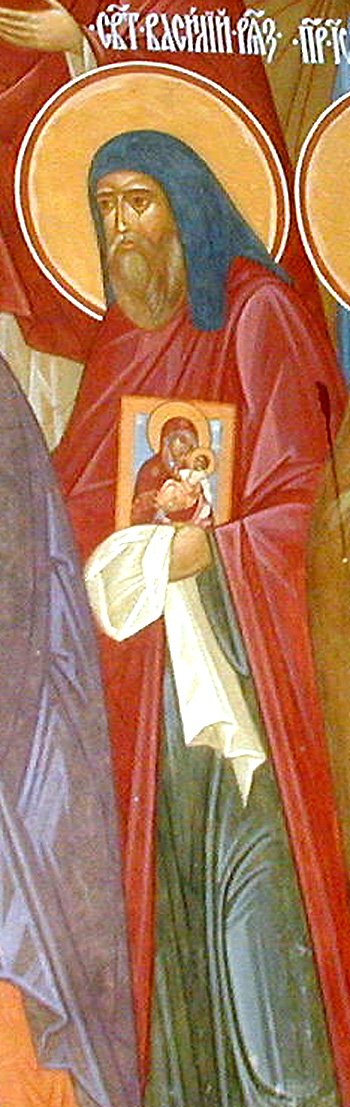
Finding of the relics of Saint Basil, Bishop of Ryazan
The Uncovering and Transfer of the Holy Relics of Saint Basil, Bishop of Ryazan (July 3), was done by Archbishop Theodoret of Ryazan (1605-1617). It pleased Divine Providence during the Time of Troubles to glorify Saint Basil. The uncovering of his relics and their transfer into the Ryazan-Dormition (afterwards Nativity) church in the Kremlin of Ryazan-Pereslavl took place on June 10, 1609.
The Uncovering and Transfer of the Holy Relics of Saint Basil, Bishop of Ryazan (July 3), was done by Archbishop Theodoret of Ryazan (1605-1617). It pleased Divine Providence during the Time of Troubles to glorify Saint Basil. The uncovering of his relics and their transfer into the Ryazan-Dormition (afterwards Nativity) church in the Kremlin of Ryazan-Pereslavl took place on June 10, 1609. This had been the cathedral church from the time of the Ryazan bishop Jonah II (1522-1547). The relics of Saint Basil were placed in a reliquary at the left kleros, beside the iconostasis. A troparion and kontakion were then composed. From that time the name of Saint Basil was “commemorated throughout all the churches of the Ryazan diocese.” People had recourse to him as to “their constant intercessor, a helper in sorrow and peril.” Under Archbishop Moses (1638-1651), a stone crypt was built over the relics of Saint Basil in 1638, and over it was put the Murom Icon of the Most Holy Theotokos “the Supplication of Basil.”
During this period services of thanksgiving to Saint Basil were served in the Ryazan churches. The first solemn celebration of the transfer of the relics of the saint took place on June 10, 1645 under Archbishop Moses. Especially fervent in veneration of the Ryazan hierarch was Archbishop Misael (1651-1655). By his command, in 1653, an inscription was made on a large silver vessel for the blessing of water, “This cup is from Ryazan-Pereslavl, in the cathedral church of the Dormition and the holy Passion-Bearers Boris and Gleb, and our Father among the saints Basil, Bishop of Ryazan, Wonderworker”.
In 1655 Saint Basil was depicted upon a silver cross together with Saint John the Forerunner and Saint Jonah, Metropolitan of Moscow. In 1712 during the time of Metropolitan Stephen Yavorsky, a stone chapel was constructed over the original burial place of Saint Basil, at the Borisoglebsk church , through the zeal of the clerk Nikḗtas Altukhov. In the years 1722-1723 under Tsar Peter I a formal investigation of the saint was conducted, after which Saint Basil was depicted upon an icon together with other Russian saints. Metropolitan Demetrius (Sechenov) of Novgorod, during his time as Bishop of Ryazan (1752-1757) compiled the service to Saint Basil, “having in mind first of all the writing of the troparion, kontakion and canon”.
Through his efforts a new crypt was constructed over the relics of Saint Basil, containing a reliquary with an icon of the saint. In 1782 the reliquary was elegantly adorned by the Archbishop of Ryazan and Zaraisk, Simon (Lagova) (1778-1804). In 1810 under the Ryazan and Zaraisk archbishop Theophylakt (Rusanov), a decree of the Holy Synod was promulgated concerning the celebration of Saint Basil on the Sunday of All Saints. On October 4, 1836 a new memorial was unveiled at the spot of the uncovering of the relics of Saint Basil. It was set up through the zeal of the churchwarden of the Borisoglebsk church, Simeon Panov. In 1871, Archbishop Alexis (Rzhanitsky, 1867-1876) served the Divine Liturgy at the Borisoglebsk church on the Feast day of Saint Basil, July 3, for the first time.
Under Archbishop Palladius (Raev, 1876-1882) the Holy Synod in 1881 appointed the following days for commemoration of Saint Basil: July 3, the day of his blessed repose, and June 10, the day of the transfer of his holy relics. Even today, Saint Basil is especially venerated in the Ryazan lands. In each temple of the Ryazan diocese there is his icon. In the majority of the churches, moreover, is found a mural of the saint sailing along on the water on his mantiya with the Murom Icon of the Mother of God in hand. In the cathedral church each Wednesday evening an Akathist is sung to him.
Troparion - Tone 4
At first you were honored with the episcopal dignity at Murom, but were unjustly banished. / You climbed
onto your mantya as if it were a light ship; / and as one without a body, you made your way supernaturally
over the water, / guided by the Providence of the Most High, and by the intercession of the Mother of God,
you reached the God-saved city of Ryazan. / There you accepted your hierarchal throne, and your God-given
flock of Ryazan. / You have done well, O Hierarch and Father Basil. / Entreat Christ God that our souls may
be saved.
Kontakion - Tone 8
O Hierarch Basil, you shone in the city of Murom like a bright star, / and upon the water you reached the city of Ryazan; / you helped the Church of God well by enlightening the people with your teaching and your life. / Even now, remember your children who pray to you, our good teacher, / and entreat Christ God and His Most Pure Mother for us, / that with grateful souls we may cry to you: / “Rejoice, O Christ-pleaser and fervent intercessor with God for us.”
Holy Martyrs Alexander and Antonina (313)
In Alexandria, the virgin Antonina was brought before Festus, the Governor, tortured for her faith in Christ, then thrown into prison. A Christian soldier named Alexander, who had never before seen or heard of Antonina, was commanded by an angel of God to go to her. Finding her, he gave her his military cloak, wrapping it about her head and body; and thus, with her head lowered, she was able to walk out of the prison while Alexander remained in her place.
In Alexandria, the virgin Antonina was brought before Festus, the Governor, tortured for her faith in Christ, then thrown into prison. A Christian soldier named Alexander, who had never before seen or heard of Antonina, was commanded by an angel of God to go to her. Finding her, he gave her his military cloak, wrapping it about her head and body; and thus, with her head lowered, she was able to walk out of the prison while Alexander remained in her place. Alexander was brought before Festus, where he too confessed his faith in Christ. Antonina, learning of this, voluntarily came before the judge, who put both of them to hideous tortures, mutilating them in many ways before having them cast into a fire and burned alive.
A slightly different account says that Festus placed Antonina under guard in a brothel rather than a prison, so that her virginity might be defiled, and that it was from there that Alexander rescued her.
Festus, the Governor, was struck mute at the time of the holy martyrs’ death, and was tormented by an evil spirit for seven days, at the end of which he died.
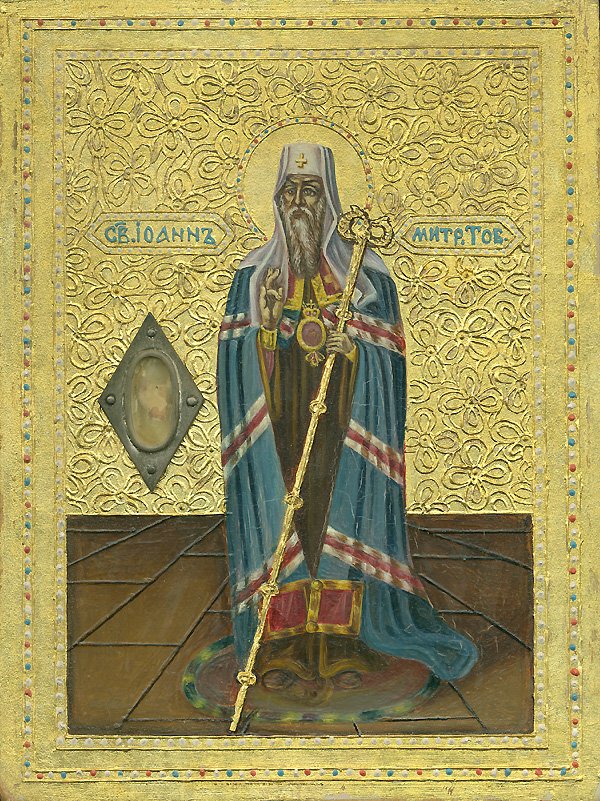
Saint John Maximovitch, Metropolitan of Tobolsk
Saint John, Metropolitan of Tobolsk and All Siberia, the Wonderwonder, in the world was named John Maximovitch, and he was born in the city of Nezhino in 1651. His father Maxim Vasil’evich and mother Euphrosynē had seven sons, of which John was the eldest. Upon his completion of the Kiev-Mogilyansk College (afterwards the Kiev Spiritual Academy), the future hierarch emerged from it as a teacher of the Latin language. Th
Saint John, Metropolitan of Tobolsk and All Siberia, the Wonderwonder, in the world was named John Maximovitch, and he was born in the city of Nezhino in 1651. His father Maxim Vasil’evich and mother Euphrosynē had seven sons, of which John was the eldest. Upon his completion of the Kiev-Mogilyansk College (afterwards the Kiev Spiritual Academy), the future hierarch emerged from it as a teacher of the Latin language. Thereafter, in 1680, he accepted monasticism at the Kiev Caves monastery and became absorbed in inner spiritual activity. With the general consent of the brethren, the young monk was given the obedience of preaching. From this period he demonstrated an exceptional eloquence. He attached a special significance to inner religious knowledge. The chief theme of his life can be defined at a stroke as, “How ought man to conform his will with the will of God?” He developed this theme both in his preachings, and in his subsequent missionary service. In answer to it appeared the work, published towards the end of his long ascetic life, and entitled “Heliotropion” or “Sunflower,” or “Conforming the Human Will to the Divine Will.” Of the many works of the holy Fathers of the Orthodox Church, this work gives a very thorough answer to this great question of Christian soteriology.
In 1688 they sent him on a mission to Moscow. There he was appointed by Patriarch Joachim (1674-1690) as vicar of the Briansk-Svensk monastery, which was then under the Kiev Caves Lavra.
Saint Theodosius, Archbishop of Chernigov, in 1695 shortly before his own death (February 5) appointed Hieromonk John as Archimandrite of the Chernigov Eletsk monastery, and designated him as his successor as bishop. (Saint John revered the memory of Saint Theodosius, believing in the power of his prayerful intercession before the Lord. Because of his faith, he received healing from a serious illness through the prayers of Saint Theodosius. At the very height of the sickness, Saint Theodosius appeared to him and said, “Serve tomorrow, you will be well.” On the following day Saint John, completely well and to the amazement of everyone, served the Divine Liturgy. This miracle of Saint John’s healing marked the beginning of the veneration of Saint Theodosius as a grace-bearing saint of God.)
On January 10, 1697 Patriarch Adrian of Moscow and All Rus (1690-1700) consecrated Archimandrite John as Bishop of Chernigov, in the Dormition cathedral of the Moscow Kremlin.
Upon entering into the administration of the diocese, Bishop John created a Collegium near the archbishop’s cathedral, similar to the Kiev Academy, which the saint intended should serve as an “Athens at Chernigov,” a school of pious enlightenment.
In view of its high level of theological education and training, Saint John’s school received wide renown. In essence, this was the first seminary in Russia. Seminaries on the model of this one began opening in other dioceses of the Russian Church.
The saint also later opened a printing press, at which he and his successors published many works of spiritual and moral content.
The life of Saint John was illumined by lofty virtues, and especially humility. It is reflected also in his works, “The Moral-Didactic Reflector” (Chernigov, 1703 and 1707); “The Alphabet, with Rhymes Added” (1705); “The Virgin Mother of God” (1707); “The Theatre, or Moral-Didactic Disgrace” (1708); “Excursus on Psalm 50” (Chernigov, 1708); “Excursus on the “Our Father” and “The Eight Gospel Beatitudes” (1709); “The Royal Way of the Cross” (Chernigov, 1709); “Thoughts on God to the Benefit of Right-Belief” (1710 and 1711); “Synaxarion Commemoration on the Victory of Poltava” (1710); “The Pilgrim” (in manuscript); “Spiritual Thoughts” (Moscow, 1782).
At Chernigov in 1714 the saint also first published his chief work, written in the Latin language. It was a peculiarity of the graduates of the Kiev school was that they wrote their works in classical Latin. Professor I. A. Maximovich in 1888 translated the “Heliotropion” into the modern Russian language and published it at first in parts in the “Chernigov Diocesan Newsletter”, and later on in a separate book (Kiev, 1896). With his name is connected also “The Latin-Greek-Russian Lexicon.”
Saint John was known to have connections with Mount Athos. He had a special interest in the fate of Russian inhabitants on the Holy Mountain, and sent them substantial material aid during these difficult years. His archbishopal grammota to the Russian monastery of Saint Panteleimon has been preserved, and it testifies to his concern for those on Mount Athos.
On August 14, 1711, after his elevation to the dignity of metropolitan, Saint John arrived at the see of Tobolsk and All Siberia. The saint concerned himself constantly with the enlightening of his diocese. There he continued with his work, started at Chernigov. He improved the school which had been opened by his predecessor, the renowned missionary Metropolitan Philotheus (Leschinsky, + 1727), and he continued the apostolic preaching among the pagans of Siberia, converting many thousands to Christ. In 1714 Saint John set off to Peking to head a mission with Archimandrite Hilarion (Lezhaisky). At Tobolsk he again undertook publishing activity, using the printing press he set up at Chernigov. To this time belongs also the publication by Metropolitan John of the “Heliotropion” in the Slavonic-Russian language (1714), so that the Siberians could also understand it.
The chronicler describes the life of the saint in Siberia: “He was quiet and unpretentious, graciously considerate, sympathetic to the poor, and merciful.” He often helped people secretly, and sometimes in the garb of a simple monk, he would bring generous alms to the homes of the needy saying, “Accept this in the Name of Jesus Christ.” His home at Tobolsk was always open to all those in need of help or a word of comfort. Even on the day he died, June 10, 1715, after Divine Liturgy Saint John had set up a dining-hall at his home for the clergy and the impoverished, and he himself served at table. Later on, having taken his leave of everyone, the saint withdrew to his chambers. When the church bells rang for Vespers, he died at prayer on his knees. The saint was buried in the chapel of Saint John Chrysostom at the Tobolsk Dormition-Sophia cathedral.
Saint John has long been venerated in Siberia. In light of numerous miracles and the longstanding local veneration of Saint John, in 1916 the Church established the all-Russian celebration of the saint on June 10, the day of repose.
Saint John’s memory is fervently kept by Siberians and by all the believing Russian people. He at present rests in the Tobolsk cathedral of the Protection of the Mother of God. The service to him was republished, with the blessing of His Holiness Patriarch Alexis I, by Metropolitan Bartholomew (Gorodtsov) in 1947 at the city of Novosibirsk.
Troparion - Tone 8
Instructor of piety, nourisher of orphans, helper of the afflicted, / unmercenary physician of the sick, speedy helper of suffering souls, / fervent intercessor with the Lord for all. / O Hierarch Father John, entreat Christ God to save our souls.
Kontakion - Tone 2
You were shown as a light for those in the darkness of ignorance, / a comforter of widows and orphans, / and a wondrous physician of the infirm, / instructor of children and youths, most radiant joy for parents. / O Hierarch Father John, pray to Christ God to grant our country confirmation in the Faith; / victory to our armies over our enemies, and great mercy to His people.
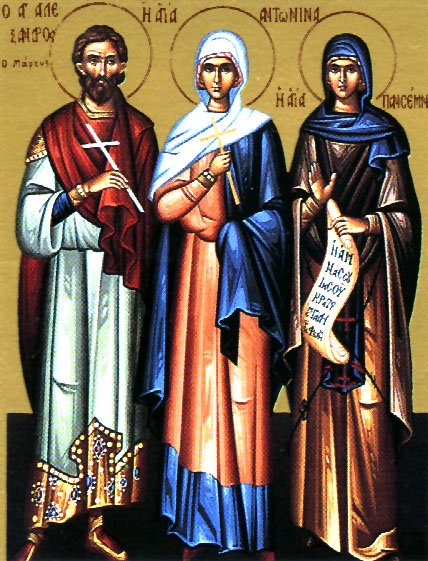
Martyr Alexander and Virgin Martyr Antonina at Constantinople
The Holy Martyrs Alexander and Antonina the Virgin. Saint Antonina was from the city of Krodamos (Asia Minor). She was arrested for being a Christian, and was brought before the governor Festus. He urged her to worship the pagan gods, promising to make her a priestess of the goddess Artemis. But the saint bravely confessed Christ, and she urged the governor to renounce the worship of demons in the form of idols.
The Holy Martyrs Alexander and Antonina the Virgin. Saint Antonina was from the city of Krodamos (Asia Minor). She was arrested for being a Christian, and was brought before the governor Festus. He urged her to worship the pagan gods, promising to make her a priestess of the goddess Artemis. But the saint bravely confessed Christ, and she urged the governor to renounce the worship of demons in the form of idols. Festus gave orders to strike the saint on the face and lock her up in prison.
The martyr spent all her time at prayer, she ate and drank nothing, but then she heard the voice of God, “Antonina, fortify yourself with food and be brave, for I am with you.” When they led her before the governor again, the martyr continued to stand up for the Christian Faith and to denounce the pagans.
The governor decided to give the holy virgin over for defilement by soldiers, but the Lord inspired one of them, Saint Alexander, to save the holy virgin. He sought permission to go in to her on the pretext that he might be able to convince her to obey the governor’s will. Saint Alexander then suggested that she put on his military attire and flee. Saint Antonina was afraid, but the Lord ordered her to agree.
No one recognized her dressed as a soldier, and she walked out of prison. The soldiers sent by Festus found Saint Alexander alone in the cell. He would not respond to the questions of the governor, and so he was tortured and mercilessly beaten. Through the inspiration of the Lord Jesus Christ, Saint Antonina also came to stand before Festus.
Soldiers cut off their hands, then they smeared them with pitch and threw them into a pit where a fire was burning. When the fire went out, they threw snakes into the pit, so that Christians would not be able to gather up the bones of the martyrs. Returning home, Festus became numb, and was able neither to eat nor to drink. He died after seven days of terrible torment.
Sts Alexander and Antonina were martyred on May 3, 313. In the Prologue their memory is listed under June 10. The relics of the saints were transferred to Constantinople and placed in the Maximov monastery.
Troparion - Tone 4
Your holy martyrs Alexander and Antonina, O Lord, / through their sufferings have received incorruptible crowns from You, our God. / For having Your strength, they laid low their adversaries, / and shattered the powerless boldness of demons. / Through their intercessions, save our souls!
Hieromartyr Metrophanes, first Chinese priest, and the Chinese New Martyrs of the Boxer Uprising (1900)
“The Holy Martyrs of China were native Chinese Orthodox Christians brought up in piety at the Russian Orthodox Mission in Peking, which had been founded in 1685. During the Boxer Rebellion of 1900 against the foreign powers occupying China, native Chinese Christians were commanded by the Boxers to renounce Christianity or be tortured to death. T
“The Holy Martyrs of China were native Chinese Orthodox Christians brought up in piety at the Russian Orthodox Mission in Peking, which had been founded in 1685. During the Boxer Rebellion of 1900 against the foreign powers occupying China, native Chinese Christians were commanded by the Boxers to renounce Christianity or be tortured to death. Two hundred and twenty-two members of the Peking Mission, led by their priest Metrophanes Tsi-Chung and his family, refused to deny Christ, and were deemed worthy of a martyric death.” ( Great Horologion)
Saint Kanides the Monk of Cappadocia
Saint Kanides was born during the reign of Emperor Theodosios the Great (ca. 379). He was the son of godly parents, Theodotos and Theophano, who lived in Cappadocia. According to Tradition, the Saint’s mother did not eat any fatty foods during the nine months when she was pregnant; and even when the saint was still a child, she was careful about what she ate.
Saint Kanides was born during the reign of Emperor Theodosios the Great (ca. 379). He was the son of godly parents, Theodotos and Theophano, who lived in Cappadocia. According to Tradition, the Saint’s mother did not eat any fatty foods during the nine months when she was pregnant; and even when the saint was still a child, she was careful about what she ate.
When he was yet a small child, he became attracted to the solitary life, and at the age of seven he went to a mountain where he lived in a cave, fasting and praying. It is said that he ate only one meal of uncooked vegetables per week. Because of the great dampness of this cave, all the hair of his head and his beard fell out.
After living an ascetical and righteous life, he reposed in peace at the age of seventy-three, in the year 460.
Troparion - Tone 8
By a flood of tears you made the desert fertile, / and your longing for God brought forth fruits in abundance. / By the radiance of miracles you illumined the whole universe! / O our holy father Kanides, pray to Christ our God to save our souls!
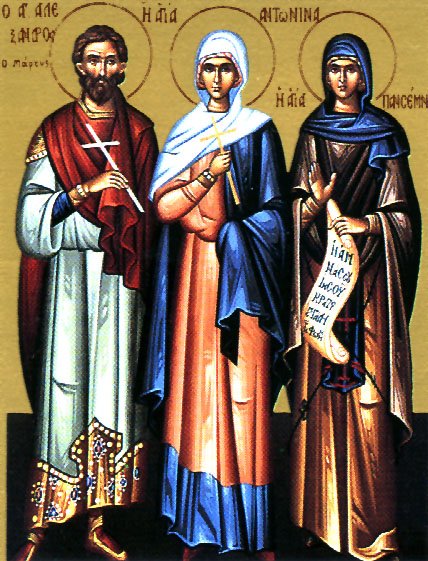
Venerable Theophanes and Saint Pansemne of Antioch
Saint Theophanes of Antioch was the son of pagans. At a youthful age he entered into marriage, but after three years his wife died. Saint Theophanes then came to believe in Christ and accepted Baptism. He gave up everything and began to live beyond the city in a manner of self-denial. He zealously taught the keeping of the commandments of God to everyone who came to him.
Saint Theophanes of Antioch was the son of pagans. At a youthful age he entered into marriage, but after three years his wife died. Saint Theophanes then came to believe in Christ and accepted Baptism. He gave up everything and began to live beyond the city in a manner of self-denial. He zealously taught the keeping of the commandments of God to everyone who came to him. He exhorted people to lead a pure and chaste life, and he condemned the debauchery of the people of Antioch. When Saint Theophanes learned about a certain profligate woman, Pansemne, who was caught up in the snares of the devil, he wanted to save her. Knowing how difficult it would be to fulfill such an intention, and conscious of his own infirmity, Saint Theophanes prayed and he besought the Lord to help him save the sinful woman.
Finally, the saint dressed up in fine clothing, took along much gold and then went to Pansemne. The monk gave her the gold and he asked her to forsake the dissolute life to marry him. Pansemne happily consented and gave him her word to become his wife. The sole condition which Saint Theophanes set for Pansemne was that she should accept Baptism. Because of the attractive marriage offer, Pansemne consented. In preparing her to accept Baptism, Saint Theophanes instructed her in the Christian Faith. He explained that the truth of God does not tolerate sin and corruption, but that the love of God is gracious to those that repent.
Having accepted Baptism, Saint Pansemne by the grace of God was completely reborn as a person. She distributed all the riches that she had acquired through profligacy, and she settled into a hut beside the cell of the monk and began to live the life of an ascetic. After 22 months she died on the very same day as the monk (+ 369).
Troparion - Tone 8
By a flood of tears you made the desert fertile, / and your longing for God brought forth fruits in abundance. / By the radiance of miracles you illumined the whole universe! / O holy Theophanes and Pansemne, pray to Christ our God to save our souls!
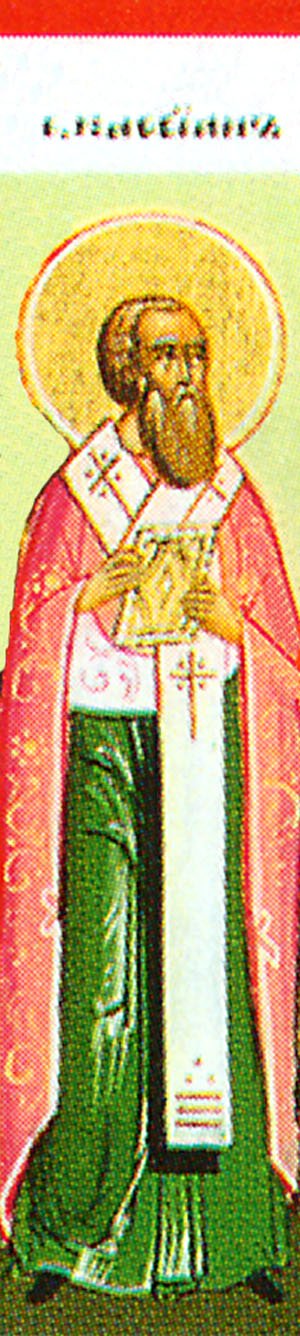
Saint Bassianus, Bishop of Lodi in Liguria
Saint Bassianus, Bishop of Lodi, 1 was a friend of Saint Ambrose, Bishop of Milan (December 7, 397). Bassianus's father ruled the territory of Syracuse (Sicily) and was preparing his son to succeed him. He sent him to Rome to receive an education. Saint Bassianus had heard about Christians even in his childhood, and he wanted to know them and to become acquainted with the Christian Faith.
Saint Bassianus, Bishop of Lodi, 1 was a friend of Saint Ambrose, Bishop of Milan (December 7, 397). Bassianus's father ruled the territory of Syracuse (Sicily) and was preparing his son to succeed him. He sent him to Rome to receive an education. Saint Bassianus had heard about Christians even in his childhood, and he wanted to know them and to become acquainted with the Christian Faith. The presbyter Gordian revealed to him the essence of Christ's teaching, and the young man wished to be baptized. During his Baptism Saint Bassianus saw an Angel at the font holding a garment, which he was to put on. The Saint made bold to ask who he was and where he came from. The Angel replied that he had been sent long ago to help him fulfill his holy intention to know Christ, and then he became invisible.
Saint Bassianus started leading a strict life, eating little food, and spending his nights in prayer. His servants were amazed at such abstinence and guessed that their master had become a Christian. They reported this to Saint Bassianus's father, who ordered him to be returned to Syracuse. Praying in the church of Saint John the Theologian, Bassianus had a vision in which the Apostle commanded him to depart from Rome. He distributed his property to the poor and, together with a faithful Christian slave, he went to Ravenna, to his relative, the Hierarch Ursus.
Bishop Ursus settled him in a secluded place outside the city, in the church dedicated to the Hieromartyr Apollinarius. Saint Bassianus apidly grew spiritually, and soon became renowned for working miracles. At this time, the judge of Ravenna was slandered and sentenced to death. On the way to his execution, he prayed to Saint Bassianus for help.
Bishop Ursus settled him in a secluded place outside the city, in the church dedicated to the Hieromartyr Apollinarius. Saint Bassianus apidly grew spiritually, and soon became renowned for working miracles. At this time, the judge of Ravenna was slandered and sentenced to death. On the way to his execution, he prayed to Saint Bassianus for help. When the executioner raised the sword above his head, the sword was suddenly knocked from his hands and flew to the side. This was repeated three times. The same thing happened to the other executioner. The Emperor was informed about what had occurred, and he he released the judge, who said that he had been saved by the intercession of Saint Bassianus.
The inhabitants of the city, believing that the prayers of Saint Bassianus were powerful before God, asked Bishop Ursus to ordain him to the dignity of presbyter. After the repose of the bishop of the city of Lodi the presbyter Clement of the cathedral church had a revelation – to choose Saint Bassianus as Bishop of Lodi The consecration was performed by Saint Ambrose of Milan, and Bishop Ursus of Ravenna.
Saint Bassianus taught people not only by his words, but also by his example, showing his flock the model of a virtuous life. In Lodi he built a beautiful church in honor of the Holy Apostles. Saint Bassianus often exchanged letters with Saint Ambrose of Milan, and he was present at the blessed repose of that Saint, and buried his body.
Saint Bassianus reposed peacefully in the year 409, after serving in the rank of Bishop for 35 years.
In the West, Saint Bassianus is commemorated on January 19.
1 Lavdia; in Liguria, northern Italy.
Troparion - Tone 4
The truth of things revealed you to your flock as a rule of faith, / a model of meekness, and a teacher of temperance. / Therefore, through humility, you attained the heights; / and through poverty, riches. / O Hierarch Bassianus our Father, entreat Christ God that our souls may be saved.
Synaxis of the Saints of Ryzan
Basil : Bishop +1295. April 12, May 21, July 3, Sunday of all Saints.
Boris : (Roman in Baptism), prince and passion-bearer. Commemorated on May 2 (translation of relics) and July 24 (+ 1015).
Constantine (Yaroslav Svyatoslavich of Murom), prince & wonderworker. Commemorated on May 21 (+ 1129).
Febronia (Euphrosynē in monasticism).
Basil : Bishop +1295. April 12, May 21, July 3, Sunday of all Saints.
Boris : (Roman in Baptism), prince and passion-bearer. Commemorated on May 2 (translation of relics) and July 24 (+ 1015).
Constantine (Yaroslav Svyatoslavich of Murom), prince & wonderworker. Commemorated on May 21 (+ 1129).
Febronia (Euphrosynē in monasticism). June 25, 1228.
Gleb : (David in Baptism), prince and passion-bearer. Commemorated on May 2 (translation of relics), July 24, September 5 (martyrdom).
Metropolitan Jonah of Kiev & Moscow (+ 1461), Wonderworker. March 31, May 27 (translation of relics in 1472), June 15.
Juliana of Lazarevo January 2.
Michael of Murom , prince. He was the son of Constantine of Murom. Commemorated on May 21.
Peter (David in monasticism), prince & wonderworker. Commemorated on June 25 (+ 1228).
Roman Olegovich , prince & martyr. Commemorated on July 19 (+ 1270).
Theodore of Murom , prince and wonderworker, the son of Constantine of Murom. May 21.
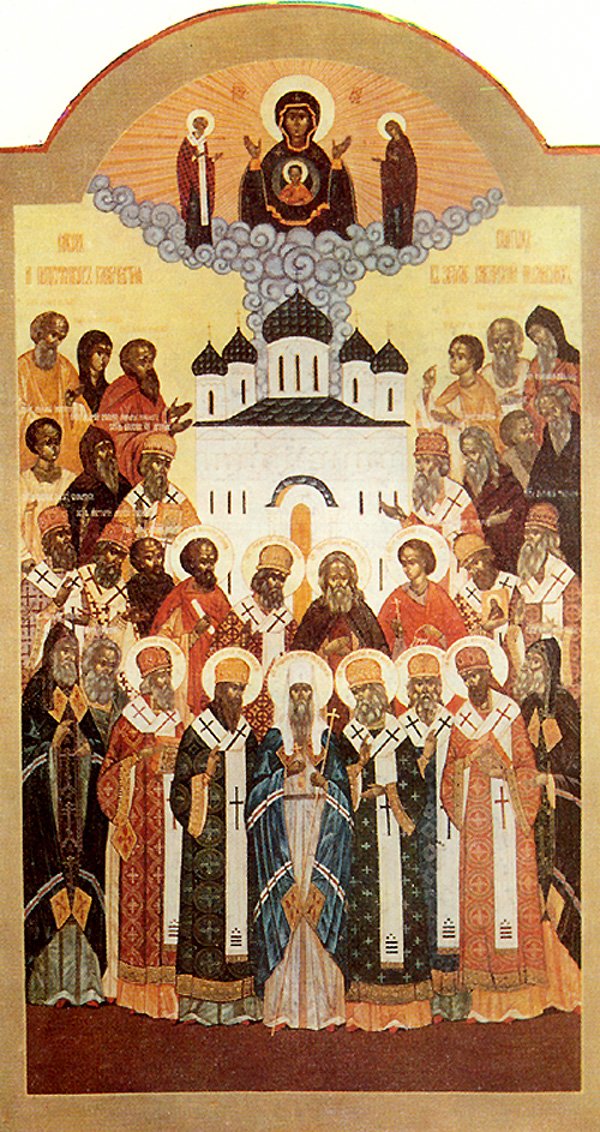
Synaxis of the Saints of Siberia
Andrew, Igumen of Raphael (Tobolsk). He is commemorated on May 14 (+ 1820)
Anthony, Metropolitan of Tobolsk . He is commemorated on March 27. (+ 1740)
Arethas of Valaam & Verkhoturye . He is commemorated on May 15 (+ 1910)
Barlaam, Archbishop of Tobolsk . He is commemorated on December 27 (+ 1802)
Barlaam, desert-dweller of Chikoysk .
Andrew, Igumen of Raphael (Tobolsk). He is commemorated on May 14 (+ 1820)
Anthony, Metropolitan of Tobolsk . He is commemorated on March 27. (+ 1740)
Arethas of Valaam & Verkhoturye . He is commemorated on May 15 (+ 1910)
Barlaam, Archbishop of Tobolsk . He is commemorated on December 27 (+ 1802)
Barlaam, desert-dweller of Chikoysk . He is commemorated on October 5 (+ 1846)
Basil of Mangazea . He is commemorated on March 22 (+1602), May 10 (Translation of his relics in 1670), May 23 (All Saints of Rostov and of Yaroslavl).
Cosmas of Verkhoturye . He is commemorated on November 1 (+ 1706)
Daniel of Achinsk . He is commemorated on April 15 (+ 1843)
Demetrius, Metropolitan of Rostov . He is commemorated on October 28 (+1709) and on September 21 (The uncovering of his relics in 1752)
Domna of Tomsk, Eldress, fool-for-Christ . She is commemorated on December 16 (+ 1872)
Gerasimus, Bishop of Astrakhan and Enotaeva . He is commemorated on June 24 (+1880)
Herman of Alaska . He is commemorated on December 13 (+ 1837) and on July 27/Aug. 9 (His Glorification in 1970)
Innocent, first Bishop of Irkutsk . He is commemorated on November 26 (+ 1731) and on February 9 (The uncovering of his relics in 1805)
Innocent, Metropolitan of Moscow, Enlightener of Alaska & Siberia . He is commemorated on March 31 (+ 1879), on Sept. 23 /Oct. 6 (His glorification in 1977), and on the Sunday before August 26 (All Saints of Moscow)
John, Metropolitan of Tobolsk, wonderworker . He is commemorated on June 10 (+ 1715)
John of Verkhoturye, fool-for-Christ . He is commemorated on April 16 (+ 1701)
Macarius of Altai . He is commemorated on May 16 (+ 1847)
Meletius, Bishop of Kharkov . He is commemorated on February 12 (+ 1840)
Meletius, Bishop of Ryazan . He is commemorated on January 14 (+ 1900)
Misael of Abalatsk, Hieromonk . He is commemorated on December 17 (+ 1797)
Nectarius, Archbishop of Tobolsk . (+ 1666)
Peter, Metropolitan of Tobolsk . He is commemorated on March 4 (+ 1820)
Philaret, Metropolitan of Kiev . He is commemorated on December 2 (+ 1857)
Philotheus, Metropoltian of Tobolsk . He is commemorated on May 31 (+ 1727)
Simeon, Metropolitan of Smolensk . He is commemorated on January 4 (+ 1699)
Simeon of Verkhoturye . He is commemorated on September 12 (The transfer of his relics in 1704), and on December 18 (His glorification in 1694)
Sinesius of Irkutsk . He is commemorated on May 10 (+ 1787)
Sophronius, Bishop & wonderworker of Smolensk . He is commemorated on March 30 (+ 1771) and on June 30 (His glorification in 1918)
Stephen of Omsk . He is commemorated on June 30 (+ 1876)
Theodore Kuzmich, Elder of Tomsk . He is commemorated on January 20 (+ 1864)
Saint Neaniskos the Martyr
Saint Neaniskos lived in the time of Maximius, the ruler of Alexandria. During the persecution of the Church by Emperor Diocletian (284-304), a female slave denounced the most wise and handsome athlete of Christ. The ruler tortured him for seven days in various ways, trying to make him deny Christ. When the tyrant saw that he was unable to do so, he ordered him to be put to death.
Saint Neaniskos lived in the time of Maximius, the ruler of Alexandria. During the persecution of the Church by Emperor Diocletian (284-304), a female slave denounced the most wise and handsome athlete of Christ. The ruler tortured him for seven days in various ways, trying to make him deny Christ. When the tyrant saw that he was unable to do so, he ordered him to be put to death.
As he was led to the place of execution, he noticed the slave girl who betrayed him in the crowd that had followed him. Then Saint Neaniskos made signs for her to approach him, and when she came near he gave her his gold ring as a token of his gratitude; because by her complaint he would now draw near to Christ, Whom he had desired for so long, and he would inherit everlasting life. When they arrived at the place of execution, he prayed for a time, and then they beheaded him.
Troparion - Tone 3
Your holy martyr Neaniskos, O Lord, / through his sufferings has received an incorruptible crown from You, our God. / For having Your strength, he laid low his adversaries, / and shattered the powerless boldness of demons. / Through his intercessions, save our souls!
Scripture Readings
☩Epistle
Romans 4:13-25
13
For the promise, that he should be the heir of the world, was not to Abraham, or to his seed, through the law, but through the righteousness of faith.
14
For if they which are of the law be heirs, faith is made void, and the promise made of none effect:
15
Because the law worketh wrath: for where no law is, there is no transgression.
16
Therefore it is of faith, that it might be by grace; to the end the promise might be sure to all the seed; not to that only which is of the law, but to that also which is of the faith of Abraham; who is the father of us all,
17
(As it is written, I have made thee a father of many nations,) before him whom he believed, even God, who quickeneth the dead, and calleth those things which be not as though they were.
18
Who against hope believed in hope, that he might become the father of many nations; according to that which was spoken, So shall thy seed be.
19
And being not weak in faith, he considered not his own body now dead, when he was about an hundred years old, neither yet the deadness of Sara’s womb:
20
He staggered not at the promise of God through unbelief; but was strong in faith, giving glory to God;
21
And being fully persuaded that, what he had promised, he was able also to perform.
22
And therefore it was imputed to him for righteousness.
23
Now it was not written for his sake alone, that it was imputed to him;
24
But for us also, to whom it shall be imputed, if we believe on him that raised up Jesus our Lord from the dead;
25
Who was delivered for our offences, and was raised again for our justification.
☩Gospel
Matthew 7:21-23
21
Not every one that saith unto me, Lord, Lord, shall enter into the kingdom of heaven; but he that doeth the will of my Father which is in heaven.
22
Many will say to me in that day, Lord, Lord, have we not prophesied in thy name? and in thy name have cast out devils? and in thy name done many wonderful works?
23
And then will I profess unto them, I never knew you: depart from me, ye that work iniquity.
Liturgical data sourced from OCA.org and orthocal.info