Fasting Rules

Meat not allowed Meat Abstain
Fish not allowed Fish Abstain
Dairy not allowed Dairy Abstain
Oil not allowed Oil Abstain
Wine not allowed Wine Abstain

Saints & Commemorations

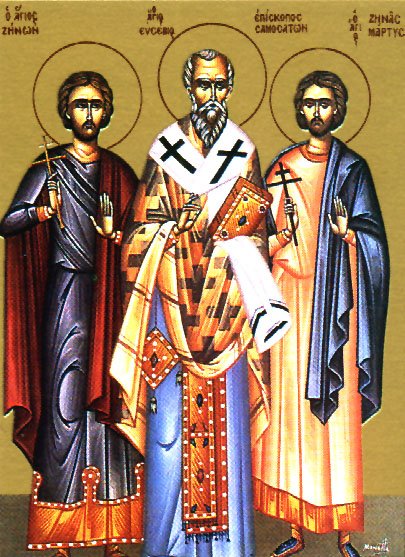
Hieromartyr Eusebius, Bishop of Samosata

Hieromartyr Eusebius, Bishop of Samosata

The Hieromartyr Eusebios (his name means pious) the Bishop of Samosata, stood firmly for the Orthodox Confession of Faith, proclaimed at the First Ecumenical Synod at Nicea in the year 325. Therefore, he suffered persecution by the Arians, and was repeatedly deprived of his See and banished. Emperor Constantius (337-361), who supported the Arians, learned that Saint Eusebios kept a conciliar decree regarding the election of the Orthodox Archbishop Meletios (February 12) to the See of Antioch. The Hieromartyr Eusebios (his name means pious) the Bishop of Samosata, stood firmly for the Orthodox Confession of Faith, proclaimed at the First Ecumenical Synod at Nicea in the year 325. Therefore, he suffered persecution by the Arians, and was repeatedly deprived of his See and banished. Emperor Constantius (337-361), who supported the Arians, learned that Saint Eusebios kept a conciliar decree regarding the election of the Orthodox Archbishop Meletios (February 12) to the See of Antioch. He was ordered to surrender the decree, but the Saint boldly refused to obey him. The enraged Emperor sent a message that if he did not surrender the decree, then his right hand would be cut off. Saint Eusebios stretched forth both hands to the emissary saying, “Cut them off, but I will not give up the conciliar decree, which denounces the wickedness and iniquity of the Arians.” Emperor Constantius marveled at the hierarch's audacity, but did not harm him. During the reign of Emperor Julian the Apostate (361-363), even more difficult times ensued, and an open persecution against Christians began. Saint Eusebios concealed his identity and went about in the garb of a soldier all across Syria, Phoenicia and Palestine, urging Christians not to abandon the Orthodox Faith. He ordained priests and deacons for the desolated churches, and he consecrated hierarchs who renounced the Arian heresy. After Julian the Apostate’s death, he was succeeded by the devout Emperor Jovian (363-364), during whose reign the persecutions stopped. Returning from exile, Saint Meletios convened a local Council at Antioch in the year 379 on the advice of Saint Eusebios. Twenty-seven hierarchs participated, and the Council reaffirmed the Orthodox teaching of the First Ecumenical Council. The Arians signed the conciliar decree, fearing the steadfast defenders of Orthodoxy: the holy hierarchs Meletios, Eusebios and Pelagios, who had great influence with the Emperor. After Jovian's death, the Arian Valentinian (364-378) came to power. The Orthodox were again subjected to persecution. Saint Meletios was banished to Armenia, Saint Pelagios to Arabia, and Saint Eusebios was condemned to exile in Thrace. After receiving the imperial decree, Saint Eusebios left Samosata by night, in order to prevent tumult among the people who esteemed him. When they learned of the hierarch's departure, the faithful followed after him with tears and begged him to return. The Saint refused the entreaty of those who had come, saying that he had to obey the authorities. The Saint urged his flock to hold fast to Orthodoxy, then blessed them and went to the place of his exile. The Arian Eunomios became Bishop of Samosata, but the people did not accept this heretic. The Orthodox would not go to his church and avoided meeting with him. The heretical Arian perceived that it was impossible to induce the Orthodox flock to follow him. Emperor Gratian (375-383) succeeded to the throne, and all the Orthodox hierarchs who had been banished under the Arians were brought back from exile. Saint Eusebios also returned to Samosata and continued with the task of building up the Church. Along with Saint Meletios, he appointed Orthodox hierarchs and clergy to the Arian parishes. In the year 380 he arrived in the Arian city of Dolikhina to establish the Orthodox Bishop Marinus there. An Arian woman threw a roof tile at the holy hierarch’s head. As he lay dying, Saint Eusebios asked her for wine and begged those around not to harm her. The Saint's body was taken to Samosata and was buried by his flock. The Saint’s nephew Antiokhos succeeded him and the Church of Samosata continued to confess the Orthodox Faith, which was firmly spread by the efforts of the holy Hieromartyr Eusebios

Troparion - Tone 4

By sharing in the ways of the Apostles, / you became a successor to their throne. / Through the practice of virtue, you found the way to divine contemplation, O divinely-inspired one: / by rightly dividing the Word of truth, you defended the Faith, even to the shedding of your blood. / O Hieromartyr Eusebios, entreat Christ God to save our souls.

St Alban, First Martyr of Great Britain (early 3rd c.)
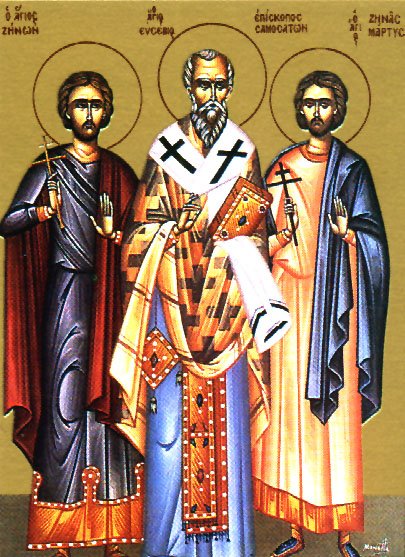
He was a soldier in the Roman army and, according to the venerable Bede, was brought to faith in Christ by a fugitive priest to whom he gave shelter. The saint exchanged clothes with the priest, allowing him to escape and ensuring his own martyrdom. Some writers, including St Bede, place his martyrdom during the reign of Diocletian (286-303). He was a soldier in the Roman army and, according to the venerable Bede, was brought to faith in Christ by a fugitive priest to whom he gave shelter. The saint exchanged clothes with the priest, allowing him to escape and ensuring his own martyrdom. Some writers, including St Bede, place his martyrdom during the reign of Diocletian (286-303). Saint Alban’s tomb was venerated as early as 429 by St Germanus of Auxerre. The town of Verulamium is either his home town or the place of his martyrdom; near it a monastery was founded, around which grew the English town of St Albans.
Martyrs Zeno and his servant, Zenas, of Philadelphia

Martyrs Zeno and his servant, Zenas, of Philadelphia

The Holy Martyrs Zeno and Zenas lived in the Arabian city of Philadelphia, and led a pious life. Saint Zeno possessed a large fortune, but he distributed his substance to the poor and manumitted slaves. Together with his devoted servant Zenas, he went to the governor and urged him to give up idolatry and accept Christ. The Holy Martyrs Zeno and Zenas lived in the Arabian city of Philadelphia, and led a pious life. Saint Zeno possessed a large fortune, but he distributed his substance to the poor and manumitted slaves. Together with his devoted servant Zenas, he went to the governor and urged him to give up idolatry and accept Christ. They were tied to pillars, struck with iron hooks, and their wounds were rubbed with vinegar and salt. Their sides and chests were scorched with fire, they were thrown in a pit, and boiling oil was poured over the sufferers. The saints endured all the tortures with forbearance and by the power of God they remained alive. Finally, the martyrs were beheaded with a sword (+ 304).

Troparion - Tone 4

Your holy martyrs Zeno and Zenas, O Lord, / through their sufferings have received incorruptible crowns from You, our God. / For having Your strength, they laid low their adversaries, / and shattered the powerless boldness of demons. / Through their intercessions, save our souls!
Martyrs Galacteon, Juliana, and Saturninus, of Constantinople

Saint Galacteon was drowned in the sea for confessing faith in Christ. Saint Juliana was burned together with her son Saturninus because they were Christians.

Troparion - Tone 4

Your holy martyrs Galacteon, Juliana, and Saturninus, O Lord, / through their sufferings have received incorruptible crowns from You, our God. / For having Your strength, they laid low their adversaries, / and shattered the powerless boldness of demons. / Through their intercessions, save our souls!

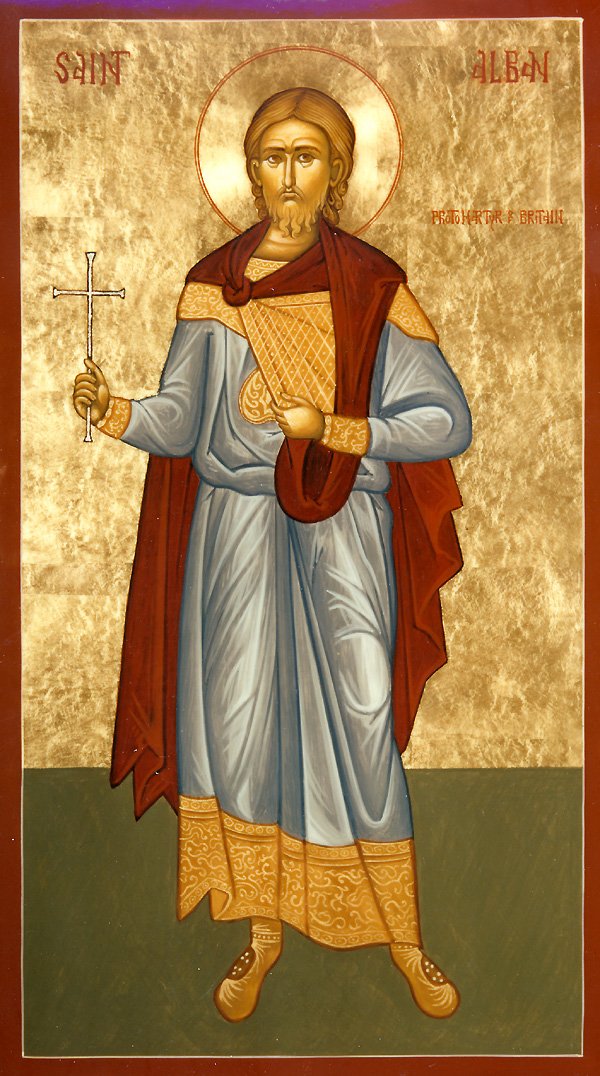
Saint Alban, Protomartyr of Britain

Saint Alban, Protomartyr of Britain

Saint Alban (or Albanus), the protomartyr of Britain, was a Roman citizen who lived at Verulamium (modern Saint Albans), a few miles northwest of London, during a time of persecution. Nothing is known about his family or his occupation. The chief magistrate of the city had orders to arrest all Christian clergy. Saint Alban (or Albanus), the protomartyr of Britain, was a Roman citizen who lived at Verulamium (modern Saint Albans), a few miles northwest of London, during a time of persecution. Nothing is known about his family or his occupation. The chief magistrate of the city had orders to arrest all Christian clergy. One of them, a priest named Amphibalus, fled to Alban’s home in order to hide from the soldiers who wished to kill him. Alban was impressed by the priest’s constant prayer and vigil, and so he questioned Amphibalus about his beliefs. As a result, Alban came to believe in Christ and asked to be baptized. Eventually, Amphibalus was forced to move on, and Alban changed clothes with him so that he could get away. The soldiers heard there was a priest hiding in Alban’s house, so they came to search it. Seeing Alban dressed in the priest’s clothes, they arrested him and brought him before the judge. The magistrate was offering sacrifice to idols when Saint Alban appeared before him. After questioning him, he discovered how Alban and the priest had switched clothes. Furious because Alban had allowed a fugitive to escape, the magistrate threatened him with death unless he returned to paganism and revealed where Amphibalus had gone. Saint Alban replied, “I am also a Christian, and I worship the true God.” After having the saint beaten and tortured, the magistrate threatened him with execution. Saint Alban rejoiced and glorified God. The magistrate ordered the soldiers to take Saint Alban to the Holmhurst Hill to be beheaded. When they came to the river Ver, they saw that the bridge was crowded with people who had come to witness Alban’s martyrdom. Since they could not proceed because of the multitude of people, Saint Alban prayed and made the Sign of the Cross over the river. At once, the waters parted so that they were able to cross over to the other side. The executioner was so astonished by the miracle that he threw down his sword and refused to behead the saint. He was arrested, and another man was found to behead them both. There is a tradition that Saint Alban became thirsty while climbing the hill and asked for water. A small spring gushed forth near the top of the hill, and he was able to drink from it. Pilgrims used to come and drink from Saint Alban’s well, but it is now dry. The date of Saint Alban’s martyrdom is uncertain, but it is believed that it took place during the reign of Decius (ca. 251) or Valerian (ca. 257). The eighteenth century Turin manuscript (which may be based on a fifth century source) suggests that Saint Alban may have been executed as early as 209, when the emperor Septimus Severus and his two sons were in Britain. The name of the executioner who was converted has not been preserved. The priest Amphibalus was ultimately caught and put to death at a place called Redbourn, four miles from Verulamium. When people began to cry out against the magistrate, he put an end to the persecution. In later years a cathedral was built on the site of the martyrdom, and the relics of Saint Alban, the priest Amphibalus, and perhaps even the executioner were enshrined within. Saint Bede (May 27) tells us that miracles frequently took place at Saint Alban’s tomb. When the Danes invaded England in 860, the relics were removed for safekeeping, then later returned. A new chapel and shrine were built for the relics in the early fourteenth century. Two hundred years later, during the dissolution of the monasteries under Henry VIII, the marble shrine was destroyed. Much later, the fragments of the shrine were reassembled on its former site. What happened to the relics is uncertain, but it is probable that they were either destroyed or buried in an unmarked spot. Although Saint Alban is sometimes depicted in military garb, there is no evidence that he was a soldier. After all, he was living in a private home when he was arrested, and not in a barracks. There is a medieval painting in the south aisle beside the Choir in the Abbey which depicts Saint Alban with red hair. A medieval seal, now in the Durham Cathedral Chapter Library, shows him with a thick beard. He is stocky, with a high, round and balding forehead, and a cloak covers his left side and right shoulder.

Troparion - Tone 4

In his struggle your holy martyr Alban, / gained the crown of life, O Christ our God. / For strengthened by you and in purity of heart, / he spoke boldly before the judges of this world, / offering up his head to you, the Judge of all!
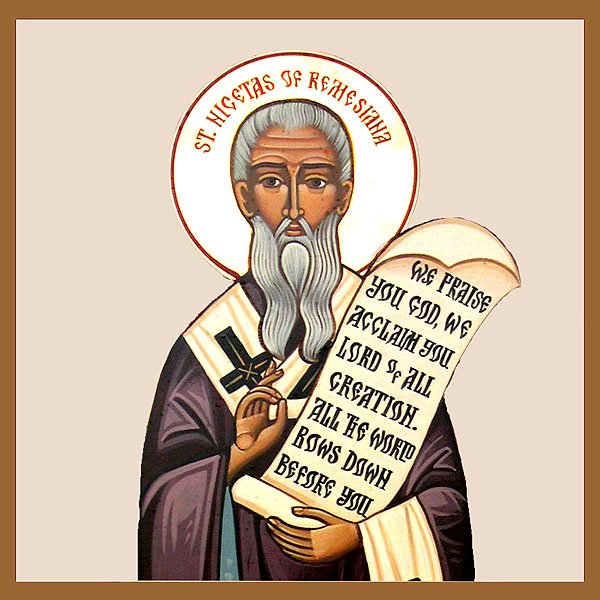
Hieromartyr Nikḗtas of Remesiana

Hieromartyr Nikḗtas of Remesiana

No information on the life of this saint is available at this time.

Troparion - Tone 4

By sharing in the ways of the Apostles, / you became a successor to their throne. / Through the practice of virtue, you found the way to divine contemplation, O inspired one of God; / by teaching the word of truth without error, you defended the Faith, / even to the shedding of your blood. / Hieromartyr Niketas, entreat Christ God to save our souls.

Martyr Nikḗtas the Dacian

No information on the life of this saint is available at this time.

Troparion - Tone 3

Your holy martyr Niketas, O Lord, / through his sufferings has received an incorruptible crown from You, our God. / For having Your strength, he laid low his adversaries, / and shattered the powerless boldness of demons. / Through his intercessions, save our souls!

Saint Gregory, Metropolitan of Wallachia

Saint Gregory (Dascalu) was Metropolitan of Wallachia. St Gregory was glorified by the Romanian Orthodox Church in 2005, and is commemorated on June 22.

Troparion - Tone 4

In truth you were revealed to your flock as a rule of faith, / an image of humility and a teacher of abstinence; / your humility exalted you; / your poverty enriched you. / Hierarch Father Gregory, / entreat Christ our God / that our souls may be saved.

Scripture Readings

Epistle

Romans 9:18-33

18 Therefore hath he mercy on whom he will have mercy, and whom he will he hardeneth.
19 Thou wilt say then unto me, Why doth he yet find fault? For who hath resisted his will?
20 Nay but, O man, who art thou that repliest against God? Shall the thing formed say to him that formed it, Why hast thou made me thus?
21 Hath not the potter power over the clay, of the same lump to make one vessel unto honour, and another unto dishonour?
22 What if God, willing to shew his wrath, and to make his power known, endured with much longsuffering the vessels of wrath fitted to destruction:
23 And that he might make known the riches of his glory on the vessels of mercy, which he had afore prepared unto glory,
24 Even us, whom he hath called, not of the Jews only, but also of the Gentiles?
25 As he saith also in Osee, I will call them my people, which were not my people; and her beloved, which was not beloved.
26 And it shall come to pass, that in the place where it was said unto them, Ye are not my people; there shall they be called the children of the living God.
27 Esaias also crieth concerning Israel, Though the number of the children of Israel be as the sand of the sea, a remnant shall be saved:
28 For he will finish the work, and cut it short in righteousness: because a short work will the Lord make upon the earth.
29 And as Esaias said before, Except the Lord of Sabaoth had left us a seed, we had been as Sodoma, and been made like unto Gomorrha.
30 What shall we say then? That the Gentiles, which followed not after righteousness, have attained to righteousness, even the righteousness which is of faith.
31 But Israel, which followed after the law of righteousness, hath not attained to the law of righteousness.
32 Wherefore? Because they sought it not by faith, but as it were by the works of the law. For they stumbled at that stumblingstone;
33 As it is written, Behold, I lay in Sion a stumblingstone and rock of offence: and whosoever believeth on him shall not be ashamed.

Gospel

Matthew 11:2-15

2 Now when John had heard in the prison the works of Christ, he sent two of his disciples,
3 And said unto him, Art thou he that should come, or do we look for another?
4 Jesus answered and said unto them, Go and shew John again those things which ye do hear and see:
5 The blind receive their sight, and the lame walk, the lepers are cleansed, and the deaf hear, the dead are raised up, and the poor have the gospel preached to them.
6 And blessed is he, whosoever shall not be offended in me.
7 And as they departed, Jesus began to say unto the multitudes concerning John, What went ye out into the wilderness to see? A reed shaken with the wind?
8 But what went ye out for to see? A man clothed in soft raiment? behold, they that wear soft clothing are in kings’ houses.
9 But what went ye out for to see? A prophet? yea, I say unto you, and more than a prophet.
10 For this is he, of whom it is written, Behold, I send my messenger before thy face, which shall prepare thy way before thee.
11 Verily I say unto you, Among them that are born of women there hath not risen a greater than John the Baptist: notwithstanding he that is least in the kingdom of heaven is greater than he.
12 And from the days of John the Baptist until now the kingdom of heaven suffereth violence, and the violent take it by force.
13 For all the prophets and the law prophesied until John.
14 And if ye will receive it, this is Elias, which was for to come.
15 He that hath ears to hear, let him hear.

Liturgical data sourced from OCA.org and orthocal.info