Fasting Rules

Meat not allowed Meat Abstain
Fish not allowed Fish Abstain
Dairy not allowed Dairy Abstain
Oil allowed Oil Allowed
Wine allowed Wine Allowed

Saints & Commemorations
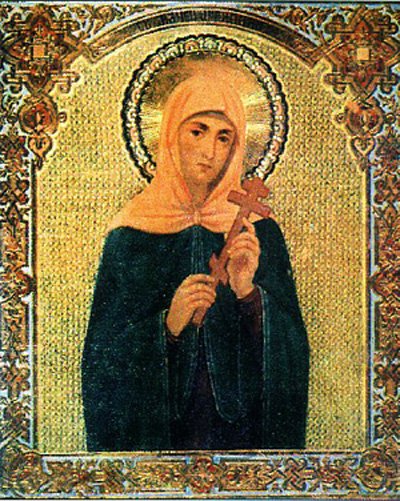
Martyr Agrippina of Rome

Martyr Agrippina of Rome

She lived in virginity in Rome during the reign of Valerian (253-260) — as the Prologue says, ‘expelling the stench of the passions from her heart with the sweet-smelling perfume of purity and chastity.’ She voluntarily presented herself to the pagans and announced herself to be a Christian, for which she was tortured to death. Her f She lived in virginity in Rome during the reign of Valerian (253-260) — as the Prologue says, ‘expelling the stench of the passions from her heart with the sweet-smelling perfume of purity and chastity.’ She voluntarily presented herself to the pagans and announced herself to be a Christian, for which she was tortured to death. Her friends Vassa, Paula and Agathonica took her relics to Sicily for burial. A church was built there in her name, and many miracles were worked there.

Troparion - Tone 4

Your lamb Agrippina calls out to You, O Jesus, in a loud voice: / "I love You, my Bridegroom, and in seeking You I endure suffering. / In baptism I was crucified so that I might reign in You, / and I died so that I might live with You. / Accept me as a pure sacrifice, / for I have offered myself in love." / Through her prayers save our souls, since You are merciful.
Righteous Artemius of Verkola

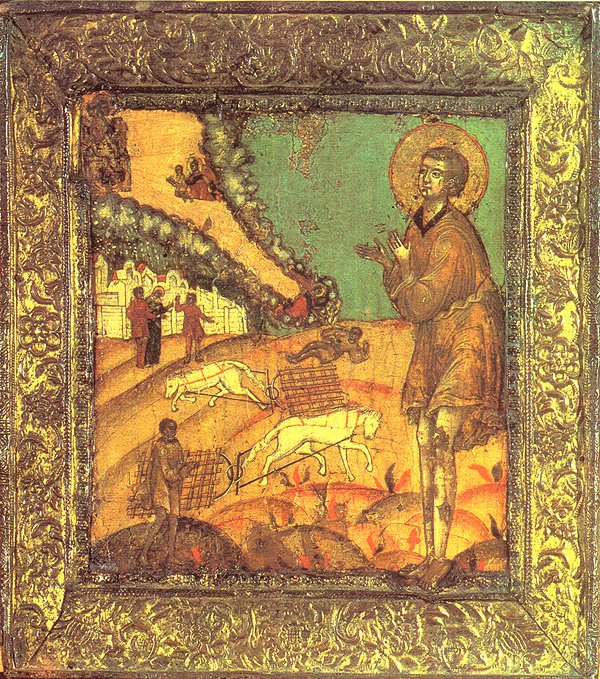
Righteous Artemius of Verkola

Holy Righteous Artemius of Verkola was born in the village of Dvina Verkola around the year 1532. The son of pious parents, Artemius was a child who was courageous, meek and diligent for every good deed. On June 23, 1545 the twelve-year-old Artemius and his father were taken by surprise in a field by a thunderstorm. Holy Righteous Artemius of Verkola was born in the village of Dvina Verkola around the year 1532. The son of pious parents, Artemius was a child who was courageous, meek and diligent for every good deed. On June 23, 1545 the twelve-year-old Artemius and his father were taken by surprise in a field by a thunderstorm. A clap of thunder broke right over their heads, and the child Artemius fell dead. People thought that this was a sign of God’s judgment, therefore they left the body in a pine forest without a funeral, and without burial. Some years later, the village reader beheld a light over the place where the incorrupt body of the Righteous Artemius lay. Taken to the church of Saint Nicholas in 1577, the holy relics were shown to be a source of numerous healings. In this village a monastery was later built, called the Verkola. In 1918, the impious Soviets chopped the holy relics into pieces and threw them into a well. The memory of Saint Artemius is also celebrated on October 20.

Troparion - Tone 2

By the will of the Almighty, Heaven was darkened by a stormcloud, / lightning flashed, and in the threatening sound of thunder, / you surrendered your soul into the hand of God, O most wise Artemios. / And now you stand before the Throne of the Master of all, / speedily granting healing to all who come to you with faith and love, / and entreating Christ God that our souls may be saved.
Second Translation of the relics of Saint Herman, Archbishop of Kazan

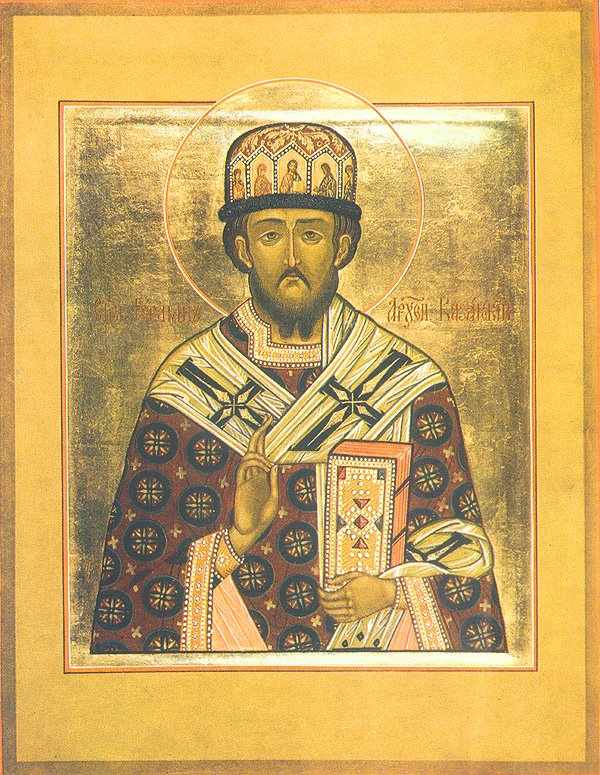
Second Translation of the relics of Saint Herman, Archbishop of Kazan

Today we commemorate the second translation of the relics of Saint Herman, Archbishop of Kazan, in 1714. St Herman is also commemorated on November 6 (his repose) and on September 25 (transfer of his relics in 1595).

Troparion - Tone 4

In truth you were revealed to your flock as a rule of faith, / an image of humility and a teacher of abstinence; / your humility exalted you; / your poverty enriched you. / Hierarch Father Herman, / entreat Christ our God / that our souls may be saved.

Martyrs Eustochius, Gaius, Probus, Lollius, and Urban, of Ancyra

The Holy Martyrs Eustochius, Gaius, Probus, Lollia and Urban suffered for Christ during the time of a persecution under the emperor Maximian (286-310). Saint Eustochius was a pagan priest, but seeing the unyielding courage of the Christian martyrs, and the miracles worked by them, he converted to Christ. The Holy Martyrs Eustochius, Gaius, Probus, Lollia and Urban suffered for Christ during the time of a persecution under the emperor Maximian (286-310). Saint Eustochius was a pagan priest, but seeing the unyielding courage of the Christian martyrs, and the miracles worked by them, he converted to Christ. He went to Bishop Eudoxius of Antioch, was baptized by him, and was ordained to the priesthood. In the city of Lystra Saint Eustochius converted his nephew Gaius and all his household, among which included the children Probus, Lollia and Urban. Soldiers of the emperor arrested Saint Eustochius and took him for trial, but tortures could not turn Eustochius from his faith. They then sent the saint to the governor Agrippinus in the Galatian city of Ancyra. The newly-converted Gaius was also sent with him with his household. All of them, even the women and children, underwent fierce torture, but the martyrs did not deny Christ and so were beheaded.

Troparion - Tone 4

Your holy martyrs O Lord, / through their sufferings have received incorruptible crowns from You, our God. / For having Your strength, they laid low their adversaries, / and shattered the powerless boldness of demons. / Through their intercessions, save our souls!
Synaxis of the Saints of Vladimir

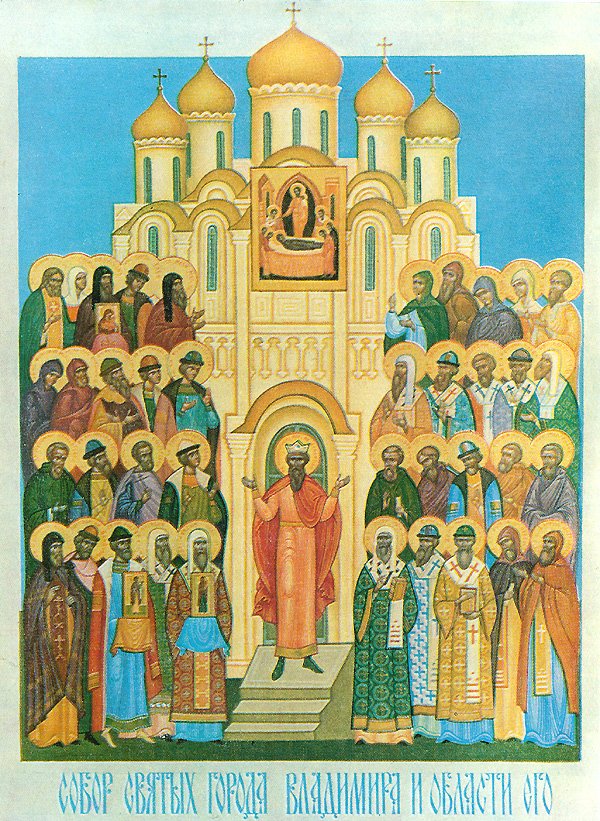
Synaxis of the Saints of Vladimir

The Synaxis of the Saints of Vladimir was established in 1982 with the blessing of Patriarch Pimen on the Feast Day of the Vladimir Icon of the Mother of God. Abram the Bulgarian (+ March 6, 1229) Archbishop Mētrophánēs (+ February 4, 1238) Holy Martyr Patrick (+ 1411) Nikḗtas of Pereyaslavl (+ May 24, 1186) Elijah Muromets of the Caves (+ Decembe The Synaxis of the Saints of Vladimir was established in 1982 with the blessing of Patriarch Pimen on the Feast Day of the Vladimir Icon of the Mother of God. Abram the Bulgarian (+ March 6, 1229) Archbishop Mētrophánēs (+ February 4, 1238) Holy Martyr Patrick (+ 1411) Nikḗtas of Pereyaslavl (+ May 24, 1186) Elijah Muromets of the Caves (+ December 19, 1188) Archimandrite Pakhomios and Igoumen Theodosios (+ 1237) Igoumen Daniel of Uspensk (+ 1238) Michael Vepizhnik (+ 1333) Sergius of Radonezh (+ September 25, 1392) Roman of Kirzhach (+ July 29, 1392) Pakhomios of Nerekhta (+ May 15, 1384) Euthymios of Suzdal (+ April 1, 1404) Stephen of Makhra (+ July 14,1406) Nikon of Radonezh (+ November 17,1426) Kosmas of Yakhroma (+ February 18, 1492) Archimandrite Job of Vladimir (+ XV century) Arkadios of Vyaznikov (+ 1592) Prokhor and Vassian of Zayastrebye (+ 1592) Dionysios of Pereyaslavl (+ April 15, 1645) Lukian of Aleksandrov (+ 1654) Cornelius of Aleksandrov (+ 1681) Zosima of Aleksandrov (+ circa 1713) Maria (Martha in monasticism) (+ 1206) Theodosia (monastic name: Euphrosyne) (+ May 4, 1244) Euphrosynē of Suzdal (+ September 1250) Vassa (in the monastery of Theodore) Nizhny Novgorod (+ 1378) Sophia of Suzdal (+ December 16, 1542) Theodosios of Murom (+ XII century) Maxim of Kiev (+ 1305) Alexei (Byakont) (+ 1378) Jonah of Moscow (+ 1461) Hilarion of Suzdal (+ 1707) Dionysios of Suzdal († June 26,1385) Arsenios of Elasson († 1625) Theodore of Rostov (+ 1023) John of Rostov (+ 1214) Simon of Pechersk (+ 1226) Cyril of Rostov (+ 1262) Serapion of Vladimir (+ 1275) Theodore of Vladimir (+ 1286) Basil of Ryazan (+ 1295) Archbishop Sophronios of Suzdal (+ 1654) Mētrophánēs of Voronezh (+ 1703) Gleb of Murom (+ 1015) Constantine of Murom (+ 1129) Michael and Theodore of Murom (XII century) Boris of Turov (+ circa 1160) Izyaslav Andreevich (+ 1165) Mstislav Iziaslavich (+ 1172) Andrew of Bogolyubovo (+ July 4, 1174) Gleb of Vladimir (+ June 20, 1174) Michael of Vladimir († 1176) Peter of Murom (+ June 25, 1228) Yuri Vsevolodovich (+ February 4, 1238) Basil (Basilko) of Rostov (+ March 4, 1238) Vsevolod Yuriyevich of Vladimir (+ February 4, 1246) Mstislav Yuriyevich (+ February 4, 1238) Vladimir of Vladimir (+ February 4, 1238) Demetrios of Vladimir (+ 1238) Theodore Yaroslavich of Vladimir (+ February 4, 1246) Svyatoslav Vsevolodovich (+ 1253) Alexander Nevsky (+ November 23, 1263) Demetrios Svyatoslavich of Yuryev (+ 1269) Demetrios Aleksandrovich (+ 1294) Theodore of Starodub (+ June 21, 1330) Irene of Murom (+ circa 1129) Febronia of Murom (+ 1228) Agatha, Theodora, Maria and Christina (+ February 4, 1238) Eudokia of Vladimir (+ XIII century) George (+ February, 1238) and Juliana Lazareva of Murom († January 2, 1604) Karp of Medush (+ XVII century) Savva of Moshok (+ 1592) Cyprian of Suzdal (+ 1622) Eudokia of Suzdal (+ 1776) Parthenios of Suzdal (+ second half of the XVI century)

Troparion - Tone 4

Today the chosen city radiantly rejoices with the Most Holy Theotokos, / and the entire land of Vladimir triumphs with them, / celebrating the memory of the great assembly of the Saints glorified by God, / in the contests of the Orthodox from ancient times, / and in the company of those who have pleased God; / with them they cry out with love: / "O wondrous intercessors with Christ God, who have received bright crowns from Him, / beseech Him to grant peace and prosperity to your homeland, / and to our souls great mercy."

Kontakion - Tone 4

As bright stars of the Church of Russia, / shining forth in all the holy lands of Vladimir by your confession of faith, / O divinely-wise Saints: / Orthodox Princes, Venerable Fathers and Mothers, Passion-bearers, and you Righteous: / earnestly entreat Christ God to grant remission of sins to those who lovingly revere your holy memory.
Meeting of the Vladimir Icon of the Mother of God in memory of the Saving of Moscow from the Invasion of Khan Achmed

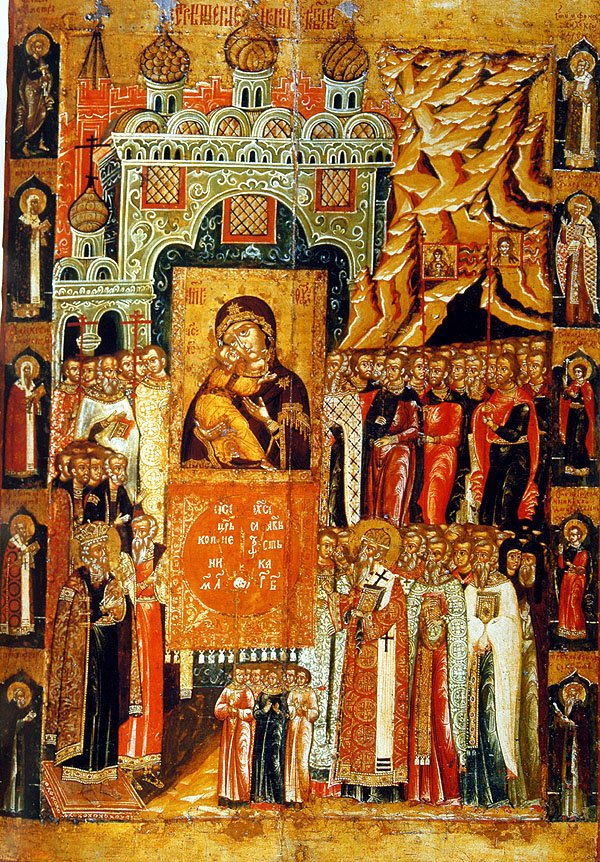
Meeting of the Vladimir Icon of the Mother of God in memory of the Saving of Moscow from the Invasion of Khan Achmed

Today the church celebrates the miracle of the Vladimir Icon of the Mother of God, which led to the saving of Moscow from the invasion of Khan Achmed in 1480. The Vladimir Icon of the Most Holy Theotokos is also commemorated on May 21 and August 26.

Troparion - Tone 4

Today the most glorious city of Moscow rejoices brightly, / like the radiance of the sun, O Sovereign Lady, on receiving your wonderworking Icon, / to which we now come and pray to you, crying out: / "O most wondrous Lady Theotokos, pray to Christ our God, Who was incarnate of you, / that this city and all Christian cities and countries may be preserved unharmed / from all of the Enemy's snares, / and that He may save our souls, for He is merciful."

Kontakion - Tone 8

O Sovereign Lady, / defend all who are in danger and misfortune / or weak from many sins, / and who stand before your holy Icon / praying with tears, humility, repentance, and invincible hope, / free them from every evil, / give them the grace they need, / and save us all, O Virgin Theotokos, / for You are the divine refuge of those who follow you.
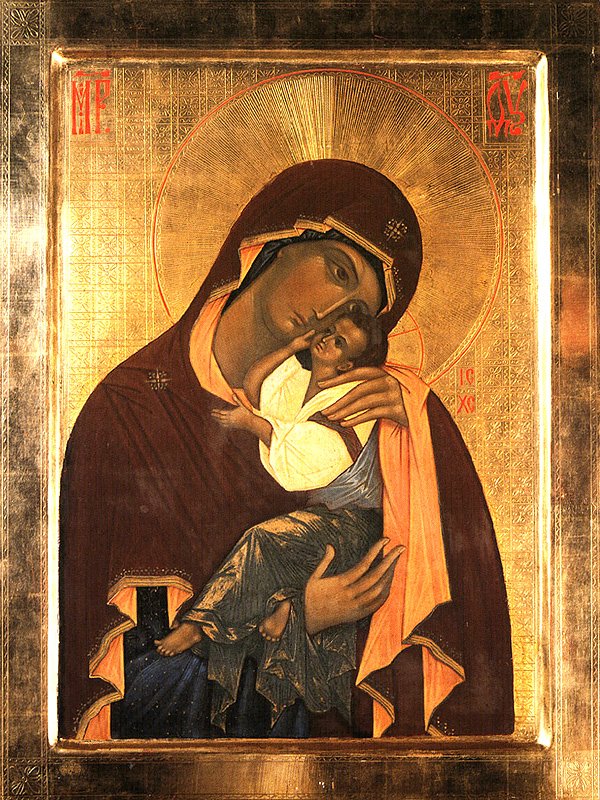
“Tenderness” Icon of the Mother of God of the Pskov Caves

“Tenderness” Icon of the Mother of God of the Pskov Caves

According to Tradition, a copy of the Vladimir Icon of the Mother of God was painted in 1521 by the devout Hieromonk Arsenios Khitrosh. Between 1529-1570 the Icon was brought to the Pskov Caves Monastery by the merchants Basil and Theodore, when Saint Cornelius († February 20, 1571) was the Igoumen. S According to Tradition, a copy of the Vladimir Icon of the Mother of God was painted in 1521 by the devout Hieromonk Arsenios Khitrosh. Between 1529-1570 the Icon was brought to the Pskov Caves Monastery by the merchants Basil and Theodore, when Saint Cornelius († February 20, 1571) was the Igoumen. Since then, the Icon has repeatedly shown its mercy and miraculous assistance to the Russian Orthodox people. Not just once have blind persons been cured while praying before the Icon. On May 28, 1587, when the Icon was in Pskov, Maria Terent'eva, a widow who was blind for about three years, was healed after she prayed before the Tenderness Icon in Holy Trinity Cathedral. Another miracle occurred on March 26, 1603, when the peasant Patapios Grigor'ev was cured after six years of blindness. At the same time, Ivan Supitsyn, a young man from a noble family, was healed of his ailment: the muscles of his left hand had been paralyzed for two years. An ancient chronicle of the Monastery says: "Not only are the Orthodox healed by the Mother of God, but even non-believers, who come to the Most Pure Theotokos and to her wonderworking Icon with faith." The Pskov Caves Tenderness Icon of the Mother of God was especially venerated during the reign of Ivan the Terrible in 1581, when Pskov and the Pskov Caves Monastery were besieged by the army of the Polish king Stephen Bathory. Several days before the siege, the Mother of God appeared to the pious Elder Father Dorótheos. The Most Holy Theotokos warned him of the impending disaster and explained that the people's sins were the cause of the misfortune which had befallen them, and told him how they might escape it. Then the Archbishop summoned Igoumen Tikhon of the Pskov Caves Monastery and ordered him to take the wonderworking Dormition (August 15) and Tenderness (June 23) Icons from the Caves, and to serve Molebens in the places which the Mother of God herself had chosen at the time of her appearance. Stephen Bathory's 100,000 man army went to Pskov, because if he succeeded there, the king planned to go even farther in order to conquer Novgorod and Moscow. The wonderworking Tenderness Icon was brought from the Monastery to the city of Pskov. The Polish army shelled the city and the Monastery with heated cannonballs from the bell tower of Mirozh Monastery. One of the cannonballs struck the Icon of the Mother of God, which was in an opening of the wall, but it did not harm the Icon, nor the people who stood around it. The siege lasted for five months, and thirty times the Poles attempted to take Pskov, but they were unable to do so. At the beginning of the XVII century the Monastery was attacked by several armies of Swedish, Lithuanian, and Polish invaders. In 1812 the French army threatened Russia. Napoleon's soldiers captured Polotsk on August 17-18, 1812, and the city of Pskov was endangered as well. The citizens asked for the Tenderness and Dormition Icons of the Mother of God to be brought from the Monastery, and also a banner depicting the Icon Not-made-by-hands. On October 7, a procession with the miraculous icons went through the city, and that very day the Russian army retook the city of Polotsk. A church in honor of Holy Archangel Michael was built there (1815-1827) to commemorate the event, and the Tenderness Icon of the Mother of God is kept there now. In the XX century the Pskov Caves Monastery had to endure two World Wars. But the ancient traditions faithfully preserved in the Monastery were not forgotten, even at that difficult time for Russian monasticism. On February 2, 1920, the Monastery and the city of Pechora were annexed to the territory of Estonia until 1940. For that reason, the Holy Dormition Pskov Caves Monastery was not subjected to ruin or desecration during the Soviet anti-Christian campaign. The Pskov Caves Monastery was one of few XX century Russian Orthodox monasteries which did not cease its prayerful service to God. Although neither the revolution nor the wars spared the Monastery (in May 1945 it lay in ruins), work and the prayer of the monastic brethren overcame further devastation, and again restored the Monastery to its beauty and splendor. The Pskov Caves Tenderness Icon of the Mother of God belongs to the iconographic type "Eleousa," which comes from the Greek word for mercy. The Theotokos is depicted holding the Child Christ in her right hand, with His cheek pressed to hers. On the Eleousa Icons of the Theotokos (the symbol and ideal of the human race) there is no distance between the Virgin and the Son of God, their love is boundless. The Icon is a prototype of Christ's sacrifice on the Cross, as the highest expression of God's love for His people. The Pskov Caves Tenderness Icon is commemorated on the following days: May 21 (Meeting of the Vladimir Icon, 1521); August 26 (Meeting of the Vladimir Icon, 1395); June 23 (Main Feast Day); October 7 (Procession around Pskov with the Tenderness and Dormition icons of the Mother of God, 1812); and on the Seventh Sunday of Pascha, the Holy Fathers of the First Ecumenical Synod (Movable Feast).

Troparion - Tone 4

Let all of us, who are burdened with sins, fall on our knees before the Theotokos, / bowing before her wonderworking Tenderness Icon, / kissing it and crying aloud with tears: / “O Sovereign Lady, accept the prayer of your unworthy servants, / and grant to us who ask, your great mercy.”

Kontakion - Tone 6

We have no other help, we have no other hope but you, O Lady. / Help us, for in you do we hope, / and of you do we boast, for we are your servants. / Let us not be put to shame.

Nikḗtas of Thebes and those with him

Saint Nikḗtas of Thebes was a resident of the seven-gated (Επτάπυλη) city of Thebes in Boetia. At the age of sixteen, he was tonsured as a monk, and other ascetics were drawn to him by reports of his spiritual character and moral purity. Among these were the monks Daniel, Theodore, and Gregory. The Vene Saint Nikḗtas of Thebes was a resident of the seven-gated (Επτάπυλη) city of Thebes in Boetia. At the age of sixteen, he was tonsured as a monk, and other ascetics were drawn to him by reports of his spiritual character and moral purity. Among these were the monks Daniel, Theodore, and Gregory. The Venerable Nikḗtas was deemed worthy of the charism of working miracles. He reposed in the Lord, full of days, in the year 1079. In the Life of Saint Nikḗtas it is said that he once traveled to Patras, where he met Saint Daniel, a great ascetic and a man of prayer. He had received from God the gift of hospitality, like that of Abraham; that is, to receive people, offering them rest by giving them spiritual guidance.

Saint Etheldreda of Ely

No information available at this time.

Troparion - Tone 8

In you, O Mother, was preserved with exactness what is according to the image; / for you took up the Cross and followed Christ. / By so doing, you taught us to disregard the flesh, for it passes away; / but to care for the soul, since it is immortal. / Therefore, O Venerable Etheldreda, your spirit rejoices with the Angels.

Úglich Portaίtissa (Gatekeeper) Icon of the Mother of God

Moscow was besieged by the Tartar king Ahmet. Prince Ivan Vasillievich brought troops to defend the city, but they were far outnumbered by the Tartar forces. Despairing of their hope in human protection, the people of the city pleaded for deliverance to the holy Mother of God before her icon. The Tartar forces were unaccountably struck with terror, and retreated in confusion, saving the city. Moscow was besieged by the Tartar king Ahmet. Prince Ivan Vasillievich brought troops to defend the city, but they were far outnumbered by the Tartar forces. Despairing of their hope in human protection, the people of the city pleaded for deliverance to the holy Mother of God before her icon. The Tartar forces were unaccountably struck with terror, and retreated in confusion, saving the city. On this day, the miracle, and the holy icon through which it was brought about, is commemorated in Russia.

Scripture Readings

Epistle

Romans 10:11-11:2

11 For the scripture saith, Whosoever believeth on him shall not be ashamed.
12 For there is no difference between the Jew and the Greek: for the same Lord over all is rich unto all that call upon him.
13 For whosoever shall call upon the name of the Lord shall be saved.
14 How then shall they call on him in whom they have not believed? and how shall they believe in him of whom they have not heard? and how shall they hear without a preacher?
15 And how shall they preach, except they be sent? as it is written, How beautiful are the feet of them that preach the gospel of peace, and bring glad tidings of good things!
16 But they have not all obeyed the gospel. For Esaias saith, Lord, who hath believed our report?
17 So then faith cometh by hearing, and hearing by the word of God.
18 But I say, Have they not heard? Yes verily, their sound went into all the earth, and their words unto the ends of the world.
19 But I say, Did not Israel know? First Moses saith, I will provoke you to jealousy by them that are no people, and by a foolish nation I will anger you.
20 But Esaias is very bold, and saith, I was found of them that sought me not; I was made manifest unto them that asked not after me.
21 But to Israel he saith, All day long I have stretched forth my hands unto a disobedient and gainsaying people.
1 I say then, Hath God cast away his people? God forbid. For I also am an Israelite, of the seed of Abraham, of the tribe of Benjamin.
2 God hath not cast away his people which he foreknew. Wot ye not what the scripture saith of Elias? how he maketh intercession to God against Israel, saying,

Gospel

Matthew 11:16-20

16 But whereunto shall I liken this generation? It is like unto children sitting in the markets, and calling unto their fellows,
17 And saying, We have piped unto you, and ye have not danced; we have mourned unto you, and ye have not lamented.
18 For John came neither eating nor drinking, and they say, He hath a devil.
19 The Son of man came eating and drinking, and they say, Behold a man gluttonous, and a winebibber, a friend of publicans and sinners. But wisdom is justified of her children.
20 Then began he to upbraid the cities wherein most of his mighty works were done, because they repented not:

Liturgical data sourced from OCA.org and orthocal.info