Fasting Rules

Meat not allowed Meat Abstain
Fish allowed Fish Allowed
Dairy not allowed Dairy Abstain
Oil allowed Oil Allowed
Wine allowed Wine Allowed

Saints & Commemorations
Nativity of the Holy Glorious Prophet, Forerunner and Baptist, John

Nativity of the Holy Glorious Prophet, Forerunner and Baptist, John

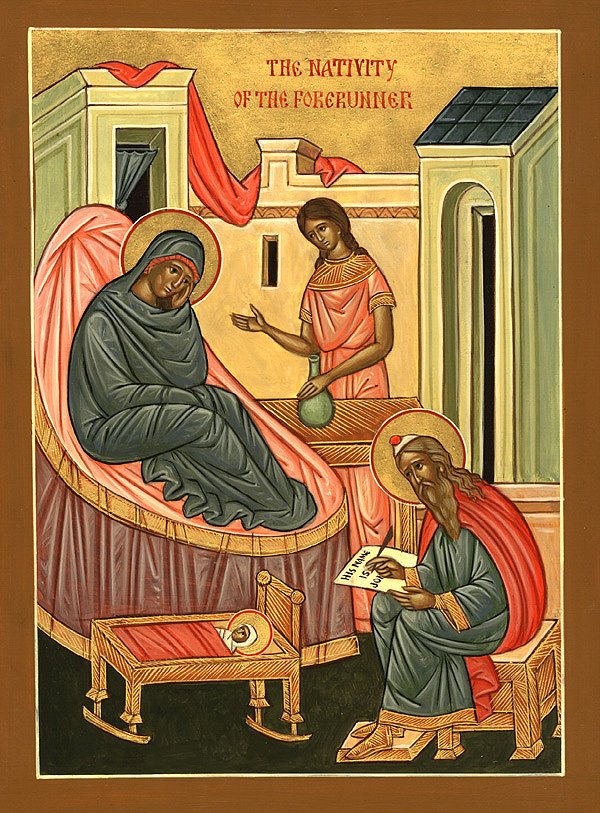
The Nativity of the Holy Forerunner and Baptist of the Lord, John: The Gospel (Luke. 1: 5) relates that the righteous parents of Saint John the Baptist, the Priest Zachariah and Elizabeth (September 5), lived in the ancient city of Hebron. They reached old age without having children, since Elizabeth was barren. The Nativity of the Holy Forerunner and Baptist of the Lord, John: The Gospel (Luke. 1: 5) relates that the righteous parents of Saint John the Baptist, the Priest Zachariah and Elizabeth (September 5), lived in the ancient city of Hebron. They reached old age without having children, since Elizabeth was barren. Once, Saint Zachariah was serving in the Temple at Jerusalem and saw the Archangel Gabriel, standing on the right side of the altar of incense. He predicted that Saint Zachariah would father a son, who would announce the Savior, the Messiah, awaited by the Old Testament Church. Zachariah was troubled, and fear fell upon him. He had doubts that in old age it was possible to have a son, and he asked for a sign. It was given to him, and it was also a chastisement for his unbelief. Zachariah was struck speechless until the time of the fulfillment of the archangel’s words. Saint Elizabeth came to be with child, and fearing derision at being pregnant so late in life, she kept it secret for five months. Then her relative, the Virgin Mary, came to share with her Her own joy. Elizabeth, “filled with the Holy Spirit,” was the first to greet the Virgin Mary as the Mother of God. Saint John leaped in his mother’s womb at the visit of the Most Holy Virgin Mary and the Son of God incarnate within Her. Soon Saint Elizabeth gave birth to a son, and all the relatives and acquaintances rejoiced together with her. On the eighth day, in accordance with the Law of Moses, he was circumcised and was called John. Everyone was amazed, since no one in the family had this name. When they asked Saint Zachariah about this, he motioned for a tablet and wrote on it: “His name is John.” Immediately his tongue was loosed, and Saint Zachariah glorified God. He also prophesied about the Coming into the world of the Messiah, and of his own son John, the Forerunner of the Lord (Luke. 1: 68-79). After the Nativity of our Lord Jesus Christ and the worship of the shepherds and the Magi, wicked king Herod gave orders to kill all male infants. Hearing about this, Saint Elizabeth fled into the wilderness and hid in a cave. Saint Zachariah was at Jerusalem and was doing his priestly service in the Temple. Herod sent soldiers to him to find out the abode of the infant John and his mother. Zachariah answered that their whereabouts were unknown to him, and he was killed right there in the Temple. Righteous Elizabeth continued to live in the wilderness with her son and she died there. The child John, protected by an angel, dwelt in the wilderness until the time when he came preaching repentance, and was accounted worthy to baptize the Lord.

Troparion - Tone 4

Prophet and Forerunner of the coming of Christ, / although we cannot praise you worthily, / we honor you in love at your nativity, / for by it you ended your father’s silence and your mother’s barrenness, / proclaiming to the world the incarnation of the Son of God!

Kontakion - Tone 3

Today the formerly barren woman gives birth to Christ’s Forerunner, / who is the fulfillment of every prophecy; / for in the Jordan, / when he laid his hand on the One foretold by the prophets, / he was revealed as Prophet, Herald, and Forerunner of God the Word.
Venerable Anthony, Abbot of Dymsk, Novgorod

Venerable Anthony, Abbot of Dymsk, Novgorod

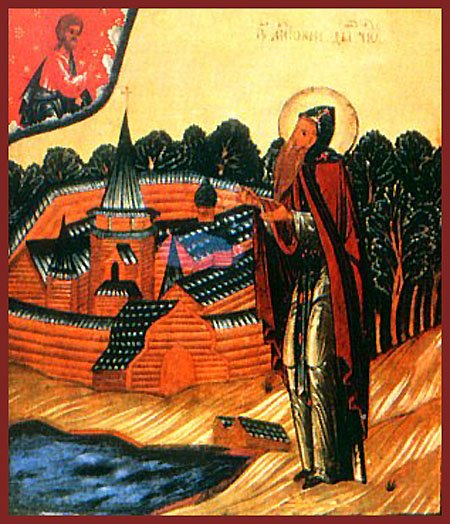
Saint Anthony of Dymsk was born at Novgorod about the year 1157. Once in church he heard the words of Christ: “If anyone would come after Me, let him deny himself and take up his cross and follow Me” (Mt.16:24), the saint resolved to leave the world and receive monastic tonsure under Saint Barlaam of Khutyn (November 6) at his monastery. Wh Saint Anthony of Dymsk was born at Novgorod about the year 1157. Once in church he heard the words of Christ: “If anyone would come after Me, let him deny himself and take up his cross and follow Me” (Mt.16:24), the saint resolved to leave the world and receive monastic tonsure under Saint Barlaam of Khutyn (November 6) at his monastery. When he was dying, Saint Barlaam appointed Saint Anthony as igumen in his place; but Anthony, shunning glory, left the monastery and settled at the shores of Lake Dyma, on the outskirts of the city of Tikhvin. Here he founded a monastery and struggled there until the end of his own life. According to Tradition, Saint Anthony made a journey to Constantinople, and returned to his monastery on the day that the igumen Barlaam died. Saint Anthony fell asleep in the Lord on June 24, 1224. In the year 1330 his relics were found incorrupt, and from that time they were glorified by many miracles. Saint Anthony of Dymsk is also commemorated on January 17.

Troparion - Tone 4

You were a zealot of virtue, a desert dweller, and ascetic of faith in Christ our God, / and by fasting and labors you deadened carnal lusts. / O namesake of Anthony the Great, / you emulated his life and built a divine church in his name; / now together with the venerable Anthony, / beseech the Savior of all, / that He may make us victorious over the lusts of the flesh, / and temples of the Holy Spirit, / according to His great mercy.

Kontakion - Tone 6

You were a peer and emulator of Venerable Barlaam, / and when you attained true obedience to him, you were shown to be worthy of him, / and you shepherded his flock until the time, / when having been zealous for his virtues, you attained the same age; / and loving silence, you were shown to be pleasing to the Lord, / and became the first Superior in the wilderness at Lake Dymsk; / therefore, we cry out to you: / “With Saint Barlaam, O Father Anthony, / entreat God for us, so He may grant us to please Him as you did, / an image of obedience and a zealot for stillness.”

Synaxis of Sts Zacharias and Elisabeth

Righteous Youths John and Jacob (James) of Meniugi

The Righteous Youths James and John of Meniugi were brothers by birth, children of the pious couple Isidore and Barbara. They were killed by miscreants (James at three years of age, and John at five years of age). Between the years 1682-1689 their relics were found incorrupt and were placed in a reliquary at the Trinity church in Meniugi village, The Righteous Youths James and John of Meniugi were brothers by birth, children of the pious couple Isidore and Barbara. They were killed by miscreants (James at three years of age, and John at five years of age). Between the years 1682-1689 their relics were found incorrupt and were placed in a reliquary at the Trinity church in Meniugi village, Novgorod diocese, on the site of the former Trinity monastery.

Seven Martyred Brothers: Orentius, Pharnacius, Eros, Firmus, Firminus, Cyriacus, and Longinus, in Georgia

They were all brothers, soldiers together during the reign of Maximian. During a Roman campaign against the Scythians beyond the Danube, Orentius fought in single combat with Marathom, a Scythian champion like Goliath, and slew him. The Roman commander ordered a sacrifice to the idols in thanksgiving for the victory; but Orentius and his brothers declared that they were Christians and would make no such sacrifice. They were all brothers, soldiers together during the reign of Maximian. During a Roman campaign against the Scythians beyond the Danube, Orentius fought in single combat with Marathom, a Scythian champion like Goliath, and slew him. The Roman commander ordered a sacrifice to the idols in thanksgiving for the victory; but Orentius and his brothers declared that they were Christians and would make no such sacrifice. In a moment, the champion of the battle became a persecuted confessor: without regard for his great victory, he and his brothers were sentenced to exile. All of them died on the way, from hunger or torture.

Troparion - Tone 4

Your holy martyrs, O Lord, / through their sufferings have received an incorruptible crown from You, our God. / For having Your strength, they laid low their adversaries, / and shattered the powerless boldness of demons. / Through their intercessions, save our souls!

Saint Athanasius Parios

Saint Athanasius Parios, the distinguished theologian and great teacher of the Greek nation, was born in the village of Kostos on the island of Paros around 1721—1722. His father, Apostolos Toulios, was from Siphnos, and his mother was a native of Paros. The future saint was a leading member of the Kollyvades movement which began on Mount Athos in the middle of the eighteenth century. T Saint Athanasius Parios, the distinguished theologian and great teacher of the Greek nation, was born in the village of Kostos on the island of Paros around 1721—1722. His father, Apostolos Toulios, was from Siphnos, and his mother was a native of Paros. The future saint was a leading member of the Kollyvades movement which began on Mount Athos in the middle of the eighteenth century. The movement derives its name from the koliva (boiled wheat) which is used during memorial services. Its proponents were Athonite monks who adhered strictly to holy Tradition, and were opposed to unwarranted innovations. They were in favor of the frequent reception of Holy Communion, and they practiced unceasing prayer of the heart. They insisted that memorial services should not be performed on Sundays, because that is the day of the Lord’s Resurrection. In the Orthodox Church Saturday is the usual day for the commemoration of the dead. Saint Athanasius went to Mount Athos in 1752. There he was ordained to the holy priesthood by Saint Macarius of Corinth (April 17), but was forced to leave the Holy Mountain when some of the monks rose in opposition to the Kollyvades. The righteous one was unjustly slandered for his views on frequent Communion and for his opposition to memorial services on Sundays. As the result of personal attacks and intrigues against him, Saint Athanasius was suspended from exercising his priestly office from 1776—1781, and was even accused of being a heretic. When the charges against him were later proven to be absurd and unfounded, his suspension was lifted, and he was restored to his former rank. Saint Athanasius knew and influenced many of his fellow Kollyvades, such as Saint Macarius of Corinth, Saint Nikēphóros of Chios (May 1), Saint Arsenius of Paros (January 31), and Saint Νikόdēmos of the Holy Mountain (July 14). He taught Saint Nikēphóros, and he encouraged Saint Νikόdēmos to publish a collection of the writings of Saint Gregory Palamas (November 14). Unfortunately, his manuscript was lost before it could be printed. After teaching at the Athonias Academy and in Thessalonica, Saint Athanasius journeyed to the island of Chios in 1788, where he taught in the gymnasium for twenty-five years, and also served as Director of schools. He was a leading educator and distinguished theologian who revived the art of eloquent speech on Chios by teaching logic, rhetoric, metaphysics, and theology. His TREATISE ON RHETORIC, an analysis of some of the orations of Demosthenes, was a most influential work. Saint Athanasius wrote many other useful books and treatises on various topics such as A HANDBOOK OF APOLOGETICS, “The Great Blessing of Water,” “On the Second Sunday of Great Lent,” “The Kneeling Prayers on Pentecost,” “On the Holy Icons,” “On Memorial Services,” “On the New Martyrs,” “On the Angels and Divine Beauty,” as well as numerous letters dealing with diverse subjects. His most important book was the EPITOME, which deals with Orthodox dogma. Saint Athanasius was also a prolific writer of saints’ Lives and of liturgical services in their honor. He wrote the lives of Saint Mark the New (June 5) and Saint Macarius of Corinth, among others. He also wrote the Preface for the NEW LEIMONARION (New Spiritual Meadow), a collection of saints’ lives and services begun by Saint Macarius, with additional material contributed by Saint Nikēphóros of Chios and by Saint Athanasius himself. Saint Athanasius retired as Director of schools in 1812, and went to join Saint Nikēphóros at the Hermitage of Saint George at Resta, Chios where he spent his final days. He departed to the Lord on June 24, 1813 at the age of ninety. Saint Athanasius was very zealous for the teachings of Christ and His Church, and patiently endured persecution and suffering during his life because of his beliefs. Since he was opposed to the so-called Age of Enlightenment and fought against the “progressive” spirit of his time, he was censured by some of his contemporaries. Although his detractors enjoyed a certain fame during their lifetime, they are all but forgotten today. On the other hand, Saint Athanasius has been glorified by God and was officially recognized as a saint of the Orthodox Church in 1995.
Venerable Barlaam of Khutin

Venerable Barlaam of Khutin

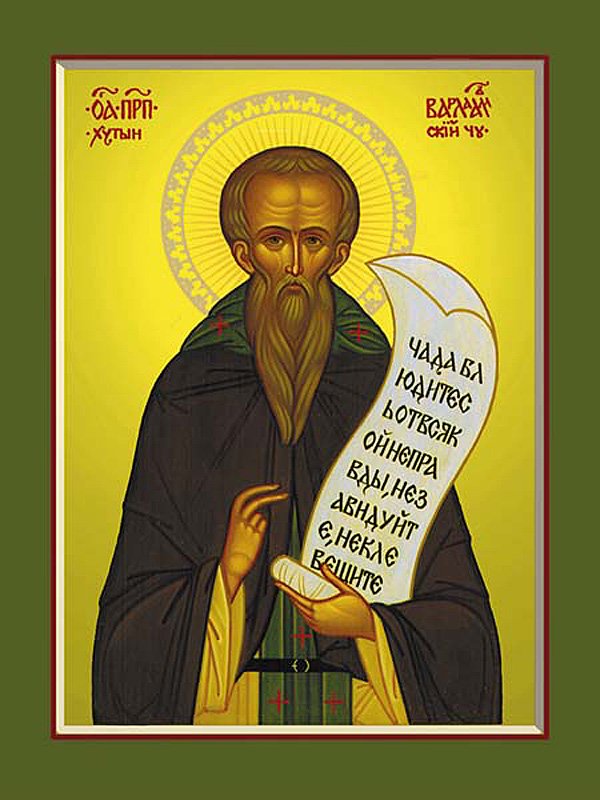
In Slavonic practice, Saint Barlaam is commemorated during the Proskomedia along with the venerable and God-bearing Fathers who shone forth in asceticism (sixth particle). Saint Barlaam is also commemorated on November 6 and February 10.

Troparion - Tone 3

Exhausting your body by sleeping on the earth, praying, and keeping vigil, O Venerable one, / you dispelled all carnal thoughts / and become a copious stream of healing for those who come to you with faith; / O Barlaam, our Father, / pray to Christ God for the salvation of our souls.

Kontakion - Tone 8

As a second Elijah, O Father, you brought down rain from the heavens, / for he brought down fire and astonished the king, / but you pleased your people and instituted a festival. / Great Novgorod takes pride in you, having your relics in itself, / preserving it unshaken by enemies, so that we may cry out to you: / “Rejoice, Venerable Barlaam, our Father.”

Scripture Readings

Epistle

Romans 11:2-12

2 God hath not cast away his people which he foreknew. Wot ye not what the scripture saith of Elias? how he maketh intercession to God against Israel, saying,
3 Lord, they have killed thy prophets, and digged down thine altars; and I am left alone, and they seek my life.
4 But what saith the answer of God unto him? I have reserved to myself seven thousand men, who have not bowed the knee to the image of Baal.
5 Even so then at this present time also there is a remnant according to the election of grace.
6 And if by grace, then is it no more of works: otherwise grace is no more grace. But if it be of works, then is it no more grace: otherwise work is no more work.
7 What then? Israel hath not obtained that which he seeketh for; but the election hath obtained it, and the rest were blinded
8 (According as it is written, God hath given them the spirit of slumber, eyes that they should not see, and ears that they should not hear;) unto this day.
9 And David saith, Let their table be made a snare, and a trap, and a stumblingblock, and a recompence unto them:
10 Let their eyes be darkened, that they may not see, and bow down their back alway.
11 I say then, Have they stumbled that they should fall? God forbid: but rather through their fall salvation is come unto the Gentiles, for to provoke them to jealousy.
12 Now if the fall of them be the riches of the world, and the diminishing of them the riches of the Gentiles; how much more their fulness?

Gospel

Matthew 11:20-26

20 Then began he to upbraid the cities wherein most of his mighty works were done, because they repented not:
21 Woe unto thee, Chorazin! woe unto thee, Bethsaida! for if the mighty works, which were done in you, had been done in Tyre and Sidon, they would have repented long ago in sackcloth and ashes.
22 But I say unto you, It shall be more tolerable for Tyre and Sidon at the day of judgment, than for you.
23 And thou, Capernaum, which art exalted unto heaven, shalt be brought down to hell: for if the mighty works, which have been done in thee, had been done in Sodom, it would have remained until this day.
24 But I say unto you, That it shall be more tolerable for the land of Sodom in the day of judgment, than for thee.
25 At that time Jesus answered and said, I thank thee, O Father, Lord of heaven and earth, because thou hast hid these things from the wise and prudent, and hast revealed them unto babes.
26 Even so, Father: for so it seemed good in thy sight.

Liturgical data sourced from OCA.org and orthocal.info