Fasting Rules
 Meat
Allowed
Meat
Allowed
 Fish
Allowed
Fish
Allowed
 Dairy
Allowed
Dairy
Allowed
 Oil
Allowed
Oil
Allowed
 Wine
Allowed
Wine
Allowed
Saints & Commemorations
Ven. Thomas of Mt Maleon
He was a renowned general, known for his great size and courage, his many victories against barbarian enemies, and his considerable wealth. But, forsaking wealth and reputation to follow Christ, he retired to the desert to live in asceticism. The Prophet Elias appeared to him and, accompanied by a pillar of fire, led him to Mount Maleon, near the Holy Mountain.
He was a renowned general, known for his great size and courage, his many victories against barbarian enemies, and his considerable wealth. But, forsaking wealth and reputation to follow Christ, he retired to the desert to live in asceticism. The Prophet Elias appeared to him and, accompanied by a pillar of fire, led him to Mount Maleon, near the Holy Mountain. There he lived in solitude, giving his days and nights to prayer. Like so many who seek to hide their holiness from the world, he was discovered, and people began to come to him for healing of their ailments and those of their loved ones. The saint healed countless ailments, drove out demons, cured the blind, and made water to pour forth from barren earth. In prayer he appeared as a pillar of fire. He reposed in peace, and his relics continued to be a powerful source of healing.
Venerable Thomas of Mount Maleos
Saint Thomas of Mount Maleos (Maleós) was a military commander before becoming a monk. Strong and brave, he participated in many battles, and brought victories to his countrymen, for which he won much glory and honor. But, striving toward God with all his heart, Saint Thomas forsook the world and its vanity, and was tonsured as a monk.
Saint Thomas of Mount Maleos (Maleós) was a military commander before becoming a monk. Strong and brave, he participated in many battles, and brought victories to his countrymen, for which he won much glory and honor. But, striving toward God with all his heart, Saint Thomas forsook the world and its vanity, and was tonsured as a monk.
With great humility he visited several Elders, asking for guidance in the spiritual life. After several years, Thomas received a blessing to live a solitary life in the wilderness. According to his biographers, Saint Thomas said that he was led by a pillar of fire to Mount Maleos by the Prophet Elias, while in an ancient Syaxarion of Constantinople it is written that Saint Thomas also appeared as a pillar of fire when the Holy Prophet Elias appeared to him, whose zealous way of life he emulated.
Dwelling in complete seclusion, Saint Thomas fought with invisible enemies with as much courage as he had displayed against the visible foes of his country. Reports of Saint Thomas's holy life could not be concealed from those living in the surrounding area. People began to flock to him seeking spiritual guidance, and those who suffered from sickness recovered, since he received from God a blessing to heal their infirmities.
He was always helping others, because even during his solitude, he prayed for everyone, and he trained himself to become a worthy instrument of God for the benefit of his neighbor.
Many of the faithful received help through the prayers of the Righteous Thomas. Even after his repose in the X century, he continues to heal those who seek his aid, from every passion and sickness.
Some of the Saint's Holy Relics are located in the Metropolis of Monemvasia and Sparta. He is particularly venerated in Lakonia (Lakonίa).
Troparion - Tone 4
O God of our Fathers, / always act with kindness towards us; / take not Your mercy from us, / but guide our lives in peace / through the prayers of Saints Thomas and Acacius.
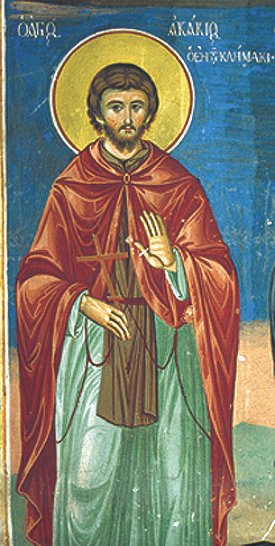
Venerable Acacius of Sinai, who is mentioned in the Ladder
Saint Acacius of Sinai lived during the sixth century and was a novice at a certain monastery in Asia. The humble monk distinguished himself by his patient and unquestioning obedience to his Elder, a harsh and dissolute man. He forced his disciple to toil excessively, starved him with hunger, and beat him without mercy.
Saint Acacius of Sinai lived during the sixth century and was a novice at a certain monastery in Asia. The humble monk distinguished himself by his patient and unquestioning obedience to his Elder, a harsh and dissolute man. He forced his disciple to toil excessively, starved him with hunger, and beat him without mercy. Despite such treatment, Saint Acacius meekly endured the affliction and thanked God for everything. Saint Acacius died after suffering these torments for nine years.
Five days after Acacius was buried, his Elder told another Elder about the death of his disciple. The second Elder did not believe that the young monk was dead. They went to the grave of Acacius and the second Elder called out: “Brother Acacius, are you dead?” From the grave a voice replied, “No, Father, how is it possible for an obedient man to die?” The startled Elder of Saint Acacius fell down with tears before the grave, asking forgiveness of his disciple.
After this he repented, constantly saying to the Fathers, “I have committed murder.” He lived in a cell near the grave of Saint Acacius, and he ended his life in prayer and in meekness. Saint John Climacus (March 30) mentions Saint Acacius in THE LADDER (Step 4:110) as an example of endurance and obedience, and of the rewards for these virtues.
Saint Acacius is also commemorated on November 29.
Troparion - Tone 4
O God of our Fathers, / always act with kindness towards us; / take not Your mercy from us, / but guide our lives in peace / through the prayers of Saints Thomas and Acacius.
Venerable Eudokia (in monasticism Euphrosyne), Grand Duchess of Moscow
Saint Euphrosyne (Euphrosynē), in the world Eudokia, was the daughter of the Suzdal prince Demetrius Constantovich (+ 1383), and from 1367 was the wife of the Moscow Great Prince Demetrius of the Don. Their happy union was for Russia a pledge of unity and peace between Moscow and Suzdal.
Saint Alexis, Metropolitan of Moscow, and even Saint Sergius of Radonezh, who baptized one of the sons of Demetrius and Eudokia, had a great influence upon the spiritual life of Princess Eudokia.
Saint Euphrosyne (Euphrosynē), in the world Eudokia, was the daughter of the Suzdal prince Demetrius Constantovich (+ 1383), and from 1367 was the wife of the Moscow Great Prince Demetrius of the Don. Their happy union was for Russia a pledge of unity and peace between Moscow and Suzdal.
Saint Alexis, Metropolitan of Moscow, and even Saint Sergius of Radonezh, who baptized one of the sons of Demetrius and Eudokia, had a great influence upon the spiritual life of Princess Eudokia. Saint Demetrius of Priluki (February 11) was the godfather of another son.
The holy princess was a builder of churches. In 1387 she founded the Ascension women’s monastery in the Moscow Kremlin. In 1395, during Tamerlane’s invasion into the southern regions of Russia, the Vladimir Icon of the Mother of God was transferred to Moscow upon her advice, miraculously defending the Russian land. During Lent, the princess secretly wore chains beneath her splendid royal garb. By her patronage the famous icon of the Archangel Michael was painted, and later became the patronal icon of the Kremlin’s Archangel Cathedral.
After raising five sons (a sixth died in infancy), the princess was tonsured as a nun with the name Euphrosyne. She completed her earthly journey on July 7, 1407 and was buried in the Ascension monastery she founded.
An old Russian church poem has survived, the lament of the princess for her husband, who had died at the age of thirty-nine.
Saint Euphrosyne is also commemorated on May 17.
Troparion - Tone 8
By a flood of tears you made the desert fertile, / and your longing for God brought forth fruits in abundance. / By the radiance of miracles you illumined the whole universe! / O our holy mother Euphrosynē, pray to Christ our God to save our souls!
Martyrs Peregrinus, Lucian, Ompeius, Hesychius, Papius, Saturninus, and Germanus, of Dyrrachium in Macedonia
The Holy Martyrs Peregrinus, Lucian, Pompeius, Hesychius, Papius, Saturninus and Germanus were natives of Italy. They suffered for Christ under the emperor Trajan in the city of Dyrrachium, located at the shore of the Adriatic sea.
Witnessing the martyrdom of Bishop Astius, who was crucified by the Romans, they openly praised the courage and firmness of the holy confessor.
The Holy Martyrs Peregrinus, Lucian, Pompeius, Hesychius, Papius, Saturninus and Germanus were natives of Italy. They suffered for Christ under the emperor Trajan in the city of Dyrrachium, located at the shore of the Adriatic sea.
Witnessing the martyrdom of Bishop Astius, who was crucified by the Romans, they openly praised the courage and firmness of the holy confessor. Because of this, they were seized, and as confessors of faith in Christ, they were drowned in the sea. Their bodies, carried to shore by the waves, were hidden in the sand by Christians. The martyrs appeared to the Bishop of Alexandria ninety years later, ordering him to bury their bodies and to build a church over them.
Troparion - Tone 4
Your holy martyrs O Lord, / through their sufferings have received incorruptible crowns from You, our God. / For having Your strength, they laid low their adversaries, / and shattered the powerless boldness of demons. / Through their intercessions, save our souls!
Martyr Evangelicus, Bishop of Tomis, Constanța in Romania
Saint Evangelicus, a follower of the holy Apostle Andrew (November 30), is the first known bishop of the diocese of Tomis (Constana, pronounced: Constantsa ) in Dacia Pontica (Lesser Scythia, or Dobrogea). He was active around the mouths of the Danube toward the end of the third century.
Bishop Evangelicus converted many pagans of Dacia Pontica to Christianity.
Saint Evangelicus, a follower of the holy Apostle Andrew (November 30), is the first known bishop of the diocese of Tomis (Constana, pronounced: Constantsa ) in Dacia Pontica (Lesser Scythia, or Dobrogea). He was active around the mouths of the Danube toward the end of the third century.
Bishop Evangelicus converted many pagans of Dacia Pontica to Christianity. He is mentioned in the account of the martyrdom of Saints Epictetus and Astion (July 8), where he is described as the founder of churches in the province. The parents of these holy martyrs were baptized by Saint Evangelicus after being converted by the priest Bonosus.
It is believed that Saint Evangelicus suffered martyrdom during the persecution of Diocletian (284-305).
Troparion - Tone 1
By sharing in the ways of the Apostles, / you became a successor to their throne. / Through the practice of virtue, / you found the way to divine contemplation, O inspired one of God; / by teaching the word of truth without error, / you defended the Faith, even to the shedding of your blood. / Hieromartyr Evangelicus entreat Christ God to save our souls.
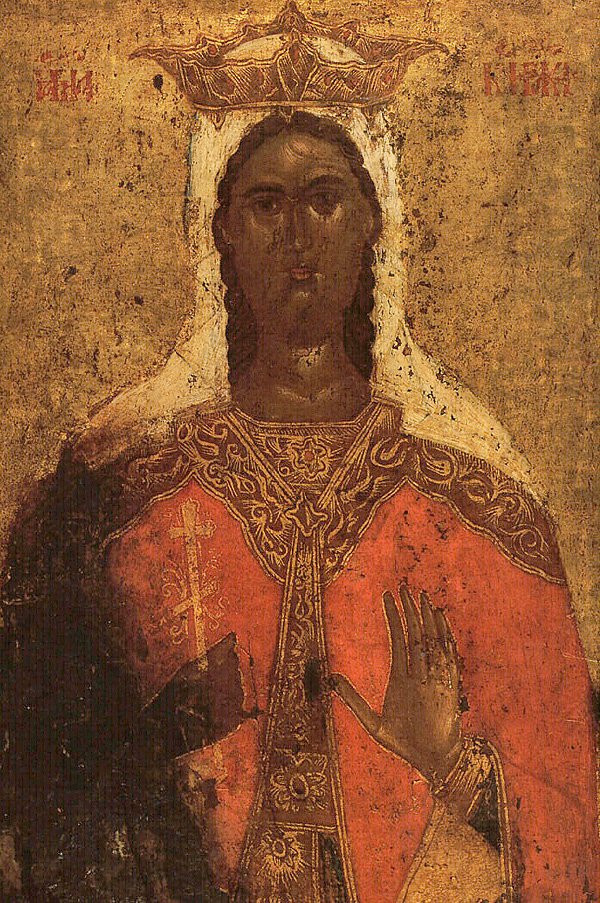
Martyr Kyriake of Nicomedia
Saint Kyriake was the only child of Dorotheus and Eusebia. Since she was born on a Sunday (Kyriake, in Greek), she was named Kyriake.
One day a wealthy magistrate wished to betroth Kyriake to his son. Not only was she young and beautiful, but her parents were wealthy, and the magistrate wished to control that wealth.
Saint Kyriake was the only child of Dorotheus and Eusebia. Since she was born on a Sunday (Kyriake, in Greek), she was named Kyriake.
One day a wealthy magistrate wished to betroth Kyriake to his son. Not only was she young and beautiful, but her parents were wealthy, and the magistrate wished to control that wealth. The magistrate went to her parents to request her hand, but Saint Kyriake told him that she wished to remain a virgin, for she had dedicated herself to Christ.
The magistrate was angered by her words, so he went to the emperor Diocletian to denounce the saint and her parents as Christians who mocked the idols, and refused to offer sacrifice to them.
Diocletian sent soldiers to arrest the family and have them brought before him. He asked them why they would not honor the gods which he himself honored. They told him that these were false gods, and that Christ was the one true God.
Dorotheus was beaten until the soldiers grew tired and were unable to continue. Since neither flattery nor torment had any effect, Diocletian sent Dorotheus and Eusebia to Melitene on the eastern border between Cappadocia and Armenia. Then he sent Saint Kyriake to be interrogated by his son-in-law and co-ruler Maximian at Nicomedia.
Maximian urged her not to throw her life away, promising her wealth and marriage to one of Diocletian’s relatives if she would worship the pagan gods. Saint Kyriake replied that she would never renounce Christ, nor did she desire worldly riches. Enraged by her bold answer, Maximian had her flogged. The soldiers who administered this punishment became tired, and had to be replaced three times.
Shamed by his failure to overcome a young woman, Maximian sent Saint Kyriake to Hilarion, the eparch of Bithynia, at Chalcedon. He told Hilarion to either convert Kyriake to paganism, or send her back to him.
Making the same promises and threats that Diocletian and Maximian had made before, Hilarion was no more successful than they were. Saint Kyriake challenged him to do his worst, because Christ would help her to triumph. The saint was suspended by her hair for several hours, while soldiers burned her body with torches. Not only did she endure all this, she also seemed to become more courageous under torture. Finally, she was taken down and put into a prison cell.
That night Christ appeared to her and healed her wounds. When Hilarion saw her the next day, he declared that she had been healed by the gods because they pitied her. Then Hilarion urged her to go to the temple to give thanks to the gods. She told him that she had been healed by Christ, but agreed to go to the temple. The eparch rejoiced, thinking that he had defeated her.
In the temple, Saint Kyriake prayed that God would destroy the soulless idols. Suddenly, there was a great earthquake which toppled the idols, shattering them to pieces. Everyone fled the temple in fear, leaving Hilarion behind. Instead of recognizing the power of Christ, the eparch blasphemed the true God as the destroyer of his pagan gods. He was struck by a bolt of lightning and died on the spot.
Saint Kyriake was tortured again by Apollonius, who succeeded Hilarion as eparch. When she was cast into a fire, the flames were extinguished. When she was thrown to wild beasts, they became tame and gentle. Therefore, Apollonius sentenced her to death by the sword. She was permitted time to pray, so she asked God to receive her soul, and to remember those who honored her martyrdom.
Just as Saint Kyriake ended her prayer, angels took her soul before the soldiers could strike off her head. Pious Christians took her relics and buried them in a place of honor.
Troparion - Tone 5
O virgin martyr Kyriake, / you were a worthy sacrifice / When you offered your pure soul to God; / wherefore Christ has glorified you, / and through you pours forth graces abundantly on all the faithful, / for He is the merciful Loving God!
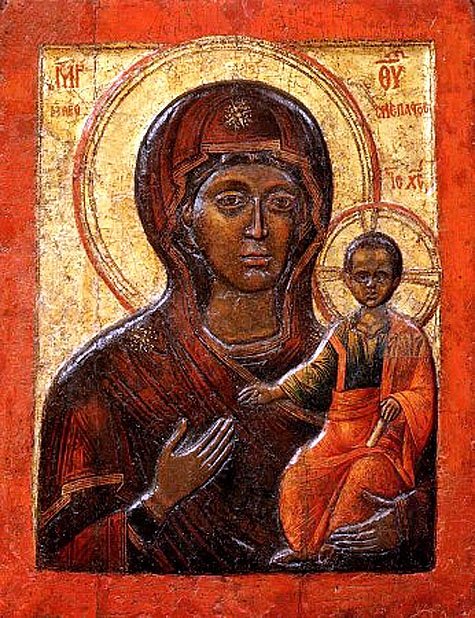
Translation of the “Blachernae” Icon of the Mother of God to Russia
The Blachernae Icon of the Mother of God was discovered at Jerusalem by the empress Eudokia during the time of Saint Juvenal, Patriarch of Jerusalem (July 2), and Saint Euthymius the Great (January 20). The holy icon was sent to Constantinople, where the empress Pulcheria placed it in the Blacernae Church, where the Venerable Robe of the Mother of God (July 2) was preserved.
The Blachernae Icon of the Mother of God was discovered at Jerusalem by the empress Eudokia during the time of Saint Juvenal, Patriarch of Jerusalem (July 2), and Saint Euthymius the Great (January 20). The holy icon was sent to Constantinople, where the empress Pulcheria placed it in the Blacernae Church, where the Venerable Robe of the Mother of God (July 2) was preserved.
This holy icon is also called the Hodēgḗtria, or “She who leads the way.” It was with this icon that Patriarch Sergius (610-631) made the rounds of the walls of Constantinople in the year 626 with Moliebens during a siege of the capital by the Avars. In memory of this and other victories, which were won thanks to the intercession of the Most Holy Theotokos, an annual celebration was established on Saturday of the Fifth Week of the Great Fast to offer Praises to the Most Holy Theotokos (Saturday of the Akathist). At first the celebration took place only at the Blachernae church in Constantinople. In the ninth century the Feast was included in the Typikon of Saint Savva the Sanctified, and in the Studite Rule. Later, it was included in the Lenten Triodion and made universal for all the Orthodox Church.
After the Fall of Constantinople in 1453, the Blachernae Icon was transferred to Mt. Athos, and in 1654 it was sent by the Athonite monks to Moscow as gift to the Tsar Aleksei Mikhailovich.
The Blachernae Icon is celebrated on July 2, and in the Fifth Week of Great Lent (Saturday of the Akathist).
Saint Prosper of Aquitaine
Saint Prosper (Prosper Tiro), "The Eradicator of Heresies," as Saint Photios (February 6) calls him, was born in the Aquitaine around the year 390. He was a renowned lay theologian, although few details of his life are known.
We know Saint Prosper chiefly from his writings. A contemporary writer described him as "a holy and venerable man." Many of Saint Prosper's writings echo the teaching of Saint Augustine (June 15) on grace.
Saint Prosper (Prosper Tiro), "The Eradicator of Heresies," as Saint Photios (February 6) calls him, was born in the Aquitaine around the year 390. He was a renowned lay theologian, although few details of his life are known.
We know Saint Prosper chiefly from his writings. A contemporary writer described him as "a holy and venerable man." Many of Saint Prosper's writings echo the teaching of Saint Augustine (June 15) on grace. Like Saint Augustine, Saint Prosper was also an opponent of the Pelagian heresy. This wise man seems to have spent his life embroiled in controversies with heretics. For the semi-Pelagians in particular, Saint Prosper was one of their most fearsome adversaries.
In Saint Prosper, science was joined to virtue. It is evident that he applied himself to literature, and especially to acquiring knowledge of Holy Scripture. He was no less an expert in human sciences than he was in theology. He excelled particularly in mathematics, astronomy, and chronology. His great learning and holiness made him well known throughout the entire Church.
Saint Prosper has sometimes been identified, mistakenly, with Saint Paulinus of Reggio (June 25), who was a bishop. Everything we know about him leads us to believe that Saint Prosper was not a bishop, nor even a priest. In a poem to his wife he wrote: "Lift me up again if I fall; correct yourself if I point out some fault. Let it never be sufficient for us to be one body, let us also be one soul." By 428, Saint Prosper persuaded his wife to become a nun, and he entered a monastery at Marseilles. When Saint Leo the Great was chosen as the Bishop of Rome in 440, he sent for Prosper to become his secretary. Many historians believe that the admirable treatise "On the Incarnation of the Word," which is ascribed to Saint Leo, is actually the work of Saint Prosper. It is possible, however, that Saint Leo may have reworked it in his own style.
Saint Prosper reposed in Rome, sometime after 455.
The icon of Saint Prosper depicts him holding a scroll which reads: "The Orthodox Faith subdues the monster of heresy."
Troparion - Tone 1
Come, you faithful, let us venerate Prosper, this new Father of the Church, / the child of Aquitaine and glory of the Gauls, an imitator of the Holy Apostles; / from all sorts of threats against Orthodoxy he delivers those who cry to him with faith: / Glory to Him Who has given you this knowledge! / Glory to Him Who has enlightened you! / Glory to Him Who saves us, by your prayers!
Scripture Readings
☩Epistle
1 Corinthians 1:1-9
1
Paul, called to be an apostle of Jesus Christ through the will of God, and Sosthenes our brother,
2
Unto the church of God which is at Corinth, to them that are sanctified in Christ Jesus, called to be saints, with all that in every place call upon the name of Jesus Christ our Lord, both theirs and ours:
3
Grace be unto you, and peace, from God our Father, and from the Lord Jesus Christ.
4
I thank my God always on your behalf, for the grace of God which is given you by Jesus Christ;
5
That in every thing ye are enriched by him, in all utterance, and in all knowledge;
6
Even as the testimony of Christ was confirmed in you:
7
So that ye come behind in no gift; waiting for the coming of our Lord Jesus Christ:
8
Who shall also confirm you unto the end, that ye may be blameless in the day of our Lord Jesus Christ.
9
God is faithful, by whom ye were called unto the fellowship of his Son Jesus Christ our Lord.
☩Gospel
Matthew 13:24-30
24
Another parable put he forth unto them, saying, The kingdom of heaven is likened unto a man which sowed good seed in his field:
25
But while men slept, his enemy came and sowed tares among the wheat, and went his way.
26
But when the blade was sprung up, and brought forth fruit, then appeared the tares also.
27
So the servants of the householder came and said unto him, Sir, didst not thou sow good seed in thy field? from whence then hath it tares?
28
He said unto them, An enemy hath done this. The servants said unto him, Wilt thou then that we go and gather them up?
29
But he said, Nay; lest while ye gather up the tares, ye root up also the wheat with them.
30
Let both grow together until the harvest: and in the time of harvest I will say to the reapers, Gather ye together first the tares, and bind them in bundles to burn them: but gather the wheat into my barn.
Liturgical data sourced from OCA.org and orthocal.info