Venerable Anthony of the Kiev Far Caves, Founder of Monasticism in Russia
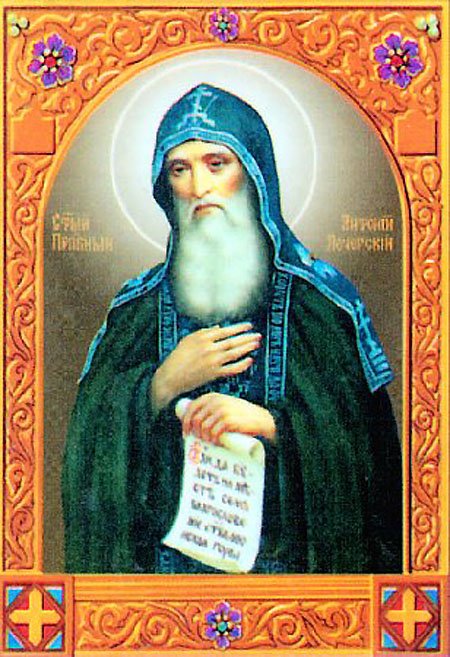
Saint Anthony of the Kiev Caves was born in the year 983 at Liubech, not far from Chernigov, and was named Antipas in Baptism. Possessing the fear of God from his youth, he desired to be clothed in the monastic schema. When he reached a mature age, he wandered until he arrived on Mt. Athos, burning with the desire to emulate the deeds of its holy inhabitants.
Saint Anthony of the Kiev Caves was born in the year 983 at Liubech, not far from Chernigov, and was named Antipas in Baptism. Possessing the fear of God from his youth, he desired to be clothed in the monastic schema. When he reached a mature age, he wandered until he arrived on Mt. Athos, burning with the desire to emulate the deeds of its holy inhabitants. Here he received monastic tonsure, and the young monk pleased God in every aspect of his spiritual struggles on the path of virtue. He particularly excelled in humility and obedience, so that all the monks rejoiced to see his holy life.
The igumen saw in Saint Anthony the great future ascetic, and inspired by God, he sent him back to his native land, saying, “Anthony, it is time for you to guide others in holiness. Return to your own Russian land, and be an example for others. May the blessing of the Holy Mountain be with you.”
Returning to the land of Rus, Anthony began to make the rounds of the monasteries about Kiev, but nowhere did he find that strict life which had drawn him to Mt. Athos.
Through the Providence of God, Anthony came to the hills of Kiev by the banks of the River Dnieper. The forested area near the village of Berestovo reminded him of his beloved Athos. There he found a cave which had been dug out by the Priest Hilarion, who later became Metropolitan of Kiev (October 21). Since he liked the spot, Anthony prayed with tears, “Lord, let the blessing of Mt. Athos be upon this spot, and strengthen me to remain here.” He began to struggle in prayer, fasting, vigil and physical labor. Every other day, or every third day, he would eat only dry bread and a little water. Sometimes he did not eat for a week. People began to come to the ascetic for his blessing and counsel, and some decided to remain with the saint.
Among Anthony’s first disciples was Saint Nikon (March 23), who tonsured Saint Theodosius of the Caves (May 3) at the monastery in the year 1032.
The virtuous life of Saint Anthony illumined the Russian land with the beauty of monasticism. Saint Anthony lovingly received those who yearned for the monastic life. After instructing them how to follow Christ, he asked Saint Nikon to tonsure them. When twelve disciples had gathered about Saint Anthony, the brethren dug a large cave and built a church and cells for the monks within it.
After he appointed Abbot Barlaam to guide the brethren, Saint Anthony withdrew from the monastery. He dug a new cave for himself, then hid himself within it. There too, monks began to settle around him. Afterwards, the saint built a small wooden church in honor of the Dormition of the Mother of God over the Far Caves.
At the insistence of Prince Izyaslav, the igumen Barlaam withdrew to the Dimitriev monastery. With the blessing of Saint Anthony and with the general agreement of the brethren, the meek and humble Theodosius was chosen as igumen. By this time, the number of brethren had already reached a hundred men. The Kiev Great Prince Izyaslav (+ 1078) gave the monks the hill on which the large church and cells were built, with a palisade all around. Thus, the renowned monastery over the caves was established. Describing this, the chronicler remarks that while many monasteries were built by emperors and nobles, they could not compare with those which are built with holy prayers and tears, and by fasting and vigil. Although Saint Anthony had no gold, he built a monastery which became the first spiritual center of Rus.
For his holiness of life, God glorified Saint Anthony with the gift of clairvoyance and wonderworking. One example of this occurred during the construction of the Great Caves church. The Most Holy Theotokos Herself stood before him and Saint Theodosius in the Blachernae church in Constantinople, where they had been miraculously transported without leaving their own monastery. Actually, two angels appeared in Constantinople in their forms (See May 3, the account of the Kiev Caves Icon of the Most Holy Theotokos). Having received gold from the Mother of God, the saints commissioned master architects, who came from Constantinople to the Russian land on the command of the Queen of Heaven to build the church at the Monastery of the Caves. During this appearance, the Mother of God foretold the impending death of Saint Anthony, which occurred on July 10, 1073.
Through Divine Providence, the relics of Saint Anthony remain hidden.
Troparion - Tone 4
Having departed from worldly tumults, / in leaving the world you followed Christ according to the Gospel. / You reached the quiet refuge of the Holy Mount Athos, / living there a life equal to the angels. / Therefore, with the blessing of the Fathers, / you came to the Kievan hills. / There having fulfilled a life loving of labors, / you illumined your homeland. / And having shown a multitude of monastics / the pathway leading to the heavenly kingdom, / you led them to Christ. / Beseech him, O Venerable Anthony, / that he may save our souls!
Kontakion - Tone 8
From your youth you gave yourself to God whom you loved above all, O Venerable One; / and in love you followed after him with your whole soul. / Scorning the passing corruption of the world, you made a cave in the earth; / and in it you struggled nobly facing the snares of the invisible enemy, / while illumining the ends of the earth like a bright, shining sun. / Therefore, with rejoicing you entered into the heavenly chambers. / Standing now before the throne of the Master together with the angels, / remember us who honor your holy memory, / that we may cry out to you: Rejoice, Anthony our Holy Father!
45 Holy Martyrs at Nicopolis in Armenia
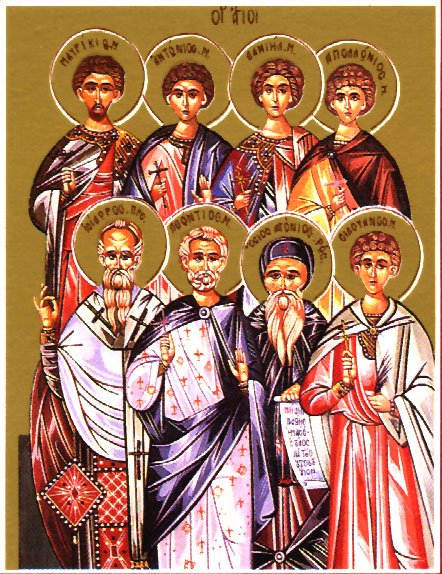
During a persecution of Christians in the reign of the Emperor Licinius, Leontius and several of his companions came before the Imperial governor in Nikopolis of Armenia, and declared themselves as Christians. They were whipped and thrown into prison, where they were given no food or drink; but a Christian noblewoman secretly brought them water, and an angel of the Lord appeared to them in their cell to comfort them.
During a persecution of Christians in the reign of the Emperor Licinius, Leontius and several of his companions came before the Imperial governor in Nikopolis of Armenia, and declared themselves as Christians. They were whipped and thrown into prison, where they were given no food or drink; but a Christian noblewoman secretly brought them water, and an angel of the Lord appeared to them in their cell to comfort them. Such was the power of their faith that, at their trial, two of their jailers proclaimed their conversion to Christianity. Many others came forward in the same way, until the company of Christians numbered forty-five in all. The judge ordered that they all have their arms and legs hacked off and that they then be burned to death.
Troparion - Tone 4
Your holy martyrs, O Lord, / through their suffering have received incorruptible crowns from You, our God. / For having Your strength, they laid low their adversaries, / and shattered the powerless boldness of demons. / Through their intercessions save our souls!
The Placing of the Honorable Robe of the Lord at Moscow
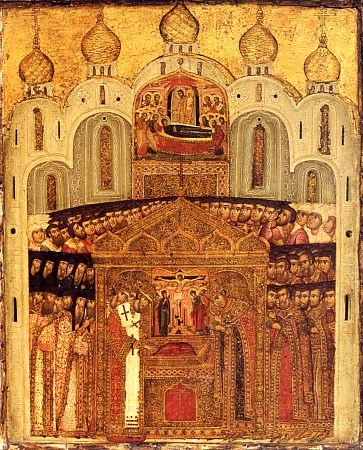
Elias, a soldier in the Roman army in Jerusalem, was a Georgian by birth, from the town of Mtskhet. When the Lord was crucified, his garments were divided by lot among the soldiers, and his robe fell to Elias, who took it home to Georgia and gave it as a gift to his sister Sidonia. The robe was buried with her, then miraculously found many years later by St Nina (January 14).
Elias, a soldier in the Roman army in Jerusalem, was a Georgian by birth, from the town of Mtskhet. When the Lord was crucified, his garments were divided by lot among the soldiers, and his robe fell to Elias, who took it home to Georgia and gave it as a gift to his sister Sidonia. The robe was buried with her, then miraculously found many years later by St Nina (January 14). King Mirian, who had accepted Christ in response to St Nina’s teaching, built a church to the Holy Apostles on the spot where the robe was found. Many years later, Georgia was conquered by the Persians, and the robe fell into their hands. In 1625 the Persian Shah Abbas, wishing to establish good relations with Russia, sent the robe to Moscow as a gift to Prince Michael Feodorovich and Patriarch Philaret. It was placed with honor in the Cathedral of the Dormition.
Troparion - Tone 4
Today, let us the faithful resort to the divine and healing Robe of the Savior, our God, / Who was pleased to wear it on His body and to pour out His holy Blood on the Cross, / with which He redeemed us from slavery to the Enemy. / Therefore, with gratitude we cry out to Him: / “By Your sacred Robe, protect our land, our Hierarchs, our city, and all the people; / and as the lover of mankind, / save our souls.”
Kontakion - Tone 4
O Master, You bestowed Your sacred Robe as a divine treasure, / and as a garment of incorruption, healing, and salvation for all people. / For in it You were pleased to clothe the holy and Life-giving flesh of Your Incarnation. / Receiving it with zeal, we solemnly celebrate, / and with fear and love, we sing to our Benefactor, crying out to You, O Christ: / “Preserve all Orthodox Christians, their Hierarchs, and all people in peace, / according to Your great mercy.”
Venerable Silvanus the Schemamonk of the Kiev Far Caves
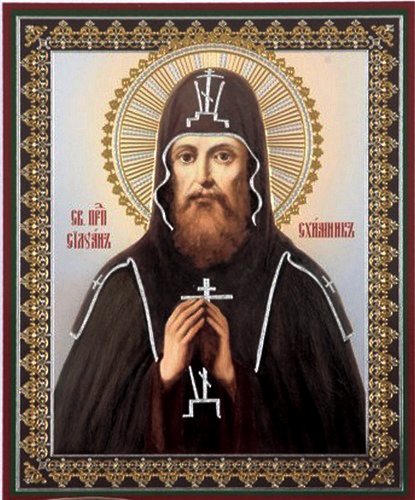
The Holy Schemamonk Silvanus (Silouan) of the Kiev Caves, zealously preserved the purity of both soul and body, he subdued his flesh with fasting and vigils, and he cleansed his soul with prayer and meditation on God. The Lord granted him an abundance of spiritual gifts: a prayerful boldness towards God, constant joy in the Lord, clairvoyance and wonderworking.
The Holy Schemamonk Silvanus (Silouan) of the Kiev Caves, zealously preserved the purity of both soul and body, he subdued his flesh with fasting and vigils, and he cleansed his soul with prayer and meditation on God. The Lord granted him an abundance of spiritual gifts: a prayerful boldness towards God, constant joy in the Lord, clairvoyance and wonderworking. The monk lived at the end of the thirteenth and beginning of the fourteenth centuries. His relics rest in the Caves.
Troparion - Tone 8
By a flood of tears you made the desert fertile, / and your longing for God brought forth fruits in abundance. / By the radiance of miracles you illumined the whole universe! / O our holy father Silvanus, pray to Christ our God to save our souls!
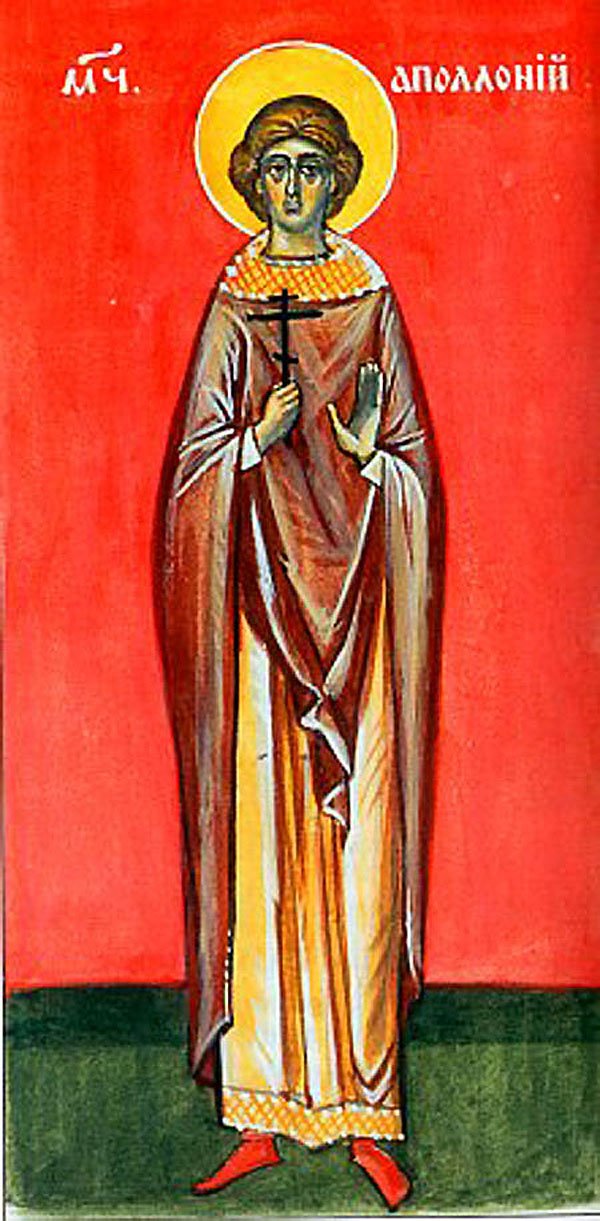
Martyr Apollonius of Sardis
The Holy Martyr Apollonius came from the city of Sardis, located in Lydia (Asia Minor). He declared himself a Christian and was arrested. When they demanded that he swear an oath on the name of the emperor, he refused, saying that it was improper to swear on the name of a mortal man. They tortured Apollonius for a long time and then crucified him.
The Holy Martyr Apollonius came from the city of Sardis, located in Lydia (Asia Minor). He declared himself a Christian and was arrested. When they demanded that he swear an oath on the name of the emperor, he refused, saying that it was improper to swear on the name of a mortal man. They tortured Apollonius for a long time and then crucified him. This occurred at Iconium either under the emperor Decius (249-251) or the emperor Valerian (253-259).
Troparion - Tone 3
Your holy martyr Apollonius, O Lord, / through his sufferings has received an incorruptible crown from You, our God. / For having Your strength, he laid low his adversaries, / and shattered the powerless boldness of demons. / Through his intercessions, save our souls!
Martyrs Bianor and Silvanus of Pisidia
Saint Bianor came from the Pisidia district of Asia Minor. As a confessor of Christianity they brought him to the prefect of the city of Isauria in Lykaonia, who demanded that Saint Bianor renounce Christ. The saint stood steadfast in the true Faith, in spite of the refined tortures. A man by the name of Silvanus beheld the suffering of the martyr.
Saint Bianor came from the Pisidia district of Asia Minor. As a confessor of Christianity they brought him to the prefect of the city of Isauria in Lykaonia, who demanded that Saint Bianor renounce Christ. The saint stood steadfast in the true Faith, in spite of the refined tortures. A man by the name of Silvanus beheld the suffering of the martyr. The endurance and bravery of Saint Bianor inspired the faith of Christ in Silvanus, and he openly declared this. They cut out his tongue and then cut off his head. Saint Bianor, after long torturing, was also beheaded.
The date of the suffering of the holy Martyrs Bianor and Silvanus is not precisely known. It is presumed that they died in Pisidia under the Roman emperor Diocletian (284-305).
Troparion - Tone 4
Your holy martyrs Bianor and Silvanus, O Lord, / through their sufferings have received incorruptible crowns from You, our God. / For having Your strength, they laid low their adversaries, / and shattered the powerless boldness of demons. / Through their intercessions, save our souls!
10,000 Martyred Fathers of the Deserts and Caves of Scete by the Impious Patriarch Theophilus of Alexandria
These holy martyrs of Christ, who lived in the deserts and caves of the Nitrian desert, were delivered up by Patriarch Theophilus of Alexandria to face a bitter death. He falsely accused them of Origenism, but in fact they incurred the patriarch’s anger by giving shelter to the priest Isidore.
Troparion - Tone 4
Your holy martyr Agathonike and his companions, O Lord, / through their sufferings have received incorruptible crowns from You, our God. / For having Your strength, they laid low their adversaries, / and shattered the powerless boldness of demons. / Through their intercessions, save our souls!
Martyr Νikόdēmos of Elbassan Albania
No information available at this time.
Troparion - Tone 3
Your holy martyr Νikόdēmos, O Lord, / through his sufferings has received an incorruptible crown from You, our God. / For having Your strength, he laid low his adversaries, / and shattered the powerless boldness of demons. / Through his intercessions, save our souls!
Monastic Martyr Nectarius of Saint Anne Skete on Mount Athos
No information available at this time.
Troparion - Tone 1
The image of God was truly preserved in you, O Father, / for you took up the Cross and followed Christ. / By so doing you taught us to disregard the flesh for it passes away / but to care instead for the soul, since it is immortal. / Therefore your spirit, venerable Nectarius, rejoices with the angels.
Kontakion - Tone 2
As a venerable and proven ascetic, as an honorable and renowned martyr, / and as a model of the desert life, O most exalted Nectarius, / we sing hymns of praise to you, / for you have trampled upon serpents.
Icon of the Mother of God of Konevits
According to Tradition, the Konevits Icon of the Most Holy Theotokos was brought from Mount Athos by Saint Arsenios the wonderworker (June 12) in the year 1393. He was tonsured as a monk at Lisogorsk Monastery in Novgorod, and then spent three years living on Mount Athos. Igoumen John Zidon gave him a Greek icon when he blessed him to return to Rus’ and to build a monastery in honor of the Virgin.
Saint Arsenios sailed the Volkhov River to the great Lake Neva (Ladoga), praying that the Lord would direct him to the place where the monastery should be built. The boat was driven by the wind to Konevits Island. Regarding this as a sign from God, Saint Arsenios landed on the island and climbed a hill (now known as the Holy Hill). There he set up a wooden Cross.
He stopped at an island of Lake Ladoga which was quite near Valaam. This island was called "Konevitsa," or "the island of the horses." It was used as a summer pasture for horses, and was also a notable site for pagan sacrifices. According to local legend, evil spirits lived under a stone called "The Horse." Saint Arsenios expelled the demons with the Athonite Icon, holy water, and prayers. The Saint built a cell for himself, and then a church, which he dedicated to the Nativity of the Most HolyTheotokos. Almost immediately, monks flocked to the island, drawn by the reports of miracles which were wrought by the Mother of God through her holy Icon.
At that time the icon was called "The Holy Mountain" Icon (Святогорская). After a flood damaged the Monastery, the buildings were moved farther inland. After Saint Arsenios reposed (June 12, 1444), he appeared to a number of people, urging a certain blind man to go to the Icon in order to be healed.
Following the repose of the Monastery’s founder, monastic life continued peacefully under the heavenly protection of the Mother of God. However, in the XVI Century, the Swedes, who had recently become Lutherans, began to preach their faith in the Karelian lands. In 1577 they sought to destroy Konevits Monastery, which was a stronghold of Orthodoxy. In answer to the monks’ prayers, a strong wind arose and broke the ice surrounding the Monastery, preventing the foe from crossing over to the island. On July 10, 1576 a miracle took place, providing the date for the Icon's annual commemoration. There is no precise information concerning this miracle, except that it was somehow connected with an attack by the Swedes.
The Swedes invaded Karelia in 1610 during their war with Russia, so the brethren were forced to leave Konevits Monastery once again. The Icon was transferred from the Konevits Monastery to Novgorod's Derevianits monastery with the blessing of Archbishop Isidore of Novgorod. After defeating the Swedes in 1718, Tsar Peter I ordered that the Konevits Monastery be restored. It took more than fifty years for the restoration work to be done (in 1766). The Icon of the Mother of God remained at Derevyanitsa Monastery until 1798. Then, with the blessing of Metropolitan Gabriel of Novgorod and St. Petersburg, it was transferred to Konevits. The Derevyanitsa Monastery was given a copy of the Icon in the silver frame which had previously contained the original Icon.
It was only in 1798, however, that Bartholomew, a builder from Kamenets, received permission from the Holy Synod to return the Holy Icon to Konevits. On June 3, 1799, Igoumen Bartholomew departed with the Icon for St. Petersburg, where the Icon remained until September of that year. During those two months, the Icon performed many miracles. Through the efforts of certain benefactors in St. Petersburg, a silver gilt riza was fashioned for the Icon. When the riza was completed, Igoumen Bartholomew returned to Konevits Monastery with the Icon. There it was met with great solemnity by the monks on September 3, 1799. Miracles continued to occur after the Icon was returned to Konevits. Even today miracles take place, and the monks of the Monastery attest to them.
After its return to Konevits, the Icon remained there until 1940, when it was moved to Hiekka farm. In 1917 Konevits was part of Finland, and the Monastery became part of the new Finnish Orthodox Church. During the war years of 1939-1940 the Finnish authorities evacuated the monks from the island, and the monks took the wonderworking Konevits Icon with them.The community moved to Papinniemi, Heinavesi (New Valaamo) in 1956. To this day, the Icon remains at the New Valaamo Monastery in Finland, and only a recent copy is to be seen on Konevits Island.
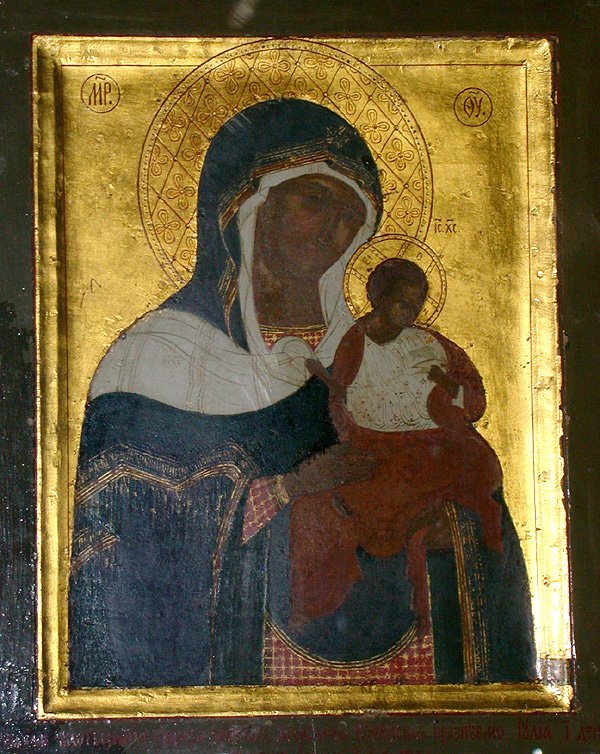
The present Icon seems to have been painted in the late XV or early XVI century, based on the Icon given to Saint Arsenios. It has been painted over two times. On the reverse is the image of the Savior not made by Hands (August 16) on a dark blue background. The Icon was sent to Moscow for restoration in 1969 - 1970, with the permission of the Finnish Orthodox Church, and then it was returned to Finland. After restoration, the Icon was almost the same as it was before.
Before restoration, there were two doves in Christ's hand, but the original painting had only one. During the XIX century the Icon was in a church dedicated to the Meeting of The Lord in the Temple (February 2). A copy of the Icon from that time had two doves, probably representing the two doves offered by Saint Joseph the Betrothed and the All-Holy Virgin.
No purely Russian icon depicts the Theotokos with a blue maphorion. If it is blue, it is probably a Greek icon, or it is based on a Greek model. There is a connection between the Konevits Icon and Byzantine Hodēgḗtria icons of the Mother of God. Perhaps the painter of the Konevits Icon was influenced by the Tikhvin Icon, which was in Chicago's Holy Trinity Cathedral, and later returned to Russia.
The Icon may have been transferred to Finland as early as 1930. On several occasions during the 1950s the Icon stopped a number of fires. Although everything around it was burnt, the Icon remained unharmed. The latest of its many miracles took place during the 1960s.
The Icon measures about 20 inches by 16 inches. It is sometimes called Golubitskaya (Голубицкая), or the Icon “with the dove.” The veil of the Virgin is light blue instead of white. There are revered copies of the Konevits Icon in the Church of the Annunciation on the bank in Moscow, and in the Church of the Resurrection of Torzhok.
Troparion - Tone 1
Like the sun rising in the east, O Sovereign Lady, / your Icon has shone upon us with brightness, / wondrously illuminating with the rays of miracles, all who approach it with faith and love, / and devoutly pray before your glory in your Son and God. / Glory to Him Who gave us this Icon through Arsenios. / Glory to Him Who brought it from Novgorod. / Glory to Him Who, through it, grants healing to all.
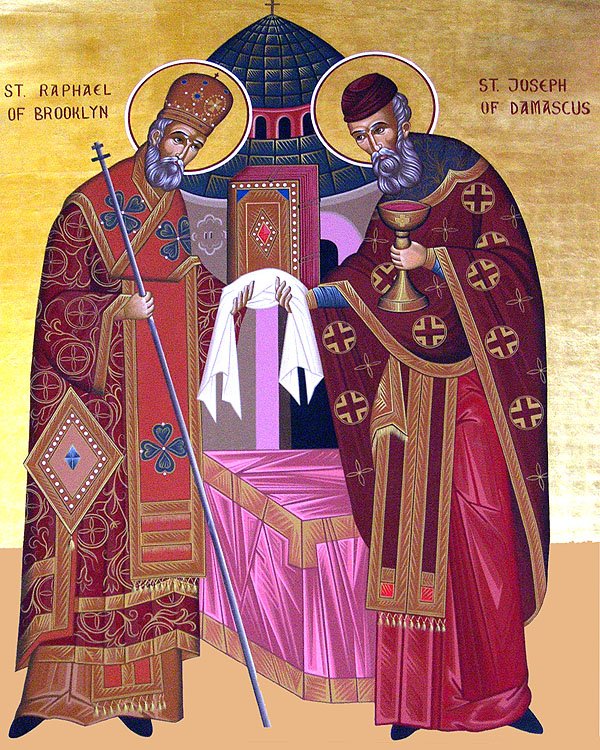
Saint Joseph, and his companions, of Damascus
No information available at this time.
Troparion - Tone 5
O faithful, let us honor the martyr of Christ, / the priest of the Church of Antioch, / who baptized the land, the churches, and the people of Syria, / in the word of the Lord, / in his blood and in the blood of his companions. / Being baptized, since his youth, by the light of the Gospel, / he labored, taught and kept the Church of Christ with her sheep. / Therefore, O Joseph the Damascene, / be our example and our protector / and our fervent intercessor with the Savior.
Scripture Readings
☩Epistle
1 Corinthians 4:5-8
5
Therefore judge nothing before the time, until the Lord come, who both will bring to light the hidden things of darkness, and will make manifest the counsels of the hearts: and then shall every man have praise of God.
6
And these things, brethren, I have in a figure transferred to myself and to Apollos for your sakes; that ye might learn in us not to think of men above that which is written, that no one of you be puffed up for one against another.
7
For who maketh thee to differ from another? and what hast thou that thou didst not receive? now if thou didst receive it, why dost thou glory, as if thou hadst not received it?
8
Now ye are full, now ye are rich, ye have reigned as kings without us: and I would to God ye did reign, that we also might reign with you.
☩Gospel
Matthew 13:44-54
44
Again, the kingdom of heaven is like unto treasure hid in a field; the which when a man hath found, he hideth, and for joy thereof goeth and selleth all that he hath, and buyeth that field.
45
Again, the kingdom of heaven is like unto a merchant man, seeking goodly pearls:
46
Who, when he had found one pearl of great price, went and sold all that he had, and bought it.
47
Again, the kingdom of heaven is like unto a net, that was cast into the sea, and gathered of every kind:
48
Which, when it was full, they drew to shore, and sat down, and gathered the good into vessels, but cast the bad away.
49
So shall it be at the end of the world: the angels shall come forth, and sever the wicked from among the just,
50
And shall cast them into the furnace of fire: there shall be wailing and gnashing of teeth.
51
Jesus saith unto them, Have ye understood all these things? They say unto him, Yea, Lord.
52
Then said he unto them, Therefore every scribe which is instructed unto the kingdom of heaven is like unto a man that is an householder, which bringeth forth out of his treasure things new and old.
53
And it came to pass, that when Jesus had finished these parables, he departed thence.
54
And when he was come into his own country, he taught them in their synagogue, insomuch that they were astonished, and said, Whence hath this man this wisdom, and these mighty works?