Fasting Rules
 Meat
Allowed
Meat
Allowed
 Fish
Allowed
Fish
Allowed
 Dairy
Allowed
Dairy
Allowed
 Oil
Allowed
Oil
Allowed
 Wine
Allowed
Wine
Allowed
Saints & Commemorations
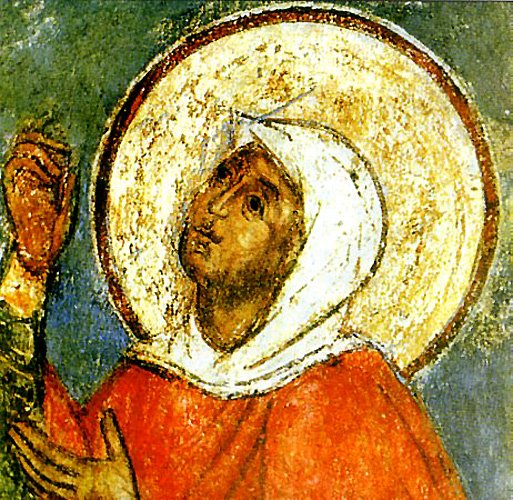
Greatmartyr Euphemia the All-praised
The Miracle of Saint Euphemia the All-Praised: The holy Great Martyr Euphemia (September 16) suffered martyrdom in the city of Chalcedon in the year 304, during the time of the persecution against Christians by the emperor Diocletian (284-305). One and a half centuries later, at a time when the Christian Church had become victorious within the Roman Empire, God deigned that Euphemia the All-Praised should again be a witness and confessor of the purity of the Orthodox teaching.
The Miracle of Saint Euphemia the All-Praised: The holy Great Martyr Euphemia (September 16) suffered martyrdom in the city of Chalcedon in the year 304, during the time of the persecution against Christians by the emperor Diocletian (284-305). One and a half centuries later, at a time when the Christian Church had become victorious within the Roman Empire, God deigned that Euphemia the All-Praised should again be a witness and confessor of the purity of the Orthodox teaching.
In the year 451 in the city of Chalcedon, in the very church where the glorified relics of the holy Great Martyr Euphemia rested, the sessions of the Fourth Ecumenical Council (July 16) took place. The Council was convened for determining the precise dogmatic formulae of the Orthodox Church concerning the nature of the God-Man Jesus Christ. This was necessary because of the widespread heresy of the Monophysites [“mono-physis” meaning “one nature”], who opposed the Orthodox teaching of the two natures in Jesus Christ, the Divine and the Human natures (in one Divine Person). The Monophysites falsely affirmed that in Christ was only one nature, the Divine [i.e. that Jesus is God but not man, by nature], causing discord and unrest within the Church. At the Council were present 630 representatives from all the local Christian Churches. On the Orthodox side Anatolius, Patriarch of Constantinople (July 3), Juvenal, Patriarch of Jerusalem (July 2), and representatives of Saint Leo, Pope of Rome (February 18) participated in the conciliar deliberations. The Monophysites were present in large numbers, headed by Dioscorus, the Patriarch of Alexandria, and the Constantinople archimandrite Eutychius.
After prolonged discussions the two sides could not come to a decisive agreement.
The holy Patriarch Anatolius of Constantinople proposed that the Council submit the decision of the Church dispute to the Holy Spirit, through His undoubted bearer Saint Euphemia the All-Praised, whose wonderworking relics had been discovered during the Council’s discussions. The Orthodox hierarchs and their opponents wrote down their confessions of faith on separate scrolls and sealed them with their seals. They opened the tomb of the holy Great Martyr Euphemia and placed both scrolls upon her bosom. Then, in the presence of the emperor Marcian (450-457), the participants of the Council sealed the tomb, putting on it the imperial seal and setting a guard to watch over it for three days. During these days both sides imposed upon themselves strict fast and made intense prayer. After three days the patriarch and the emperor in the presence of the Council opened the tomb with its relics: the scroll with the Orthodox confession was held by Saint Euphemia in her right hand, and the scroll of the heretics lay at her feet. Saint Euphemia, as though alive, raised her hand and gave the scroll to the patriarch. After this miracle many of the hesitant accepted the Orthodox confession, while those remaining obstinant in the heresy were consigned to the Council’s condemnation and excommunication.
After an invasion by the Persians during the seventh century, the relics of Saint Euphemia were transferred from Chalcedon to Constantinople, into a newly built church dedicated to her. Many years later, during the period of the Iconoclast heresy, the reliquary with the relics of the saint was cast into the sea by order of the Iconoclast emperor Leo the Isaurian (716-741). The reliquary was rescued from the sea by the ship-owning brothers Sergius and Sergonos, who gave it over to the local bishop. The holy bishop ordered that the relics be preserved in secret, beneath a crypt, since the Iconoclast heresy was continuing to rage. A small church was built over the relics, and over the reliquary was put a board with an inscription stating whose relics rested within. When the Iconoclast heresy was finally condemned at the holy Seventh Ecumenical Council (in the year 787), during the time of Saint Tarasius, Patriarch of Constantinople (784-806) and the emperor Constantine VI (780-797) and his mother Saint Irene (797-802), the relics of the holy Great Martyr Euphemia were once again solemnly transferred to Constantinople.
Troparion - Tone 3
You brought joy to the Orthodox / and shame to the defenders of heresy, / for you confirmed what the Fathers of the Fourth Council had correctly taught. / Glorious martyr Euphemia, fair virgin of Christ, / entreat Christ God to grant us His great mercy.
Kontakion - Tone 2
For the sake of Christ your Bridegroom / you underwent struggles in both martyrdom and faith. / Now intercede with the Mother of God / that heresies and the insolent enemies of the Orthodox be placed underfoot. / You received and guarded that which was defined by the six hundred and thirty God-bearing Fathers, / all-praised Euphemia.
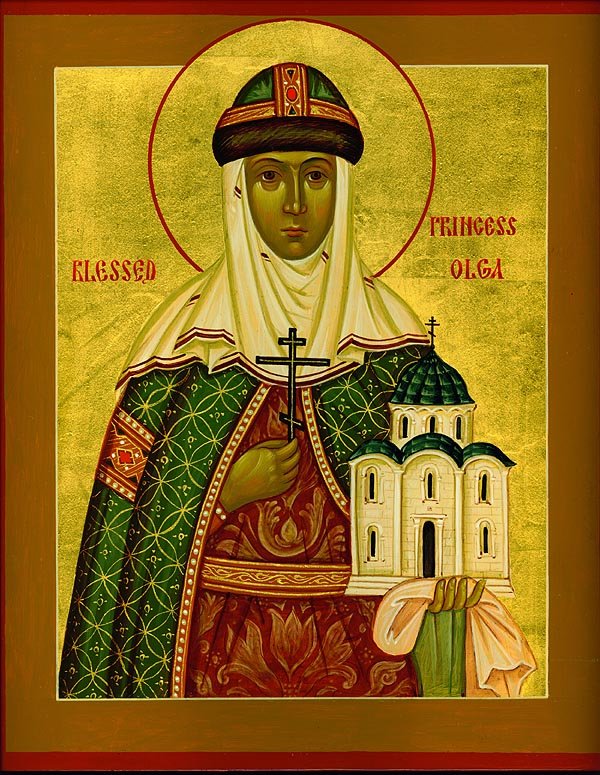
Equal-to-the-Apostles Blessed Great Princess Olga (in Holy Baptism Helen)
“Saint Olga, renowned for her wisdom and sobriety, in her youth became the wife of Igor, Great Prince of Kiev, who ruled during the tenth century. After her husband’s death, she herself ruled capably, and was finally moved to accept the Faith of Christ. She travelled to Constantinople to receive Holy Baptism. The
“Saint Olga, renowned for her wisdom and sobriety, in her youth became the wife of Igor, Great Prince of Kiev, who ruled during the tenth century. After her husband’s death, she herself ruled capably, and was finally moved to accept the Faith of Christ. She travelled to Constantinople to receive Holy Baptism. The Emperor, seeing her outward beauty and inward greatness, asked her to marry him. She said she could not do this before she was baptized; she furthermore asked him to be her Godfather at the font, which he agreed to do. After she was baptized (receiving the name of Helen), the Emperor repeated his proposal of marriage. She answered that now he was her father, through Holy Baptism, and that not even among the heathen was it heard of a man marrying his daughter. Gracefully accepting to be outwitted by her, he sent her back to her land with priests and sacred texts and holy icons. Although her son Svyatoslav remained a pagan, she planted the seed of faith in her grandson Vladimir (see July 15). She reposed in peace in 969.” (Great Horologion)
Troparion - Tone 1
Giving your mind the wings of divine understanding, / you soared above visible creation seeking God the Creator of all. / When you had found Him, you received rebirth through baptism. / As one who enjoys the Tree of Life, / you remain eternally incorrupt, ever-glorious Olga.
Kontakion - Tone 4
Today let us praise God the Benefactor of all, / who glorified divinely-wise Olga, / that through her prayers, He may grant our souls remission of sins.
New Martyrs Nikodemos (1722) and Nektarios (1820)
These two martyrs were unrelated, but their stories are similar. Both were Christians who embraced Islam at an early age under the Turks. Both later repented and, after doing penance, resolved to return to the place of their apostasy and accept martyrdom. Both presented themselves to the Turks, proclaimed their Christian faith, and were beheaded according to Islamic law.
These two martyrs were unrelated, but their stories are similar. Both were Christians who embraced Islam at an early age under the Turks. Both later repented and, after doing penance, resolved to return to the place of their apostasy and accept martyrdom. Both presented themselves to the Turks, proclaimed their Christian faith, and were beheaded according to Islamic law.
Saint Nikodemos not only embraced Islam, but forced his family to do the same. One of his sons fled to the Holy Mountain and became a monk. The father pursued him there, but was moved to repentance by the holiness of the place and became a monk himself. After three years of penance, he resolved to return home to Albania and embrace his martyrdom.
Saint Nektarios converted to Islam (the Prologue says under duress) at the age of seventeen. When his mother saw him dressed as a Turk, she cried “Get away from me! I do not know you. I bore you as a Christian, not a Turk!” Repenting of his deed he went to the Holy Mountain and became a monk. Like St Nikodemos, he determined after a few years to return home and accept martyrdom for Christ.
Hieromartyr Kindeos the Presbyter of Pamphylia
The Hieromartyr Kindeos was a priest in the village of Talmenia (Sidḗ in Pamphylia) in Asia Minor. At that time Emperor Diocletian was persecuting the Christians. Even so, Saint Kindeos labored tirelessly to spread the message of the Gospel. For this reason, he was denounced to the eparch Stratónikos and condemned to be burnt alive.
A
The Hieromartyr Kindeos was a priest in the village of Talmenia (Sidḗ in Pamphylia) in Asia Minor. At that time Emperor Diocletian was persecuting the Christians. Even so, Saint Kindeos labored tirelessly to spread the message of the Gospel. For this reason, he was denounced to the eparch Stratónikos and condemned to be burnt alive.
As the soldiers were leading him to his death, they met a wood-cutter with a large bundle of firewood, which they confiscated to be used as kindling for the fire, and the Martyr paid the man 30 copper coins for it. On the way, the man with the wood suddenly became ill and fell down. The Saint took the burden upon his own shoulders and carried it to the place of execution.
Even in the fire, the Hieromartyr Kindeos, with God's help, remained a steadfast warrior of Christ. After he had been placed on the pyre, and before the flames enveloped him, he he found the strength to entreat the spectators to accept the true Faith and the Lord's grace. Then a powerful thunderstorm sprang up, and the fire went out. When the storm abated, the Holy Martyr surrendered his soul to Christ in the year 290.
A pagan priest who had heard the words of Saint Kindeos was astonished by his courage in the face of death. The priest and his wife believed in Christ, and were baptized. It was they who arranged for the burial of the Holy Martyr.
Troparion - Tone 4
By sharing in the ways of the Apostles, / you became a successor to their throne. / Through the practice of virtue, you found the way to divine contemplation, O inspired one of God; / by teaching the word of truth without error, you defended the Faith, / even to the shedding of your blood. / Hieromartyr Kindeos, entreat Christ God to save our souls.
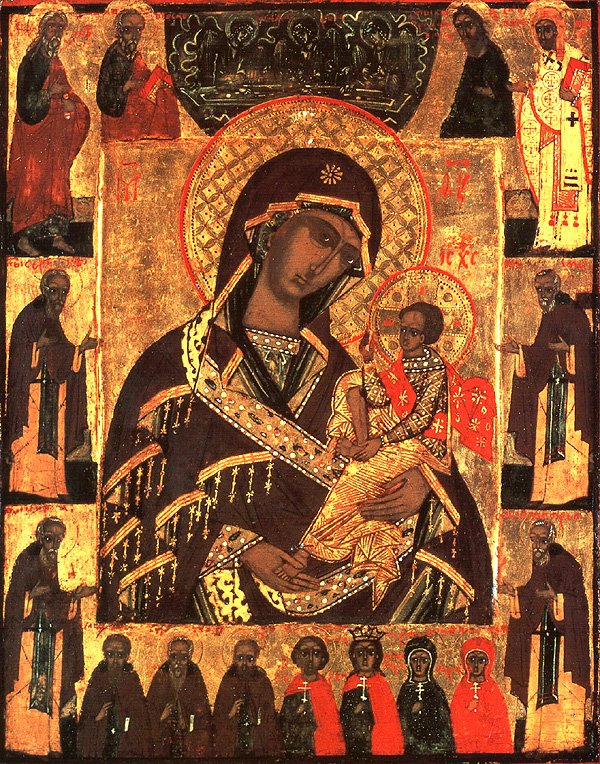
Icon of the Mother of God of Rzhevsk
The Rzhevsk (or Okovetsk) Icon of the Mother of God is from the Rzhevets Monastery in Poltava. On May 26, 1539, on the day of the Descent of the Holy Spirit (Pentecost), in Tver diocese, in Vyryshensk town situated in a virgin forest on the bank of the rivulet Vyryshna in the Okovetsk district, not far from the city of Rzhev, at a crossroads for people from four surrounding villages, the monk Stephen made a discovery: fastened to a pine tree was a large iron cross and on another tree an old painted icon depicting the Mother of God with Child, and also Saint Nicholas the Wonderworker of Myra.
The Rzhevsk (or Okovetsk) Icon of the Mother of God is from the Rzhevets Monastery in Poltava. On May 26, 1539, on the day of the Descent of the Holy Spirit (Pentecost), in Tver diocese, in Vyryshensk town situated in a virgin forest on the bank of the rivulet Vyryshna in the Okovetsk district, not far from the city of Rzhev, at a crossroads for people from four surrounding villages, the monk Stephen made a discovery: fastened to a pine tree was a large iron cross and on another tree an old painted icon depicting the Mother of God with Child, and also Saint Nicholas the Wonderworker of Myra. With the discovery of the holy cross and the icon there shone an extraordinary light and healings occurred. From the Day of the Holy Spirit to the start of the Apostles’ Fast, 27 healings occurred.
The monk Stephen, and right after him the Rzhevsk priest Gregory Onisiphorov, journeyed to Moscow with reports of the appearance of the holy icon and cross and the healing that occurred. The then head of the Russian Church, Metropolitan Joasaph (1539-1541) of Moscow, gave thanks to the Lord, and after verifying the miracles of that place, gave blessing to erect there two churches: one dedicated to the Procession of the Venerable Wood of the Cross of the Lord, and the other in honor of the Hodēgḗtria Mother of God, having in it a chapel named for Saint Nicholas the Wonderworker. At the consecration of the churches a priest and deacon were sent from Moscow, together with church utensils, icons, vestments, books and bells.
In January 1541 the Rzhevsk icon was solemnly transferred to Moscow for the consecration of a church in honor of the Rzhevsk Icon of the Mother of God. After the consecration of the temple, the icon and cross were transferred to the Dormition cathedral, where they remained until July 11. On this day the Rzhevsk icon and cross were returned to the place of their miraculous appearance. The metropolitan together with all the assembled clergy of the capital, and with the young Tsar Ivan Vasilievich, and all the people, accompanied the icon from the Dormition cathedral to the church of the Rzhevsk Icon of the Mother of God, where a copy of this venerable icon was placed. In memory of this celebration the Feast of the Rzhevsk Icon of the Mother of God was established on July 11.
Troparion - Tone 4
Let us sinners and wretched people now run most earnestly to the Theotokos, / and let us fall down in repentance, crying out from the depths of our souls: / “O Sovereign Lady, have compassion on us, / help us, and come quickly, for we are perishing from a multitude of transgressions. / Do not turn your servants away empty-handed, for we have you as our only hope.”
Kontakion - Tone 6
We have no other help, we have no other hope, but you, O Lady. / Help us, for in you we hope, / and of you we boast, for we are your servants. / Let us not be put to shame.
St Sophrony of Essex (1993) (June 28 OC)
He was born in Russia in 1896. As a young man, he lived an artist’s life, trying to succeed as a painter while engaging in a wide-ranging spiritual search which included study of the Eastern religions. He fled to Paris during the Russian Revolution. There he rediscovered the Orthodoxy of his childhood and gave his life wholly to repentance and prayer, often spending hours at a time prostrated and weeping on the floor of his Paris apartment. I
He was born in Russia in 1896. As a young man, he lived an artist’s life, trying to succeed as a painter while engaging in a wide-ranging spiritual search which included study of the Eastern religions. He fled to Paris during the Russian Revolution. There he rediscovered the Orthodoxy of his childhood and gave his life wholly to repentance and prayer, often spending hours at a time prostrated and weeping on the floor of his Paris apartment. In 1925 he moved to Mt Athos, where he lived as a monk for more than twenty years. On the Holy Mountain he became the spiritual child of the holy elder Silouan. After St Silouan’s repose, his own health badly damaged by living in a damp cave, he was granted permission by his monastery to leave the Holy Mountain and write a life of St Silouan. This is St Silouan of Mt Athos, a great spiritual treasure which includes the writings of the Saint as well as Fr Sophrony’s profound reflections on his life. (It was largely through Fr Sophrony’s work that St Silouan, who lived an almost completely hidden life, was glorified by the Church).
In 1959 Fr Sophrony founded the Monastery of St John the Baptist in Essex, England, where he lived until his repose. He was a spiritual father to Metropolitan Hierotheos of Nafpakthos, one of present-day Orthodoxy’s most profound spiritual writers, who has said this about him: “I ascertained from almost the first meeting… that Father Sophrony was a Theologian of our Church, a God-seer. I realized, that is, that the Elder had seen the Uncreated Light… I had discerned that he was truly a God-seer, because otherwise his whole life, his whole demeanor, the words he said, the counsels, and in any case his whole personality, could not be justified. He was literally altered by the uncreated Grace of God.” At Essex, he was known as spiritual father to many and (little publicized) as a wonderworker and intercessor. He reposed in peace in 1993. In 2019 He was formally glorified as a Saint of the Church by the Patriarchate of Constantinople.
Any who wish to drink from the deep well of his teaching can read (in addition to St Silouan) his books On Prayer and We Shall See Him As He Is.
“Any and every dogmatic error will inevitably reflect on one’s spiritual life.” — Elder Sophrony
New Monastic Martyr Νikόdēmos of Albania
The New Monastic Martyr Νikόdēmos came from Elbasan, a town of Epirus (Albania) and was raised by devout parents. When he reached a suitable age, he married a Christian woman and they had several children. Since he associated with Turks, he was influenced by them and became a Moslem. He even forced his children to follow his example, except for one son, who was abducted by certain Christians and sent to Mount Athos. Th
The New Monastic Martyr Νikόdēmos came from Elbasan, a town of Epirus (Albania) and was raised by devout parents. When he reached a suitable age, he married a Christian woman and they had several children. Since he associated with Turks, he was influenced by them and became a Moslem. He even forced his children to follow his example, except for one son, who was abducted by certain Christians and sent to Mount Athos. There he was tonsured as a monk.
Searching for the young man in order to convert him to Islam, the wretched father learned that he was on the Holy Mountain. He traveled to Athos in great anger, vowing to cause serious trouble for the monasteries if he found his son there. God, Who desires that all may be saved, effected his salvation in a marvelous way. Instead of finding his son and converting him, he himself came to his senses and repented. Forsaking both Islam and the world, he became a monk at the Skete of Saint Anne, in the Kalyva (isolated cell) of the Ascension, with the new name of Νikόdēmos.
His repentance was such that he kept a strict fast for three years, weeping and begging God to forgive his terrible sin of apostasy. One day he heard some of the Fathers saying that whoever denies Christ must go back to the same place and confess Him before men. From that moment, he burned with a desire for martyrdom. Therefore, he prepared himself through asceticism, fasting, and prayer.
Hearing of Saint Akakios (April 12) of the Skete of Kausokalyvia [Καυσοκαλύβια], Νikόdēmos visited him in order to receive his blessing and his instructions. As soon as Νikόdēmos beheld the Saint, he fell down at his feet and wept for a long time. Saint Akakios took him by the hand and addressed him by name, although he did not know him. Raising him up, he comforted him. Then he withdrew for a short distance and began to pray. Those who were present saw a light from Heaven, shining like a star, which illumined the Saint's face. Then he turned to Νikόdēmos and whispered something to him, and then the radiance disappeared.
Overcome with contrition and by divine grace, Νikόdēmos cried out with a loud voice. Then he went into the cave and wept for a considerable time. Later, he returned to Saint Akakios and asked for his blessing to go forth to martyrdom. Blessing him and placing a staff in his hand, the Saint said, "Take this staff and go before the pasha. By the power of God, you will complete your martyrdom well."
Νikόdēmos took the staff, and was ready to leave at once to achieve his goal. However, weakened by fasting, he was not capable of walking all the way back to Elbasan. Therefore, he asked Saint Akakios if he might break his fast in order to strengthen himself for the journey.
The Saint replied, "Now, more than ever, you must fast, Brother, for soon you will be struggling for Christ. Walk as much as you can, and the Lord Who said 'Man shall not live by bread alone, but by every word that proceeds from the mouth of God' (Matthew 4:4), shall strengthen you to walk with ease."
The Martyr answered, "O Father, by your prayers, may our Lord Jesus Christ have mercy on me, and enable me to confess the good confession (I Timothy 6:12). I fear the demons, however."
Saint Akakios chided him, "Fear God, Brother, and not the demons who have no authority of their own over us. Therefore, place all your hope in Christ, not only to vanquish the demons, but also to help you in bearing witness to Him."
Hearing this, Νikόdēmos wept tears of joy. Falling down to the ground and kissing the Saint's feet, he received his blessing and went on his way. While he was still on the Holy Mountain, the Lord appeared to Νikόdēmos and encouraged him. He revealed all the trials that he would face, and even the site of his execution.
Strengthened by Christ, Νikόdēmos arrived at Elbasan. There he was recognized by the Turks, arrested, and brought before the pasha, who tried to make him return to Islam. Νikόdēmos rejected the religion of the Turks and courageously confessed Christ. Then they took him to a high precipice and pushed him off. Miraculously, he floated down gently and landed on his feet.
Returning to the palace, he appeared before the pasha, who was terrified to see him alive. He almost released Νikόdēmos, but fearing the mob of Turks, he turned the Martyr over to them. They tortured him for three days and nights before leading him to the place of execution. Along the way, they made him kneel several times, as if they intended to behead him.
When they reached the place which the Lord had revealed to him, Christ's Martyr showed no sign of fear. He bent his neck and was beheaded with a sword, and his soul went to Heaven with the crown of martyrdom on July 11, 1722.
After the Saint's martyrdom, Christians buried him in the church of the Theotokos, where his incorrupt and fragrant relics are still preserved, working miracles for those who run to him with faith. A piece of his relics is also kept in the Skete of Saint Anne, where there is a manuscript with his Church Service. A new Service was composed by the monk John Danielidis and others.
Troparion - Tone 1
The image of God was truly preserved in you, O Father, / for you took up the Cross and followed Christ. / By so doing you taught us to disregard the flesh for it passes away / but to care instead for the soul, since it is immortal. / Therefore your spirit, venerable Νikόdēmos, rejoices with the angels.
Kontakion - Tone 2
As a venerable and proven ascetic, as an honorable and renowned martyr, / and as a model of the desert life, O most exalted Νikόdēmos, / we sing hymns of praise to you, / for you have trampled upon serpents.
Transfer of the Relics of Saint Barbara
In the VI century the relics of the Holy Great Martyr Barbara (December 4) were transferred from Heliopolis to Constantinople, and in the XII century Princess Barbara, the daughter of the Byzantine Emperor Alexios Komnenos (reigned 1081-1118) married the Russian Prince Michael Izyaslavich, bringing with her the relics of Saint Barbara.
In the VI century the relics of the Holy Great Martyr Barbara (December 4) were transferred from Heliopolis to Constantinople, and in the XII century Princess Barbara, the daughter of the Byzantine Emperor Alexios Komnenos (reigned 1081-1118) married the Russian Prince Michael Izyaslavich, bringing with her the relics of Saint Barbara. They remain in the cathedral of the Holy Prince Vladimir (July 15) up to the present day. An Akathist to Saint Barbara is served there every Tuesday.
The hand of Saint Barbara is kept in a special shrine at Saint Michael's Monastery in Kiev, on the left side of the church. The glove covering her hand is changed frequently, then the old glove is cut up and the pieces are distributed to pilgrims.
Troparion - Tone 8
Let us honor the holy martyr Barbara, / for as a bird she escaped the snares of the enemy, / and destroyed them through the help and defense of the Cross.
Kontakion - Tone 4
Singing the praises of the Trinity, / you followed God by enduring suffering; / you renounced the multitude of idols, / O holy martyr Barbara. / In your struggles, you were not frightened by the threats of your torturers, but cried out in a loud voice: / “I worship the Trinity in one God-head.”
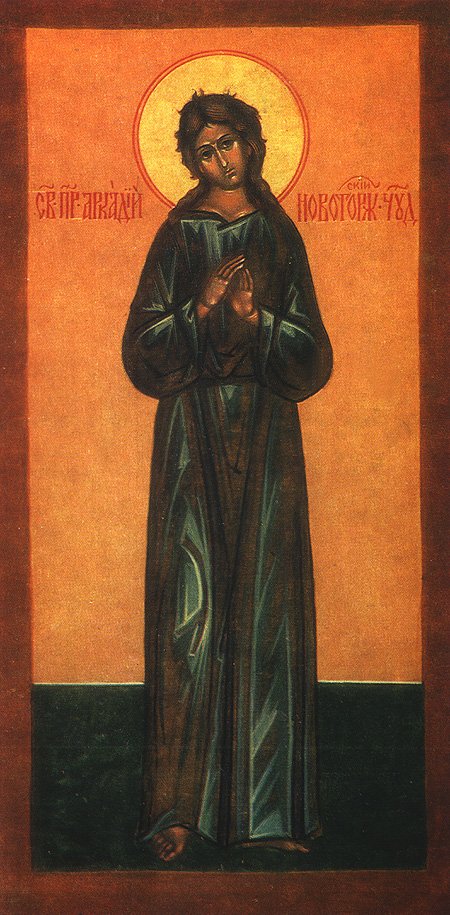
Venerable Arcadius of Novotorsk
Saint Arcadius of Vyazma and Novotorsk was from the city of Vyazma of pious parents, who from childhood taught him prayer and obedience. The gentle, perceptive, prudent and good youth chose for his ascetic feat of being a fool-for-Christ. He lived by alms, and slept wherever he found himself, whether in the forest, or on the church portico.
Saint Arcadius of Vyazma and Novotorsk was from the city of Vyazma of pious parents, who from childhood taught him prayer and obedience. The gentle, perceptive, prudent and good youth chose for his ascetic feat of being a fool-for-Christ. He lived by alms, and slept wherever he found himself, whether in the forest, or on the church portico.
His blessed serenity and closeness to nature imparted to the figure of young Arcadius a peculiar spiritual aspect and aloofness from worldly vanity. In church, when absorbed in prayer, Saint Arcadius often wept tears of tenderness and spiritual joy. Though he seldom spoke, his advice was always good, and his predictions were fulfilled.
An experienced guide, Saint Ephraim the Wonderworker of Novotorsk (January 28), helped the young ascetic to avoid spiritual dangers while passing through the difficult and unusual exploit of foolishness. After this the people of Vyazma witnessed several miracles, worked through the prayers of Blessed Arcadius, but the saint fled human fame and traveled along the upper Tvertsa River. Here Saint Arcadius shared the work with his spiritual guide Saint Ephraim, and with him founded a church and monastery in honor of the holy Passion-Bearers Boris and Gleb (May 2).
Entering into the newly-built monastery, Saint Arcadius became a monk and took upon himself the exploit of full obedience to his spiritual Father, Saint Ephraim. Saint Arcadius never missed Liturgy and he was always the first to appear for Matins together with his spiritual guide. After Saint Ephraim’s repose (January 28, 1053), Saint Arcadius continued to pursue asceticism in accord with the last wishes of his Elder, dwelling in prayer, fasting and silence. After several years, he also fell asleep in the Lord (December 13, 1077).
In 1594, a chapel dedicated to Saint Arcadius was built in one of the churches of Vyazma. A combined celebration of Saints Arcadius and Ephraim was established by Metropolitan Dionysius in the years 1584-1587. The relics of Saint Arcadius, glorified by miracles of healing, were uncovered on June 11, 1572, and on July 11, 1677, they were placed in a stone crypt of Saints Boris and Gleb cathedral in the city of Novotorsk (New Market). In 1841, the left side chapel of Saints Boris and Gleb cathedral church was dedicated in honor of Saint Arcadius. The solemn celebration of the 300th anniversary of the uncovering of the holy relics of Saint Arcadius took place in the city of Novotorsk in July of 1977. He is also commemorated on August 14 and June 11 (Transfer of his relics).
Troparion - Tone 8
By a flood of tears you made the desert fertile, / and your longing for God brought forth fruits in abundance. / By the radiance of miracles you illumined the whole universe! / O our holy father Arcadius, pray to Christ our God to save our souls!
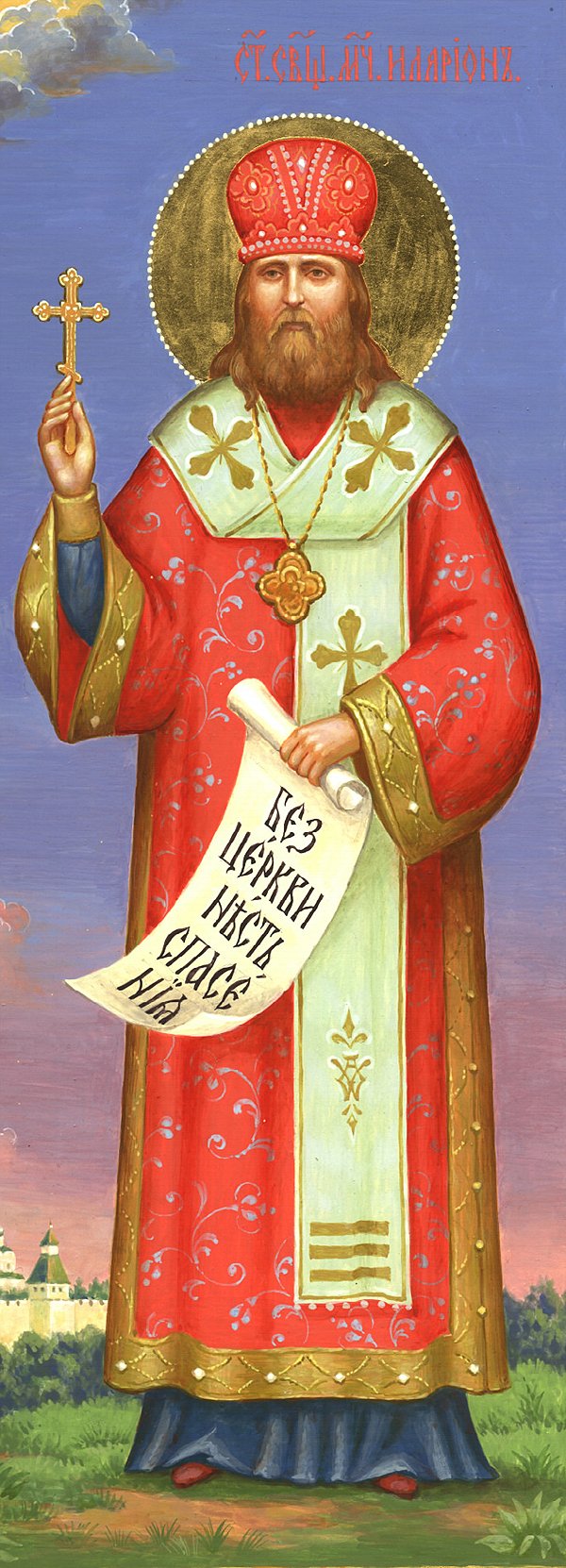
Finding of the Relics of Saint Hilarion, Archbishop of Verey
The New Hieromartyr Hilarion (Troitsky) fell asleep in the Lord on December 15, 1929 after spending six years in labor camps. When Metropolitan Seraphim (Chichagov) of Leningrad obtained permission from the authorities to take Saint Hilarion's body from the prison hospital for burial, he vested him in white vestments and a mitre, and then brought him to the church at Novodevichii Monastery in Leningrad.
The New Hieromartyr Hilarion (Troitsky) fell asleep in the Lord on December 15, 1929 after spending six years in labor camps. When Metropolitan Seraphim (Chichagov) of Leningrad obtained permission from the authorities to take Saint Hilarion's body from the prison hospital for burial, he vested him in white vestments and a mitre, and then brought him to the church at Novodevichii Monastery in Leningrad. When the Saint's relatives saw his body, they barely recognized him. His years in the labor camps had changed his appearance from that of a man of forty-four into a grey-haired old man.
Metropolitan Seraphim presided at the funeral service and burial, assisted by Archbishop Alexei (Simansky), the future Patriarch of Moscow, and five other hierarchs. Saint Hilarion was buried in the cemetery of Novodevichii Monastery in Leningrad.
The relics of Saint Hilarion were found on July 11, 1998.
On May 10, 1999, Saint Hilarion, the Archbishop of Verey, was glorified as a saint by the Russian Orthodox Church. On the eve of his canonization, the Holy Hieromartyr’s relics were uncovered and transferred from St. Petersburg to Moscow and were placed in the church of the Sretensky Monastery.
Saint Hilarion is commemorated on December 15 (his repose in 1929); May 10 (his glorification in 1999); the Third Sunday after Pentecost (All Saints of St. Petersburg); July 11 (The Finding of his relics in 1998); on the Sunday nearest to August 26 (All Saints of Moscow).
Troparion - Tone 4
O Hilarion, warrior of Christ, / glory and boast of the Church of Russia, / you confessed Christ before the perishing world, / you strengthened the Church by your blood, / and having acquired divine understanding, / you proclaimed to the faithful: / Without the Church there is no salvation!
Kontakion - Tone 6
O Hilarion, Hieromartyr of Christ, you were not afraid of the servants of the coming Antichrist, / but confessed Christ courageously and laid down your life for God's Church, / O adornment of the New Martyrs of Russia, and boast of Holy Russia, / you are the glory and confirmation of our Church.
Scripture Readings
☩Epistle
Romans 9:1-5
1
I say the truth in Christ, I lie not, my conscience also bearing me witness in the Holy Ghost,
2
That I have great heaviness and continual sorrow in my heart.
3
For I could wish that myself were accursed from Christ for my brethren, my kinsmen according to the flesh:
4
Who are Israelites; to whom pertaineth the adoption, and the glory, and the covenants, and the giving of the law, and the service of God, and the promises;
5
Whose are the fathers, and of whom as concerning the flesh Christ came, who is over all, God blessed for ever. Amen.
☩Gospel
Matthew 9:18-26
18
While he spake these things unto them, behold, there came a certain ruler, and worshipped him, saying, My daughter is even now dead: but come and lay thy hand upon her, and she shall live.
19
And Jesus arose, and followed him, and so did his disciples.
20
And, behold, a woman, which was diseased with an issue of blood twelve years, came behind him, and touched the hem of his garment:
21
For she said within herself, If I may but touch his garment, I shall be whole.
22
But Jesus turned him about, and when he saw her, he said, Daughter, be of good comfort; thy faith hath made thee whole. And the woman was made whole from that hour.
23
And when Jesus came into the ruler’s house, and saw the minstrels and the people making a noise,
24
He said unto them, Give place: for the maid is not dead, but sleepeth. And they laughed him to scorn.
25
But when the people were put forth, he went in, and took her by the hand, and the maid arose.
26
And the fame hereof went abroad into all that land.
Liturgical data sourced from OCA.org and orthocal.info