Fasting Rules

Meat allowed Meat Allowed
Fish allowed Fish Allowed
Dairy allowed Dairy Allowed
Oil allowed Oil Allowed
Wine allowed Wine Allowed

Saints & Commemorations
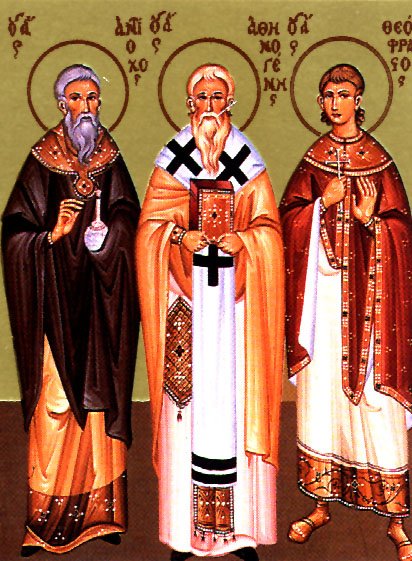
Hieromartyr Athenogenes, Bishop of Heracleopolis, and his ten disciples

Hieromartyr Athenogenes, Bishop of Heracleopolis, and his ten disciples

Hieromartyr Athenogenes and his Ten Disciples suffered for Christ during the persecution of Christians in the city of Sebastea in Cappadocia. The governor Philomachos arranged a large festival in honor of the pagan gods and called upon the citizens of Sebastea to offer sacrifice to the idols. Most of the inhabitants of Sebastea were Christians, and refused to participate in the impious celebration. Hieromartyr Athenogenes and his Ten Disciples suffered for Christ during the persecution of Christians in the city of Sebastea in Cappadocia. The governor Philomachos arranged a large festival in honor of the pagan gods and called upon the citizens of Sebastea to offer sacrifice to the idols. Most of the inhabitants of Sebastea were Christians, and refused to participate in the impious celebration. Soldiers were ordered to kill those who resisted, and so many Christians received a martyr’s crown. It came to the governor’s attention that Christianity was spreading because of the grace-filled preaching of Bishop Athenogenes. Soldiers were ordered to find the Elder and arrest him. Bishop Athenogenes and ten of his disciples lived in a small monastery not far from the city. The soldiers did not find the bishop there, so they arrested his disciples. The governor ordered that they be bound with chains and thrown into prison. Saint Athenogenes was arrested when he came to Sebastea to inform the judge that those who had been jailed were innocent. While in prison, Saint Athenogenes encouraged his spiritual children for their impending struggle. Led forth to trial, all the holy martyrs confessed themselves Christians and refused to offer sacrifice to idols. After undergoing fierce tortures, the disciples of the holy bishop were beheaded. After the execution of the disciples, the executioners were ordered to torture the bishop. Strengthened by the Lord, Saint Athenogenes underwent the tortures with dignity. His only request was that he be executed in the monastery. Taken to his own monastery, the saint gave thanks to God, and he rejoiced in the sufferings that he had undergone for Him. Saint Athenogenes asked that the Lord would forgive the sins of all those who would remember both him and his disciples. The Lord granted the saint to hear His Voice before death, announcing the promise given to the penitent thief: “Today you shall be with Me in Paradise.” The hieromartyr willingly bent his neck beneath the sword.

Troparion - Tone 2

Most blessed and wise Bishop and Martyr Athenogenes, / you grew as a palm tree in the Monastic life; / towering as a cedar in your struggles, / through your teachings you brought a number of martyrs to Christ. / We honor them together with you.

Kontakion - Tone 4

By sharing in the ways of the Apostles, / you became a successor to their throne. / Through the practice of virtue, you found the way to divine contemplation, O inspired one of God; / by teaching the word of truth without error, you defended the Faith, / even to the shedding of your blood. / Hieromartyr Athenogenes, entreat Christ God to save our souls.

Martyrs Paul and two sisters, Chionia (Thea) and Alevtina (Valentina), at Cæsarea in Palestine

The Holy Martyrs Paul, Alevtina, and Chionia were from Egypt. During the persecution against Christians under the emperor Maximian (305-313), they were taken to Palestinian Caesarea. Without the slightest fear they confessed themselves as followers of Christ. In the year 308 the sisters Alevtina and Chionia were burned, and Paul was beheaded.

Troparion - Tone 4

Your holy martyrs O Lord, / through their sufferings have received incorruptible crowns from You, our God. / For having Your strength, they laid low their adversaries, / and shattered the powerless boldness of demons. / Through their intercessions, save our souls!
Martyr Antiochus the Physician of Sebaste

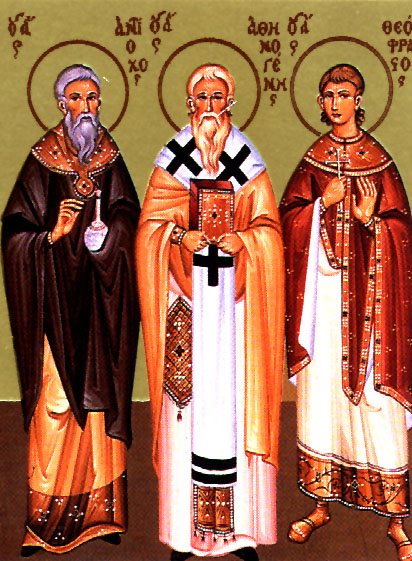
Martyr Antiochus the Physician of Sebaste

The Holy Martyr Antiochus, a native of Cappadocian Sebastea, was the brother of the holy Martyr Platon (November 18), and he was a physician. The pagans learned that he was a Christian, and they brought him to trial and subjected him to fierce tortures. Thrown into boiling water, the saint remained unharmed. The Holy Martyr Antiochus, a native of Cappadocian Sebastea, was the brother of the holy Martyr Platon (November 18), and he was a physician. The pagans learned that he was a Christian, and they brought him to trial and subjected him to fierce tortures. Thrown into boiling water, the saint remained unharmed. He was then given over to be eaten by wild beasts, but they did not harm him. Instead, the beasts lay peacefully at his feet. Through the prayers of the martyr many miracles were worked and the idols crumbled into dust. The pagans beheaded Saint Antiochus. Seeing the guiltless suffering of the saint, Cyriacus, a participant in the execution, was converted to Christ. He confessed his faith in front of everyone and was also beheaded. They buried the martyrs side by side.

Troparion - Tone 3

Your holy martyr Antiochus, O Lord, / through his sufferings has received an incorruptible crown from You, our God. / For having Your strength, he laid low his adversaries, / and shattered the powerless boldness of demons. / Through his intercessions, save our souls!
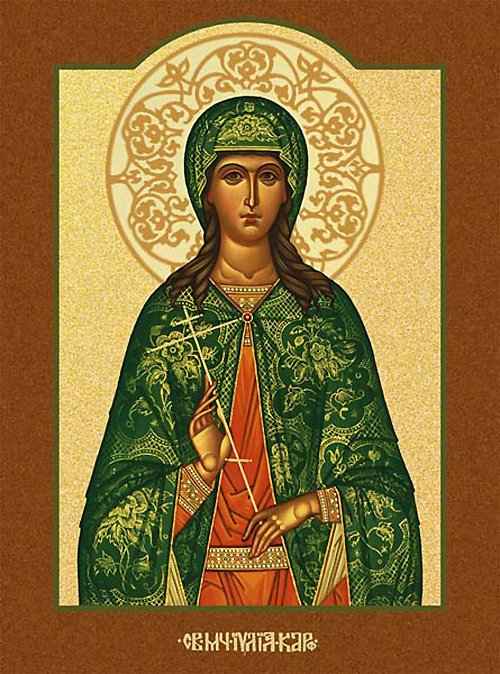
Virgin Martyr Julia of Carthage

Virgin Martyr Julia of Carthage

The Virgin Martyr Julia was born in Carthage into a Christian family. While still a girl she was captured by the Persians. They carried her off to Syria and sold her into slavery. Fulfilling the Christian commandments, Saint Julia faithfully served her master. She preserved herself in purity, kept the fasts and prayed much to God. The Virgin Martyr Julia was born in Carthage into a Christian family. While still a girl she was captured by the Persians. They carried her off to Syria and sold her into slavery. Fulfilling the Christian commandments, Saint Julia faithfully served her master. She preserved herself in purity, kept the fasts and prayed much to God. No amount of urging by her pagan master could turn her to idolatry. Once the master set off with merchandise for Gaul and took Saint Julia with him. Along the way the ship stopped over at the island of Corsica, and the master decided to take part in a pagan festival, but Julia remained on the ship. The Corsicans plied the merchant and his companions with wine, and when they had fallen into a drunken sleep, they took Julia from the ship. Saint Julia was not afraid to acknowledge that she was a Christian, and the savage pagans crucified her. An angel of the Lord reported the death of the holy martyr to the monks of a monastery, located on a nearby island. The monks took the body of the saint and buried it in a church in their monastery. In about the year 763 the relics of the holy Martyr Julia were transferred to a women’s monastery in the city of Breschia (historians give conflicting years of the death of the saint: as either the fifth or seventh century).

New Martyr John of Trnovo

No information available at this time.

Troparion - Tone 3

Your holy martyr John, O Lord, / through his sufferings has received an incorruptible crown from You, our God. / For having Your strength, he laid low his adversaries, / and shattered the powerless boldness of demons. / Through his intercessions, save our souls!

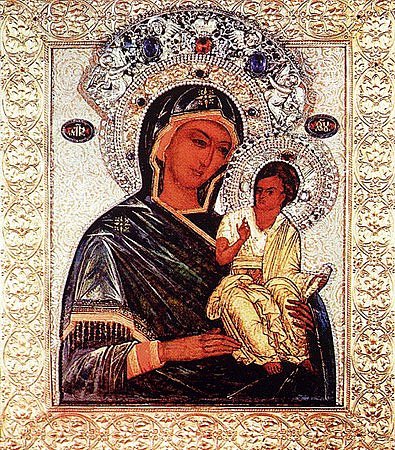
Icon of the Mother of God of Chirsk-Pskov

Icon of the Mother of God of Chirsk-Pskov

In the XV century, in the territory of the Pskov principality, there was a certain village called Chirsk, or Chersk, where, in the church of the Nativity of Christ, there was a Hodēgḗtria Icon of the Mother of God. In 1420, during the reign of Tsar Basil I of Moscow, and when Archbishop Simeon occupied the See of Novgorod and Pskov, a great disaster broke out over the Pskov region - the plague. Pe In the XV century, in the territory of the Pskov principality, there was a certain village called Chirsk, or Chersk, where, in the church of the Nativity of Christ, there was a Hodēgḗtria Icon of the Mother of God. In 1420, during the reign of Tsar Basil I of Moscow, and when Archbishop Simeon occupied the See of Novgorod and Pskov, a great disaster broke out over the Pskov region - the plague. People were despondent and sought solace and comfort by praying to God and the Queen of Heaven for help. On July 16, 1420, as a consolation for the faithful and the encouragement of the faint-hearted, a great Sign took place in the church of the Nativity of Christ at Chirsk: tears flowed from the eyes of the Mother of God on the Icon. News of the miracle spread quickly among the inhabitants of that region, and they began to flock in large numbers to venerate the newly glorified Icon. Soon Prince Theodore of Pskov was informed of this, so he sent priests to Chirsk, along with many noble and devout persons, with orders to take this Icon and bring it to Pskov. With reverence and solemnity, they obeyed the command of their Prince. At Pskov, when it was learned that the holy Icon was nearing the city, Prince Theodore went out to meet it, with all the clergy and people. This moment of the meeting was marked by an amazing new miracle: tears began to flow again from the eyes of the Mother of God, even more copiously than before, which was witnessed by all those who were present. The people, trembling at the sight, fell to the ground with tears, crying out: "Lord, have mercy! O Most Holy Sovereign Lady Theotokos, do not forsake us, but help us, your sinful and unworthy servants, and save us!" The Cross Procession came to a halt, and the priests who carried the Icon served a Moleben of thanksgiving. This wonderworking Icon was brought into the city of Pskov and was placed in the cathedral church of the Life-Giving Trinity, where it remains to this day. Every year, on the Feast of Mid-Pentecost, the Icon is taken from Holy Trinity Cathedral and carried around the city. The Holy Apostle and Evangelist Luke and Saint Theodosios of the Kiev Caves are depicted on the reverse of the Icon.

Troparion - Tone 4

O Most Holy Theotokos, / we your servants, having you as an Indestructible wall1 / and a fountain of miracles, the power of our enemies is overthrown. / Therefore, we entreat you: / "Give peace to your city and great mercy to our souls."1 See The “Unbreakable (or “Indestructible”) Wall” Icon (Sunday of All Saints)

Kontakion - Tone 4

O Most Holy Theotokos, / we your servants, having you as an Indestructible wall1 / and a fountain of miracles, the power of our enemies is overthrown. / Therefore, we entreat you: / "Give peace to your city and great mercy to our souls."

Scripture Readings

Epistle

1 Corinthians 7:24-35

24 Brethren, let every man, wherein he is called, therein abide with God.
25 Now concerning virgins I have no commandment of the Lord: yet I give my judgment, as one that hath obtained mercy of the Lord to be faithful.
26 I suppose therefore that this is good for the present distress, I say, that it is good for a man so to be.
27 Art thou bound unto a wife? seek not to be loosed. Art thou loosed from a wife? seek not a wife.
28 But and if thou marry, thou hast not sinned; and if a virgin marry, she hath not sinned. Nevertheless such shall have trouble in the flesh: but I spare you.
29 But this I say, brethren, the time is short: it remaineth, that both they that have wives be as though they had none;
30 And they that weep, as though they wept not; and they that rejoice, as though they rejoiced not; and they that buy, as though they possessed not;
31 And they that use this world, as not abusing it: for the fashion of this world passeth away.
32 But I would have you without carefulness. He that is unmarried careth for the things that belong to the Lord, how he may please the Lord:
33 But he that is married careth for the things that are of the world, how he may please his wife.
34 There is difference also between a wife and a virgin. The unmarried woman careth for the things of the Lord, that she may be holy both in body and in spirit: but she that is married careth for the things of the world, how she may please her husband.
35 And this I speak for your own profit; not that I may cast a snare upon you, but for that which is comely, and that ye may attend upon the Lord without distraction.

Gospel

Matthew 15:12-21

12 Then came his disciples, and said unto him, Knowest thou that the Pharisees were offended, after they heard this saying?
13 But he answered and said, Every plant, which my heavenly Father hath not planted, shall be rooted up.
14 Let them alone: they be blind leaders of the blind. And if the blind lead the blind, both shall fall into the ditch.
15 Then answered Peter and said unto him, Declare unto us this parable.
16 And Jesus said, Are ye also yet without understanding?
17 Do not ye yet understand, that whatsoever entereth in at the mouth goeth into the belly, and is cast out into the draught?
18 But those things which proceed out of the mouth come forth from the heart; and they defile the man.
19 For out of the heart proceed evil thoughts, murders, adulteries, fornications, thefts, false witness, blasphemies:
20 These are the things which defile a man: but to eat with unwashen hands defileth not a man.
21 Then Jesus went thence, and departed into the coasts of Tyre and Sidon.

Liturgical data sourced from OCA.org and orthocal.info