Fasting Rules
 Meat
Abstain
Meat
Abstain
 Fish
Allowed
Fish
Allowed
 Dairy
Abstain
Dairy
Abstain
 Oil
Allowed
Oil
Allowed
 Wine
Allowed
Wine
Allowed
Saints & Commemorations
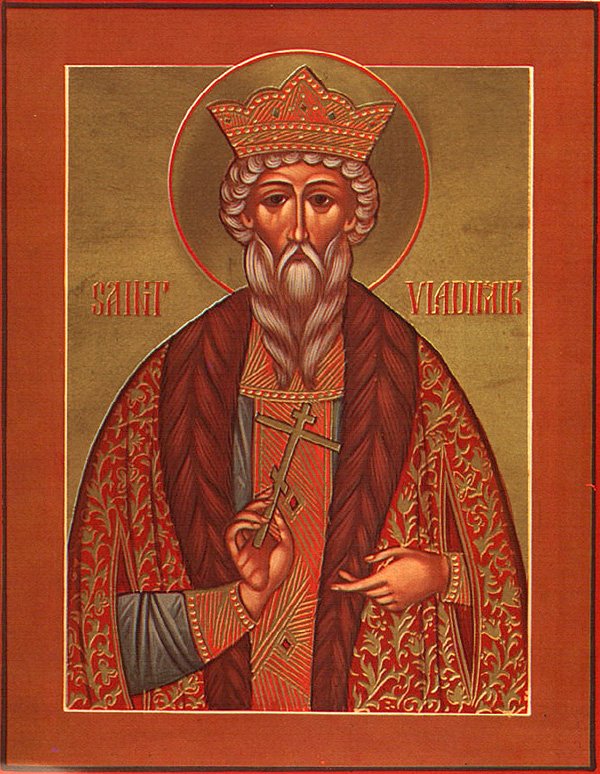
Holy Great Prince Vladimir (Basil in Baptism), Equal of the Apostles, and Enlightener of Rus'
The Holy Equal of the Apostles and Great Prince Vladimir, the youngest son of Prince Svyatoslav of Kiev, was born in 963. He was only six years old when his grandmother, the Holy Princess Olga (July 11), who had raised him, reposed, and his father sent him to reign in Novgorod under the tutelage of the voivode Dobryn, his mother's brother.
The Holy Equal of the Apostles and Great Prince Vladimir, the youngest son of Prince Svyatoslav of Kiev, was born in 963. He was only six years old when his grandmother, the Holy Princess Olga (July 11), who had raised him, reposed, and his father sent him to reign in Novgorod under the tutelage of the voivode Dobryn, his mother's brother. Princess Malusha, who still bore her Scandinavian name Malchrid, was a Christian. After Saint Vladimir converted to Christianity and founded the church of the Tithes at Kiev, she donated her estate to it.
Saint Olga's son Prince Svyatoslav was killed in battle with the Pechenegs three years after his mother's repose. Then his sons' tutors fought a war among themselves. Christian Kiev and pagan Novgorod struggled for supremacy. After the death of his father Svyatoslav in 972, Prince Vladimir of Novgorod was forced to flee to Scandinavia in 976, Vladimir's brother Yaropolk murdered his other brother Oleg of Drelinia and conquered Rus'. For the rest of his life Prince Vladimir mourned their deaths.
At the age of seventeen he began to rule on his own. He spent the first six years of his reign on military campaigns, leading his army personally, reconquering Novgorod from Yaropolk. By 980, Vladimir had consolidated the territory of Kievan Rus' from what is now Belarus, Russia, and Ukraine to the Baltic Sea. In addition, he strengthened the frontiers against the incursions of Bulgarians, Baltic tribes, and Eastern nomads.
All the Slavic tribes from the Carpathians and the Neman, and the city of Gorodyon (Grodno) to Beloozero, Anka and Volga united to form a single whole – the Russian land (Русскую землo), and they were called Russians. In gratitude for his victory at Kiev he set up idols of pagan gods - Perun and Beles - and offered them human sacrifices. In ancient times, the Slavs did not have idols and sacrifices, but adopted them much later from other pagan lands.
In the VI century, the Greeks said of them: "They recognize one God as the Ruler of the whole world." He was called Svarog, which means "blue sky." Perun, Veles, and other, lesser deities were thought to be his children. The Slavs believed in the immortality of the soul and in the afterlife, which predisposed them toward Christianity.
In the year 860 the Russians attacked Constantinople from the sea, but the Greeks immersed the robe of the Most Holy Theotokos in the ocean. The sea became agitated, and the Russian ships were swept away and retreated. After that, they sent an embassy to Constantinople to request Baptism. This was the first Baptism of Rus'.
Also in 860 Saint Cyril, the enlightener of the Slavs, baptized 200 families in the southern Russian steppes. He made his own translation of the Gospel and the Psalter. Metropolitan Michael was sent to care for the converts, and the Prince gathered the people and called them to be baptized. The elders agreed, but they demanded a miracle. They wanted a Gospel book to be thrown into the fire without being burnt. The Gospel was thrown in, the miracle occurred, and the people were baptized. This was the second Baptism of Rus'.
The third took place under Princess Olga. By that time, there were already many Christians in Kiev and there was a church dedicated to the Prophet Elijah. After Saint Olga's repose, the spread of Christianity was halted temporarily, but not for long. The time of Prince Vladimir had come.
In those days, Kiev was a large trading city. Merchants came from all over the world, as well as preachers of various religions. Saint Vladimir wanted to unite his people, not just under one government, but also under one Faith. The Prince sent envoys to various countries to see which religion would be most suitable for his people. When Vladimir's emissaries returned from Constantinople, they told him that when they stood in the church of Hagia Sophia (Holy Wisdom), they did not know "whether they were on earth or in heaven."
Kiev was located on a great waterway from the Varangian region to Constantinople; that is, from Scandinavia to the Byzantine Empire. The proximity of Orthodox Constantinople may have influenced Saint Vladimir, and the memory of Christianity, recently destroyed by Svyatoslav, was revived. According to the XI century writer Jacob Mnikh, the young Prince Vladimir remembered the example of his grandmother, Princess Olga, "the wisest of men," as she was called by her contemporaries. Furthermore, he could not help being influenced by the example of his mother, the Christian Princess Malusha, as well. The heroic death of Holy Protomartyrs Theodore and his son John (July 12) in 983 also made a lasting impression on him.
In one Icelandic saga it is said that in his youth, King Olaf of Norway had lived for a long time at the court of "the Gardarikian king Vol'demar" (Gardarika, that is, the land of cities. The Scandinavians called it Northwestern Russia). When he reached adulthood, he left there on military campaigns, according to the custom of the Scandinavians of that time. While upon the sea, he heard a heavenly voice calling him to Constantinople, where he would come to know the only true God. There he was baptized, and on the way back, he stopped to see King Vol'demar and urged him to convert to Christianity. When he returned from his campaign as a Christian, King Olaf encouraged his people to be baptized.
Prince Vladimir, however, was still a pagan, and he adhered to pagan customs. He also had five wives. How he was brought to Christ, and how his conversion was took place, remains a mystery.
Metropolitan Hilarion († 1053) in his "Word of Law and Grace," addressed the departed Great Prince Vladimir, saying, "How did you believe? How was your mind moved to love what is unseen, and to strive for heavenly things? You have not seen any Apostle who, after coming to your land, inclined your heart to humility. Guided only by your kind heart and sharp mind, you realized that there is one God."
He continued: "Upon him came a visitation of the Most High, and the eye of the All-Merciful God looked upon him; and a thought shone forth in his heart - he realized the futility of idol worship, and sought the one God, the Creator of all things, both visible and invisible. He had heard about the Orthodox, and the strong Christ-loving faith of the Byzantine Empire, who honor the one God in Trinity, and worship Him. When he heard all this, he was aflame in spirit, and with all his heart he longed to be a Christian, and to convert his entire land to Christianity."
As to the reason for the conversion of Saint Vladimir to Christ, another writer of the XI century, Saint Nestor the Chronicler (October 27) states in his Life of Saints Boris and Gleb: "In those years there was a Prince named Vladimir, who ruled the Russian land. He was righteous and merciful to the poor, to orphans, and to widows, but he was a pagan. God intervened and made him a Christian, just like Saint Eustathios Plakidas (September 20). So Prince Vladimir became a Christian, receiving the name Basil at his Baptism."
Although Venerable Nestor the Chronicler pointed out that the Holy Prince Vladimir's experience was similar to that of Saint Eustathios, the exact details are not known. Meanwhile, by the will of God, external events led Saint Vladimir to the fulfillment of his desire. The Byzantine Emperors Constantine and Basil asked Vladimir to help them put down the revolt of Phokas. Vladimir agreed, but asked for the hand of Princess Anna Porphyrogenita, in return. The Emperors agreed, and sent clergy and the sacred utensils required for the Baptism of Rus'.
But when Vladimir defeated Phokas, they did not fulfill their obligations. Then Vladimir conquered Korsun, thereby forcing the Emperors to keep their promise. He returned Korsun to the Greeks as a ransom for his bride. His army was baptized and, according to the "Tale of the Baptism of Russia," he himself was baptized. This was in 988, and the Chronicle says that before Baptism he became blind, but received his sight when he came out of the water. However, Jacob Mnikh (XI century) writes that Vladimir captured Korsun when he was already a Christian, and that he was baptized in 987 at his estate Vasiliev (now Vasilkov).
When Prince Vladimir returned to Kiev, the Orthodox priests who came with him were obviously Bulgarians (Bulgaria was then subject to the Byzantine Empire). They baptized the people of Kiev at the confluence of the river, then called Khreshchatyk, with the Dnieper. They brought with them liturgical books translated into Slavonic by Saints Cyril and Methodios (May 11), the enlighteners of the Slavs. With them was Metropolitan Michael of Kiev (June 15, September 30). At Kiev, where people had heard of Christianity, the Faith was quickly established. In the north, at Novgorod, Rostov, and Murom, paganism lasted longer, and it took a great deal of effort for princes and preachers to uproot it.
Prince Vladimir was twenty-five years old at the Baptism of Rus'. With all the fervor of youth, he began to fulfill the precepts of Christ, especially those about helping the poor, sick and disadvantaged. This assistance was provided on a large scale. Throughout Russia, the poor were sought and were given everything they needed, and the sick also received treatment. During Saint Vladimir's reign, the state served the people, which was very unusual in those days. In ancient times there was no death penalty in Russia. Instead, there was a "penalty," that is, a monetary fine. Saint Vladimir confirmed this custom, saying: "I am afraid of sin." This custom became law and entered the Code of Laws compiled under his son, Great Prince Yaroslav under the name "Russkaya Pravda."
The people loved their Prince, praising him in songs and epics, calling him the Beautiful Sun. Saint Vladimir summoned the elders of the people from all over Russia for meetings and provided feasts for them. The memory of these feasts is also preserved in the epics. He built new cities, such as Volodymyr-Volynsky (where his palace once stood), Vladimir in the land of Suzdal, and others. He strengthened the boundaries of his possessions as a defense against the neighboring pagan tribes. In order to unite Russia, he sent his sons to rule in different cities: at Rostov, Murom, Novgorod, Polotsk, and other places. Soon the influence of the Varangians began to wane, and the importance of the Slavs increased. In Kiev, at the place where the Russian Protomartyrs Theodore and John were murdered, he built the church of the Tithes and dedicated it to the Dormition of the Most Holy Theotokos, donating a tenth of his income for its upkeep.
The Holy Prince Vladimir reposed on July 15, 1015 in his beloved village of Berestov and was buried in the church of the Tithes. A piece of his holy relics was kept in Holy Wisdom Cathedral, established by his son, Great Prince Yaroslav the Wise.
The Feast Day of Saint Vladimir was instituted by Saint Alexander Nevsky (November 23) after May 15, 1240, because of Saint Vladimir's help and intercession at Saint Alexander's renowned victory over the Crusaders at the Neva River. In Russia, the Church veneration of the Holy Prince began much earlier. In Saint Hilarion's "Word of Law and Grace," the holy Prince is called "an apostolic sovereign," similar to Saint Constantine (May 20); and his evangelization of the Russian land is likened to the preaching of the Gospel by the Holy Apostles.
Saint Vladimir is commemorated on July 15 (the day of his repose) and on the second Sunday of Great Lent, along with the Synaxis of the Venerable Fathers of the Kiev Caves, and all Saints who shone forth in Little Russia.
Troparion - Tone 4
Holy Prince Vladimir, / you were like a merchant in search of fine pearls. / By sending servants to Constantinople for the Orthodox Faith, you found Christ, the priceless pearl. / He appointed you to be another Paul, / washing away in baptism your physical and spiritual blindness. / We celebrate your memory, / asking you to pray for all Orthodox Christians and for us, your spiritual children.
Kontakion - Tone 8
Most glorious Vladimir, in your old age you imitated the great apostle Paul: / He abandoned childish things, while you forsook the idolatry of your youth. / Together with him you reached the fullness of divine wisdom: / You were adorned with the purity of holy baptism. / Now as you stand before Christ our Savior, pray that all Orthodox Christians may be saved.
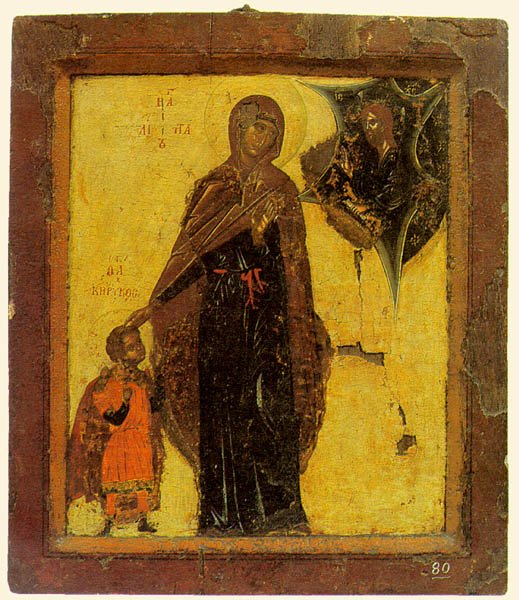
Saint Quiricus (Kḗrykos) and his mother Julitta
“Holy Julitta was of noble birth. She was widowed young, and left with a newborn child, Cyricus. She lived in Iconium, a city of Lycaonia, and was a very devout Christian. She had her son baptised immediately after his birth and, when he was three years old, instructed him in the Faith and taught him to pray insofar as a child of that age is capable of learning. W
“Holy Julitta was of noble birth. She was widowed young, and left with a newborn child, Cyricus. She lived in Iconium, a city of Lycaonia, and was a very devout Christian. She had her son baptised immediately after his birth and, when he was three years old, instructed him in the Faith and taught him to pray insofar as a child of that age is capable of learning. When Diocletian launched a persecution of Christians, much innocent blood was shed in the city of Iconium. Julitta took her son and hid from the wrath of the pagans in the town of Seleucid, but things were no better there. Julitta was arrested as a Christian and brought to trial. Seeing Julitta so courageously proclaim her faith in the Lord Jesus, the judge, to distress her and make her waver, took the child in his arms and began to kiss it. But Cyricus shouted: ‘I am a Christian; let me go to my mother!’, and he began to scratch the judge, turning his face away from him. The judge was furious, threw the child to the ground and kicked it, and the child rolled down the stone steps and gave his holy and innocent soul to God. Seeing how Cyricus suffered before her, Julitta was filled with joy and gave thanks to God that her son had been counted worthy of the wreath of martyrdom. After harsh torture, Julitta was beheaded, in the year 304. The relics of Ss Cyricus and Julitta have wonderworking power to this day. A part of the relics of these saints is to be found in Ochrid, in the Church of the Holy Mother of God, the Healer.” (Prologue. In the Prologue, the name of Cyricus is spelled “Cerycus.” It is changed here for consistency with other sources.)
Martyr Aboudimos of the Isle of Tenedos
This courageous soldier of Christ was from the island of Tenedos, which lies opposite the renowned city of Troy,
and he was one of the first Christians to be put to death during the persecution of the Church under Diocletian in the early IV century.
Since Saint Aboudimos would not agree to worship idols, or to eat any food which had been sacrificed to them, he was bound and severely beaten.
This courageous soldier of Christ was from the island of Tenedos, which lies opposite the renowned city of Troy,
and he was one of the first Christians to be put to death during the persecution of the Church under Diocletian in the early IV century.
Since Saint Aboudimos would not agree to worship idols, or to eat any food which had been sacrificed to them, he was bound and severely beaten. All the while he kept shouting, “I am a Christian.” Then they broke his ribs with iron nails; and when he continued to confess Christ, they beheaded him.
The Saint’s holy relics were seen on the island of Tenedos at the beginning of the XII century by the Russian pilgrim Daniel.
Troparion - Tone 3
Your holy martyr Aboudimos, O Lord, / through his sufferings has received an incorruptible crown from You, our God. / For having Your strength, he laid low his adversaries, / and shattered the powerless boldness of demons. / Through his intercessions, save our souls!
Scripture Readings
☩Epistle
1 Corinthians 7:12-24
12
But to the rest speak I, not the Lord: If any brother hath a wife that believeth not, and she be pleased to dwell with him, let him not put her away.
13
And the woman which hath an husband that believeth not, and if he be pleased to dwell with her, let her not leave him.
14
For the unbelieving husband is sanctified by the wife, and the unbelieving wife is sanctified by the husband: else were your children unclean; but now are they holy.
15
But if the unbelieving depart, let him depart. A brother or a sister is not under bondage in such cases: but God hath called us to peace.
16
For what knowest thou, O wife, whether thou shalt save thy husband? or how knowest thou, O man, whether thou shalt save thy wife?
17
But as God hath distributed to every man, as the Lord hath called every one, so let him walk. And so ordain I in all churches.
18
Is any man called being circumcised? let him not become uncircumcised. Is any called in uncircumcision? let him not be circumcised.
19
Circumcision is nothing, and uncircumcision is nothing, but the keeping of the commandments of God.
20
Let every man abide in the same calling wherein he was called.
21
Art thou called being a servant? care not for it: but if thou mayest be made free, use it rather.
22
For he that is called in the Lord, being a servant, is the Lord’s freeman: likewise also he that is called, being free, is Christ’s servant.
23
Ye are bought with a price; be not ye the servants of men.
24
Brethren, let every man, wherein he is called, therein abide with God.
☩Gospel
Matthew 14:35-15:11
35
And when the men of that place had knowledge of him, they sent out into all that country round about, and brought unto him all that were diseased;
36
And besought him that they might only touch the hem of his garment: and as many as touched were made perfectly whole.
1
Then came to Jesus scribes and Pharisees, which were of Jerusalem, saying,
2
Why do thy disciples transgress the tradition of the elders? for they wash not their hands when they eat bread.
3
But he answered and said unto them, Why do ye also transgress the commandment of God by your tradition?
4
For God commanded, saying, Honour thy father and mother: and, He that curseth father or mother, let him die the death.
5
But ye say, Whosoever shall say to his father or his mother, It is a gift, by whatsoever thou mightest be profited by me;
6
And honour not his father or his mother, he shall be free. Thus have ye made the commandment of God of none effect by your tradition.
7
Ye hypocrites, well did Esaias prophesy of you, saying,
8
This people draweth nigh unto me with their mouth, and honoureth me with their lips; but their heart is far from me.
9
But in vain they do worship me, teaching for doctrines the commandments of men.
10
And he called the multitude, and said unto them, Hear, and understand:
11
Not that which goeth into the mouth defileth a man; but that which cometh out of the mouth, this defileth a man.
Liturgical data sourced from OCA.org and orthocal.info