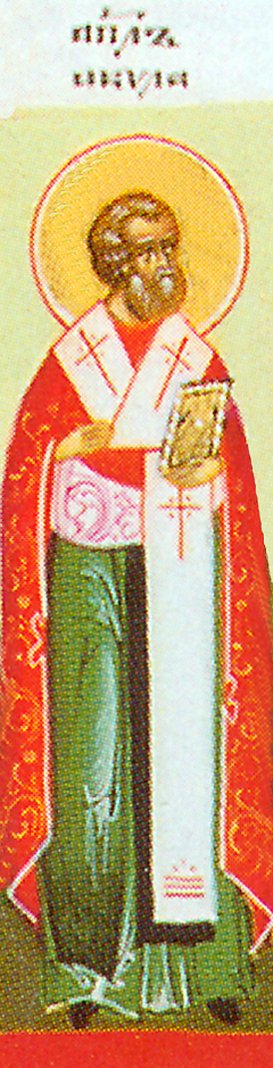
He, along with his wife Priscilla, is mentioned in the book of Acts and in St Paul’s Epistle to the Romans. He and his wife were Jews who moved to Corinth when the Emperor Claudius expelled all Jews from Italy. They were working as tentmakers in Corinth when they met and worked with St Paul, also a tentmaker by trade, who brought them to faith in Christ. F
He, along with his wife Priscilla, is mentioned in the book of Acts and in St Paul’s Epistle to the Romans. He and his wife were Jews who moved to Corinth when the Emperor Claudius expelled all Jews from Italy. They were working as tentmakers in Corinth when they met and worked with St Paul, also a tentmaker by trade, who brought them to faith in Christ. From that time onward they worked diligently to spread the Gospel of Christ. The Prologue says that they died at the hands of pagans, the Great Horologion that the circumstances of their repose are unknown.
Troparion - Tone 1
As a disciple and companion of Paul / you received in your soul the grace of preaching. / You shone in the night of error and struggled for the Lord’s glory. / Sacred minister of the Savior, Aquila, we all acclaim you.
Kontakion - Tone 4
The Church has acquired you, O Aquila, / who shine like a great sun. / With the splendor of your teaching / she enlightens those who honor you with faith, / glorious Apostle of the Lord.
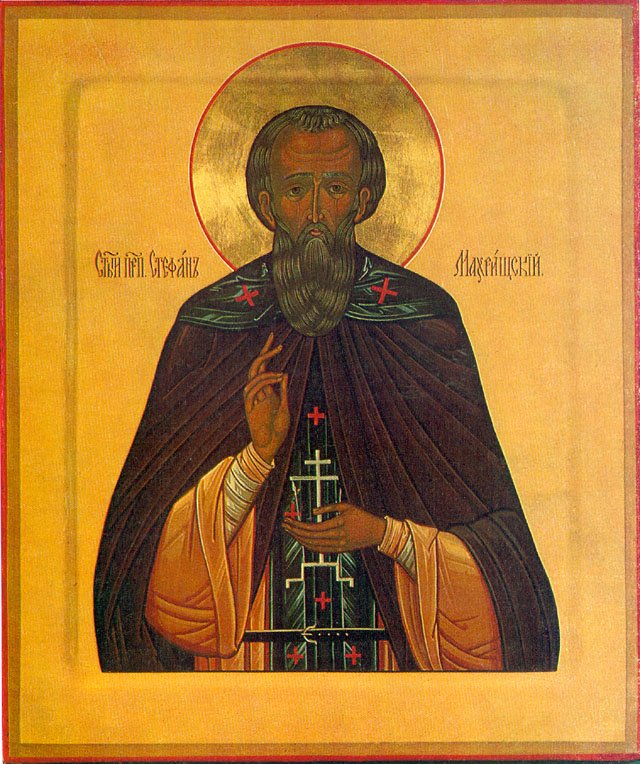
Venerable Stephen, Abbot of Makhrishche, Vologda
Saint Stephen of Makhra (Makhrishche) was a native of Kiev. He accepted monasticism at the monastery of the Caves, where he spent several years in deeds of obedience and prayer. The oppressions of the Latins compelled him to journey on to Moscow, where Great Prince Ivan II (1353-1359) graciously received him, permitting him to settle in the locale of Makhra not far from Gorodisch, 35 versts from the Sergiev monastery.
Saint Stephen of Makhra (Makhrishche) was a native of Kiev. He accepted monasticism at the monastery of the Caves, where he spent several years in deeds of obedience and prayer. The oppressions of the Latins compelled him to journey on to Moscow, where Great Prince Ivan II (1353-1359) graciously received him, permitting him to settle in the locale of Makhra not far from Gorodisch, 35 versts from the Sergiev monastery.
Having built himself a cell and spending his life at ascetic labors, and esteeming silence, he did not accept those wishing to join him. But then he yielded to the requests, and in this way, in 1358 he founded a monastery, in which he was established as igumen.
Living near his monastery were the Yurkov brothers. Fearing that the land which they ruled might be given over to the monastery, they threatened to kill the holy ascetic. The admonitions of the monk did not help. Saint Stephen then moved to a different place. Sixty versts north of Vologda, at the River Avnezha, he founded with his disciple Gregory a monastery in the name of the Holy Trinity. Great Prince Demetrius Ioannovich sent books and other liturgical items to the Avnezhsk wilderness, but the venerable Stephen sent them in turn to the Makhra monastery. Having returned to his monastery, Saint Stephen ordered life in it according to a cenobitic Rule.
When Saint Sergius of Radonezh moved from his monastery, in order to find a place for his ascetic deeds, Saint Stephen then received him, and gave the great ascetic Sergius his own disciple Simon, who knew the surrounding area quite well. Saint Sergius settled together with Simon on the island of Kirzhach, where he founded a monastery.
Saint Stephen was strict with himself and indulgent towards others. He worked for the monastery the hardest of all, he zealously guided the brethren to the ways of salvation with gentle and quiet talks, and he wore very old and coarse clothing.
The monk lived to extreme old age, became a schemamonk and died in 1406 on July 14. In 1550 during the construction of a new stone church in the name of the Holy Trinity, his holy relics were found to be incorrupt. They were glorified by blessings of help in various sicknesses and misfortunes for all who called on the name of the saint.
Troparion - Tone 8
By a flood of tears you made the desert fertile, / and your longing for God brought forth fruits in abundance. / By the radiance of miracles you illumined the whole universe! / O our holy father Stephen, pray to Christ our God to save our souls!
Martyr Justus at Rome
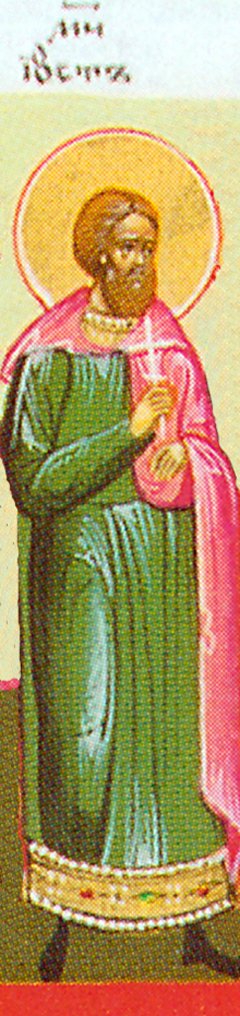
The Holy Martyr Justus was a Roman soldier, to whom the Life-Creating Cross of the Lord appeared in a vision. Justus believed in Christ and gave away his possessions to the poor. By decree of the official of Magnesia, Justus was taken to trial as a Christian. After various tortures, the holy martyr was thrown into a fire and gave up his soul to God, but the flames did not harm his body.
Troparion - Tone 3
Your holy martyr Justus, O Lord, / through his sufferings has received an incorruptible crown from You, our God. / For having Your strength, he laid low his adversaries, / and shattered the powerless boldness of demons. / Through his intercessions, save our souls!
Our Father among the Saints Joseph, Archbishop of Thessalonika (833)
He was the brother of St Theodore the Studite (November 11), and is also sometimes called Studite. He is one of the inspired composers of the canons in the Lenten Triodion, many of which bear the title “by Joseph”. (He should not be confused with St Joseph the Hymnographer, who is commemorated April 3.) As Archbishop of Thessalonika, he suffered gre
He was the brother of St Theodore the Studite (November 11), and is also sometimes called Studite. He is one of the inspired composers of the canons in the Lenten Triodion, many of which bear the title “by Joseph”. (He should not be confused with St Joseph the Hymnographer, who is commemorated April 3.) As Archbishop of Thessalonika, he suffered greatly for his zealous defense of the holy icons: he was imprisoned, and was exiled three times.
Venerable Hellius of Egypt
Saint Hellius lived and died in the fourth century. He was sent to a monastery when he was still a child. There he was raised in piety, temperance and chastity.
When he grew up, he went into the Egyptian desert, where through his ascetical struggles he attained great proficiency in the spiritual life.
Saint Hellius lived and died in the fourth century. He was sent to a monastery when he was still a child. There he was raised in piety, temperance and chastity.
When he grew up, he went into the Egyptian desert, where through his ascetical struggles he attained great proficiency in the spiritual life. He was endowed with the gift of clairvoyance, and he knew all the thoughts and disposition of the monks conversing with him.
Great faith, simplicity of soul and deep humility allowed Saint Hellius to command wild animals. Once, the saint became tired while carrying a heavy load to the monastery. He prayed and called a wild donkey to carry his burden. The donkey meekly carried the load to the place and was set free to return to the wilderness. Another time, when Saint Hellius needed to cross a river and there was no boat, he summoned a crocodile from the water and crossed to the opposite shore while standing on its back.
One of the young novices of the monastery, whom Saint Hellius visited, asked him to take him along into the far desert. Saint Hellius warned him about the great work, exploits and temptations which inevitably beset all the hermits, but since the novice continued fervently to ask, he took him along. On the first night the novice, frightened by terrible visions, ran to Saint Hellius. The monk comforted and calmed him down and ordered him to return. Tracing the Sign of the Cross over the cave, the monk told the young hermit not to fear, because he would not be disturbed by these apparitions any more. Trusting the word of the saint, the novice decided to remain in solitude and afterwards attained such perfection that he, like his teacher Hellius, received food from an angel.
Saint Hellius peacefully entered the heavenly mansions after reaching an advanced age.
Troparion - Tone 8
By a flood of tears you made the desert fertile, / and your longing for God brought forth fruits in abundance. / By the radiance of miracles you illumined the whole universe! / O our holy father Hellius, pray to Christ our God to save our souls!
St Nikodemos of the Holy Mountain, spiritual writer (1809)
He is best known for his collections of Orthodox writings, most importantly the Philokalia, a five-volume compendium of writings on asceticism and prayer, especially the Jesus Prayer, by the holy Fathers of the Church. (The first four volumes have been translated into English). He produced an Orthodox edition of Unseen Warfare, originally by Lorenzo Scupoli, a Roman Catholic.
He is best known for his collections of Orthodox writings, most importantly the Philokalia, a five-volume compendium of writings on asceticism and prayer, especially the Jesus Prayer, by the holy Fathers of the Church. (The first four volumes have been translated into English). He produced an Orthodox edition of Unseen Warfare, originally by Lorenzo Scupoli, a Roman Catholic. (This was further revised by St Theophan the Recluse). He also edited the Pedalion (Rudder), a collection of the canons of the Orthodox Church with his commentary.
Note: The English edition of the Rudder needs to be read with care, since it includes additional comments by the translator, not clearly distinguished from those of the Saint.
Venerable Onesimus of Magnesia
Saint Onesimus the Wonderworker was born in Caesarea in Palestine at the beginning of the fourth century, and entered a monastery in Ephesus.
Later, he founded a monastery at Magnesia and remained there for the rest of his life. He performed many miracles.
Troparion - Tone 8
By a flood of tears you made the desert fertile, / and your longing for God brought forth fruits in abundance. / By the radiance of miracles you illumined the whole universe! / O our holy father Onesimus, pray to Christ our God to save our souls!
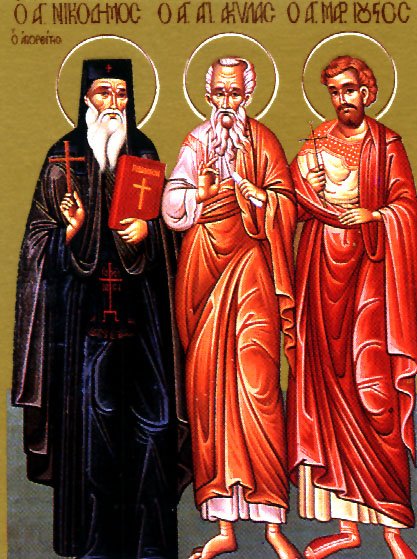
Repose of Venerable Nikodemos the Hagiorite
Saint Nikodemos (Νikόdēmos) of the Holy Mountain was born on the Greek island of Naxos in the year 1748, and was named Nicholas in Holy Baptism. As a child he was well-behaved, avoiding bad company and everything which might harm the inner man. He was zealous in his love for that which is good and beneficial, and he loved sacred and secular learning. Hi
Saint Nikodemos (Νikόdēmos) of the Holy Mountain was born on the Greek island of Naxos in the year 1748, and was named Nicholas in Holy Baptism. As a child he was well-behaved, avoiding bad company and everything which might harm the inner man. He was zealous in his love for that which is good and beneficial, and he loved sacred and secular learning. His first education on Naxos came from the village priest, who taught him to love Christ and His Church. He also assisted the priest during the Divine Liturgy and other Services.
Later Nicholas attended the school at Naxos, where Archimandrite Chrysanthos, the brother of Saint Cosmas Aitolos (August 24), taught him sacred and secular letters.
At the age of twenty-six, he arrived on Mount Athos and was tonsured at Dionysiou Monastery with the name Nikodemos. As his first obedience, Father Nikodemos served as the monastery’s secretary. Two years after entering Dionysiou Monastery, the Metropolitan of Corinth, Saint Makarios Notaras (April 17), arrived there, and assigned the young monk to edit the manuscript of the Philokalia, which he had found in 1777 at Vatopedi Monastery. Editing this book was the beginning of many years of literary activity for Saint Nikodemos. He soon moved to Pantokrator Skḗtē, where he was under obedience to Elder Arsenios of the Pelopónnēsos, under whose guidance he studied Holy Scriptures and the writings of the Holy Fathers.
According to the testimony of his contemporaries, Saint Nikodemos was a simple man, without any malice, unassuming, and distinguished by his profound concentration. He possessed remarkable mental abilities: he knew the Holy Scriptures by heart, and even remembered chapter, verse, and the pages they were on. Moreover, he could recite long passages from the writings of the Holy Fathers from memory.
In 1783 Saint Nikodemos was tonsured into the Great Schema, and spent the next six years in complete silence. On his next visit to Mount Athos, Saint Makarios gave Nikodemos the obedience of editing of the writings of Saint Symeon the New Theologian (printed in three volumes: Syros, 1790). This meant giving up his silence and occupying himself once more with literary work. From that time until his death, he continued to devote himself to such endeavors.
One of the ascetic's remarkable books was his Exomologitarion (Manual of Confession), which was published in 1794. This was the first book of its kind in the Orthodox Church. Drawing from Holy Scripture and from the Fathers of the Church, Saint Nikodemos lists the qualifications a confessor must have, if he is to be a true confessor, and offers advice on how one should prepare for Confession, how to confess, and how one ought to guard himself against sin after Confession.
The Saint also made great contributions by publishing liturgical books. Using materials from the manuscript collections on Mount Athos, he published sixty-two Canons to the Most Holy Theotokos under the title, New Theotokarion (Venice, 1796).
The most wise Nikodemos is also known as a composer and interpreter of hymns. His Canon in honor of the "Quick to Hear” Icon of the Mother of God (November 9) and his “Service and Encomium in Honor of the Fathers who Shone on the Holy Mountain of Athos” are used even beyond the Holy Mountain. Some of his other books include the Heortodromion, an interpretation of the Canons which are sung on Feasts of the Lord and of the Mother of God (Venice,1836), and The New Ladder, an interpretation of the 75 Hymns of Degrees (Anabathmoi) of the liturgical book called the Oktoekhos (Constantinople, 1844).
It is readily apparent that the literary work of Saint Nikodemos was multi-faceted, representing more than half a dozen fields of theology: ascetical-mystical theology, ethics, Canon Law, exegesis, hagiology, liturgics, and hymnography. He wrote the preface to the Philokalia, and brief Lives of the ascetics whose writings are included therein. Among the Saint’s ascetical works, his translation of Lorenzo Scupoli’s book, Unseen Warfare (1796), is well known, and has been translated into Russian, English, and other languages.
Saint Nikodemos had a special love for hagiography, as attested by his work, New Eklogion (Venice, 1803), and his posthumous book, The New Synaxarion (1819). He completed a Modern Greek translation of Saint Paul's Fourteen Epistles in three volumes (1819) as interpreted by the Hierarch Mētrophánēs, by Saint Theophylaktos, the Archbishop of Bulgaria (December 31), and others.
Saint Nikodemos also wrote An Interpretation of Saint Paul's Seven Catholic Epistles (published in Venice in 1806).
In 1799 Nikodemos edited the New Martyrologion, which he and Saint Makarios of Corinth seem to have prepared together in order to demonstrate that the Orthodox Church continues to produce Saints, particularly Martyrs, who were subjected to the same trials, torments, and death as the ancient Martyrs. The example of the Saints whose Lives appear in this book strengthened and encouraged the Orthodox to remain faithful to Christ, and not to convert to the religion of their oppressors.
Saint Nikodemos prepared a new edition of the Pedalion or Rudder, in collaboration with Hieromonk Agapios. This was printed in 1801, and contained the Canons of the Holy Apostles, those of the Holy Ecumenical and Local Synods, and of the Holy Fathers.
His most edifying book, Christian Morality, was published in Venice in 1803. In it he says: "Those monks who are strong in body and in soul ... should occasionally go into the world to preach and to counsel. Those who cannot go into the world, either because of the passions that assail them when they are in the midst of society, or because they are physically infirm, should seek the good of their brethren through prayer and by offering counsel to those who visit them, and if they are learned, by writing edifying books." 1
Not long before his repose, Father Nikodemos, worn out by his literary work and ascetical struggles, went to live at the Kelli of the iconographers Hieromonks Stephen and Neophytos Skourtaίos, who were brothers by birth. He asked them to help with the publication of his works, because he was hindered by his infirmities.
The day before he went to the Lord, he was able to make his Confession, receive Holy Unction, and then Holy Communion.
His first biographer, Father Euthymios, describes the Saint's repose in this manner: "When the sun rose on the earth that day (Wednesday July 14, 1809), the intelligible sun of the Church set. The fiery pillar, the guide of the New Israel into piety disappeared; the cloud which refreshed those who were melting in the heat of sin, hid itself.”
His many friends and acquaintances mourned, and the words of a certain Christian were typical of the thoughts of many individuals of that time: “Oh, my Fathers, it would have been better for a thousand Christians to have died today, and not Nikodemos.”
Saint Nikodemos reposed peacefully at the age of sixty on July 14, 1809, and was glorified by the Church of Constantinople in 1955.
1 Constantine Cavarnos, Modern Orthodox Saints Volume 3, Saint Nicodemus the Hagiorite, pages 46-47. (Belmont, Massachusetts, 1974).
Scripture Readings
☩Epistle
1 Corinthians 6:20-7:12
20
For ye are bought with a price: therefore glorify God in your body, and in your spirit, which are God’s.
1
Now concerning the things whereof ye wrote unto me: It is good for a man not to touch a woman.
2
Nevertheless, to avoid fornication, let every man have his own wife, and let every woman have her own husband.
3
Let the husband render unto the wife due benevolence: and likewise also the wife unto the husband.
4
The wife hath not power of her own body, but the husband: and likewise also the husband hath not power of his own body, but the wife.
5
Defraud ye not one the other, except it be with consent for a time, that ye may give yourselves to fasting and prayer; and come together again, that Satan tempt you not for your incontinency.
6
But I speak this by permission, and not of commandment.
7
For I would that all men were even as I myself. But every man hath his proper gift of God, one after this manner, and another after that.
8
I say therefore to the unmarried and widows, It is good for them if they abide even as I.
9
But if they cannot contain, let them marry: for it is better to marry than to burn.
10
And unto the married I command, yet not I, but the Lord, Let not the wife depart from her husband:
11
But and if she depart, let her remain unmarried, or be reconciled to her husband: and let not the husband put away his wife.
12
But to the rest speak I, not the Lord: If any brother hath a wife that believeth not, and she be pleased to dwell with him, let him not put her away.
☩Gospel
Matthew 14:1-13
1
At that time Herod the tetrarch heard of the fame of Jesus,
2
And said unto his servants, This is John the Baptist; he is risen from the dead; and therefore mighty works do shew forth themselves in him.
3
For Herod had laid hold on John, and bound him, and put him in prison for Herodias’ sake, his brother Philip’s wife.
4
For John said unto him, It is not lawful for thee to have her.
5
And when he would have put him to death, he feared the multitude, because they counted him as a prophet.
6
But when Herod’s birthday was kept, the daughter of Herodias danced before them, and pleased Herod.
7
Whereupon he promised with an oath to give her whatsoever she would ask.
8
And she, being before instructed of her mother, said, Give me here John Baptist’s head in a charger.
9
And the king was sorry: nevertheless for the oath’s sake, and them which sat with him at meat, he commanded it to be given her.
10
And he sent, and beheaded John in the prison.
11
And his head was brought in a charger, and given to the damsel: and she brought it to her mother.
12
And his disciples came, and took up the body, and buried it, and went and told Jesus.
13
When Jesus heard of it, he departed thence by ship into a desert place apart: and when the people had heard thereof, they followed him on foot out of the cities.
 Meat
Allowed
Meat
Allowed
 Fish
Allowed
Fish
Allowed
 Dairy
Allowed
Dairy
Allowed
 Oil
Allowed
Oil
Allowed
 Wine
Allowed
Wine
Allowed