Fasting Rules
 Meat
Allowed
Meat
Allowed
 Fish
Allowed
Fish
Allowed
 Dairy
Allowed
Dairy
Allowed
 Oil
Allowed
Oil
Allowed
 Wine
Allowed
Wine
Allowed
Saints & Commemorations
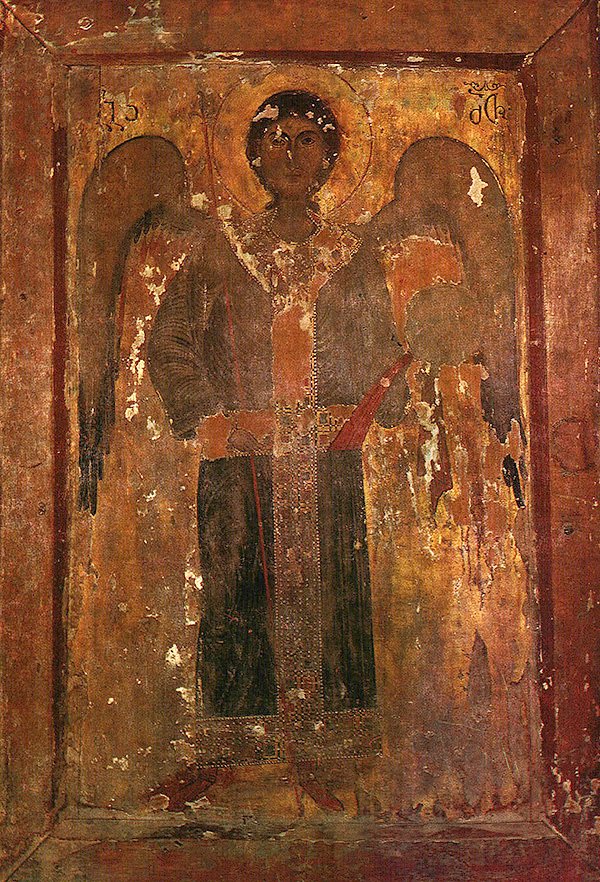
Synaxis of the Archangel Gabriel
The Synaxis of the Archangel Gabriel is celebrated on the day after the Annunciation, and a second time on July 13. It was instituted in the ninth century, perhaps to celebrate the dedication of a church at Constantinople. Originally, the Feast was observed on October 16 (Juan Mateos, Le Typikon De La Grande Eglise ).
The Synaxis of the Archangel Gabriel is celebrated on the day after the Annunciation, and a second time on July 13. It was instituted in the ninth century, perhaps to celebrate the dedication of a church at Constantinople. Originally, the Feast was observed on October 16 (Juan Mateos, Le Typikon De La Grande Eglise ).
An account of the Holy Archangel Gabriel is found under March 26 and November 8.
Troparion - Tone 4
Gabriel, commander of the heavenly hosts, / we who are unworthy beseech you, / by your prayers encompass us beneath the wings of your immaterial glory, / and faithfully preserve us who fall down and cry to you: / “Deliver us from all harm, for you are the commander of the powers on high!”
Kontakion - Tone 2
You look upon God’s glory in heaven, / and bring grace from on high to earth, / wise Gabriel, leader of angels, / minister of God’s glory, and divine defender of the world! / Save and preserve those who cry to you: / “Be our defense, so that no one can be against us!”
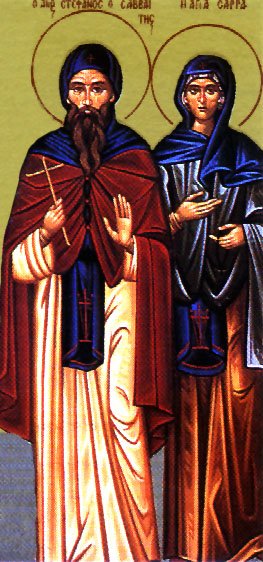
Venerable Stephen of Saint Savva Monastery
Saint Stephen of Saint Savva’s Monastery, the nephew of Saint John of Damascus (December 4), was born in the year 725. When he was ten years old he entered the Lavra of Saint Savva the Sanctified (December 5) and was tonsured as a monk. He spent his whole life at this monastery, sometimes going out into the desert to live in solitude and devote himself to spiritual struggles.
Saint Stephen of Saint Savva’s Monastery, the nephew of Saint John of Damascus (December 4), was born in the year 725. When he was ten years old he entered the Lavra of Saint Savva the Sanctified (December 5) and was tonsured as a monk. He spent his whole life at this monastery, sometimes going out into the desert to live in solitude and devote himself to spiritual struggles.
Saint Stephen’s holy life was so pleasing to God that he was given the gifts of wonderworking and clairvoyance. He also healed the sick, cast out devils, and was able to discern the thoughts of those who came to him for counsel. He fell asleep in the Lord in the year 794, foretelling in advance the day of his death. The Life of Saint Stephen was compiled by his disciple Leontius.
Today’s saint should not be confused with the other Saint Stephen of Saint Savva’s Monastery who is commemorated on October 28.
Troparion - Tone 8
By a flood of tears you made the desert fertile, / and your longing for God brought forth fruits in abundance. / By the radiance of miracles you illumined the whole universe! / O our holy father Stephen, pray to Christ our God to save our souls!
Holy Martyr Golinduc of Persia (6th c.)
She was a Persian noblewoman during the reign of Chosroës II (590-628). Through a vision of an angel, she came to belief in Christ and received holy baptism; her name in baptism was Maria. Her furious husband reported her to King Chosroës, who had her thrown into a foul dungeon known as Oblivion for eighteen years. D
She was a Persian noblewoman during the reign of Chosroës II (590-628). Through a vision of an angel, she came to belief in Christ and received holy baptism; her name in baptism was Maria. Her furious husband reported her to King Chosroës, who had her thrown into a foul dungeon known as Oblivion for eighteen years. During these years she was repeatedly told to renounce Christ and was tormented in many ways. She was thrown to venomous snakes, which refused to harm her. Some lawless young men were sent to her cell to defile her, but God made her invisible to them. Many Persians, amazed and inspired by her patient sufferings, accepted Christ. She was finally set free through the visitation of an angel, traveled to Jerusalem and Constantinople, and reposed in peace.
She is commemorated July 12 on the Slavic calendar. Oddly, she is called a Martyr in all accounts, though she died free and in peace; presumably her eighteen years of cruel imprisonment earned her the title.
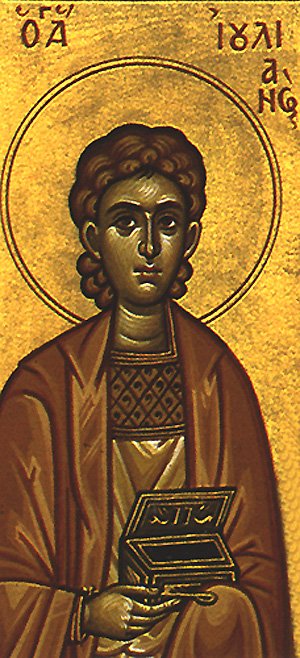
Saint Julian, Bishop of Cenomanis (Le Mans), Gaul
He was made bishop by the Apostle Peter and sent to Gaul as a missionary. Some believe that he was Simon the Leper, whom the Lord healed, later named Julian in Baptism. In Gaul, despite great difficulty and privation, he converted many to faith in Christ and worked many miracles — healing the sick, driving out demons, and even raising the dead. I
He was made bishop by the Apostle Peter and sent to Gaul as a missionary. Some believe that he was Simon the Leper, whom the Lord healed, later named Julian in Baptism. In Gaul, despite great difficulty and privation, he converted many to faith in Christ and worked many miracles — healing the sick, driving out demons, and even raising the dead. In time the local prince, Defenson, was baptised along with many of his subjects. He reposed in peace.
Troparion - Tone 4
In truth you were revealed to your flock as a rule of faith, / an image of humility and a teacher of abstinence; / your humility exalted you; / your poverty enriched you. / Hierarch Father Julian, / entreat Christ our God / that our souls may be saved.
Repose of Photios Kontoglou (1965) (June 30 OC)
He is called “Blessed Photios” by many, but has not yet been officially glorified. In the twentieth century, he almost singlehandedly restored the practice of true Byzantine iconography to the Church. He was born in 1895 in one of the many Greek towns of Asia Minor. He and his family fled to Greece during the “exchange of populations” of 1923, when more than a million Greeks were driven from Turkey and resettled in Greece. He stud
He is called “Blessed Photios” by many, but has not yet been officially glorified. In the twentieth century, he almost singlehandedly restored the practice of true Byzantine iconography to the Church. He was born in 1895 in one of the many Greek towns of Asia Minor. He and his family fled to Greece during the “exchange of populations” of 1923, when more than a million Greeks were driven from Turkey and resettled in Greece. He studied to be a secular artist, but was increasingly drawn to Byzantine iconography, the practice of which had almost disappeared: he learned the iconographic ethos and technique by copying ancient models and studying with the few monks on the Holy Mountain who still practiced true iconography. Initially his work was scorned, since secular western standards had come to dominate even the art of the Church. Slowly, through his tireless labors, an understanding of Orthodoxy iconography was restored to the Church, not only in Greece, but throughout the world. Though married, he lived his life in poverty, often donating his work to churches or performing it for nominal fees. His deeply spiritual writings are greatly honored in Greece, though most remain untranslated into English.
Martyr Serapion
The Holy Martyr Serapion, suffered for Christ before the Emperor Severus (193-211). As a Christian he was brought to judgment before the governor Achilles. The holy martyr firmly proclaimed to the pagans his faith in Christ, and he was subjected to inhuman torments. Afterwards, he was thrown into prison.
The Holy Martyr Serapion, suffered for Christ before the Emperor Severus (193-211). As a Christian he was brought to judgment before the governor Achilles. The holy martyr firmly proclaimed to the pagans his faith in Christ, and he was subjected to inhuman torments. Afterwards, he was thrown into prison.
Healed by the Lord Jesus Christ, he was brought to the judgment place and he presented himself before the judge completely healthy. The enraged pagans sentenced the saint to be burned alive. In the midst of the flames, he gave up his soul to God (+ ca. 205).
Troparion - Tone 3
Your holy martyr Serapion, O Lord, / through his sufferings has received an incorruptible crown from You, our God. / For having Your strength, he laid low his adversaries, / and shattered the powerless boldness of demons. / Through his intercessions, save our souls!
Martyr Marcian of Iconium
The Holy Martyr Marcian, a native of Lycian Iconium, while still at a youthful age converted many to Christ by his fiery preaching. For his zeal the idol-worshippers subjected the saint to bodily punishment, and then sent him to Cappadocia to the governor Perennias. By persuasion and threats, he attempted to turn the youth away from the Truth, Christ.
The Holy Martyr Marcian, a native of Lycian Iconium, while still at a youthful age converted many to Christ by his fiery preaching. For his zeal the idol-worshippers subjected the saint to bodily punishment, and then sent him to Cappadocia to the governor Perennias. By persuasion and threats, he attempted to turn the youth away from the Truth, Christ.
Saint Marcian fearlessly testified about the truthfulness of the Christian Faith, and he accused Perennias of worshipping inanimate idols. The enraged governor gave orders to subject the saint to severe torments, but in his sufferings the saint remained steadfast in his faithfulness to Christ. They cut off his head while he prayed, giving thanks to God for his fate (+258).
Troparion - Tone 3
Your holy martyr Marcian, O Lord, / through his sufferings has received an incorruptible crown from You, our God. / For having Your strength, he laid low his adversaries, / and shattered the powerless boldness of demons. / Through his intercessions, save our souls!
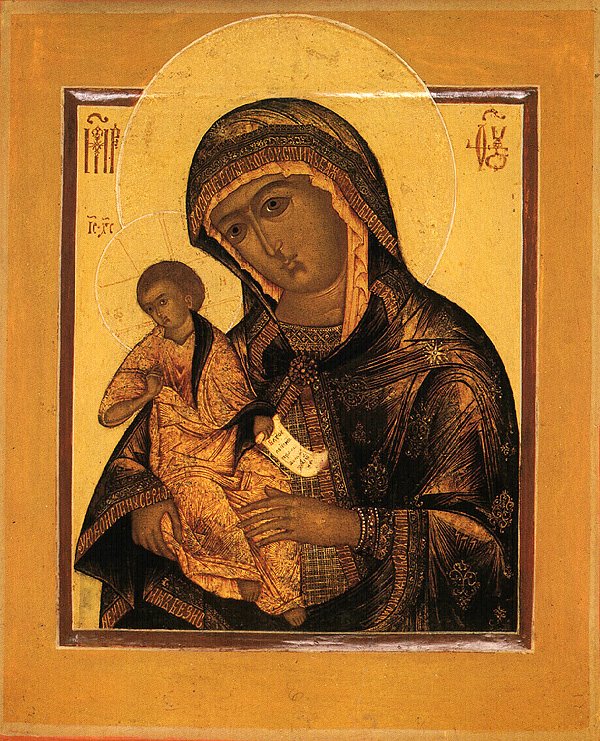
“It Is Truly Meet” (“Axion Estin”) Icon of the Mother of God
The “It is Truly Meet” Icon of the Mother of God is in the high place of the altar of the cathedral church of the Karyes monastery on Mount Athos.
One Saturday night an Elder went to Karyes for the all-night Vigil. He left, instructing his disciple to remain behind and read the service in their cell. As
The “It is Truly Meet” Icon of the Mother of God is in the high place of the altar of the cathedral church of the Karyes monastery on Mount Athos.
One Saturday night an Elder went to Karyes for the all-night Vigil. He left, instructing his disciple to remain behind and read the service in their cell. As it grew dark, the disciple heard a knock on the door. When he opened the door, he saw an unknown monk who called himself Gabriel, and he invited him to come in. They stood before the icon of the Mother of God and read the service together with reverence and compunction.
During the Ninth Ode of the Canon, the disciple began to sing “My soul magnifies the Lord...” with the Irmos of Saint Cosmas the Hymnographer (October 14), “More honorable than the Cherubim....”
The stranger sang the next verse, “For He has regarded the low estate of His handmaiden....” Then he chanted something the disciple had never heard before, “It is truly meet to bless Thee, O Theotokos, ever-blessed and most pure, and the Mother of our God...” Then he continued with, “More honorable than the Cherubim....”
While the hymn was being sung, the icon of the Theotokos shone with a heavenly light. The disciple was moved by the new version of the familiar hymn, and asked his guest to write the words down for him. When the stranger asked for paper and ink, the disciple said that they did not have any.
The stranger took a roof tile and wrote the words of the hymn on its surface with his finger. The disciple knew then that this was no ordinary monk, but the Archangel Gabriel. The angel said, “Sing in this manner, and all the Orthodox as well.” Then he disappeared, and the icon of the Mother of God continued to radiate light for some time afterward.
The Eleousa Icon of the Mother of God, before which the hymn “It Is Truly Meet” was first sung, was transferred to the katholikon at Karyes. The tile, with the hymn written on it by the Archangel Gabriel, was taken to Constantinople when Saint Nicholas Chrysoberges (December 16) was Patriarch.
Numerous copies of the “It Is Truly Meet” Icon are revered in Russian churches. At the Galerna Harbor of Peterburg a church with five cupolas was built in honor of the Merciful Mother of God, and into it they put a grace-bearing copy of the “It Is Truly Meet” icon sent from Athos.
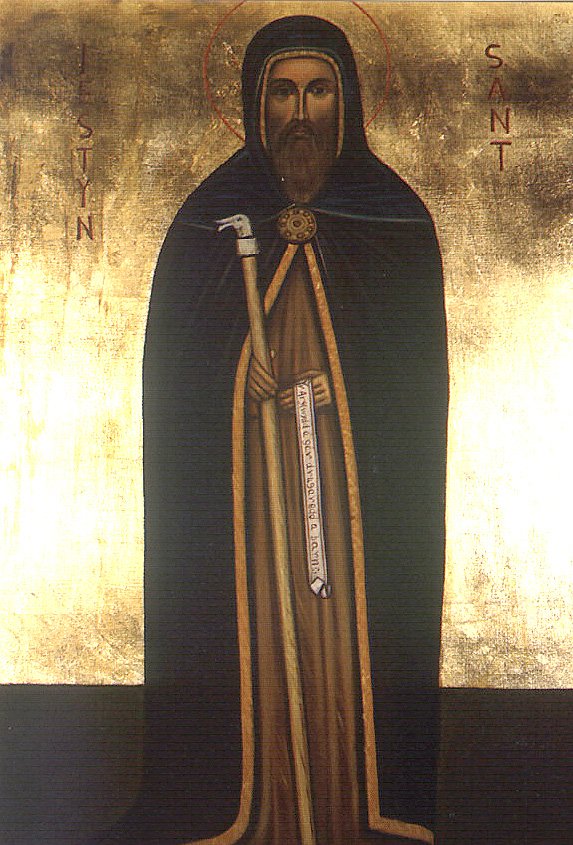
Saint Just of Penwith
No information available at this time.
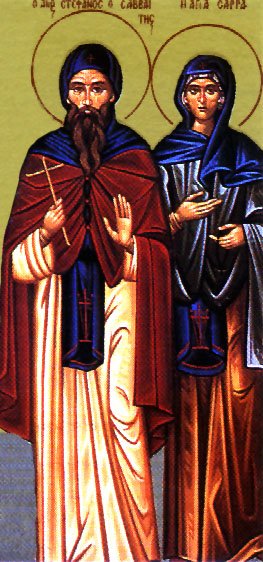
Virgin Abbess Sarah of Sketis in Libya
It is written in The Paradise of the Fathers that Mother Sarah spoke these words: “If I were to ask God that all people might be built up through me, I would be found expressing contrition at the door of each one who repents. But I pray to God especially that my heart may be pure with Him and with everyone.”
Once two great Elders and anchorites left Mount Pelusium (in the northeastern Nile Delta) and went to see Amma Sarah. Spe
It is written in The Paradise of the Fathers that Mother Sarah spoke these words: “If I were to ask God that all people might be built up through me, I would be found expressing contrition at the door of each one who repents. But I pray to God especially that my heart may be pure with Him and with everyone.”
Once two great Elders and anchorites left Mount Pelusium (in the northeastern Nile Delta) and went to see Amma Sarah. Speaking among themselves they said, “Let us humble this old woman.” When they came to her she said, “Be careful, you may be humbled by the words you have spoken. Behold, anchorites have come to one who is a woman. According to nature, I am a woman, but not according to my worth.”
Once she went to Sketis, and she was offered some food. She did not eat any of the best food however, she ate only the plain food. This was because she did not want to use her journey and her visit as an excuse to relax her fasting. Then they said to her, “Truly, you are like those who dwell at Sketis.”
It was said of Amma Sarah, the ascetic of Sketis, that the blessed one lived above a river for sixty years, but she never looked out from her abode to see it.
Mother Sarah said, “It is a good thing for a person to give alms, even if he does so in order to win the approval of others, because by doing this, he will come to do it for God’s sake.”
Saint Sarah brought many women to monasticism by the example of her holy and God-pleasing life. She reposed in peace in the year 370 at the age of eighty.
Troparion - Tone 8
By a flood of tears you made the desert fertile, / and your longing for God brought forth fruits in abundance. / By the radiance of miracles you illumined the whole universe! / O our holy mother Sarah, pray to Christ our God to save our souls!
Scripture Readings
☩Epistle
1 Corinthians 5:9-6:11
9
I wrote unto you in an epistle not to company with fornicators:
10
Yet not altogether with the fornicators of this world, or with the covetous, or extortioners, or with idolaters; for then must ye needs go out of the world.
11
But now I have written unto you not to keep company, if any man that is called a brother be a fornicator, or covetous, or an idolater, or a railer, or a drunkard, or an extortioner; with such an one no not to eat.
12
For what have I to do to judge them also that are without? do not ye judge them that are within?
13
But them that are without God judgeth. Therefore put away from among yourselves that wicked person.
1
Dare any of you, having a matter against another, go to law before the unjust, and not before the saints?
2
Do ye not know that the saints shall judge the world? and if the world shall be judged by you, are ye unworthy to judge the smallest matters?
3
Know ye not that we shall judge angels? how much more things that pertain to this life?
4
If then ye have judgments of things pertaining to this life, set them to judge who are least esteemed in the church.
5
I speak to your shame. Is it so, that there is not a wise man among you? no, not one that shall be able to judge between his brethren?
6
But brother goeth to law with brother, and that before the unbelievers.
7
Now therefore there is utterly a fault among you, because ye go to law one with another. Why do ye not rather take wrong? why do ye not rather suffer yourselves to be defrauded?
8
Nay, ye do wrong, and defraud, and that your brethren.
9
Know ye not that the unrighteous shall not inherit the kingdom of God? Be not deceived: neither fornicators, nor idolaters, nor adulterers, nor effeminate, nor abusers of themselves with mankind,
10
Nor thieves, nor covetous, nor drunkards, nor revilers, nor extortioners, shall inherit the kingdom of God.
11
And such were some of you: but ye are washed, but ye are sanctified, but ye are justified in the name of the Lord Jesus, and by the Spirit of our God.
☩Gospel
Matthew 13:54-58
54
And when he was come into his own country, he taught them in their synagogue, insomuch that they were astonished, and said, Whence hath this man this wisdom, and these mighty works?
55
Is not this the carpenter’s son? is not his mother called Mary? and his brethren, James, and Joses, and Simon, and Judas?
56
And his sisters, are they not all with us? Whence then hath this man all these things?
57
And they were offended in him. But Jesus said unto them, A prophet is not without honour, save in his own country, and in his own house.
58
And he did not many mighty works there because of their unbelief.
Liturgical data sourced from OCA.org and orthocal.info