Fasting Rules
 Meat
Allowed
Meat
Allowed
 Fish
Allowed
Fish
Allowed
 Dairy
Allowed
Dairy
Allowed
 Oil
Allowed
Oil
Allowed
 Wine
Allowed
Wine
Allowed
Saints & Commemorations
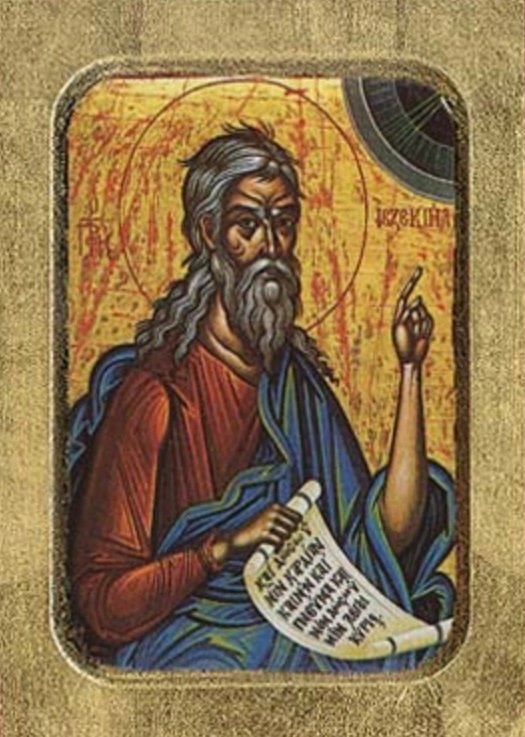
Prophet Ezekiel
He is commemorated today on the Slavic calendar. See July 23, his commemoration on the Greek calendar.
Troparion - Tone 2
We celebrate the memory / of Your prophet Ezekiel, O Lord; / through him we entreat You, / save our souls.
Our Righteous Fathers John and Symeon, the Fool for Christ's Sake (570)
These two brothers in Christ were from Edessa in Mesopotamia. After a pilgrimage to Jerusalem they fled the world together; they were tonsured as monks, but soon left their monastery to struggle in prayer near the Dead Sea. Thus they passed thirty years in silence and asceticism. Symeon was then commanded by God to leave the desert and serve God among the world’s people. A
These two brothers in Christ were from Edessa in Mesopotamia. After a pilgrimage to Jerusalem they fled the world together; they were tonsured as monks, but soon left their monastery to struggle in prayer near the Dead Sea. Thus they passed thirty years in silence and asceticism. Symeon was then commanded by God to leave the desert and serve God among the world’s people. At their parting John said to him: ‘Keep your heart from all that you see in the world. Whatever there may be that touches your hand, let it not take hold of your heart. When food passes your lips, let not your heart be sweetened by it. If your feet have to move, let there be peace within you. Whatever you do outwardly, let your mind remain tranquil. Pray for me, that God may not part us from each other in the world to come.’ Symeon went to Emesa in Syria, where he spent the rest of his life, feigning madness in order to conceal his holiness from men. But he performed miracles of healing and appeared to people of the city in dreams, calling them to repentance. He was given the gift of discernment of others’ inward condition, and while dancing and raving through the streets would approach people, whisper their sins in their ears, and call them to repentance. He reposed peacefully in 590; John, who had remained in the desert, reposed soon afterward.
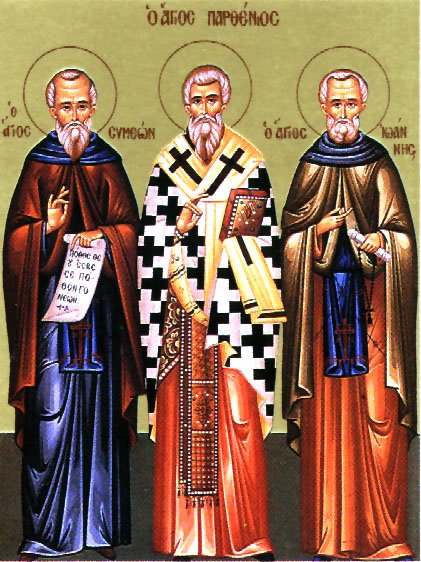
Venerable Simeon of Emessa the Fool-For-Christ, and his fellow ascetic Venerable John
The Monks Simeon, Fool-for-Christ, and his Fellow-Ascetic John were Syrians, and they lived in the sixth century at the city of Edessa. From childhood they were bound by close ties of friendship. The older of them, Simeon, was unmarried and lived with his aged mother. John, however, although he was married, lived with his father (his mother was dead) and with his young wife.
The Monks Simeon, Fool-for-Christ, and his Fellow-Ascetic John were Syrians, and they lived in the sixth century at the city of Edessa. From childhood they were bound by close ties of friendship. The older of them, Simeon, was unmarried and lived with his aged mother. John, however, although he was married, lived with his father (his mother was dead) and with his young wife. Both friends belonged to wealthy families. When Simeon was thirty years old, and John twenty-four, they made a pilgrimage to Jerusalem on the Feast of the Exaltation of the Venerable and Life-Creating Cross of the Lord. On the journey home the friends spoke of the soul’s path to salvation. Dismounting their horses, they sent the servants on ahead with the horses, while they continued on foot.
Passing through Jordan, they saw monasteries on the edge of the desert. Both of them were filled with an irrepressible desire to leave the world and spend their remaining life in monastic struggles. They turned off from the road, which their servants followed to Syria, and they prayed zealously that God would guide them to the monasteries on the opposite side. They besought the Lord to indicate which monastery they should choose, and they decided to enter whichever monastery had its gates open. At this time the Lord informed Igumen Nikon in a dream to open the monastery gates, so that the sheep of Christ could enter in.
In great joy the comrades came through the open gates of the monastery, where they were warmly welcomed by the igumen, and they remained at the monastery. In a short while they received the monastic tonsure.
After remaining at the monastery for a certain time, Simeon desired to intensify his efforts, and to go into the desert to pursue asceticism in complete solitude. John did not wish to be left behind by his companion, and he decided to share with him the work of a desert-dweller. The Lord revealed the intentions of the companions to Igumen Nikon, and on that night when Saints Simeon and John intended to depart the monastery, he himself opened the gates for them. He prayed with them, gave them his blessing and sent them into the wilderness.
When they began their life in the desert, the spiritual brothers at first experienced the strong assaults of the devil. They were tempted by grief over abandoning their families, and the demons tried to discourage the ascetics, subjecting them to weakness, despondency and idleness. The brothers Simeon and John remembered their monastic calling, and trusting in the prayers of their Elder Nikon, they continued upon their chosen path. They spent their time in unceasing prayer and strict fasting, encouraging one another in their struggle against temptation.
After a while, with God’s help, the temptations stopped. The monks were told by God that Simeon’s mother and John’s wife had died, and that the Lord had vouchsafed them the blessings of Paradise. After this Simeon and John lived in the desert for twenty-nine years, and they attained complete dispassion (apathia) and a high degree of spirituality. Saint Simeon, through the inspiration of God, considered that now it was proper for him to serve people. To do this, he must leave the desert solitude and go into the world. Saint John, however, believing that he had not attained such a degree of dispassion as his companion, decided not to leave the wilderness.
The brethren parted with tears. Simeon journeyed to Jerusalem, and there he venerated the Tomb of the Lord and all the holy places. By his great humility the holy ascetic entreated the Lord to permit him to serve his neighbor in such a way that they should not acknowledge him. Saint Simeon chose for himself the difficult task of foolishness for Christ. Having come to the city of Emesa, he stayed there and passed himself off as a simpleton, behaving strangely, for which he was subjected to insults, abuse and beatings. In spite of this, he accomplished many good deeds. He cast out demons, healed the sick, delivered people from immanent death, brought the unbelieving to faith, and sinners to repentance.
All these things he did under the guise of foolishness, and he never received praise or thanks from people. Saint John highly esteemed his spiritual brother, however. When one of the inhabitants of the city of Emesa visited him in the wilderness, asking for his advice and prayers, he would invariably direct them to “the fool Simeon”, who was better able to offer them spiritual counsel. For three days before his death Saint Simeon ceased to appear on the streets, and he enclosed himself in his hut, where there was nothing except for bundles of firewood. Having remained in unceasing prayer for three days, Saint Simeon fell asleep in the Lord. Some of the city poor, his companions, had not seen the fool for some time. They went to his hut and found him dead.
Taking up the dead body, they carried him without church singing to a place where the homeless and strangers were buried. While they carried the body of Saint Simeon, several of the inhabitants heard a wondrous church singing, but could not understand from whence it came.
After Saint Simeon died, Saint John also fell asleep in the Lord. Shortly before his death, Saint Simeon saw a vision of his spiritual brother wearing a crown upon his head with the inscription: “For endurance in the desert.”
Troparion - Tone 1
Having heard the voice of Your Apostle Paul: / we are fools for Christ’s sake! / Your servant Simeon, O Christ God, / lived the life of a fool here on earth for Your sake. / Therefore as we venerate his memory, / we entreat You, O Lord, to save our souls!
Kontakion - Tone 2
Let us praise with fervent love, / this man who lived in the flesh as an angel, / adorning his soul with the most radiant virtues! / Simeon, the equal to the Apostles and the Bearer of God. / Together with him, let us honor his companion John, / for they both ever stand before God, interceding for us all!
Marcella, Virgin-Martyr of Chios (ca. 1500)
Her mother died when she was very young, and she was brought up by her father. As she grew older, she grew in virtue and beauty. Her father conceived an illicit desire for her and made improper advances toward her, which troubled her so greatly that she fled her village and hid in the mountains. Her father pursued her, even wounding her with arrows in his effort to possess her.
Her mother died when she was very young, and she was brought up by her father. As she grew older, she grew in virtue and beauty. Her father conceived an illicit desire for her and made improper advances toward her, which troubled her so greatly that she fled her village and hid in the mountains. Her father pursued her, even wounding her with arrows in his effort to possess her. Finally she took refuge in a cloven rock. When her father found that he could not drag her from her refuge, he viciously dismembered her and threw her head into the sea. From the rock that had sheltered her a stream appeared, whose water had healing virtues. The holy Marcella is especially venerated on Chios to this day.
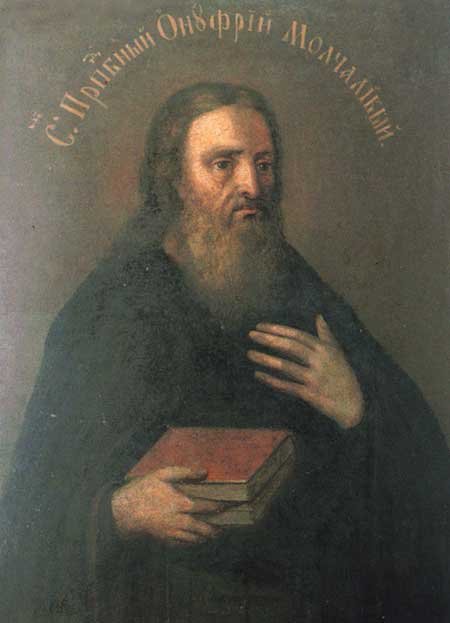
Venerable Onuphrius the Silent and Venerable Onesimos the Recluse, of the Kiev Caves
In the calendar of the Moscow Patriarchate both Venerable Onuphrios the Silent of the Kiev Caves (XII century), and Onesimos the Recluse of the Kiev Caves, Near Caves (XII-XIII century) are commemorated on July 21.
Venerable Onuphrios the Silent of the Kiev Caves was an ascetic in the Near Caves of Saint Anthony during the XII century.
In the calendar of the Moscow Patriarchate both Venerable Onuphrios the Silent of the Kiev Caves (XII century), and Onesimos the Recluse of the Kiev Caves, Near Caves (XII-XIII century) are commemorated on July 21.
Venerable Onuphrios the Silent of the Kiev Caves was an ascetic in the Near Caves of Saint Anthony during the XII century. He is also commemorated on September 28 (Synaxis of the Fathers of the Near Caves).
Venerable Onesimos the Recluse of the Caves (XII-XIII), was an ascetic in the Kiev Caves Lavra. He enclosed himself in the Near Caves of Saint Anthony. The holy relics of Saint Onesimos are buried in the place of his ascetical contests. He is also commemorated on October 4 with Saint Elladios.
The term Kiev Caves refers to both the Far (Дальних) Caves of Saint Theodosios, and to the Near (Ближних) Caves of Venerable Anthony. If term Kiev Caves Lavra is used, it means both Caves. If the text only says Far Caves, it is taken for granted that it means just the Far Caves, and not the Near Caves (and vice versa).
The Synaxis of the Venerable Fathers of the Far Caves of Venerable Theodosios is celebrated on August 28. Furthermore, the Synaxis of All the Venerable Fathers of the Kiev Caves is observed on the second Sunday of Great Lent.
Troparion - Tone 8
By a flood of tears you made the desert fertile, / and your longing for God brought forth fruits in abundance. / By the radiance of miracles you illumined the whole universe! / O our holy father Onuphrius, pray to Christ our God to save our souls!
Icon of the Mother of God of Armatia
The Armatia Icon of the Mother of God was in Constantinople at the Armatian monastery. The place where the monastery was located, was called “Armation” or “of the Armatians” and received its name from the military magister Armatios, nephew of the tyrant Basiliscus, and a contemporary of the emperor Zeno (474-491).
The ce
The Armatia Icon of the Mother of God was in Constantinople at the Armatian monastery. The place where the monastery was located, was called “Armation” or “of the Armatians” and received its name from the military magister Armatios, nephew of the tyrant Basiliscus, and a contemporary of the emperor Zeno (474-491).
The celebration of the wonderworking icon was established to commemorate deliverance from the Iconoclast heresy. The Seventh Ecumenical Council of 787 drew up dogmatic definitions about icon veneration based on Holy Scripture and Church Tradition.
The Armatia Icon of the Most Holy Theotokos is commemorated twice during the year, on July 21 and August 17.
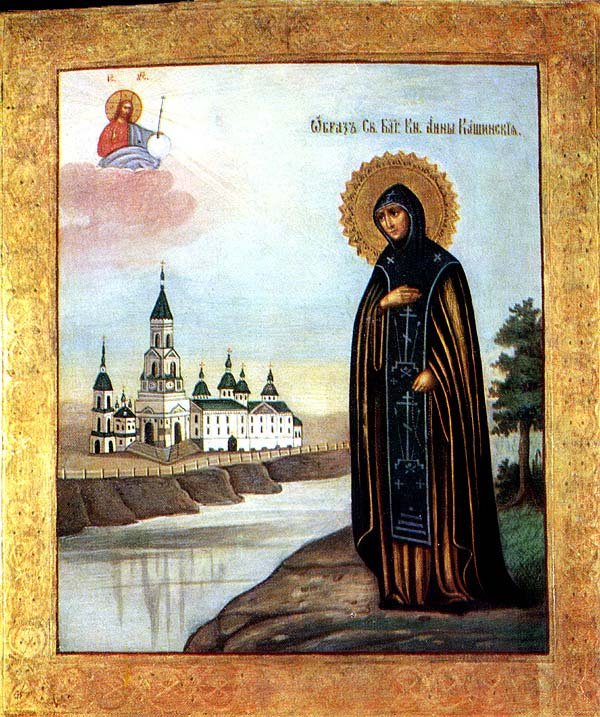
The Finding of the honored relics of the Venerable right-believing Great Princess and Nun Anna of Kashin, Wonderworker
The Holy right-believing Princess Anna of Kashin (Euphrosynē in monasticism) reposed on October 2, 1368.
On July 21, 1649, Archbishop Jonah of Kazan and some of the local clergy opened Saint Anna's tomb, and noticed that her relics were incorrupt. Several miracles of healing occurred at that time. The clergy and citizens of Kashin petitioned Tsar Alexei (reigned 1645-1676) to order an examination of Princess Anna's relics.
The Holy right-believing Princess Anna of Kashin (Euphrosynē in monasticism) reposed on October 2, 1368.
On July 21, 1649, Archbishop Jonah of Kazan and some of the local clergy opened Saint Anna's tomb, and noticed that her relics were incorrupt. Several miracles of healing occurred at that time. The clergy and citizens of Kashin petitioned Tsar Alexei (reigned 1645-1676) to order an examination of Princess Anna's relics.
In 1650, a Council of the Russian Church met and decided to number Princess Anna among the Saints, ordering a Church Service to be composed for her, and that she be venerated throughout Russia. The solemn transfer of her relics from the wooden Dormition Cathedral to the stone Resurrection Cathedral took place on June 12, 1650.
In 1677 Patriarch Joachim proposed to the Moscow Council that Saint Anna's veneration throughout Russia should be discontinued because of the Old Believer Schism, which made use of her name for its own purposes. When she was buried, her hand was positioned to make the Sign of the Cross with two fingers, rather than three. Therefore, only her local veneration was permitted. However, the memory of Saint Anna, whom God had glorified, could not be erased by a decree. People continued to love and venerate her, and many miracles took place at her tomb.
Finally, the Church-wide veneration of Saint Anna was restored on June 12, 1909. During the Soviet period, however, the relics of Saint Anna were taken from the Cathedral and moved several times. Finally on June 25, 1993, her relics were returned to Kashin's Resurrection Cathedral.
Troparion - Tone 3
We glorify you today, Venerable Mother, / Great Princess, and Nun Anna, / for as a fertile vine among thorns, / you blossomed in the city of Kashin with your virtues and astonished everyone with your wonderful life, / therefore you pleased Christ God; / and now, rejoicing and triumphant, / you dwell in the assembly of Venerable women, / enjoying heavenly beauty and joy. / We pray to you, "Entreat Christ, our God, the Lover of mankind, / that He may grant us peace and great mercy."
Kontakion - Tone 8
Having been enlightened by Divine grace, O Venerable one, / and having bound your wise soul to the love of Christ, with uprightness of mind, you scorned temporal, corruptible, and earthly goods. / You armed yourself courageously against noetic enemies with the Sign of the Cross, / extinguishing the coals of the passions by the ascetical struggles of fasting and prayer. / O Anna worthy of glory, / even after death you pour forth grace upon those who come to your relics. / Now, in the heavenly Bridal Chamber with the wise virgins,1 pray to Christ for us who honor your holy memory.1 Matthew 25:1-13.
Scripture Readings
☩Epistle
1 Corinthians 10:5-12
5
But with many of them God was not well pleased: for they were overthrown in the wilderness.
6
Now these things were our examples, to the intent we should not lust after evil things, as they also lusted.
7
Neither be ye idolaters, as were some of them; as it is written, The people sat down to eat and drink, and rose up to play.
8
Neither let us commit fornication, as some of them committed, and fell in one day three and twenty thousand.
9
Neither let us tempt Christ, as some of them also tempted, and were destroyed of serpents.
10
Neither murmur ye, as some of them also murmured, and were destroyed of the destroyer.
11
Now all these things happened unto them for ensamples: and they are written for our admonition, upon whom the ends of the world are come.
12
Wherefore let him that thinketh he standeth take heed lest he fall.
☩Gospel
Matthew 16:6-12
6
Then Jesus said unto them, Take heed and beware of the leaven of the Pharisees and of the Sadducees.
7
And they reasoned among themselves, saying, It is because we have taken no bread.
8
Which when Jesus perceived, he said unto them, O ye of little faith, why reason ye among yourselves, because ye have brought no bread?
9
Do ye not yet understand, neither remember the five loaves of the five thousand, and how many baskets ye took up?
10
Neither the seven loaves of the four thousand, and how many baskets ye took up?
11
How is it that ye do not understand that I spake it not to you concerning bread, that ye should beware of the leaven of the Pharisees and of the Sadducees?
12
Then understood they how that he bade them not beware of the leaven of bread, but of the doctrine of the Pharisees and of the Sadducees.
Liturgical data sourced from OCA.org and orthocal.info