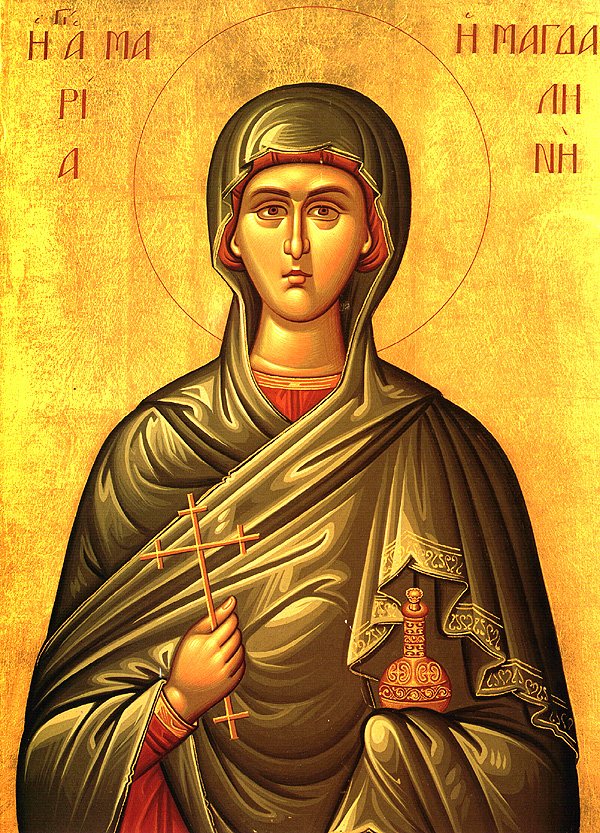
Holy Myrrhbearer Mary Magdalene, Equal-to-the-Apostles
She was from the town of Magdala on the Sea of Galilee, for which reason she is called “Magdalene.” The Lord Jesus cast out seven demons from her, after which she became His faithful disciple, following Him even to the Cross when most of His disciples had fled. With the other holy Myrrh-bearers, she prepared the spices to anoint His body and carried them to His tomb. The
She was from the town of Magdala on the Sea of Galilee, for which reason she is called “Magdalene.” The Lord Jesus cast out seven demons from her, after which she became His faithful disciple, following Him even to the Cross when most of His disciples had fled. With the other holy Myrrh-bearers, she prepared the spices to anoint His body and carried them to His tomb. There she was one of the first witnesses to the Resurrection, and the first to proclaim it.
Various traditions hold that, after Christ’s ascension, she traveled to Rome, where she presented the Emperor with a red egg and proclaimed “Christ is Risen!” For this reason her icons often show her holding a red egg, and from this the tradition of distributing red eggs at Pascha is said to have arisen. She is then said to have travelled to Ephesus where she helped St John the Theologian in his gospel ministry before reposing there.
Mary Magdalene is sometimes identified with the “sinful woman” of the Gospels, but this is not the Church’s tradition. Neither the Gospels nor the sacred hymnography of the Church make this connection.
The name ‘Madeleine’ is a form of ‘Magdalene’.
Myrrhbearer and Equal of the Apostles Mary Magdalene
The Holy Myrrh-Bearer Equal of the Apostles Mary Magdalene. On the banks of Lake Genesareth (Galilee), between the cities of Capharnum and Tiberias, was the small city of Magdala, the remains of which have survived to our day. Now only the small village of Mejhdel stands on the site.
A woman whose name has entered forever into the Gospel account was born and grew up in Magdala.
The Holy Myrrh-Bearer Equal of the Apostles Mary Magdalene. On the banks of Lake Genesareth (Galilee), between the cities of Capharnum and Tiberias, was the small city of Magdala, the remains of which have survived to our day. Now only the small village of Mejhdel stands on the site.
A woman whose name has entered forever into the Gospel account was born and grew up in Magdala. The Gospel tells us nothing of Mary’s younger years, but Tradition informs us that Mary of Magdala was young and pretty, and led a sinful life. It says in the Gospels that the Lord expelled seven devils from Mary (Luke. 8:2). From the moment of her healing Mary led a new life, and became a true disciple of the Savior.
The Gospel relates that Mary followed after the Lord, when He went with the Apostles through the cities and villages of Judea and Galilee preaching about the Kingdom of God. Together with the pious women Joanna, wife of Choza (steward of Herod), Susanna and others, she served Him from her own possessions (Luke 8:1-3) and undoubtedly shared with the Apostles the evangelic tasks in common with the other women. The Evangelist Luke, evidently, has her in view together with the other women, stating that at the moment of the Procession of Christ onto Golgotha, when after the Scourging He took on Himself the heavy Cross, collapsing under its weight, the women followed after Him weeping and wailing, but He consoled them. The Gospel relates that Mary Magdalene was present on Golgotha at the moment of the Lord’s Crucifixion. While all the disciples of the Savior ran away, she remained fearlessly at the Cross together with the Mother of God and the Apostle John.
The Evangelists also list among those standing at the Cross the mother of the Apostle James, and Salome, and other women followers of the Lord from Galilee, but all mention Mary Magdalene first. Saint John, in addition to the Mother of God, names only her and Mary Cleopas. This indicates how much she stood out from all the women who gathered around the Lord.
She was faithful to Him not only in the days of His Glory, but also at the moment of His extreme humiliation and insult. As the Evangelist Matthew relates, she was present at the Burial of the Lord. Before her eyes Joseph and Νikόdēmos went out to the tomb with His lifeless Body. She watched as they covered over the entrance to the cave with a large stone, entombing the Source of Life.
Faithful to the Law in which she was raised, Mary together with the other women spent the following day at rest, because it was the great day of the Sabbath, coinciding with the Feast of Passover. But all the rest of the peaceful day the women gathered spices to go to the Grave of the Lord at dawn on Sunday and anoint His Body according to the custom of the Jews.
It is necessary to mention that, having agreed to go on the first day of the week to the Tomb early in the morning, the holy women had no possibility of meeting with one another on Saturday. They went separately on Friday evening to their own homes. They went out only at dawn the following day to go to the Sepulchre, not all together, but each from her own house.
The Evangelist Matthew writes that the women came to the grave at dawn, or as the Evangelist Mark expresses, extremely early before the rising of the sun. The Evangelist John, elaborating upon these, says that Mary came to the grave so early that it was still dark. Obviously, she waited impatiently for the end of night, but it was not yet daybreak. She ran to the place where the Lord’s Body lay.
Mary went to the tomb alone. Seeing the stone pushed away from the cave, she ran away in fear to tell the close Apostles of Christ, Peter and John. Hearing the strange message that the Lord was gone from the tomb, both Apostles ran to the tomb and, seeing the shroud and winding cloths, they were amazed. They went and said nothing to anyone, but Mary returned to the tomb and stood about the entrance to the tomb and wept. Here in this dark tomb so recently lay her lifeless Lord.
Wanting proof that the tomb really was empty, she went down to it and saw a strange sight. She saw two angels in white garments, one sitting at the head, the other at the foot, where the Body of Jesus had been placed. They asked her, “Woman, why weepest thou?” She answered them with the words which she had said to the Apostles, “They have taken my Lord, and I do not know where they have laid Him.” At that moment, she turned around and saw the Risen Jesus standing near the grave, but she did not recognize Him.
He asked Mary, “Woman, why weepest thou? Whom dost thou seek?” She answered thinking that she was seeing the gardener, “Sir, if thou hast taken him, tell where thou hast put Him, and I will take Him away.”
Then she recognized the Lord’s voice. This was the voice she heard in those days and years, when she followed the Lord through all the cities and places where He preached. He spoke her name, and she gave a joyful shout, “Rabbi” (Teacher).
Respect and love, fondness and deep veneration, a feeling of thankfulness and recognition at His Splendor as great Teacher, all came together in this single outcry. She was able to say nothing more and she threw herself down at the feet of her Teacher to wash them with tears of joy. But the Lord said to her: “Touch me not; for I am not yet ascended to My Father; but go to My brethren and tell them: ‘I ascend to My Father, and your Father; to My God and to your God.’”
She came to herself and again ran to the Apostles, to do the will of Him sending her to preach. Again she ran into the house, where the Apostles still remained in dismay, and proclaimed to them the joyous message, “I have seen the Lord!” This was the first preaching in the world about the Resurrection.
The Apostles proclaimed the Glad Tidings to the world, but she proclaimed it to the Apostles themselves.
Holy Scripture does not tell us about the life of Mary Magdalene after the Resurrection of Christ, but it is impossible to doubt, that if in the terrifying minutes of Christ’s Crucifixion she was at the foot of His Cross with His All-Pure Mother and Saint John, she must have stayed with them during the happier time after the Resurrection and Ascension of Christ. Thus in the Acts of the Apostles Saint Luke writes that all the Apostles with one mind stayed in prayer and supplication, with certain women and Mary the Mother of Jesus and His brethren.
Holy Tradition testifies that when the Apostles departed from Jerusalem to preach to all the ends of the earth, then Mary Magdalene also went with them. A daring woman, whose heart was full of reminiscence of the Resurrection, she went beyond her native borders and went to preach in pagan Rome. Everywhere she proclaimed to people about Christ and His teaching. When many did not believe that Christ is risen, she repeated to them what she had said to the Apostles on the radiant morning of the Resurrection: “I have seen the Lord!” With this message she went all over Italy.
Tradition relates that in Italy Mary Magdalene visited Emperor Tiberias (14-37 A.D.) and proclaimed to him Christ’s Resurrection. According to Tradition, she brought him a red egg as a symbol of the Resurrection, a symbol of new life with the words: “Christ is Risen!” Then she told the emperor that in his Province of Judea the unjustly condemned Jesus the Galilean, a holy man, a miracleworker, powerful before God and all mankind, had been executed at the instigation of the Jewish High Priests, and the sentence confirmed by the procurator appointed by Tiberias, Pontius Pilate.
Mary repeated the words of the Apostles, that we are redeemed from the vanity of life not with perishable silver or gold, but rather by the precious Blood of Christ.
Thanks to Mary Magdalene the custom to give each other paschal eggs on the day of the Radiant Resurrection of Christ spread among Christians over all the world. In one ancient Greek manuscript, written on parchment, kept in the monastery library of Saint Athanasius near Thessalonica, is a prayer read on the day of Holy Pascha for the blessing of eggs and cheese. In it is indicated that the igumen in passing out the blessed eggs says to the brethren: “Thus have we received from the holy Fathers, who preserved this custom from the very time of the holy Apostles, therefore the holy Equal of the Apostles Mary Magdalene first showed believers the example of this joyful offering.”
Mary Magdalene continued her preaching in Italy and in the city of Rome itself. Evidently, the Apostle Paul has her in mind in his Epistle to the Romans (16: 6), where together with other ascetics of evangelic preaching he mentions Mary (Mariam), who as he expresses “has bestowed much labor on us.” Evidently, she extensively served the Church in its means of subsistence and its difficulties, being exposed to dangers, and sharing with the Apostles the labors of preaching.
According to Church Tradition, she remained in Rome until the arrival of the Apostle Paul, and for two more years following his departure from Rome after the first court judgment upon him. From Rome, Saint Mary Magdalene, already bent with age, moved to Ephesus where the holy Apostle John unceasingly labored. There the saint finished her earthly life and was buried.
Her holy relics were transferred in the ninth century to Constantinople, and placed in the monastery Church of Saint Lazarus. In the era of the Crusader campaigns they were transferred to Italy and placed at Rome under the altar of the Lateran Cathedral. Part of the relics of Mary Magdalene are said to be in Provage, France near Marseilles, where over them at the foot of a steep mountain a splendid church is built in her honor.
The Orthodox Church honors the holy memory of Saint Mary Magdalene, the woman called by the Lord Himself from darkness to light, and from the power of Satan to God.
Formerly immersed in sin and having received healing, she sincerely and irrevocably began a new life and never wavered from that path. Mary loved the Lord Who called her to a new life. She was faithful to Him not only when He was surrounded by enthusiastic crowds and winning recognition as a miracle-worker, but also when all the disciples deserted Him in fear and He, humiliated and crucified, hung in torment upon the Cross. This is why the Lord, knowing her faithfulness, appeared to her first, and esteemed her worthy to be first to proclaim His Resurrection.
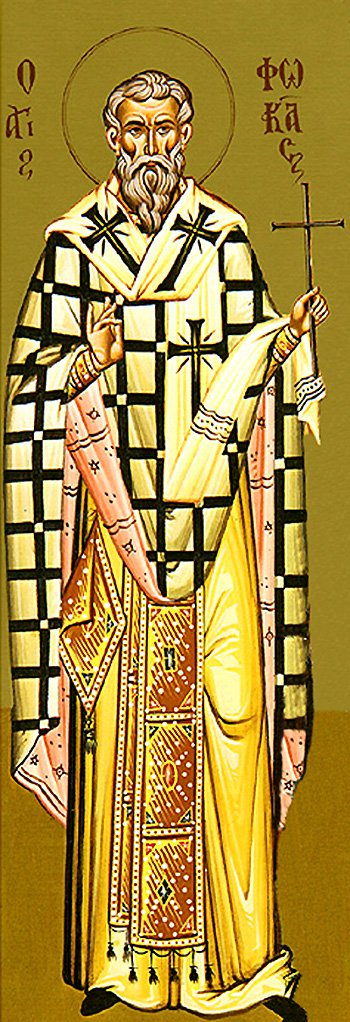
Translation of the relics of the Hieromartyr Phocas, Bishop of Sinope
The Transfer of the Relics of the Hieromartyr Phocas from Sinope to Constantinople occurred on July 22 in either the year 403 or 404. His life is found under September 22.
Troparion - Tone 4
By sharing in the ways of the Apostles, / you became a successor to their throne. / Through the practice of virtue, you found the way to divine contemplation, / O inspired one of God; / by teaching the word of truth without error, you defended the Faith, / even to the shedding of your blood. / Hieromartyr Phocas entreat Christ God to save our souls.
Kontakion - Tone 2
The Master established you as a brilliant sun / shining on all the faithful, glorious hieromartyr Phocas. / He has accepted your life, faith and contest as myrrh, / for He is rich in mercy.
Repose of Venerable Cornelius of Pereyaslavl
Saint Cornelius of Pereyaslavl, in the world Konon, was the son of a Ryazan merchant. In his youth he left his parental home and lived for five years as a novice of the Elder Paul in the Lukianov wilderness near Pereyaslavl. Afterwards the young ascetic transferred to the Pereyaslavl monastery of Saints Boris and Gleb on the Sands [Peskakh].
Saint Cornelius of Pereyaslavl, in the world Konon, was the son of a Ryazan merchant. In his youth he left his parental home and lived for five years as a novice of the Elder Paul in the Lukianov wilderness near Pereyaslavl. Afterwards the young ascetic transferred to the Pereyaslavl monastery of Saints Boris and Gleb on the Sands [Peskakh]. Konon eagerly went to church and unquestioningly did everything that they commanded him.
The holy novice did not sit down to eat in the trapeza with the brethren, but contented himself with whatever remained, accepting food only three times a week. After five years, he received monastic tonsure with the name Cornelius. From that time no one saw the monk sleeping on a bed. Several of the brethren scoffed at Saint Cornelius as foolish, but he quietly endured the insults and intensified his efforts. Having asked permission of the igumen to live as a hermit, he secluded himself into his own separately constructed cell and constantly practiced asceticism in fasting and prayer.
Once the brethren found him barely alive, and the cell was locked from within. Three months Saint Cornelius lay ill, and he could take only water and juice. The monk, having recovered and being persuaded by the igumen, stayed to live with the brethren. Saint Cornelius was the sacristan in church, he served in the trapeza, and also toiled in the garden. As if to bless the saint’s labors, excellent apples grew in the monastery garden, which he lovingly distributed to visitors.
The body of Saint Cornelius was withered up from strict fasting, but he did not cease to toil. With his own hands he built a well for the brethren. For thirty years Saint Cornelius lived in complete silence, being considered by the brethren as deaf and dumb. Before his death on July 22, 1693, Saint Cornelius made his confession to the monastery priest Father Barlaam, received the Holy Mysteries and took the schema.
He was buried in the chapel. Nine years later, during the construction of a new church, his relics were found incorrupt. In the year 1705, Saint Demetrius, Metropolitan of Rostov (October 28), saw the relics of Saint Cornelius, and they were in the new church in a secluded place. The holy bishop composed a Troparion and Kontakion to the saint.
Troparion - Tone 8
Let us honor the new God-pleaser, Venerable Cornelius, / who lifted the cross upon his shoulders, eagerly taking up the yoke of Christ, / he fought courageously against invisible enemies and intrigues, / and as a good soldier he stands before the Master Christ and prays without ceasing for our souls.
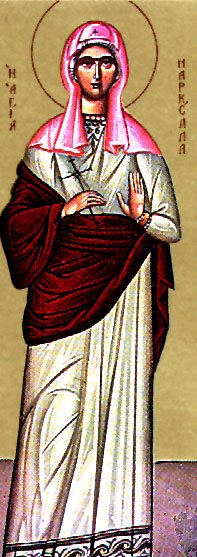
Martyr Markella of Chios
Saint Markella lived in the village of Volissos, Chios sometime after the middle of the fourteenth century. Her parents were Christians, and among the wealthiest citizens of Volissos. The saint’s mother died when she was young, and so her father, the mayor of the village, saw to her education.
She had been trained by her mother to be respectful and devout, and to guard her purity. S
Saint Markella lived in the village of Volissos, Chios sometime after the middle of the fourteenth century. Her parents were Christians, and among the wealthiest citizens of Volissos. The saint’s mother died when she was young, and so her father, the mayor of the village, saw to her education.
She had been trained by her mother to be respectful and devout, and to guard her purity. She avoided associations with other girls who were more outgoing than she was so that she would not come to spiritual harm through such company. Her goal was to attain the Kingdom of Heaven, and to become a bride of Christ.
Saint Markella increased in virtue as she grew older, fasting, praying, and attending church services. She tried to keep the commandments and to lead others to God. She loved and respected her father, and comforted him in his sorrow. She told him she would take care of him in his old age, and would not abandon him.
As an adult, Saint Markella was loved by everyone for her beauty and for her spiritual gifts. The Enemy of our salvation tried to lure her into sin by placing evil thoughts in her mind. She resisted these temptations, and so the devil turned away from a direct confrontation with the young woman. Instead, he incited her father with an unnatural desire for his daughter.
Markella’s father changed in his behavior toward her. He became moody and depressed, forbidding her to go into the garden or to speak with the neighbors. Unable to understand the reason for this change, the saint went to her room and wept. She prayed before an icon of the Mother of God, asking Her to help her father. Soon she fell asleep, only to be awakened by her father’s shouting.
The unfortunate man had spent a long time struggling against his lust, but finally he gave in to it. At times he would speak to his daughter roughly, then later he would appear to be gentle. He wanted to be near her, and to stroke her hair. Unaware of her father’s intentions, Saint Markella was happy to see him emerge from his melancholy state, thinking that her prayer had been answered.
One day, her father openly declared the nature of his feelings for her. Horrified, the saint tried to avoid him as much as she could. Even the neighbors realized that there was something wrong with the man, so they stopped speaking to him.
A shepherd was tending his sheep near the beach one morning, and was leading them into the shade of a plane tree to avoid the hot July sun. Just as he was about to lie down, he heard a noise and looked up. He saw a young woman with a torn dress running down the hill. She hid in a nearby bush, ignoring its thorns.
The shepherd wondered who was chasing her, and how she had come to this spot. Then he heard the sound of a horse approaching, and recognized the mayor of the village. He asked the shepherd if he had seen his daughter. He said that he had not seen her, but pointed to her hiding place with his finger.
The mayor ordered Markella to come out of the bush, but she refused. Therefore, he set fire to the bush in order to force her out. She emerged on the side opposite her father, and ran toward the rocky shore, calling out to the Mother of God for help.
Markella continued to run, even though blood was flowing from her face and hands. Feeling a sharp pain in her leg, she saw that she had been shot with an arrow. She paused to pull it out, then took to flight once more. She scrambled over the rocks, staining them with her blood. Hearing her father getting closer, she prayed that the earth would open up and swallow her.
The saint sank to her knees, her strength all gone, and then a miracle took place. The rock split open and received her body up to the waist. Her father drew near with wild-eyed joy shouting, “I have caught you. Now where will you go?
Drawing his sword, he began to butcher his helpless daughter, cutting off pieces of her body. Finally, he seized her by the hair and cut off her head, throwing it into the sea. At once the calm sea became stormy, and large waves crashed to the shore near the murderer’s feet. Thinking that the sea was going to drown him because of his crime, he turned and fled. His ultimate fate has not been recorded.
In later years, pious Christians built a church on the spot where Saint Markella hid in the bush. The spot where she was killed became known as “The Martyrdom of Saint Markella,” and the rock that opened to receive her is still there. The rock appears to be a large stone that broke off from a mountain and rolled into the sea. Soil from the mountain covers the spot on the side facing the land. On the side facing the ocean is a small hole, about the size of a finger. A healing water flows from the opening, which cures every illness.
The flow of water is not due to the movements of the tide, because when the tide is out, there would be no water. This, however, is not the case. The water is clear, but some of the nearby rocks have been stained with a reddish-yellow color. According to tradition, the lower extremities of Saint Markella’s body are concealed in the rock.
The most astonishing thing about the rock is not the warmth of the water, nor the discoloration of the other rocks, but what happens when a priest performs the Blessing of Water. A sort of steam rises up from the water near the rock, and the entire area is covered with a mist. The sea returns to normal as soon as the service is over. Many miracles have occurred at the spot, and pilgrims flock there from all over the world.
Troparion - Tone 4
Your lamb Markella calls out to You, O Jesus, in a loud voice: / “I love You, my Bridegroom, and in seeking You I endure suffering. / In Baptism I was crucified so that I might reign in You, / and I died so that I might live with You. / Accept me as a pure sacrifice, / for I have offered myself in love.” / Through her prayers, save our souls, since You are merciful.
Scripture Readings
☩Epistle
1 Corinthians 10:12-22
12
Wherefore let him that thinketh he standeth take heed lest he fall.
13
There hath no temptation taken you but such as is common to man: but God is faithful, who will not suffer you to be tempted above that ye are able; but will with the temptation also make a way to escape, that ye may be able to bear it.
14
Wherefore, my dearly beloved, flee from idolatry.
15
I speak as to wise men; judge ye what I say.
16
The cup of blessing which we bless, is it not the communion of the blood of Christ? The bread which we break, is it not the communion of the body of Christ?
17
For we being many are one bread, and one body: for we are all partakers of that one bread.
18
Behold Israel after the flesh: are not they which eat of the sacrifices partakers of the altar?
19
What say I then? that the idol is any thing, or that which is offered in sacrifice to idols is any thing?
20
But I say, that the things which the Gentiles sacrifice, they sacrifice to devils, and not to God: and I would not that ye should have fellowship with devils.
21
Ye cannot drink the cup of the Lord, and the cup of devils: ye cannot be partakers of the Lord’s table, and of the table of devils.
22
Do we provoke the Lord to jealousy? are we stronger than he?
☩Gospel
Matthew 16:20-24
20
Then charged he his disciples that they should tell no man that he was Jesus the Christ.
21
From that time forth began Jesus to shew unto his disciples, how that he must go unto Jerusalem, and suffer many things of the elders and chief priests and scribes, and be killed, and be raised again the third day.
22
Then Peter took him, and began to rebuke him, saying, Be it far from thee, Lord: this shall not be unto thee.
23
But he turned, and said unto Peter, Get thee behind me, Satan: thou art an offence unto me: for thou savourest not the things that be of God, but those that be of men.
24
Then said Jesus unto his disciples, If any man will come after me, let him deny himself, and take up his cross, and follow me.
 Meat
Abstain
Meat
Abstain
 Fish
Abstain
Fish
Abstain
 Dairy
Abstain
Dairy
Abstain
 Oil
Abstain
Oil
Abstain
 Wine
Abstain
Wine
Abstain