Fasting Rules
 Meat
Abstain
Meat
Abstain
 Fish
Abstain
Fish
Abstain
 Dairy
Abstain
Dairy
Abstain
 Oil
Abstain
Oil
Abstain
 Wine
Abstain
Wine
Abstain
Saints & Commemorations
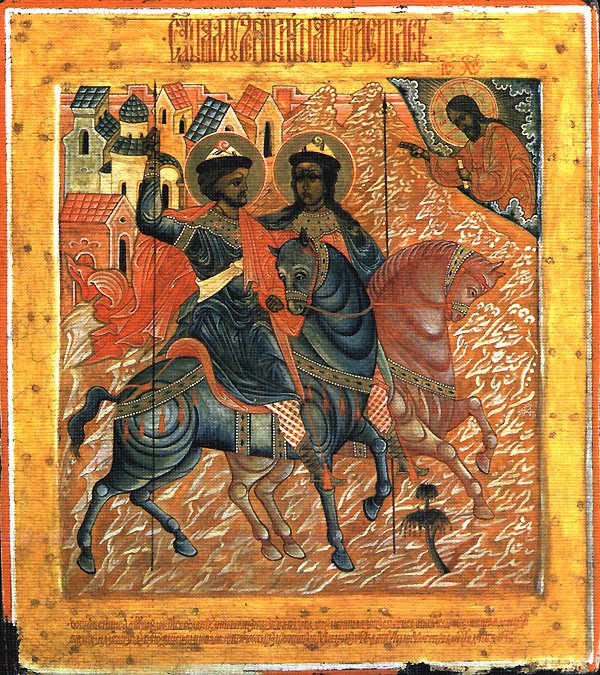
Martyrs and Passion-Bearers Boris and Gleb
Saints Boris and Gleb were sons of Saint Vladimir (July 15). Saint Boris was named Romanus and Saint Gleb was named David at their Baptism. After their father’s death the eldest son Sviatopolk planned to kill his brothers Boris, Gleb, and Yaroslav in order to seize power. He sent a message to Boris, pretending that he wished to live in peace with him, and to increase Boris’s land holdings inherited from their father.
So
Saints Boris and Gleb were sons of Saint Vladimir (July 15). Saint Boris was named Romanus and Saint Gleb was named David at their Baptism. After their father’s death the eldest son Sviatopolk planned to kill his brothers Boris, Gleb, and Yaroslav in order to seize power. He sent a message to Boris, pretending that he wished to live in peace with him, and to increase Boris’s land holdings inherited from their father.
Some of Vladimir’s advisers told Boris that he should take the army and establish himelf as ruler of Kiev. Saint Boris, however, said that he could never lift his hand against his own brother. Unfortunately, Sviatopolk was not so scrupulous. He came to the town of Vyshegorod to ask its leaders if they were loyal to him. They assured him that they were ready to die for him.
Sviatopolk sent assassins to the Alta to kill Boris, who already knew that his brother wanted him dead. When they arrived they heard him chanting psalms and praying before an icon of Christ. He asked the Lord to strengthen him for the suffering he was about to endure. He also prayed for Sviatopolk, asking God not to count this against him as sin.
Then he lay down upon his couch, and the assassins stabbed him with their lances, and also killed some of Boris’s servants. Wrapping Boris in a cloth, they threw him onto a wagon and drove off with him. When Sviatopolk saw that he was still breathing, he sent some men to finish him off with swords.
After Sviatopolk had killed Boris, he wondered, “Now how can I kill Gleb?” He sent him a message saying that their father was ill and wished to see him. As he was on his way, he received word from Yaroslav that their father had died and that Sviatopolk had murdered Boris.
Saint Gleb wept for his father and brother, and was lamenting them when the assassins arrived. They seized his boat and drew their weapons, but it was Gleb’s cook Torchin who stabbed him with a knife.
The martyr’s body was thrown onto the shore between two trees. Later, he was buried beside Saint Boris in the church of Saint Basil.
Saints Boris and Gleb received the crown of martyrdom in 1015. They became known as Passion-Bearers, since they did not resist evil with violence.
The holy martyrs Princes Boris and Gleb are also commemorated on May 2.
Troparion - Tone 2
Righteous passion-bearers and true fulfillers of the Gospel of Christ, / chaste Boris and guileless Gleb, / you did not resist the attacks of your brother, the enemy, / when he killed your bodies but could not touch your souls. / Therefore, let the evil lover of power mourn / while you rejoice with the angels standing before the Holy Trinity. / Pray that those who honor your memory may be pleasing to God, / and that all Orthodox Christians may be saved.
Kontakion - Tone 3
Today your most glorious memory shines forth, / noble participants in the passion of Christ, holy Boris and Gleb, / for you call us together to sing praises to Christ our God! / Praying to Him before your sacred images, / we receive the gift of healing by your prayers, / for you are indeed divine healers.
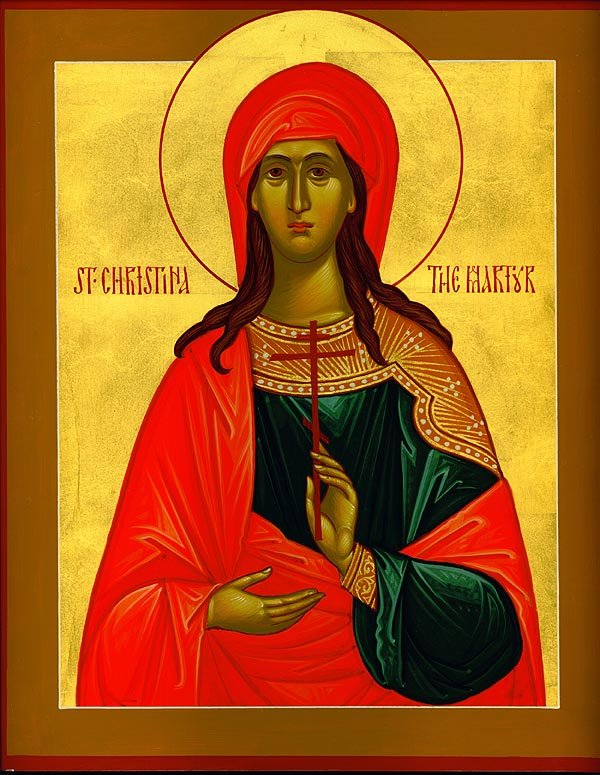
Martyr Christina of Tyre
She was from Tyre in Syria, the daughter of a pagan named Urban. She is a miraculous example of one brought to faith in Christ without any human intervention. When she was about eleven years old, her father, seeing her great beauty and wanting to protect her from men until she was grown, made her live alone on the top floor of a fine house, with slaves, all worldly comforts, and gold and silver idols.
She was from Tyre in Syria, the daughter of a pagan named Urban. She is a miraculous example of one brought to faith in Christ without any human intervention. When she was about eleven years old, her father, seeing her great beauty and wanting to protect her from men until she was grown, made her live alone on the top floor of a fine house, with slaves, all worldly comforts, and gold and silver idols. Passing the time by looking out the window, Christina came by her meditations on the beauty and order of nature to believe in the one, living God. An Angel of the Lord then came to her, who marked her with the sign of the Cross and instructed her in the truth of the Gospel. The newly-enlightened Christina smashed all the idols in her room, so infuriating her father that he sent her to be tortured and beheaded for her faith. Her father, though in good health and in the prime of life, died that night. Christina was subjected to horrible tortures and mutilations, and finally died by the sword, her faith unshaken.
Troparion to St Christina: O Lord Jesus, unto Thee Thy lamb doth cry with a great voice:* O my Bridegroom, Thee I love;* and seeking Thee, I now contest, and with Thy baptism am crucified and buried.* I suffer for Thy sake, that I may reign with Thee;* for Thy sake I die, that I may live in Thee:* accept me offered out of longing to Thee as a spotless sacrifice.* Lord, save our souls through her intercessions,* since Thou art great in mercy.
Venerable Polycarp, Archimandrite of the Kiev Far Caves
Saint Polycarp the Archimandrite entered the Kiev Caves Monastery, where he received monastic tonsure and struggled for the salvation of his soul.
Soon Polycarp (whose name means “much fruit”) began to bear fruits of repentance and virtue. His relative Saint Simon (May 10), who became Bishop of Vladimir and Suzdal, planted the seeds which Saint Polycarp developed. As
Saint Polycarp the Archimandrite entered the Kiev Caves Monastery, where he received monastic tonsure and struggled for the salvation of his soul.
Soon Polycarp (whose name means “much fruit”) began to bear fruits of repentance and virtue. His relative Saint Simon (May 10), who became Bishop of Vladimir and Suzdal, planted the seeds which Saint Polycarp developed. As the holy bishop taught Polycarp the principles of the spiritual life, the two became increasingly united in spirit, just as they were related by blood.
When Saint Simon left the Monastery of the Caves to assume his hierarchal responsibilities in Vladimir, he took Polycarp with him. Saint Polycarp wrote down the stories that Saint Simeon told him of the God-pleasing ascetics of the Kiev Caves so that others might also benefit from them. Therefore, he is also known as Saint Polycarp the Hagiologist. Although Saint Polycarp returned to the monastery, he always tried to live according to Saint Simeon’s instructions.
After the repose of Igumen Akindynus, the brethren chose Polycarp to succeed him as the Superior of the Lavra. He proved to be a skilled guide for the brethren in their struggle for salvation, and also for those outside the monastery.
The Great Prince Rostislav was one of many who profited from the teaching of Saint Polycarp, and asked that he be allowed to become a monk. Saint Polykarp told him, “God has appointed you to stand for the truth, to judge with justice, and to stand firmly before the Cross.”
Rostislav answered, “Holy Father, one cannot be a prince in this world without falling into sin. I am already exhausted and weakened by daily cares and labors. Now in my old age I would like to serve God and emulate those who have followed the narrow and sorrowful path and received the Kingdom of Heaven. I have heard of how Constantine (May 21), great among kings, appeared to a certain Elder and said, ‘If I had known what glory the monks receive in heaven... I would have taken off my crown and royal purple, and replaced them with the monastic garb’.”
Saint Polycarp told him, “If you desire this from your heart, then may it be God’s will.”
However, as the prince was passing through Smolensk, he fell ill and asked to be taken home to Kiev. Seeing how weak he was, his sister Rogneda urged him to remain in Smolensk and be buried in the church they had built there.
Rostislav would not accept this suggestion. He said, “If I do not make it back to Kiev, then let me be placed in the church my father built in the Monastery of Saint Theodore. If God delivers me from this illness and grants me health, then I vow to become a monk at the Monastery of the Caves under Polycarp.”
As he lay at death’s door, Rostislav said to the priest Simon, “You must answer before God since you hindered me from being tonsured by the holy one in the Caves Monastery, for I truly desired that. May the Lord not count it as a sin that I did not fulfill this.”
Saint Polycarp went to the Lord on July 24, 1182. After this, no successor was chosen for a long time. Although there were many worthy Elders in the Lavra, they all declined the office of igumen out of humility. The brethren realized that they could not remain for long without a shepherd. They assembled in the church and prayed to Saints Anthony and Theodosius and Saint Polycarp to help them find someone worthy to take his place.
Then a voice was heard saying, “Let us go to the priest Basil in Schekovitsa. Let him be our Superior and rule the monastery in the monastic rank.”
The monks went to the widowed priest Basil and asked him to be their Superior, but he refused for a long time. After many entreaties, he finally agreed and went with them to the monastery. He was tonsured as a monk and installed as igumen by Metropolitan Nikēphóros of Kiev, Bishops Laurence of Turov and Nicholas of Polotsk. Igumen Basil proved to be a model of virtues and a worthy successor to Saint Polycarp.
Troparion - Tone 8
By a flood of tears you made the desert fertile, / and your longing for God brought forth fruits in abundance. / By the radiance of miracles you illumined the whole universe! / O our holy father Polycarp, pray to Christ our God to save our souls!
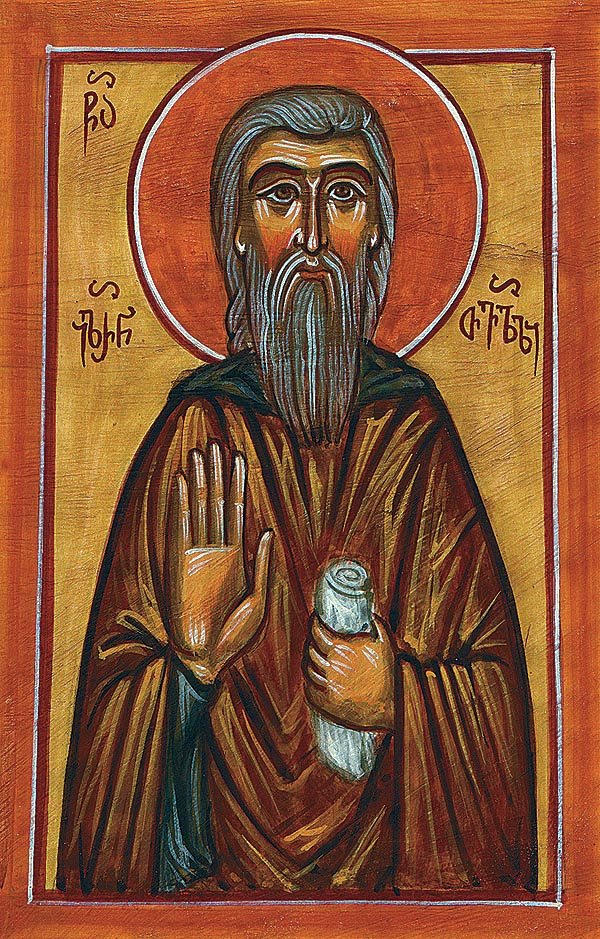
Saint Hilarion of Tvali
Saint Hilarion of Tvali (Tulashvili) served as abbot of Khakhuli Monastery in southwestern Georgia at the beginning of the 11th century.
In his work The Life of George of the Holy Mountain , George the Lesser writes that Venerable Hilarion was outstanding in virtue and celebrated for his sermons and ascetic labors.
Saint Hilarion of Tvali (Tulashvili) served as abbot of Khakhuli Monastery in southwestern Georgia at the beginning of the 11th century.
In his work The Life of George of the Holy Mountain , George the Lesser writes that Venerable Hilarion was outstanding in virtue and celebrated for his sermons and ascetic labors.
Saint Hilarion raised the young George of the Holy Mountain to be a brilliant writer, translator, theologian and patriot. From him George also received a blessing to enter the monastic life.
According to the chronicle Life of Kartli , Saint Hilarion was a famous translator and writer and an eminent theologian.
Eventually Saint Hilarion moved from Khakhuli to Tvali Monastery, not far from Antioch, where he remained for the rest of his life. According to the 19th-century historian-iconographer Michael Sabinin, Saint Hilarion reposed in the year 1041.
Troparion - Tone 8
By a flood of tears you made the desert fertile, / and your longing for God brought forth fruits in abundance. / By the radiance of miracles you illumined the whole universe! / O our holy father Hilarion, pray to Christ our God to save our souls!
Synaxis of the Smolensk Saints
Abramius the wonderworker. + August 21, ca. 1224.
Andrew, Prince. October 27(Uncovering of his relics) ca. 1390.
Anthony, Bishop of Vologda. + October 26, 1588 & January 17.
Arcadius, monk of Vyazma, disciple of Saint Ephraim of Novotorzhok. Ca. 1592. July 11, August 14 (translation of his relics in 1798), December 13.
Abramius the wonderworker. + August 21, ca. 1224.
Andrew, Prince. October 27(Uncovering of his relics) ca. 1390.
Anthony, Bishop of Vologda. + October 26, 1588 & January 17.
Arcadius, monk of Vyazma, disciple of Saint Ephraim of Novotorzhok. Ca. 1592. July 11, August 14 (translation of his relics in 1798), December 13.
Arcadius Dorogobuzhsky, disciple of Saint Gerasimus of Baldino. XVI century.
Constantine, Prince, son of Saint Theodore of Smolensk March 5 (translation of his relics), June 22, September 19.
David, prince and wonderworker, son of Theodore of Smolensk. March 5 (translation of his relics in 1321), June 22, September 9.
Ephraim of Novotorzhok + 1053. January 28, June 11 (translation of his relics in 1572).
Ephraim of Smolensk, disciple of Saint Abramius of Smolesk. + August 21, 1238.
Gerasimus of Baldino, + May 1, 1554.
Gleb (David in Baptism), prince and passion-bearer. May 2 (translation of his relics in 1115), July 24 (commemorated with Saint Boris), September 5 (his martyrdom in 1015). Gleb, prince of Smolensk, July 7 (XIV-XV century).
Ignatius, Bishop of Smolensk, wonderworker. + January 29, 1210.
Juliana, princess of Vyazma. June 2 (uncovering of her relics in 1819), December 21 (her martyrdom in 1406).
Macarius (Glukharov), Apostle to the Altai + May 15, 1847.
Mercurius, warrior and martyr + November 24, 1239.
Mercurius, Hieromartyr, Bishop of Smolensk. + August 7, 1238.
Michael, Bishop of Smolensk + November 28, 1402.
Michael, Prince, son of Saint Theodore of Smolensk. September 19, 1290.
Nicholas, Archbishop of Japan, equal of the Apostles (in the world Ivan Dimitrievich Kasatkin). + February 3, 1912.
Pitirim, Bishop of Tambov. + July 28, 1698.
Prochorus of the Kiev Caves, wonderworker. + February 10, 1107.
Rostislav (Michael in Baptism) Great Prince of Kiev. + 1167. March 14.
Simeon, Prince of Vyazma. + December 21, 1406.
Simeon, Metropolitan of Smolensk + January 4, 1699.
Simeon, disciple of Saint Sergius of Radonezh. + 1392.
Theodore, Prince and wonderworker + 1299. March 5 (translation of his relics in 1321), June 22, September 19.
Saint Athenagoras of Athens
Saint Athenogoras was a Christian philosopher and apologist of the second century A.D. He probably came from Athens where he studied Middle Platonism and Stoic philosophy. He flourished during the time of the Roman emperors Marcus Aurelius (161-180) and Commodus (180 - 192).
There are some basic facts about Saint Athenagoras, his formation and his work which are drawn from his two works, preserved in a codex from the year 914, which was produced in the literary workshop of Arethas: “Embassy (or Supplication) for the Christians" and "On the Resurrection of the dead.”
Saint Athenagoras stands out among the apologists of his day because of his literary excellence and his clear and eloquent style. His
Saint Athenogoras was a Christian philosopher and apologist of the second century A.D. He probably came from Athens where he studied Middle Platonism and Stoic philosophy. He flourished during the time of the Roman emperors Marcus Aurelius (161-180) and Commodus (180 - 192).
There are some basic facts about Saint Athenagoras, his formation and his work which are drawn from his two works, preserved in a codex from the year 914, which was produced in the literary workshop of Arethas: “Embassy (or Supplication) for the Christians" and "On the Resurrection of the dead.”
Saint Athenagoras stands out among the apologists of his day because of his literary excellence and his clear and eloquent style. His writings contain quotes from poets and philosophers, and from the rhythm of his sentences, and the arrangement of his material, we can deduce that he attended a school of rhetoric. In the field of theology he affirms Orthodox teachings about the Holy Trinity, the divine inspiration of the Holy Scriptures, and reveals a strict ascetical position concerning the moral life of Christians. His work has an important place in the ecclesiastical writings of the first two centuries.
Scripture Readings
☩Epistle
1 Corinthians 11:8-22
8
For the man is not of the woman; but the woman of the man.
9
Neither was the man created for the woman; but the woman for the man.
10
For this cause ought the woman to have power on her head because of the angels.
11
Nevertheless neither is the man without the woman, neither the woman without the man, in the Lord.
12
For as the woman is of the man, even so is the man also by the woman; but all things of God.
13
Judge in yourselves: is it comely that a woman pray unto God uncovered?
14
Doth not even nature itself teach you, that, if a man have long hair, it is a shame unto him?
15
But if a woman have long hair, it is a glory to her: for her hair is given her for a covering.
16
But if any man seem to be contentious, we have no such custom, neither the churches of God.
17
Now in this that I declare unto you I praise you not, that ye come together not for the better, but for the worse.
18
For first of all, when ye come together in the church, I hear that there be divisions among you; and I partly believe it.
19
For there must be also heresies among you, that they which are approved may be made manifest among you.
20
When ye come together therefore into one place, this is not to eat the Lord’s supper.
21
For in eating every one taketh before other his own supper: and one is hungry, and another is drunken.
22
What? have ye not houses to eat and to drink in? or despise ye the church of God, and shame them that have not? What shall I say to you? shall I praise you in this? I praise you not.
☩Gospel
Matthew 17:10-18
10
And his disciples asked him, saying, Why then say the scribes that Elias must first come?
11
And Jesus answered and said unto them, Elias truly shall first come, and restore all things.
12
But I say unto you, That Elias is come already, and they knew him not, but have done unto him whatsoever they listed. Likewise shall also the Son of man suffer of them.
13
Then the disciples understood that he spake unto them of John the Baptist.
14
And when they were come to the multitude, there came to him a certain man, kneeling down to him, and saying,
15
Lord, have mercy on my son: for he is lunatick, and sore vexed: for ofttimes he falleth into the fire, and oft into the water.
16
And I brought him to thy disciples, and they could not cure him.
17
Then Jesus answered and said, O faithless and perverse generation, how long shall I be with you? how long shall I suffer you? bring him hither to me.
18
And Jesus rebuked the devil; and he departed out of him: and the child was cured from that very hour.
Liturgical data sourced from OCA.org and orthocal.info