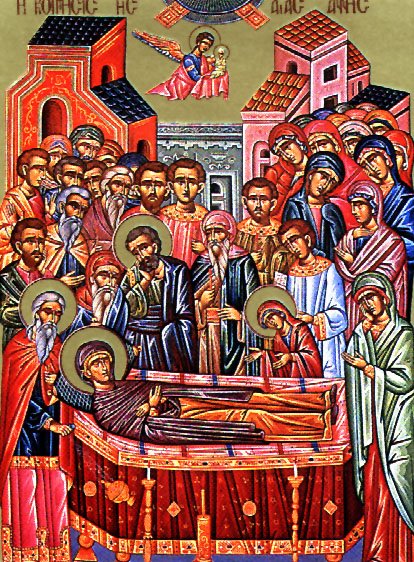
Dormition of the Righteous Anna, the Mother of the Most Holy Theotokos
According to tradition, both Anna and her husband Joachim had reposed by the time the Most Holy Theotokos was about eleven years old and living in the Temple; thus when she reached maturity she was an orphan, and was given into the care of the noble Joseph. The prayers of St Anna are invoked for conceiving children and for help in difficult childbirth. Her main feast is on September 9th.
Troparion - Tone 4
Divinely-wise Anna, you carried in your womb the pure Mother of God, who gave life to our Life. / Therefore, you are now carried joyfully to the inheritance of heaven, / to the abode of those who rejoice in glory, / where you seek forgiveness of sins for those who faithfully honor you, ever blessed one.
Kontakion - Tone 2
We celebrate the memory of the progenitors of Christ, / and with faith we ask their help, / that deliverance from every affliction be granted to those who cry out: / “Be with us, O God, who in Your good pleasure glorified them.”
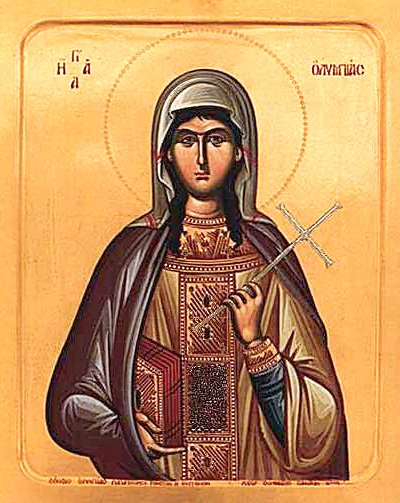
Holy Woman Olympias (Olympiada) the Deaconess of Constantinople
Saint Olympias the Deaconess was the daughter of the senator Anicius Secundus, and by her mother she was the granddaughter of the noted eparch Eulalios (he is mentioned in the life of Saint Nicholas). Before her marriage to Anicius Secundus, Olympias’s mother had been married to the Armenian emperor Arsak and became widowed. W
Saint Olympias the Deaconess was the daughter of the senator Anicius Secundus, and by her mother she was the granddaughter of the noted eparch Eulalios (he is mentioned in the life of Saint Nicholas). Before her marriage to Anicius Secundus, Olympias’s mother had been married to the Armenian emperor Arsak and became widowed. When Saint Olympias was still very young, her parents betrothed her to a nobleman. The marriage was supposed to take place when Saint Olympias reached the age of maturity. The bridegroom soon died, however, and Saint Olympias did not wish to enter into another marriage, preferring a life of virginity.
After the death of her parents she became the heir to great wealth, which she began to distribute to all the needy: the poor, the orphaned and the widowed. She also gave generously to the churches, monasteries, hospices and shelters for the downtrodden and the homeless.
Holy Patriarch Nectarius (381-397) appointed Saint Olympias as a deaconess. The saint fulfilled her service honorably and without reproach.
Saint Olympias provided great assistance to hierarchs coming to Constantinople: Amphilochius, Bishop of Iconium, Onesimus of Pontum, Gregory the Theologian, Saint Basil the Great’s brother Peter of Sebaste, Epiphanius of Cyprus, and she attended to them all with great love. She did not regard her wealth as her own but rather God’s, and she distributed not only to good people, but also to their enemies.
Saint John Chrysostom (November 13) had high regard for Saint Olympias, and he showed her good will and spiritual love. When this holy hierarch was unjustly banished, Saint Olympias and the other deaconesses were deeply upset. Leaving the church for the last time, Saint John Chrysostom called out to Saint Olympias and the other deaconesses Pentadia, Proklia and Salbina. He said that the matters incited against him would come to an end, but scarcely more would they see him. He asked them not to abandon the Church, but to continue serving it under his successor. The holy women, shedding tears, fell down before the saint.
Patriarch Theophilus of Alexandria (385-412), had repeatedly benefited from the generosity of Saint Olympias, but turned against her for her devotion to Saint John Chrysostom. She had also taken in and fed monks, arriving in Constantinople, whom Patriarch Theophilus had banished from the Egyptian desert. He levelled unrighteous accusations against her and attempted to cast doubt on her holy life.
After the banishment of Saint John Chrysostom, someone set fire to a large church, and after this a large part of the city burned down.
All the supporters of Saint John Chrysostom came under suspicion of arson, and they were summoned for interrogation. They summoned Saint Olympias to trial, rigorously interrogating her. They fined her a large sum of money for the crime of arson, despite her innocence and a lack of evidence against her. After this the saint left Constantinople and set out to Kyzikos (on the Sea of Marmara). But her enemies did not cease their persecution. In the year 405 they sentenced her to prison at Nicomedia, where the saint underwent much grief and deprivation. Saint John Chrysostom wrote to her from his exile, consoling her in her sorrow. In the year 409 Saint Olympias entered into eternal rest.
Saint Olympias appeared in a dream to the Bishop of Nicomedia and commanded that her body be placed in a wooden coffin and cast into the sea. “Wherever the waves carry the coffin, there let my body be buried,” said the saint. The coffin was brought by the waves to a place named Brokthoi near Constantinople. The inhabitants, informed of this by God, took the holy relics of Saint Olympias and placed them in the church of the holy Apostle Thomas.
Afterwards, during an invasion of enemies, the church was burned, but the relics were preserved. Under the Patriarch Sergius (610-638), they were transferred to Constantinople and put in the women’s monastery founded by Saint Olympias. Miracles and healings occurred from her relics.
St Olympias the Deaconess (408)
She was born to a noble family in Constantinople: her father Anysius Secundus was a senator. She was betrothed to a nobleman who died before they could be wed; resisting all advice to take another husband, Olympias devoted herself entirely to God, giving her large inheritance to the Church and to the poor.
She was born to a noble family in Constantinople: her father Anysius Secundus was a senator. She was betrothed to a nobleman who died before they could be wed; resisting all advice to take another husband, Olympias devoted herself entirely to God, giving her large inheritance to the Church and to the poor. She served as a deaconess, first under the Patriarch Nektarios, then under St John Chrysostom. When St John was sent into exile, he advised her to remain in Constantinople, and to continue to serve the Church whatever patriarch took his place. But as soon as the holy hierarch went into exile, a fire destroyed a large part of the City, and St John’s enemies accused the holy Olympias of setting the fire. She in turn was exiled to Nikomedia, where she reposed in 408. She left instructions that her body be placed in a coffin and thrown into the sea, to be buried wherever it was cast up. The coffin came to shore at Vrochthoi and was buried there at a church dedicated to the Apostle Thomas. Her relics have continued to be a source of great miracles of healing.
During his exile, St John Chrysostom wrote a number of letters to St Olympias, seventeen of which have been preserved through the centuries. In one he writes: ‘Now I am deeply joyful, not only because you have been delivered from sickness, but even more because you are bearing adversities with such fortitude, calling them trifles — a characteristic of a soul filled with power and abounding in the rich fruits of courage. You are not only enduring misfortune with fortitude, but are making light of it in a seemingly effortless way, rejoicing and triumphing over it — this is a proof of the greatest wisdom.’
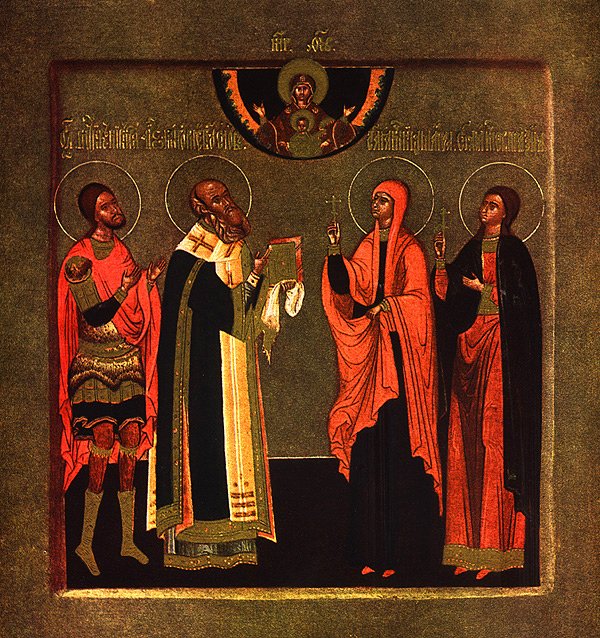
Virgin Martyr Eupraxia of Tabenna
Saint Eupraxia was daughter of the Constantinople dignitary Antigonos, a kinsman of the holy Emperor Theodosius the Great (379-395).
Antigonus and his wife Eupraxia were pious and bestowed generous alms on the destitute. A daughter was born to them, whom they also named Eupraxia. Antigonos soon died, and the mother withdrew from the imperial court.
Saint Eupraxia was daughter of the Constantinople dignitary Antigonos, a kinsman of the holy Emperor Theodosius the Great (379-395).
Antigonus and his wife Eupraxia were pious and bestowed generous alms on the destitute. A daughter was born to them, whom they also named Eupraxia. Antigonos soon died, and the mother withdrew from the imperial court. She went with her daughter to Egypt, on the pretext of inspecting her properties. Near the Thebaid there was a women’s monastery with a strict monastic rule. The life of the inhabitants attracted the pious widow. She wanted to bestow aid on this monastery, but the abbess Theophila refused and said that the nuns had fully devoted themselves to God and that they did not wish the acquisition of any earthly riches. The abbess consented to accept only candles, incense and oil.
The younger Eupraxia was seven years old at this time. She liked the monastic way of life and she decided to remain at the monastery. Her pious mother did not stand in the way of her daughter’s wish. Taking leave of her daughter at the monastery, Eupraxia asked her daughter to be humble, never to dwell upon her noble descent, and to serve God and her sisters.
In a short while the mother died. Having learned of her death, the emperor Saint Theodosius sent Saint Eupraxia the Younger a letter in which he reminded her that her parents had betrothed her to the son of a certain senator, intending that she marry him when she reached age fifteen. The Emperor desired that she honor the commitment made by her parents. In reply, Saint Eupraxia wrote to the emperor that she had already become a bride of Christ, and she requested of the emperor to dispose of her properties, distributing the proceeds for the use of the Church and the needy.
Saint Eupraxia, when she reached the age of maturity, intensified her ascetic efforts all the more. At first she partook of food once a day, then after two days, three days, and finally, once a week. She combined her fasting with the fulfilling of all her monastic obediences. She toiled humbly in the kitchen, she washed dishes, she swept the premises and served the sisters with zeal and love. The sisters also loved the humble Eupraxia. But one of them envied her and explained away all her efforts as a desire for glory. This sister began to trouble and to reproach her, but the holy virgin did not answer her back, and instead humbly asked forgiveness.
The Enemy of the human race caused the saint much misfortune. Once,while getting water, she fell into the well, and the sisters pulled her out. Another time, Saint Eupraxia was chopping wood for the kitchen, and cut herself on the leg with an axe. When she carried an armload of wood up the ladder, she stepped on the hem of her garment. She fell, and a sharp splinter cut her near the eyes. All these woes Saint Eupraxia endured with patience, and when they asked her to rest, she would not consent.
For her efforts, the Lord granted Saint Eupraxia a gift of wonderworking. Through her prayers she healed a deaf and dumb crippled child, and she delivered a demon-possessed woman from infirmity. They began to bring the sick for healing to the monastery. The holy virgin humbled herself all the more, counting herself as least among the sisters. Before the death of Saint Eupraxia, the abbess had a vision. The holy virgin was transported into a splendid palace, and stood before the Throne of the Lord, surrounded by holy angels. The All-Pure Virgin showed Saint Eupraxia around the luminous chamber and said that She had made it ready for her, and that she would come into this habitation after ten days.
The abbess and the sisters wept bitterly, not wanting to lose Saint Eupraxia. The saint herself, in learning about the vision, wept because she was not prepared for death. She asked the abbess to pray that the Lord would grant her one year more for repentance. The abbess consoled Saint Eupraxia and said that the Lord would grant her His great mercy. Suddenly Saint Eupraxia sensed herself not well, and having sickened, she soon peacefully died at the age of thirty.
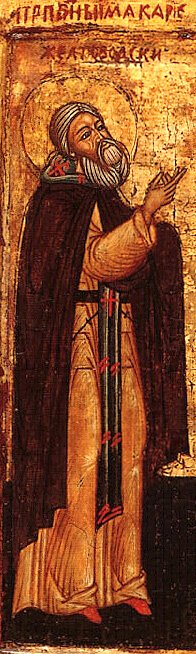
Venerable Makarios, Abbot of Zheltovod and Unzha
Our Venerable Father Makarios of Zheltovod and Unzha was born in the year 1349 at Nizhni-Novgorod into a pious family, and was baptized in the parish church of the Myrrh-bearing women. His secular name is unknown.
At the age of twelve, he left his parents' home, and was tonsured at the Nizhni-Novgorod Ascension Monastery of the Caves when Saint Dionysios (June 26) was the Igoumen.
Our Venerable Father Makarios of Zheltovod and Unzha was born in the year 1349 at Nizhni-Novgorod into a pious family, and was baptized in the parish church of the Myrrh-bearing women. His secular name is unknown.
At the age of twelve, he left his parents' home, and was tonsured at the Nizhni-Novgorod Ascension Monastery of the Caves when Saint Dionysios (June 26) was the Igoumen. 1 With all the intensity of his youthful soul, the future Saint devoted himself to the work of salvation. He attracted the notice of the brethren because of his very strict fasting and precise observance of the monastic Rule.
Only three years later did his parents learn where he had gone. His father went to him, tearfully begging his son to come out and see him. Makarios spoke to his father through the wall, saying that he would see him in the life to come.
“At least give me your hand," his distraught father said. The son acceded to his request, and after kissing his son's outstretched hand, the father returned home.
Finding his renown to be a burden, and disturbed by the many people who visited him, the humble Makarios moved to the shores of the Volga River, where he engaged in ascetic struggles near a place called Yellow Waters. With his firm determination and patience, he overcame the attacks of the Enemy of our salvation. Other lovers of solitude gathered around Saint Makarios, and he founded the Unzha Makariev-Trinity Monastery for them in 1435.
Later, with the permission of the local prince, and with the blessing of his Superior, he established a monastery on a tract called Yellow Waters. He was led there by the Great Prince Basil II the Dark of Moscow, who lived for some time at this monastery during his struggle with Prince Demetrios Shemyaka. There was a lake nearby, and the Saint baptized some local Finnish residents in it, enlightening them with the light of Christ's faith.
He began to preach Christ to the surrounding Cheremis and Chuvash peoples, and he baptized both Mohammedans and pagans in a lake. The Kazan Tatars destroyed the monastery in 1439, and took Saint Makarios captive. Out of respect for his piety and charity, the Khan released him from captivity and freed nearly 400 Christians along with him. In return, Saint Makarios promised not to settle at Yellow Waters.
The way back to their homeland took them through huge dense forests. Once, when the travelers were very tired and hungry, they caught an elk, and they wanted to kill it. However, Saint Makarios did not bless them to kill the elk, since it was during the Apostles' Fast. In order to identify the elk later, Saint Makarios told them to cut the tip of its ear. By the mercy of God, even the small children survived, after going without food until the Feast of the Apostles. On June 29, when the Fast ended, they encountered the same elk. The elk was killed, and the travelers regained their strength.
Saint Makarios buried those who had been killed at his monastery, and then he went 200 versts to the border of Galich. When he arrived at the city of Unzha, Saint Makarios set up a cross 15 versts from the city, and built a cell on the shores of Unzha Lake. There he started a new monastery.
During his fifth year at Unzha Lake, Saint Makarios became ill, and reposed at the age of 95. His holy relics rest there to this day.
After his death, the Tatars abducted a young woman on the very day of her wedding. They took her far away, and Saint Makarios appeared to her during the night. Miraculously, on that same night she found herself at the gates of her city, to the great joy of her young husband.
When he was still alive, Saint Makarios healed a blind and demon-possessed girl. After his repose in 1444, many people received healing from his relics. The monks built a church over his grave, and established a cenobitic Rule for the monastery.
In 1522, Tatars attacked Unzha and wanted to destroy the silver reliquary at the Makariev Monastery, but they were struck blind. Fleeing in a panic, many of them drowned in the Unzha River. In 1532, through the prayers of Saint Makarios, the city of Soligalich was saved from the Tatars. In gratitude, the inhabitants built a chapel in the cathedral church in honor of the Saint. By his prayers, more than 50 people received healing from grievous infirmities. This was confirmed by a commission which was sent to investigate by Patriarch Philaret in 1619.
Saint Makarios is commemorated on July 25, the day of his repose, and on October 12, the day when his relics were found in 1671, at the Unzha Makariev-Trinity Monastery which he had founded.
1 Later, he became the Archbishop of Suzdal.
Troparion - Tone 5
Today your city of Galich praises you, for within its boundaries you shone as a great sun; / and by your miracles, O Venerable Makarios, you have illumined all things. / Now pray to the Lord that our souls may be delivered from the temptations of the Enemy, / and that your city may be protected from the invasion of pagans.
Kontakion - Tone 2
You appeared as a second Moses, O Venerable one, for he divided the sea with his staff, / and you conquered the passions like Amalek,1 passing through the impenetrable wilderness with an untroubled mind. / There, by your prayers, you worked great miracles, feeding hungry people to satiety. / Now pray to the Lord to give consolation to all those in sorrow, O ever-memorable Father Makarios, / and to the region of Galich, and praise and affirmation to all the Russian land.1 Genesis 36:12
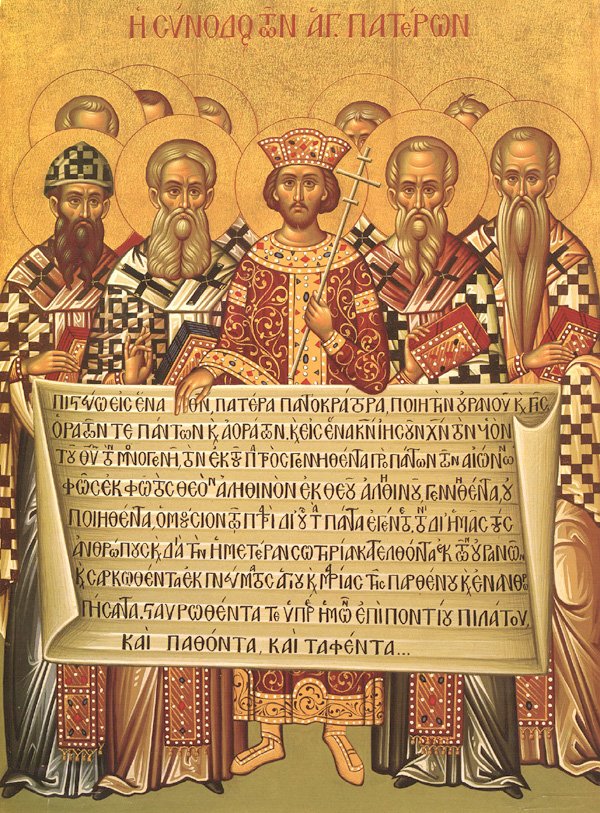
Commemoration of the Holy 165 Fathers of the Fifth Ecumenical Council
This council was held in Constantinople during the reign of Justinian the Great. The council condemned the various forms of monophysitism, the heretical writings of Theodore of Mopsuestia and Theodoret, and the writings of Origen (particularly on universal salvation).
Scripture Readings
☩Epistle
Romans 13:1-10
1
Let every soul be subject unto the higher powers. For there is no power but of God: the powers that be are ordained of God.
2
Whosoever therefore resisteth the power, resisteth the ordinance of God: and they that resist shall receive to themselves damnation.
3
For rulers are not a terror to good works, but to the evil. Wilt thou then not be afraid of the power? do that which is good, and thou shalt have praise of the same:
4
For he is the minister of God to thee for good. But if thou do that which is evil, be afraid; for he beareth not the sword in vain: for he is the minister of God, a revenger to execute wrath upon him that doeth evil.
5
Wherefore ye must needs be subject, not only for wrath, but also for conscience sake.
6
For for this cause pay ye tribute also: for they are God’s ministers, attending continually upon this very thing.
7
Render therefore to all their dues: tribute to whom tribute is due; custom to whom custom; fear to whom fear; honour to whom honour.
8
Owe no man any thing, but to love one another: for he that loveth another hath fulfilled the law.
9
For this, Thou shalt not commit adultery, Thou shalt not kill, Thou shalt not steal, Thou shalt not bear false witness, Thou shalt not covet; and if there be any other commandment, it is briefly comprehended in this saying, namely, Thou shalt love thy neighbour as thyself.
10
Love worketh no ill to his neighbour: therefore love is the fulfilling of the law.
☩Gospel
Matthew 12:30-37
30
He that is not with me is against me; and he that gathereth not with me scattereth abroad.
31
Wherefore I say unto you, All manner of sin and blasphemy shall be forgiven unto men: but the blasphemy against the Holy Ghost shall not be forgiven unto men.
32
And whosoever speaketh a word against the Son of man, it shall be forgiven him: but whosoever speaketh against the Holy Ghost, it shall not be forgiven him, neither in this world, neither in the world to come.
33
Either make the tree good, and his fruit good; or else make the tree corrupt, and his fruit corrupt: for the tree is known by his fruit.
34
O generation of vipers, how can ye, being evil, speak good things? for out of the abundance of the heart the mouth speaketh.
35
A good man out of the good treasure of the heart bringeth forth good things: and an evil man out of the evil treasure bringeth forth evil things.
36
But I say unto you, That every idle word that men shall speak, they shall give account thereof in the day of judgment.
37
For by thy words thou shalt be justified, and by thy words thou shalt be condemned.
 Meat
Allowed
Meat
Allowed
 Fish
Allowed
Fish
Allowed
 Dairy
Allowed
Dairy
Allowed
 Oil
Allowed
Oil
Allowed
 Wine
Allowed
Wine
Allowed