Holy Wonderworking Unmercenary Physicians Cosmas and Damian at Rome
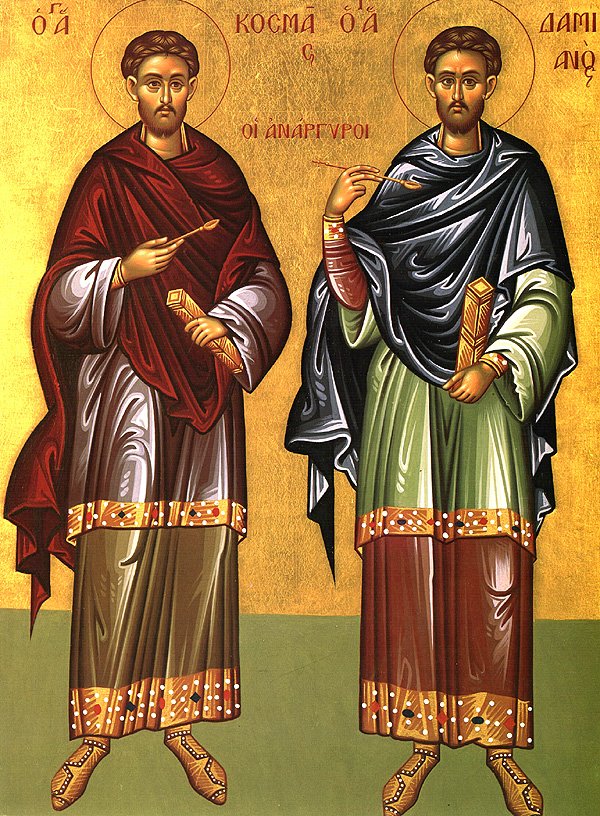
The Holy Martyrs, Wonderworkers and Unmercenary Physicians Cosmas and Damian were born at Rome, brothers by birth, and physicians by profession. They suffered at Rome in the reign of the emperor Carinus (283-284). Brought up by their parents in the rules of piety, they led strict and chaste lives, and they were granted by God the gift of healing the sick.
The Holy Martyrs, Wonderworkers and Unmercenary Physicians Cosmas and Damian were born at Rome, brothers by birth, and physicians by profession. They suffered at Rome in the reign of the emperor Carinus (283-284). Brought up by their parents in the rules of piety, they led strict and chaste lives, and they were granted by God the gift of healing the sick. By their generosity and exceptional kindness to all, the brothers converted many to Christ. The brothers told the sick, “It is not by our own power that we treat you, but by the power of Christ, the true God. Believe in Him and be healed.” Since they accepted no payment for their treatment of the infirm, the holy brothers were called “unmercenary physicians.”
Their life of active service and their great spiritual influence on the people around them led many into the Church, attracting the attention of the Roman authorities. Soldiers were sent after the brothers. Hearing about this, local Christians convinced Saints Cosmas and Damian to hide for a while until they could help them escape. Unable to find the brothers, the soldiers arrested instead other Christians of the area where the saints lived. Saints Cosmas and Damian then came out of hiding and surrendered to the soldiers, asking them to release those who had been arrested because of them.
At Rome, the saints were imprisoned and put on trial. Before the Roman emperor and the judge they openly professed their faith in Christ God, Who had come into the world to save mankind and redeem the world from sin, and they resolutely refused to offer sacrifice to the pagan gods. They said, “We have done evil to no one, we are not involved with the magic or sorcery of which you accuse us. We treat the infirm by the power of our Lord and Savior Jesus Christ and we take no payment for rendering aid to the sick, because our Lord commanded His disciples, ‘Freely have you received, freely give’ (Mt. 10: 8).”
The emperor, however, continued with his demands. Through the prayer of the holy brothers, imbued with the power of grace, God suddenly struck Carinus blind, so that he too might experience the almighty power of the Lord, Who does not forgive blasphemy against the Holy Spirit (Mt. 12:31). The people, beholding the miracle, cried out, “Great is the Christian God! There is no other God but Him!” Many of those who believed besought the holy brothers to heal the emperor, and he himself implored the saints, promising to convert to the true God, Christ the Savior, so the saints healed him. After this, Saints Cosmas and Damian were honorably set free, and once again they set about treating the sick.
But what the hatred of the pagans and the ferocity of the Roman authorities could not do, was accomplished by black envy, one of the strongest passions of sinful human nature. An older physician, an instructor, under whom the holy brothers had studied the art of medicine, became envious of their fame. Driven to madness by malice, and overcome by passionate envy, he summoned the two brothers, formerly his most beloved students, proposing that they should all go together in order to gather various medicinal herbs. Going far into the mountains, he murdered them and threw their bodies into a river.
Thus these holy brothers, the Unmercenary Physicians Cosmas and Damian, ended their earthly journey as martyrs. Although they had devoted their lives to the Christian service of their neighbors, and had escaped the Roman sword and prison, they were treacherously murdered by their teacher.
The Lord glorifies those who are pleasing to God. Now, through the prayers of the holy martyrs Cosmas and Damian, God grants healing to all who with faith have recourse to their heavenly intercession.
The Unmercenary Saints Cosmas and Damian of Rome should not be confused with the Unmercenary Saints Cosmas and Damian of Asia Minor (November 1), or the Unmercenary Saints Cosmas and Damian of Arabia (October 17).
Part of the skulls of Saints Cosmas and Damian are located in the sacred Pantokrator Monastery on Mount Athos. Pieces of the Holy Relics of Saints Cosmas and Damian may be found in the Roman Catholic Church of the Holy Unmercenaries in Rome.
Troparion - Tone 8
Holy unmercenaries and wonderworkers, Cosmas and Damian, visit our / infirmities. / Freely you have received; freely give to us.
Kontakion - Tone 2
Having received the grace of healing, / you grant healing to those in need. / Glorious wonder workers and physicians, Cosmas and Damian, / visit us and put down the insolence of our enemies, / and bring healing to the world through your miracles.
Martyr Potitus at Naples
The Holy Martyr Potitus suffered under the emperor Antoninus Pius (reigned 138-161). Having become familiar with the Christian teaching, the young Potitus believed in the true God and accepted holy Baptism at thirteen years of age. When he learned of this, his pagan father was extremely upset and tried, first by endearments, and then by threats to dissuade his son from his faith in Christ the Savior, but his efforts were in vain.
The Holy Martyr Potitus suffered under the emperor Antoninus Pius (reigned 138-161). Having become familiar with the Christian teaching, the young Potitus believed in the true God and accepted holy Baptism at thirteen years of age. When he learned of this, his pagan father was extremely upset and tried, first by endearments, and then by threats to dissuade his son from his faith in Christ the Savior, but his efforts were in vain. Impressed by the boy’s firmness of faith, the father also came to believe in the Son of God and became a Christian himself.
Saint Potitus traveled through many lands preaching about Christ, and by the power of God he worked wondrous miracles.
In the region of Epiros, lived the illustrious woman Kyriake, the wife of a senator; she was afflicted with leprosy. Hearing of Saint Potitus, she summoned him and asked him to heal her. The saint declared that if she believed in Christ, she would be healed. The woman accepted holy Baptism and was immediately made well. Seeing such a miracle, her husband and all their household believed in Christ and were baptized as well.
After this, the saint settled on Mount Garganus and lived in solitude, among the animals. He was found there by servants of the emperor Antoninus, whose daughter was possessed by a demon. Through the lips of the maiden, the devil said that he would come out of her only if Potitus should come. They brought the holy youth to the emperor, and through the prayers of Saint Potitus the demon released the girl. But instead of being grateful, the emperor treated the saint with inhuman cruelty. For his firm confession of faith in Christ the Savior, and for his refusal to offer sacrifice to the pagan gods, to whom the emperor imputed the healing of his daughter, he ordered that the saint’s tongue be torn out, and that he be blinded. After lengthy torture, Saint Potitus was finally beheaded.
Troparion - Tone 3
Your holy martyr Potitus, O Lord, / through his sufferings has received an incorruptible crown from You, our God. / For having Your strength, he laid low his adversaries, / and shattered the powerless boldness of demons. / Through his intercessions, save our souls!
Venerable Peter of Constantinople
Saint Peter was born into a patrician family at Constantinople at the end of the eighth century. During the reign of the Byzantine emperor Nikēphóros (802-811) Peter was commissioned as an officer and participated in the campaigns of the Greek army against Bulgaria. In one particular battle the emperor was mortally wounded, and Peter was one of many soldiers taken captive.
One night, while he was praying, the holy Evangelist John the Theologian appeared to him in a vision and released him from captivity. Having returned to Constantinople, Saint Peter left the world and withdrew into a monastery on Mount Olympus (in Asia Minor) and became a monk. There he passed his time in constant ascetic efforts for 34 years under the guidance of Saint Joannicius the Great (November 4). Saint Peter lived all his monastic life in strict fasting and constant vigil, wearing a prickly hair-shirt and going barefoot. He lived the final eight years of his life at Constantinople, where he founded a church and a monastery named for Saint Euandrus.
Saint Peter died in 854 in the seventieth year of his life, and was buried in his monastery.
Troparion - Tone 8
By a flood of tears you made the desert fertile, / and your longing for God brought forth fruits in abundance. / By the radiance of miracles you illumined the whole universe! / O our holy father Peter, pray to Christ our God to save our souls!
Saint Angelina of Serbia
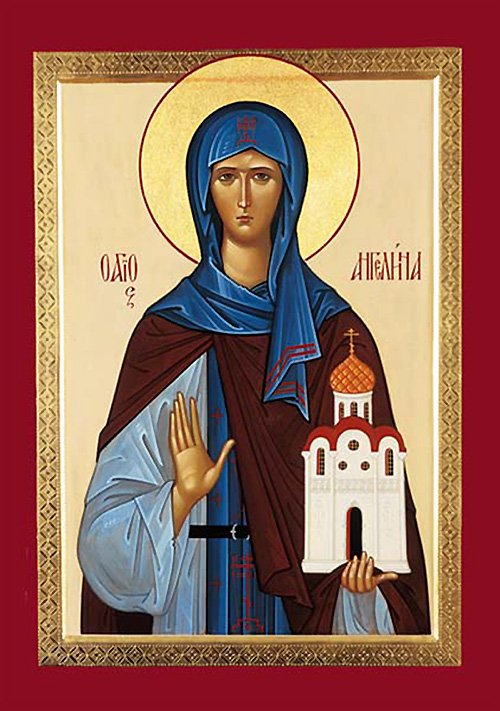
Saint Angelina was the daughter of Prince George Skenderbeg of Albania. Her mother’s name is not known, but she raised her daughter in Christian piety and taught her to love God.
Saint Stephen Brancovich (October 9 and December 10), the ruler of Serbia, had come to Albania to escape those who wished to kill him. S
Saint Angelina was the daughter of Prince George Skenderbeg of Albania. Her mother’s name is not known, but she raised her daughter in Christian piety and taught her to love God.
Saint Stephen Brancovich (October 9 and December 10), the ruler of Serbia, had come to Albania to escape those who wished to kill him. Some time before he arrived in Albania, Saint Stephen was unjustly blinded by the Turkish Sultan for some perceived offense. Since he was innocent, he bore his affliction with courage.
Saint Stephen was not only Prince George’s guest, but he was also treated as a member of his family. Not surprisingly, Stephen and Angelina eventually fell in love. With her parents’ blessing, they were married in church. After a few years, they were blessed with two sons: George and John.
When the boys were grown, Saint Stephen and his family were forced to flee to Italy for their safety. At that time the Turks invaded Albania and began to slaughter men, women, and even children.
Saint Stephen died in 1468, leaving Angelina a widow. In her distress, she turned to the ruler of Hungary for help. He gave them the town of Kupinovo in Sirmie.
Saint Angelina left Italy with her sons in 1486, stopping in Serbia to bury Saint Stephen’s incorrupt body in his native land.
The children of these pious parents also became saints. George gave up his claim to the throne in favor of his brother John, then entered a monastery and received the name Maximus.
John was married, but had no sons. He died in 1503 at a young age, and many miracles took place before his holy relics.
Saint Angelina survived her husband and both of her sons. Mindful of her soul’s salvation, she entered a women’s monastery. She departed to the Lord in peace, and her body was buried in the same tomb as her sons in the monastery of Krushedol in Frushka Gora.
Saint Angelina is also commemorated on December 10 with her husband Saint Stephen and her son Saint John.
Troparion - Tone 8
In you the image was preserved with exactness, O Mother, / for taking up your cross, you followed after Christ. / By so doing, you taught us to disregard the flesh, for it passes away, / but to care instead for the soul, since it is immortal. / Therefore, most venerable Mother Angelina your spirit rejoices with the Angels.
Translation of the relics of Venerable John of Rila from Trnovo to Rila
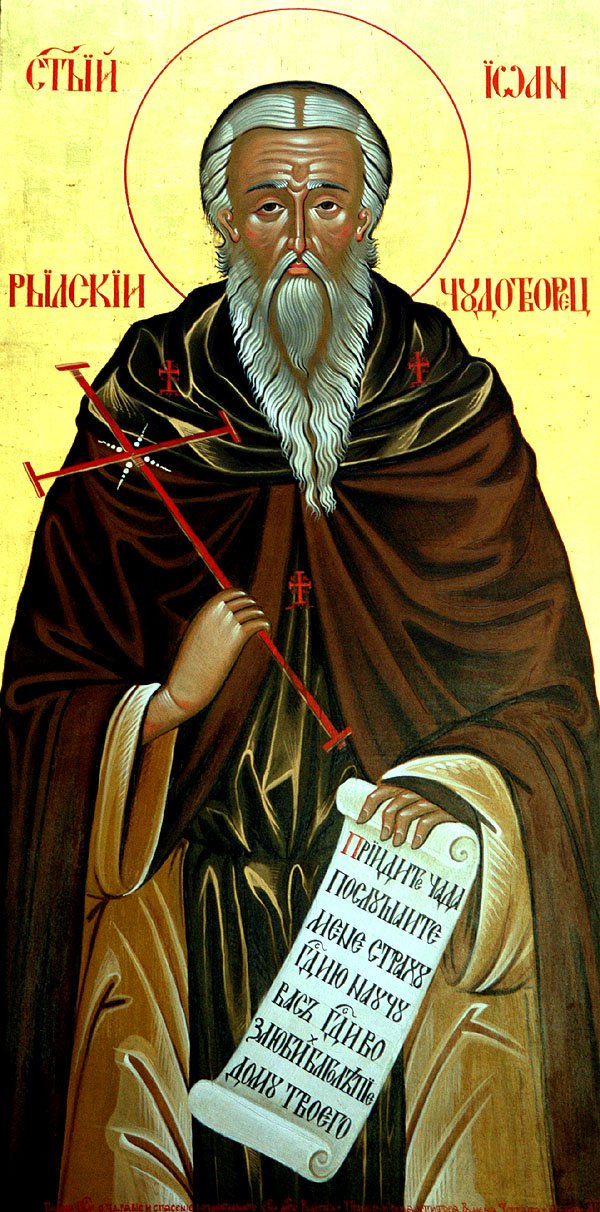
On October 19, 1238 the relics of Saint John of Rila were solemnly transferred to the new capital, Trnovo, and put in a church dedicated to the saint. Then on July 1, 1469 the holy relics of Saint John were returned to the Rila monastery, where they rest to the present day, granting grace-filled help to all the believers.
Troparion - Tone 8
By a flood of tears you made the desert fertile, / and your longing for God brought forth fruits in abundance. / By the radiance of miracles you illumined the whole universe! / O our holy father John, pray to Christ our God to save our souls!
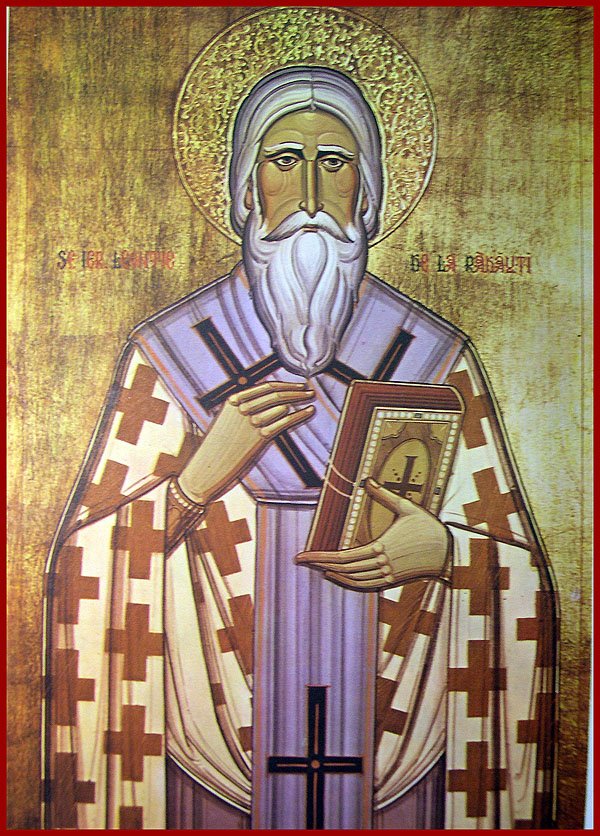
Saint Leontius of Rădăuţi
Saint Leontius was born in Rduci, Moldavia in the fourteenth century. He was named Laurence when he received the monastic tonsure. In time he was found worthy of ordination to the holy priesthood, and founded a monastery near Rduci, which later became known as Saint Laurence’s Monastery. Among his many disciples was Saint Daniel the Hesychast (December 18).
Because of his holy life, he received from God the grace of working miracles. Many sick people were healed by his prayers, and he became a father, teacher, and protector to all.
Prince Alexander the Good recommended that he be made Bishop of Rduci. Saint Leontius led his flock with wisdom for many years, then retired to live alone in the wilderness. He received the Great Schema with the name of Leontius, and departed to the Lord soon afterward. His holy relics were found incorrupt, and many people received healing at his tomb.
Saint Leontius was glorified by the Orthodox Church of Romania in 1992.
Troparion - Tone 8
Spending your entire life in spiritual endeavors, / and being found worthy to be a
bishop, / you served the Church of Christ with humility and in the fear of God. / Holy
Hierarch Leontius, entreat the Lord to save our souls.
Scripture Readings
☩Epistle
Romans 15:7-16
7
Wherefore receive ye one another, as Christ also received us to the glory of God.
8
Now I say that Jesus Christ was a minister of the circumcision for the truth of God, to confirm the promises made unto the fathers:
9
And that the Gentiles might glorify God for his mercy; as it is written, For this cause I will confess to thee among the Gentiles, and sing unto thy name.
10
And again he saith, Rejoice, ye Gentiles, with his people.
11
And again, Praise the Lord, all ye Gentiles; and laud him, all ye people.
12
And again, Esaias saith, There shall be a root of Jesse, and he that shall rise to reign over the Gentiles; in him shall the Gentiles trust.
13
Now the God of hope fill you with all joy and peace in believing, that ye may abound in hope, through the power of the Holy Ghost.
14
And I myself also am persuaded of you, my brethren, that ye also are full of goodness, filled with all knowledge, able also to admonish one another.
15
Nevertheless, brethren, I have written the more boldly unto you in some sort, as putting you in mind, because of the grace that is given to me of God,
16
That I should be the minister of Jesus Christ to the Gentiles, ministering the gospel of God, that the offering up of the Gentiles might be acceptable, being sanctified by the Holy Ghost.
☩Gospel
Matthew 12:38-45
38
Then certain of the scribes and of the Pharisees answered, saying, Master, we would see a sign from thee.
39
But he answered and said unto them, An evil and adulterous generation seeketh after a sign; and there shall no sign be given to it, but the sign of the prophet Jonas:
40
For as Jonas was three days and three nights in the whale’s belly; so shall the Son of man be three days and three nights in the heart of the earth.
41
The men of Nineveh shall rise in judgment with this generation, and shall condemn it: because they repented at the preaching of Jonas; and, behold, a greater than Jonas is here.
42
The queen of the south shall rise up in the judgment with this generation, and shall condemn it: for she came from the uttermost parts of the earth to hear the wisdom of Solomon; and, behold, a greater than Solomon is here.
43
When the unclean spirit is gone out of a man, he walketh through dry places, seeking rest, and findeth none.
44
Then he saith, I will return into my house from whence I came out; and when he is come, he findeth it empty, swept, and garnished.
45
Then goeth he, and taketh with himself seven other spirits more wicked than himself, and they enter in and dwell there: and the last state of that man is worse than the first. Even so shall it be also unto this wicked generation.