Fasting Rules
 Meat
Allowed
Meat
Allowed
 Fish
Allowed
Fish
Allowed
 Dairy
Allowed
Dairy
Allowed
 Oil
Allowed
Oil
Allowed
 Wine
Allowed
Wine
Allowed
Saints & Commemorations
![Saint John [Maximovitch], Archbishop of Shanghai and San Francisco](https://img.theparishconnect.com/94BjKGH_X9FIJGCsq0uqmw-c8lhe6uoz5pDCK3QEYqI/resize:fit:800:0:0/gravity:ce/aHR0cHM6Ly9yMi1jZG4udGhlcGFyaXNoY29ubmVjdC53b3JrZXJzLmRldi9jb3JlL29jYS1pY29ucy8yMDYzOTItc2FpbnQtam9obi1tYXhpbW92aXRjaC1hcmNoYmlzaG9wLW9mLXNoYW5naGFpLWFuZC1zYW4tZnJhbmNpc2NvLmpwZw)
Saint John [Maximovitch], Archbishop of Shanghai and San Francisco
This brightly-shining Saint of our own day was born in Russia in 1896. In 1921 his family fled the Russian Revolution to Serbia, where he became a monk and was ordained a priest. From the time of his entry into monastic life he adopted a severely ascetical way of life: for the rest of his life he never slept in a bed, sleeping only briefly in a chair or prostrated before the icons.
This brightly-shining Saint of our own day was born in Russia in 1896. In 1921 his family fled the Russian Revolution to Serbia, where he became a monk and was ordained a priest. From the time of his entry into monastic life he adopted a severely ascetical way of life: for the rest of his life he never slept in a bed, sleeping only briefly in a chair or prostrated before the icons. He ate one meal a day, in the evening. Teaching seminarians in Serbia, he instructed them each day to devote six hours to divine services, six hours to prayer (not including the divine services!), six hours to good works, and six hours to rest (these six hours obviously included eating and bathing as well as sleeping). Whether his seminarians followed his counsels we do not know, but he himself not only followed but exceeded them.
In 1934 he was made Bishop of Shanghai (in the Russian Church Abroad), where he served not only the Russian emigre community but a number of native Chinese Orthodox; from time to time he served the Divine Liturgy in Chinese. When the Communists took power in China, he labored tirelessly to evacuate his flock to safety, first to the Philippines, then to various western countries including the United States. He served as Bishop in Paris and Brussels, then, in 1962 was made Archbishop of San Francisco. Throughout his life as monk and hierarch he was revered (and sometimes condemned) for his ascetical labors and unceasing intercessions. During his life and ever since, numerous miraculous healings of all manner of afflictions have been accomplished through his prayers. Once, in Shanghai, a caretaker, investigating strange noises in the cathedral after midnight, discovered Bishop John standing in the belltower, looking down on the city and praying for the people. Years later, when he visited Holy Trinity Monastery in Jordanville, New York, the priest responsible for hosting him found the saint walking through the halls of the monastery, standing outside the door of each room and praying for the monk or seminarian sleeping within. When the Archbishop had prayed outside each room, he returned to the beginning of his circuit and began praying again; and so he spent the entire night.
Even as Archbishop, he lived in near-absolute poverty. His appearance was striking: His cassock was made of blue Chinese “peasant cloth,” crudely decorated with crosses stitched by orphans who had been in his care in Shanghai. His Bishop’s “miter” was often a cloth cap to which he had glued paper icons. Even in the United States, even while serving the Divine Liturgy (which he did every day), he went barefoot in all seasons. (Eventually, after he was hospitalized with an infected foot, his Metropolitan ordered him to wear shoes; thereafter, he wore sandals). Needless to say, he was an embarrassment to those who like their bishops to make a more worldly appearance, but among his various flocks throughout the world, there were always those who recognized him as a Saint in his own lifetime.
Following his repose in 1966, a steady stream of healings and other miracles was accomplished through his intercessions, and in 1996 he was glorified as a Saint of the Church. His incorrupt and wonder-working relics can be venerated at his cathedral in San Francisco. At St John’s funeral, the eulogist told his mourners (and all of us): because Archbishop John was able to live the spirituality of the Orthodox Church so fully, even in modern, western, urban society, we are without excuse.
Footnote: An acquaintance of Monk John once met him on a train in Serbia. When asked his destination, Monk John replied, “I’m going to straighten out a mistake. I’ve gotten a letter meant for some other John whom they intend to make a bishop.” The same person met him again on his return journey and asked if he had been able to resolve his problem. John answered, “The mistake is much worse than I thought: they did make me a bishop.”
Troparion - Tone 5
Your care for your flock in its sojourn prefigured your prayers, / which you always offer up for the whole world. / Thus we believe, having come to know your love, O holy hierarch and wonderworker John. / Wholly sanctified by God through the ministry of the all-pure Mysteries, / and ever strengthened by them yourself, / you hastened to the suffering, O healer, easing their afflictions. / Hasten now to help us, who honor you with all our heart.
Kontakion - Tone 4
Your heart went out to all who entreat you with love, O hierarch John, / and who remember the struggle of your life, and thy painless and easy repose, / O faithful servant of the all-pure Directress.*
* Directress refers to the Mother of God as Hodēgḗtria (She who shows the way).
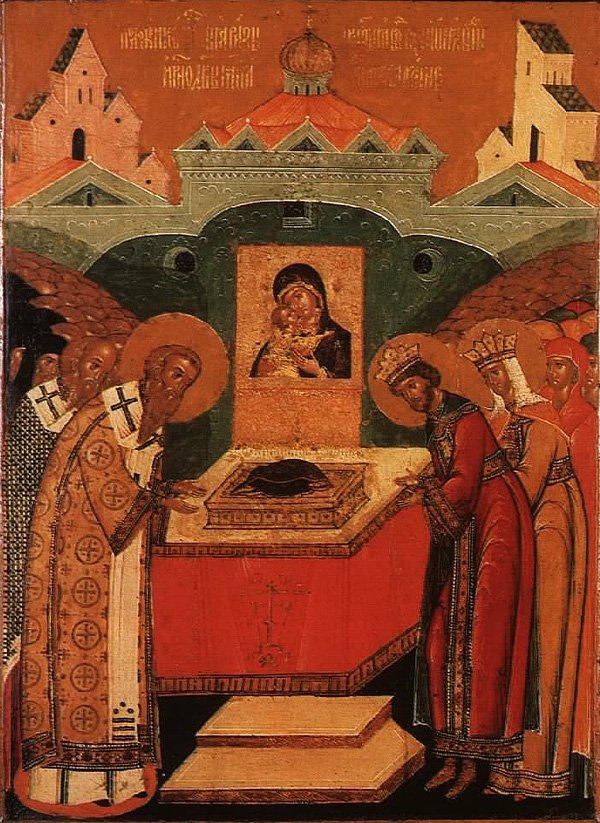
The Placing of the Honorable Robe of the Most Holy Mother of God at Blachernae
During the reign of Leo the Great (457-474), two noblemen on pilgrimage to the Holy Land stayed at the home of an old widow. Seeing the miracles wrought in a small shrine in her house, they learned from her that she had the robe of the most holy Mother of God stored in a small chest in her house. The old woman was a descendant of one of two virgins who had attended the Theotokos before her dormition; in her last days on earth she had given each of them one of her garments as a blessing.
During the reign of Leo the Great (457-474), two noblemen on pilgrimage to the Holy Land stayed at the home of an old widow. Seeing the miracles wrought in a small shrine in her house, they learned from her that she had the robe of the most holy Mother of God stored in a small chest in her house. The old woman was a descendant of one of two virgins who had attended the Theotokos before her dormition; in her last days on earth she had given each of them one of her garments as a blessing. The two pilgrims stole the garment and brought it to Blachernae near Constantinople, where they built a church dedicated to Sts Peter and Paul, and secretly deposited the robe there. Again, the multitude of miracles wrought through the robe revealed its presence, and it became known to the Emperor Leo and to the Orthodox people in general.
Troparion - Tone 8
Ever-Virgin Theotokos, protectress of mankind, you have given your people a powerful legacy: / the robe and sash of your most honored body, which remained incorrupt throughout your seedless childbearing; for through you time and nature are renewed! / Therefore we implore you: “Grant peace to your people and to our souls great mercy!”
Kontakion - Tone 4
O Pure One, full of the grace of God, / you have given your sacred robe as a garment of incorruption to all the faithful, / with it you covered your holy body, O divine protection of all mankind. / We celebrate its enshrinement in Blachernae with love and we cry aloud with awe: / “Rejoice, O Virgin, boast of Christians.”
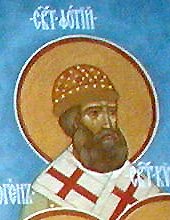
Saint Photius, Metropolitan of Kiev
Saint Photius, Metropolitan of Kiev and All Russia, was by birth a Greek from the Peloponnesian city of Monembasia (Malbasia). While still in his adolescence he entered a monastery and was tonsured under the Elder Acacius, a great ascetic (afterwards the Metropolitan of Monembasia). In 1408, when Photius was in Constantinople with the Patriarch on church matters, the question arose about a replacement for the Russian See after the death of Saint Cyprian (September 16).
Saint Photius, Metropolitan of Kiev and All Russia, was by birth a Greek from the Peloponnesian city of Monembasia (Malbasia). While still in his adolescence he entered a monastery and was tonsured under the Elder Acacius, a great ascetic (afterwards the Metropolitan of Monembasia). In 1408, when Photius was in Constantinople with the Patriarch on church matters, the question arose about a replacement for the Russian See after the death of Saint Cyprian (September 16). The choice of Patriarch Matthew (1397-1410) fell upon Photius, known for his learning and holiness of life. On September 1, 1408 Saint Photius was made Metropolitan and in the next year arrived in Rus.
He spent half a year at Kiev (September 1409-February 1410), concerning himself with settling affairs in the southern dioceses of the Russian Church, then included within the principality of Lithuania, or more precisely, of Lithuania and Russia. The saint perceived that the throne of the Metropolitan, the spiritual center of churchly life in Rus, could not remain in the Kiev lands, where everything increasingly fell under the dependence of Catholic Poland. On the day of Holy Pascha in 1410, Metropolitan Photius arrived in Moscow following the example of former Russian Metropolitans, who transferred their residence first to Vladimir, then to Moscow.
For 22 years the saint labored in the difficult service of archpastor of the Russian Church. In grievous conditions of war, fratricidal strife, and pillaging incursions of Tatars he knew how to highly advance the spiritual significance, the material prosperity and well-being of the churches under the See of Moscow.
Favorable conditions in the Church allowed Saint Photius to render great assistance to the increasingly impoverished Patriarch of Constantinople, and to strengthen the international position of the Russian Orthodox Church and the Russian realm.
The enemies of Orthodoxy tried to subvert the churchly-patriotic service of Saint Photius more than once. In the spring of 1410, when Saint Photius arrived in Vladimir from Moscow, Khan Edigei, having laid waste this portion of the Russian Land for two years, undertook a new campaign with the intent of capturing the Metropolitan himself. A Tatar detachment, headed by Prince Talychoi “the Exile,” suddenly and quickly took Vladimir, but God preserved His righteous saint.
The evening before, not suspecting danger, the saint had gone off to the Svyatoozersk (Holy Lake) monastery beyond the city. When the Tatars attempted pursuit, he concealed himself in a small settlement, surrounded by impassable swamps, at the River Senega. Unable to capture the Metropolitan, the rapacious Tatars plundered Vladimir, especially the Dormition cathedral church. The doorkeeper of the cathedral, Patrikii, endured terrible torments and accepted a martyr’s death from the plundering Tatars, but he did not reveal where the church sacred items and treasury were hidden.
Through the efforts of Metropolitan Photius the canonical unity of the Russian Church was restored. The separate Lithuanian metropolitanate, established by Prince Vitovt for the southern and western eparchies [dioceses], was abolished in 1420. In that same year the saint visited the returned eparchies and greeted the flock with an instructive encyclical. The wise and erudite pastor left behind many instructions and letters. Of great theological significance was his denunciation of the heresy of the Strigolniki, which had arisen at Pskov prior to his time. By his wise efforts the heresy was put to an end in 1427.
Important Church historical sources compiled by Saint Photius are his “Order of Selection and Installation of Bishops” (1423), “ Discourse on the Seriousness of the Priestly Office and the Obligations of Church Servers,” and also the “Spiritual Testament”, in which he tells of his life. Another great work of the saint was the compilation, under his guidance, of the Obscherussk (All-Russian) Chronicle (about 1423).
On April 20, 1430 the holy archpastor was informed by an angel of his approaching end, and he reposed peacefully on the Feast of the Placing of the Robe of the Most Holy Theotokos at Blachernae, on July 2, 1431. His relics were uncovered in the year 1471. Two sakkoi (robes) of Saint Photius are preserved in the Armory Palace of the Moscow Kremlin.
Troparion - Tone 4
In truth you were revealed to your flock as a rule of faith, / an image of humility and a teacher of abstinence; / your humility exalted you; / your poverty enriched you. / Hierarch Father Photius, / entreat Christ our God / that our souls may be saved.
St Juvenaly, First Martyr of America and Alaska (1796)
“St Juvenal was (together with St Herman, see Dec. 12) a member of the first mission sent from Russia to proclaim the Gospel in the New World. He was a priest-monk, and a zealous follower of the Apostles, and baptized hundreds of the natives of Alaska. He was martyred by enraged pagans in 1796.” (Great Horologion)
Saint Juvenal, Patriarch of Jerusalem
Saint Juvenal, Patriarch of Jerusalem, occupied the throne of the Holy City during the years 420-458. During this period great luminaries of the Church enlightened the world: Saints Euthymios the Great (January 20), Simeon the Stylite (September 1), Gerasimos of Jordan (March 4), and many others.
Saint Juvenal was a friend and converser with Saint Euthymios the Great.
Saint Juvenal, Patriarch of Jerusalem, occupied the throne of the Holy City during the years 420-458. During this period great luminaries of the Church enlightened the world: Saints Euthymios the Great (January 20), Simeon the Stylite (September 1), Gerasimos of Jordan (March 4), and many others.
Saint Juvenal was a friend and converser with Saint Euthymios the Great. During Saint Juvenal’s archpastoral service, the Eastern Church was troubled by dangerous false teachings, which he opposed with a pastoral zeal, safeguarding the flock of Christ.
The Third Ecumenical Council was convened in the city of Ephesus in 431. It condemned the heresy of Nestorius, which was opposed to the Orthodox teaching about the divine nature of Jesus Christ. Saint Cyril of Alexandria (June 9) presided at this Council, and among his colleagues was Patriarch Juvenal.
In 451, the Fourth Ecumenical Council met in the city of Chalcedon. It condemned the Eutchian [Monophysite] heresy, which taught that the human nature in Christ was completely swallowed up and absorbed by the divine nature. The Holy Fathers, among them Saint Juvenal, condemned the heresy of Eutychios and affirmed the Orthodox doctrine of the union of two natures in the Lord Jesus Christ, the divine and the human, without separation and without mixture. The heretics, however, continued to confuse the minds of Christians.
At the head of the heretics stood Theodosius, who lived at Jerusalem, and who had won to his side Eudokia, the widow of Emperor Theodosios the Younger (+ 450), who lived at Jerusalem. He demanded that Patriarch Juvenal repudiate the Council of Chalcedon; that is to say, that he should renounce the Orthodox dogma of the two natures in Christ.
Saint Juvenal would not agree to embrace falsehood, and bravely confessed the Chalcedonian doctrine before the heretics. Theodosius and his adherents then deposed Patriarch Juvenal from the patriarchal throne. The Saint fled to Constantinople, to Patriarch Anatolios (July 3) and the Emperor Marcian. The heretic Theodosios, under Eudokia's patronage, occupied the patriarchal throne in Palestine, but only for twenty months. Emperor Marcian, holding Saint Juvenal in high esteem, placed him on the patriarchal throne once more, and so the Holy Confessor returned to Jerusalem.
The Saint made many efforts to restore Church peace. At the suggestion of Saint Simeon the Stylite, Empress Eudokia repented before Saint Juvenal and returned to communion with the Orthodox. A large part of the Jerusalem flock, who had been led astray by the heretics, followed her. After defeating the pernicious heresies, and establishing oneness of mind and propriety, Patriarch Juvenal reposed peacefully among his faithful flock, after serving as a bishop for thirty-eight years.
Troparion - Tone 4
O successor of the Brother of the Lord on the archpastoral throne of the holy city of Jerusalem, / you are worthy of praise. / With the divinely-wise Fathers of Chalcedon / you expounded the Incarnation of the Son of God, / Who came to renew the world and to deify all men, / united with Him in His Church. O Hierarch Father Juvenal, / now as you stand before the throne of Father of Lights in the Kingdom, / pray for those who lovingly honor you, / and may the peace and mercy of the Savior be with us.
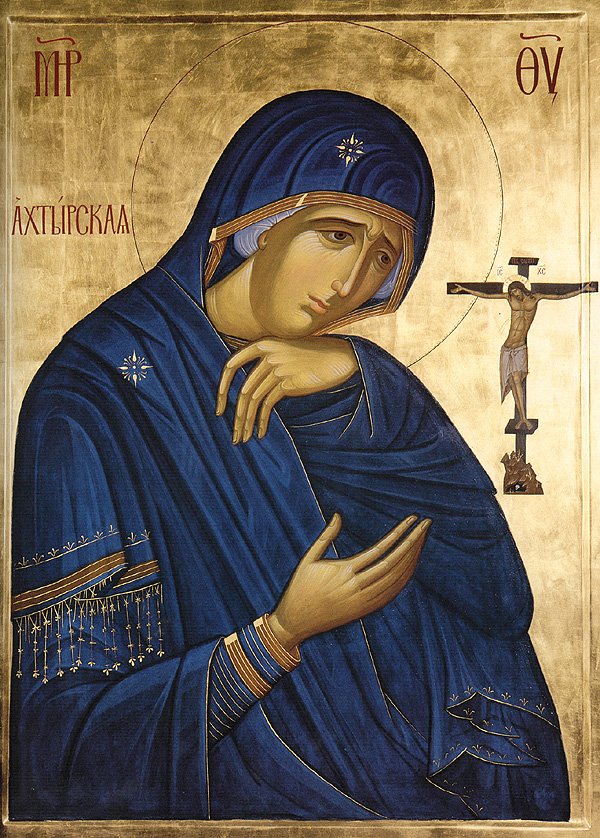
Icon of the Mother of God of Akhtyr
The Akhtyr Icon of the Most Holy Theotokos appeared on July 2, 1739 in the village of Akhtyr in the area of Kharkov, east of Kiev.
Father Basil Danilov, a righteous man of strong faith, was the priest of the Dormition church in Akhtyr. He wanted to try out a new scythe, and so he went out to a field by the church.
The Akhtyr Icon of the Most Holy Theotokos appeared on July 2, 1739 in the village of Akhtyr in the area of Kharkov, east of Kiev.
Father Basil Danilov, a righteous man of strong faith, was the priest of the Dormition church in Akhtyr. He wanted to try out a new scythe, and so he went out to a field by the church. As he began to cut the tall grass, Father Basil noticed an icon of the Mother of God shining with a radiant light. Dropping the scythe, he fell to his knees and began to pray, then took the icon to his home.
The icon remained in the priest’s home for three years. No one could spend the night in the same room as the icon, because an inexplicable fear would force them to leave.
One night the Theotokos appeared to Father Basil in a dream, reproaching him because he had not cleaned the icon in the three years since he had found it. When he awoke, he dusted the icon off and washed it with water, then went back to sleep. That night he had another dream in which he saw himself going to the river in order to pour out the water he had used to wash the icon. The Mother of God appeared to him again and ordered him to return home with the water, explaining that it would cure people of malaria and fever.
When Father Basil’s daughter became ill with malaria, he gave her some of the water to drink and she was healed. Others also received healing in this way. The priest decided that the icon should not remain in his home, so he took it to the church.
An iconographer named John was commissioned to restore the icon. When his son was suffering from malaria, John remembered how the water used to wash the icon had cured people of that disease. Therefore, he washed the icon and gave his son some of the water to drink. The young man was healed at once, and there were many other miracles after this one.
The miracles of the Akhtyr Icon were investigated no less than three times. In 1751 the Holy Synod determined that reports of the miracles were true, and declared the icon to be wonderworking.
Empress Elizabeth had a stone church built in Akhtyr for the icon, and she personally donated two thousand rubles. Saint Joasaph of Belgorod (September 4 and December 10) blessed the cornerstone. The church was consecrated in the year 1768.
Tsar Nicholas I ordered that on the Saturday before Pentecost the Akhtyr Icon should be taken from the Protection Cathedral and carried in procession to the Akhtyr-Holy Trinity Monastery. The icon was brought back to the cathedral on the Sunday of All Saints. Unfortunately, the icon was stolen from the Protection Cathedral on April 1, 1905. Many copies of the Akhtyr Icon were made before it was stolen.
On July 2 many churches bless water in remembrance of the healings which took place after the Mother of God ordered Father Basil Danilov to wash the icon.
The original Icon (not shown here) is rather unusual, and does not seem to have any earlier prototype. Furthermore, It is painted in the Western style. The Mother of God is depicted with her head uncovered, Christ's Crucifixion is portrayed too small, and the Virgin seems to be gazing directly at the Cross. Her hands are folded and her fingers are pointing upward, which is not the typical gesture of prayer in Orthodox iconography. Usually, Orthodox Icons depict the figure's hands raised with the palms facing upward, or with the arms crossed over the chest, just as we do when receiving Holy Communion.
In 1903, the Icon was sent to St. Petersburg for restoration, and it was stolen. Afterward, it ended up in Harbin, China, where it was purchased by S.A. Stepanov. According to the testimony of Archpriest N. Tryphanov of Harbin, who was very familiar with the Akhtyr Icon in the city of Akhtyrka, declared that the image was the genuine wonderworking Icon.
In the 1950s, Stepanov's son took the Icon to Brazil, and then to San Francisco, where he gave it to the Russian Orthodox Youth Committee. The icon's location in San Francisco became known in 1975.
In 1995, a copy was made and was brought to the Akhtyr Protection Cathedral by Metropolitan Nikodemos (Rusnak) of Kharkov and Bogodukhov. With that copy, the tradition of a Cross Procession to the site of the Akhtyr-Holy Trinity Monastery, was resumed on the third Suday after Pentecost.
In July of 2010, Demetrios Medvedev, the President of the Russian Federation presented the wonderworking Icon to the Novodevichii Convent of the Resurrection in Moscow, where it is kept in the Resurrection Cathedral.
Troparion - Tone 4
Most blessed Virgin, pure Mother of God, / standing before the Cross of your Son and our God, / you endured great sorrow and received from Him the grace to comfort those in sorrow. / Therefore, gazing reverently upon your most pure Icon and seeing you depicted on it, / before the Cross of the Savior, / with breaking hearts we cry out to you: / “O fervent protectress good and merciful. / Hasten to deliver us from all adversity, need, and sickness, and save our souls, / that we may always glorify you with thanksgiving.”
Kontakion - Tone 8
Let us turn, O believers, to the gracious source of mercy and bounty, / the miraculous Icon of the Most Pure Virgin, / for it has been given to us from on high for the healing of souls and bodies, / and we venerate it with love, crying out to the Theotokos: / “O All-praised Mother, All-merciful Queen, / protect and preserve us from all evil things by your maternal intercession before God.”
Icon of the Mother of God of Pozhai
The Pozhai Dormition Monastery was founded in the XVII century on the banks of the Neman River. Its precious shrine was a wonderworking Icon of the Mother of God called Pozhai. It is of very ancient origin and was sent from Rome by Pope Alexander VII as a sign of special favor to the founder of the Pozhai Monastery, Christopher Sigismund Pac, the Chancellor of the Grand Duchy of Lithuania in 1661.The holy Icon was placed behind the left kliros in the Dormition Cathedral, built in 1662-1674, in a gilded oval frame.
The Pozhai Dormition Monastery was founded in the XVII century on the banks of the Neman River. Its precious shrine was a wonderworking Icon of the Mother of God called Pozhai. It is of very ancient origin and was sent from Rome by Pope Alexander VII as a sign of special favor to the founder of the Pozhai Monastery, Christopher Sigismund Pac, the Chancellor of the Grand Duchy of Lithuania in 1661.The holy Icon was placed behind the left kliros in the Dormition Cathedral, built in 1662-1674, in a gilded oval frame.
The Icon was painted on an oval-shaped canvas by an unknown artist. Some believe that the image may have been painted by two masters: First, the Mother of God with her Child; and second, with a wreath of colorful and magnificent flowers. On the face of the Most Holy Theotokos is an expression of mercy and love for the suffering and sorrowful, who with faith resort to her grace-filled help and intercession.
In 1830, the Monastery and the Pozhai Icon which was located there, was given to the Orthodox and remained under the jurisdiction of the Orthodox Church until 1914. The Pozhai Dormition Monastery was founded there, and the church was rebuilt in 1839, and consecrated in 1840. In 1898, a gilded silver oklad was made for the holy Icon, and the image, which had been damaged by time, was restored.
In 1893, the city of Kovno, not far from where the Monastery is located, was threatened by cholera. The frightened people fled into the forest, and those who remained prayed to the Most Holy Theotokos, their Heavenly Protectress. The Mother of God did not abandon those who suffered and hoped for her all-powerful intercession – and so the terrible illness ceased. About that time, in remembrance of this event, a copy of the miraculous Pozhai Icon was painted. This copy was kept in the Annunciation Cathedral in Kaunas. An inscription appears at the bottom of the Icon: "This image was built by the parish guardianship in remembrance of the deliverance of the parish from cholera in 1893."
At all times, even when the Icon of the Most Holy Theotokos was in the possession of the Orthodox, Roman Catholics constantly visited the Monastery to pray before the Icon.
In Soviet times, the Pozhai Monastery was closed. There was a camp site and a psychiatric hospital. The Icon was received by the Kaunas Archdiocese. In 2000, it was solemnly transferred to the restored Pozhai Monastery.
Icon of the Mother of God of Theodotiev
This Icon appeared in 1483 in the vicinity of Ryazan in a desert place called "Staroe," near the village of Theodotiev Since numerous healings began to occur from the Icon, by order of the Ryazan prince it was transferred to the city of Ryazan and placed with due honor in the cathedral church of the Dormition of the Most Holy Theotokos.
This Icon appeared in 1483 in the vicinity of Ryazan in a desert place called "Staroe," near the village of Theodotiev Since numerous healings began to occur from the Icon, by order of the Ryazan prince it was transferred to the city of Ryazan and placed with due honor in the cathedral church of the Dormition of the Most Holy Theotokos. In 1611, by order of Archbishop Theodoret of Ryazan, a copy of the Icon was made and sent to the village of Theodotiev.
The chronicles recorded miraculous healings by the power of the Mother of God from a plague in 1771. The Theodotiev Icon was carried both into the city and in the surrounding villages. If it was brought to some house in which the disease had not yet been brought, then the plague did not appear in it at all. If the house were already infected with the pestilence, then it ceased at once.
Another striking case of miraculous healing from the icon of the Mother of God dates back to 1812. In the home of a resident of Ryazan, a retired sergeant, his sick sister-in-law Xenia was lying. She was greatly tormented by an eye ailment, and for thirteen weeks she could not see anything. On March 19, 1812, the Theodotiev Icon was brought to the house next door.
The ailing Xenia's sister went there to ask permission to bring the Icon to her home. At that time, Xenia seemed to doze off and saw some unknown woman in a dream, who said to her: "Get up, for a most revered Visitor will soon come to you, and you shall see her." The sick woman replied: "How can I see her, if I am blind?"
"Believe me, you shalll see her," the unknown woman said again. The patient then woke up and wondered what this vision would mean. Soon they brought the wonderworking Icon and served a Moleben with an Akathist. During the reading of the Akathist, the patient's eyelashes began to flutter, and while reading the Kontakion "O All-Hymned Mother," her eyes suddenly opened.
The inhabitants of Ryazan have revered the Theodotiev Icon from ancient times, and there are always many who bow down before it. The Icon was frequently taken to homes, and Molebens were served before the beginning of some family business, a marriage, for example. More than once, during a dry spell, a Cross Procession was made with it, and the lack of rain ended.
July 2, the Feast Day of this Icon was established in 1618, in remembrance of the deliverance of Ryazan from an invasion of robber detachments of the Zaporozhye Cossacks.
After the closure of the Dormition Cathedral in the nineteen thirties, all traces of the original Icon were lost. Perhaps it is in some museum storeroom. However, copies of the Icon have survived to this day, and they are also glorified by miracles. One of these is located in the village of Thedotievo, Spassky District, Ryazan Region, the other is in Ryazan's Cathedral of Saints Boris and Gleb.
Troparion - Tone 4
Let us sinners and wretched people now run most earnestly to the Theotokos, / and let us fall down in repentance, crying out from the depths of our souls: / “O Sovereign Lady, have compassion on us, / help us, and come quickly, for we are perishing from a multitude of transgressions. / Do not turn your servants away empty-handed, for we have you as our only hope.”
Kontakion - Tone 6
We have no other help, we have no other hope, but you, O Sovereign Lady. / Help us, for in you do we hope, / and of you do we boast, for we are your servants. / Let us not be put to shame.
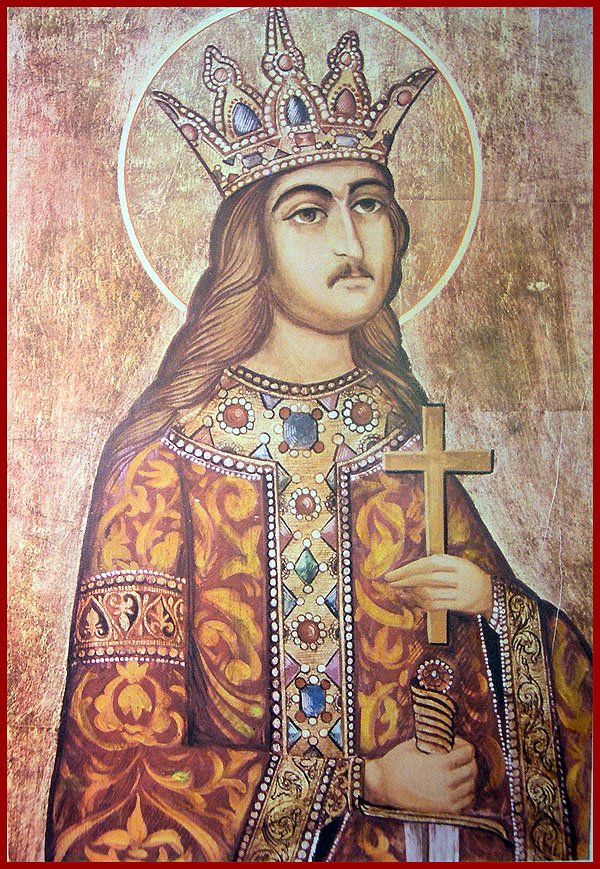
Saint Stephen the Great
Saint Stephen succeeded his father, Prince Bogdan II, as Prince of Moldavia on April 12, 1457 soon after the latter was murdered. He defended his country against the Turks, and he also built many churches and monasteries.
Saint Stephen the Great was a spiritual son of Saint Daniel the Hesychast (December 18), who told him that if he built a church after every battle he would be victorious in all his wars.
Saint Stephen succeeded his father, Prince Bogdan II, as Prince of Moldavia on April 12, 1457 soon after the latter was murdered. He defended his country against the Turks, and he also built many churches and monasteries.
Saint Stephen the Great was a spiritual son of Saint Daniel the Hesychast (December 18), who told him that if he built a church after every battle he would be victorious in all his wars. Following Saint Daniel’s counsel, Saint Stephen won forty-seven battles and built forty-eight churches or monasteries. He also built the Putna Dormition Monastery in northern Moldavia in 1466 when Saint Daniel urged him to do so.
In 1476, Saint Stephen lost the battle of Razboieni to the Turks. He went to visit Saint Daniel at the Voronets Monastery to ask whether or not he should surrender the country to the Moslems. Saint Daniel told him not to surrender, because he would soon win a decisive victory. Saint Daniel also told him that after he had saved the nation, Stephen should build a monastery in honor of Saint George at that place. Having faith in Saint Daniel’s prophecy, Stephen went forth with his army and drove the Turks from the country.
Saint Stephen fell asleep in the Lord on July 2, 1504, and was buried at the Putna Monastery. He was glorified by the Orthodox Church of Romania in 1992.
Troparion - Tone 2
O right-believing Prince Stephen, / the Church of Christ had you as a fearless defender of the true Faith; / for this reason all the people have called you great, good, and holy, and have honored you. / By your prayers to God, we always have you as the strengthener of our Orthodox Faith and the protector of our country.
Kontakion - Tone 1
By truly loving God, O glorious Stephen, you built holy churches and monasteries; / you helped the poor
and forgave those who wronged you. / Because of your deeds, God endowed you with wisdom and the
power to overcome the enemies of your country and of the Christian Faith. / Therefore, we honor you
and call you Father.
Scripture Readings
☩Epistle
Romans 15:17-29
17
I have therefore whereof I may glory through Jesus Christ in those things which pertain to God.
18
For I will not dare to speak of any of those things which Christ hath not wrought by me, to make the Gentiles obedient, by word and deed,
19
Through mighty signs and wonders, by the power of the Spirit of God; so that from Jerusalem, and round about unto Illyricum, I have fully preached the gospel of Christ.
20
Yea, so have I strived to preach the gospel, not where Christ was named, lest I should build upon another man’s foundation:
21
But as it is written, To whom he was not spoken of, they shall see: and they that have not heard shall understand.
22
For which cause also I have been much hindered from coming to you.
23
But now having no more place in these parts, and having a great desire these many years to come unto you;
24
Whensoever I take my journey into Spain, I will come to you: for I trust to see you in my journey, and to be brought on my way thitherward by you, if first I be somewhat filled with your company.
25
But now I go unto Jerusalem to minister unto the saints.
26
For it hath pleased them of Macedonia and Achaia to make a certain contribution for the poor saints which are at Jerusalem.
27
It hath pleased them verily; and their debtors they are. For if the Gentiles have been made partakers of their spiritual things, their duty is also to minister unto them in carnal things.
28
When therefore I have performed this, and have sealed to them this fruit, I will come by you into Spain.
29
And I am sure that, when I come unto you, I shall come in the fulness of the blessing of the gospel of Christ.
☩Gospel
Matthew 12:46-13:3
46
While he yet talked to the people, behold, his mother and his brethren stood without, desiring to speak with him.
47
Then one said unto him, Behold, thy mother and thy brethren stand without, desiring to speak with thee.
48
But he answered and said unto him that told him, Who is my mother? and who are my brethren?
49
And he stretched forth his hand toward his disciples, and said, Behold my mother and my brethren!
50
For whosoever shall do the will of my Father which is in heaven, the same is my brother, and sister, and mother.
1
The same day went Jesus out of the house, and sat by the sea side.
2
And great multitudes were gathered together unto him, so that he went into a ship, and sat; and the whole multitude stood on the shore.
3
And he spake many things unto them in parables, saying, Behold, a sower went forth to sow;
Liturgical data sourced from OCA.org and orthocal.info